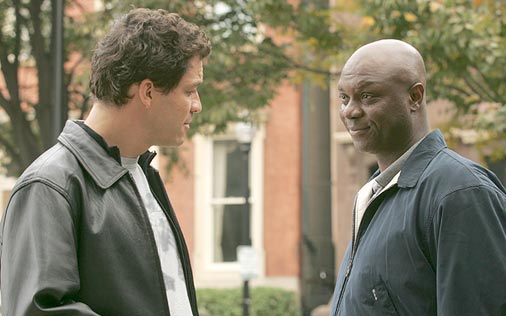
Blood Wing? True West? Something along those lines…

Since Switzerland is behind the rest of the world in all things pop culture, we’ve only just finished watching the first season of True Blood. Now, for those of you who have been following my HBO fetishism for a while, this will come as a bit of a surprise, but… I thought that True Blood was nothing much to write home about. It was entertaining enough, but I wouldn’t give the best episode of the series for the worst of Deadwood, The Wire or Six Feet Under, that other Alan Ball series. (I might be willing to exchange any episode of True Blood for that episode of The Sopranos where Tony meets his father’s mistress. Shudder…)

One major problem with the series, at least from my point of view, is that the main characters are much less interesting than the side characters that wander in for a couple of episodes. Bill and Sookie (or “Sookaaah!”, as Bill might put it) are okay, as are Sam, Tara, Jason and all the others, but I never really cared all that much about what was going to happen to them. On the other hand, I cared about poor, shlubby, gay vampire Eddie, I cared about psychotic, sexy hippie/murderess Amy, and I definitely wouldn’t mind seeing more of Kurt Kobain lookalike Eric (a charismatic performance by Alexander “Iceman” Skarsgard) or the Magister as played by Zeljko Ivanek.

At the same time, True Blood is almost perfect fare for a tired evening after a day at the office. It’s fun, it’s nice to look at, and that title tune always gets my toes twitching. Now, if only it was on offer as a downloadable track for Rock Band

We’re also almost at the end of the first season of The West Wing. It took me an episode or two to forget that the guy playing the President had also been Greg Stillson in David Cronenberg’s film version of The Dead Zone, i.e. not a man you’d want anywhere near the White House, but now I’m okay with Prez Jed Bartlett sitting in the Oval Office.
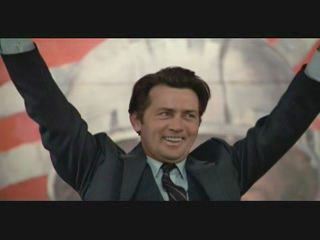
So far I’m enjoying the series a lot, although it’s pretty much the opposite of True Blood – intelligent writing, heavy on words and ideas, and very little in the way of graphic sex, fangs, shapeshifters and blood. It does, however, have Allison Janney, an actress who I’ve come to like a lot. If I had to single out one of the characters from the series as my favourite one, it’d be her C.J. Gregg. Janney is as pitch-perfect with scenes of political drama as she is with understated humour and outright goofiness.

It’s amazing, though, how bad most of the characters on the series are when it comes to interpersonal relationships that aren’t primarily defined by work. They make great colleagues (when they’re not making vicious fun of you after a root canal) – they seem to make for lousy boy- and girlfriends (though mostly boyfriends). Déformation professionelle, I guess.

A rabbi, a Mormon and an angel walk into a bar

I’m not a big fan of Meryl Streep. Obviously she’s a good actress and has done some very fine work – but I find it difficult to watch many of her performances without thinking that they are too visible, too clearly acted for my tastes. Streep is too much of an institution to vanish behind her roles, something that I also feel with respect to many of Robert de Niro’s performances in the last ten years or so.

Having said that, though, I very much liked Streep’s performance in the HBO miniseries Angels in America – or should I say, her performances? As was the case in the original stage play by Tony Kushner, most of the roles were doubled, with actors playing two or three different parts. It’s something I enjoy in stage plays, but it rarely works in film, which tends to be too caught up in presenting a realistic surface while sneaking the most outrageously unrealistic plot elements by us. Angels in America, Part I: “Millennium Approaches” starts with a funeral sermon delivered by an ancient, doddering rabbi, played by Ms. Streep. Yes, it’s showy – we can make up one of the preeminent American actresses so she looks like nothing like herself! – but it works.

There’s a lot about “Millennium Approaches” that works. The cast is pretty much perfect, my favourites probably being Patrick Wilson’s Joe (I’ve liked him in every role I’ve seen him in so far), Mary Louise Parker’s Harper and Jeffrey Wright’s Belize. Under Mike Nichols’ direction the play translates very well to the small screen; the humour and the pathos are all there and highly effective. After watching the first part, I was all geared up for part II, “Perestroika”.

I’d read both plays years ago; I did an amateur production of “Millennium Approaches” in 2000, and afterwards we did a reading of “Perestroika”. Back then I thought it was the weaker of the two, failing to do a satisfying pay-off to the cliffhanger ending of the first play. However, I didn’t expect “Perestroika” to fall on its face with quite as resounding a thud. Yes, there were elements of camp melodrama in the first three hours of Angels in America, but they were pulled off well. Part II, however, descends into scenes that would have made Ken Russell embarrassed. The actors try their best, but some scenes – especially the ones featuring the angel whose appearance “Millennium Approaches” leads up to – are cringeworthy. There may be some way to make lines such as “The blood-pump of creation! Holy estrus! Holy orifice!” and groin-bumping scenes between Meryl Streep and Emma Thompson work, but if there is, Nichols hasn’t found it.

It’s not just the HBO production, mind you; Kushner’s original play falters badly in the second part. There are still some strong scenes (especially the ones that eschew operatic metaphysics), but the script becomes prone to hamfisted speechifying.

I’ve rarely seen a play, film or series that does so well in the first part and fails so badly in the second part. And based on what I’ve seen, I am very glad that we decided to leave it at the evocative cliffhanger at the end of “Millennium Approaches”. The thought of making people I like deliver those lines… Nothing angelic about that.

P.S.: One thing I liked from beginning to end, though: Thomas Newman’s score.

The end is the beginning is the end

HBO has been known to do some killer season finales – no pun intended, although it would be a perfectly accurate one in the case of the last episode of Rome‘s first season. The lead-up to the murder of Caesar is masterfully composed and reminiscent of another plot to have a leader and father figure killed in another HBO series: Livia Soprano’s planned killing of that disappointment of a son. (Is it a coincidence that Livia was named for another larger-than-life mother from ancient Rome?)

Throughout the season I’ve been impressed with Ciaran Hinds’ layered portrayal of Caesar, a man whose fierce intelligence, pride and ambition inspire awe even when he’s at his most arrogant and dismissive. His death, even though it’s clear that it’s coming, is startling in its force and brutality – not just in terms of blood and gore, but in terms of the story and the characters. Another favourite of mine (other than Titus Pullo, of course, who’s just a big sweetie when he isn’t murdering people in a jealous rage) is Brutus, who is portrayed by Tobias Menzies with a fascinating mix of hurt pride, bitterness, self-loathing and, strangest of all, genuine love for Caesar.

Another HBO series finale that pushed all the right buttons with me was Generation Kill‘s final episode, “Bomb in the Garden”. It’s rare for a series that is so documentary in its approach to manage its story and character arcs so deftly, but David Simon and Ed Burns have done a brilliant job. The final scene recalls another work by Simon and Burns, namely the ending of The Wire’s season 2, both scenes using a Johnny Cash song (in both cases making me think that perhaps, just perhaps, I ought to check out that Cash guy’s music). And yes, I am quite okay with admitting my considerable man-crush on Alexander Skarsgard.

With all these endings, it’s only fitting that I finally finished Grand Theft Auto IV. So much has been written about the game already that I won’t add anything other than this: I enjoyed the latest installment of Liberty City. If there’s a more convincing, living and breathing city in any game, I haven’t played it yet. Take it away, Philip.

E, S, A, R, I, N, T, U, L…

In the hands of a different cast and crew, The Diving Bell and the Butterfly (Le Scaphandre et le Papillon) could have been bad – or worse, it could have been absolutely nothingy. Of course the real-life premise is memorable and impressive – locked-in syndrome, being a prisoner inside your own body – but making this work as a magazine article or even a book is very different from making it work as a film. Without a keen directorial vision, this would’ve turned into the worst kind of movie-of-the-week.

I’ve never seen any other films by Julian Schnabel (the sheer silliness of his name may have kept me from watching his earlier work), but based on this film I’m definitely going to keep my eyes open for Basquiat and Before Night Falls. The movie isn’t overburdened by directorial flourishes, but Schnabel has a strong sense of the visual, in the real scenes as much as in those that take place in Jean-Do’s imagination or are inspired by his words. Talking of which, The Diving Bell and the Butterfly, based on Jean-Dominique Bauby’s memoir (the film could be described as a sort of making-of of the memoir, but that would be far too banal a description for what Schnabel achieves), strikes a deft balance between the visual and the verbal. It hums with the energy of words – Jean-Do is filled with language, even if his condition doesn’t allow him to express them easily. Each word is a battle, each phrase is a war – at least at first, but one of the refreshing aspects of the film is that the women who help the man express himself are all French beauties of the Emanuelle Seigner type (and one of them looks like a Gallic dead ringer for Naomi Watts), and Jean-Do is the kind of man who falls in love, at least a bit, with every woman he sees.

The lightness that the film has, derived equally from Bauby’s ironic tone (he isn’t afraid of laughing at himself and his situation) and Schnabel’s visual idiom, doesn’t detract from its darker side, though. Quite the opposite, in fact. The horror of Jean-Do’s situation makes especially the first twenty minutes almost unbearable at times. Schnabel doesn’t need to emphasise this – he shows, quite simply and unflinchingly.

I’ve only just finished watching the film about an hour ago, so my first impression is still fresh and might change. However, throughout the movie I kept thinking of another film, this one by Alejandro Amenábar: The Sea Inside (Mar Adentro), also a true-life story, based on the struggles of a Spanish quadruplegic fighting for his right to die. Both films are centred on men who have been taken prisoner by their failing bodies; both men are full of life, yet have been deprived of the ability to life as fully as they desire; and both The Diving Bell and the Butterfly and The Sea Inside use similar imagery, especially the ocean and seaside. To some extent they feel like a French and a Spanish take on similar issues and would make near-perfect companion pieces.

Isn't the resemblance uncanny?

On a different note: we’ve added another HBO series to the already considerable list. It’s called Wome, at least if you ask Michael Palin:

And like so many HBO series, it’s got a pretty cool title sequence. Enjoy!

It was you, Bodie. You broke my heart.

Life (and Death) on the Streets

I feel old. I been out there since I was 13. I ain’t never fucked up a count, never stole off a package, never did some shit that I wasn’t told to do. I been straight up. But what come back? Hmm? You’d think if I get jammed up on some shit they’d be like, “A’ight, yeah. Bodie been there. Bodie hang tough. We got his pay lawyer. We got a bail.” They want me to stand with them, right? But where the fuck they at when they supposed to be standing by us? I mean, when shit goes bad and there’s hell to pay, where they at? This game is rigged, man. We like the little bitches on a chessboard.

Poor Bodie. Poor loyal, misguided, tragic Bodie. Like so many on The Wire, we’ve seen him do terrible things ever since he and Poot shot Wallace back in season 1 – yet he wasn’t a bad guy. He wasn’t evil. He was just one of those little bitches on a chessboard, just like another tragic player who decided that enough was enough and ended up hanging from a prison doorknob with a belt around his neck.

Poor Randy. Screwed over by the stupidity of a cop who doesn’t get that he’s betraying this kid – but screwed over even more by a society where talking to a cop is much worse a crime than putting a bullet in someone’s head, it seems, and by a system that at best can keep an account of the people it’s failing – but actually helping them? Sorry, no. Not enough money, not enough people to do the work, not enough of an incentive to cut through the red tape.

Poor Carver, trying so hard to do right by those under his care. Poor Dukie, for whom a day in high school is more frightening than a life on the corners. Poor Michael, killing his soul to protect his little brother. Poor Bubbles, saddest of all. You all broke my heart… and I know I’ll be back for more.

bubbles

I’d thought that season 2 of The Wire was as tragic as it would get. Frank Sobotka going to his death, thinking that he had even the tiniest chance of patching things up for himself, his nephew, his union, for the men he felt responsible for. But the slow, drawn out death of the working stiffs’ union doesn’t hold a candle to the perpetual, systemic sickness which The Wire, season by season, evokes for us, and the way it infects the youngest already.

With “Final Grades”, the season 4 finale, The Wire may just have topped Six Feet Under as my favourite series. The care and intricacy with which the characters are developed, the interconnecting themes play out – has there ever been a series as perfectly constructed yet feeling so right and so true? I could point to episodes, plot strands and even characters in Six Feet Under that didn’t add anything much to the overall series. The Wire? Everything adds to the whole, coming together with dizzying precision, affecting me to an extent that I never would have expected from what looks like a naturalistic cop series about drugs and crime.

Chris, Michael and Snoop (shudder...)

All of this might sound like The Wire is too complex, too constructed for its own good, but the scenes and the characters breathe with a lightness of touch that has to be seen over a number of seasons to be appreciated. It’s only when you take a step back that you can see just how perfectly wrought the series is.

Okay, enough of this clumsy attempt to put into words the effect that “Final Grades” had on me. Unless you’re scared of spoilers, you may want to check out this page (http://www.theguywiththeglasses.com/2008/03/wire-top-scenes.html) as it deftly picks some of the best scenes of the series up to the end of season 4.

And, apart from anything else, it’s good to see a quality series that actually makes it to the end without being cancelled prematurely. (There is something cruelly ironic about releasing a DVD set called Deadwood – Complete Collection. Be honest, cocksucker, and call it what it is: Deadwood – Dead Before Its Time or Deadwood – We Killed It Because We Had To Pay For This Weirdo Surfer Dude Series or Deadwood – Because A Good Novel With The Final Chapter Ripped Out Is Still A Good Novel, Right?)

Hamsterdam and the gooey kablooie

You have to admire Stringer Bell’s attempts to de-thuggify the Baltimore drug trade. His endeavours to get his business away from the drive-by shootings and everyday violence is one thing; his sweet, endearing (not words easily used when it comes to The Wire, except for everyone’s favourite addict Bubbles) meeting rules are something else altogether. It wouldn’t feel more strange to have these dealers and “soldiers” in the drug war speaking in Jane Austenese.

Season 3 of The Wire once more is among the best TV there is. It’s smart, impeccably crafted and unexpectedly funny. (A shout-out has to go to “My dawg…”.) I’m also finding it less affecting than the second season, though. Is it that the stevedores represented by Frank Sobotka had more pathos? Frank’s final episode nearly had me in tears. Or is it that I, in spite of my impeccable bleeding heart credentials, can relate better to pudgy, corrupt white guys with receding hairlines than to black hoppers slinging red tops and getting hot and bothered about semi-automatics.

There’s more than enough here to get to the viewer, though: Cutty’s attempts to get back into the game after 17 years in prison, or Bunny Colvin’s subversive social experiment born out of a frustration with the shambles and hypocrisy of the war on drugs and a wish to do something, however radical, that might actually break the stalemate and help.

And on that happy note I’d like to thank Amazon for its special offers. (No, I don’t get paid for this. I should, though!) Thanks to them, seasons 4 and 5 of The Wire are on the way and I don’t even feel too guilty about spending the money. I’m slowly running out of interesting HBO series, though… so in one, two years’ time I’ll either be reduced to Sex and the City – or it’s back to Six Feet Under. In which case I might as well rename this blog “Fisher & Sons”.

… like hormonal hobbits, all obsessed with a ring

Anthony Lane is one of my favourite film critics. I don’t always agree with him, but by and large he’s got a great bullshit detector when it comes to movies. His dismembering of Revenge of the Sith is a classic – I got considerably more enjoyment out of it than out of George Lucas’ third dismal prequel:

The general opinion of “Revenge of the Sith” seems to be that it marks a distinct improvement on the last two episodes, “The Phantom Menace” and “Attack of the Clones.” True, but only in the same way that dying from natural causes is preferable to crucifixion.

(Thanks, Robot Chicken.)

The New Yorker website has now put Lane’s review of Sex and the City (one of the few HBO series that would probably make my head explode). Again, it’s great fun to read – I doubt the film could make me laugh half as much:

Secrecy has clouded “Sex and the City” since it was first announced. When would the film appear? Who would find a husband? Would one of the main characters die? If so, would she commit suicide by self-pity (a constant threat), or would a crocodile escape from the Bronx Zoo and wreak a flesh-ripping revenge for all those handbags?

If you like wit as sharp as a well honed knife, do browse Lane’s reviews. Well worth it, especially when it comes to the films you hate.

In a world…

Okay, this is a bit of a cheat entry – but I was just surfing DVD reviews and was reminded of one of my favourite trailers ever. So, without much further ado, here it is:

What else? I’ve started rewatching The Sopranos, and I’m surprised at how many of the scenes I remember best are actually from the first season. What happened in seasons 2 to 5? (I haven’t seen the final season yet, but I’m very, very curious. From what I’ve heard and read, I could imagine being one of those Hipster Douchebags(tm) who actually like the way the series ended.)

His name is Snot Boogie?!

This film nerd here is a complex beast. On the one hand, I get as much childlike joy out of well-executed genre films that follow the formula to a T. I enjoy the climactic showdown between Hero and Villain. On the other hand, I cackle gleefully when a film (or a book, for that matter) frustrates my expectations. No Country for Old Men is a good case in point, where the supposed hero dies off-stage and isn’t even killed by the bad guy of the piece. Even Raiders of the Lost Ark, a genre movie if there ever was one, doesn’t end with the hero triumphing: it ends with the hero tied to a stake as the ultima deus ex machina comes and melts the faces off a bunch of undeserving unbelievers.

I just finished re-reading Neil Gaiman’s Stardust. I’d last read it in the summer of 2001, just after graduating. I have fond memories of sitting in a French café in Edinburgh during festival time, drinking good coffee, eating croissants and not looking up from my book until I’d finished half of it in one sitting. What I remembered much less was the plot, at least beyond the broad strokes. What I definitely didn’t remember was how differently it told its story from how Hollywood would (and, from what I’ve heard, did) do it. Here too, we don’t get a showdown with the villainess – instead, we get a melancholy coda and a bittersweet ending that made me realise how rarely Hollywood does “bittersweet”. I know that most Gaiman fans prefer American Gods, but I must say that even without Charles Vess’ pictures (I have the non-pic edition), this is a beautiful, wonderfully light, exquisitely crafted fairytale. In comparison, I feel that American Gods collapses under its own ambition, because its dozens of ideas never really come together in a fully satisfactory way.

Narnia it ain\'t...

Oh, and in case you’re wondering about the title of this entry? Well, we’ve just started watching The Wire season 1. Very different fare from Buffy, if you would believe it… But intriguing, with carefully drawn characters and lots of shades of grey. Definitely looking forward to seeing more of it – and telling you all about it, in epic detail. Shudder and despair.