It’s a Mann’s world

Yesterday we watched The Insider, Michael Mann’s 1999 film about whistleblower Jeffrey Wigand, 60 Minutes and the evil machinations of big US tobbaco. I like Mann’s cool jazz style, the calm rhythm of his movies. Watching The Insider for the fourth or fifth time, though, I was struck at how much the director’s cinematic world is a male one.

Insiders inside a car (duh…)

Like in several of Mann’s movies, it’s not so much that there isn’t any sympathy for the women (in this case especially Wigand’s wife Liane, played by Diane Venora), but that the film’s focus always remains with the man, and as a result the women are seen in terms of whether they remain loyal to their men or not. It’s really weird – if I write it like that, it makes Mann sound like the worst misogynist ever. However, I don’t think that’s quite fair. Venora’s character in Heat (this time she’s together with the Pacino character) also decides to walk out on her man because his job is more important than his family. It’s not that he doesn’t love her, but he’s obsessed with what he does. Perhaps that’s why the films aren’t straightforward exercises in sexism – Mann’s men are obsessive-compulsive, they choose their duties like lonesome cowboys. There’s something glamorous and admirable to the male protagonists, but at the same time they’re stuck in adolescence and in the belief that they don’t need anyone else, except the other boys they play their lethal games with.

By comparison, the women live in the real world much more than the men. Things aren’t as clear cut for them. Venora’s Justine Hanna in Heat realises that she will always come second to her husband. Her Liane Wigand knows that Jeffrey (fantastically acted by Russell Crowe, by the way) will not give up his quixotic quest against big tobacco, not even for the sake of his family. She comes off worse, perhaps, than other women in Mann, because Jeffrey Wigand is so clearly doing the right thing. But there is understanding in the film for her plight.

In the hands of a lesser director and actress, Liane and Justine would simply be shrews who screw over their good-guy husbands. It’s difficult to completely shake the feeling that they are disloyal and selfish. But they have a strength and a dignity that makes us look and think twice.

But it doesn’t change that, at its heart, Michael Mann’s world is a man’s world indeed.

Tom and Jamie,/Sitting in a Car…

Sniffle…

Since I feel like I’ve come down with something, I’m going to take it easy today. No long speeches, no pretentious analyses of videogame narratives.

Just a trailer for one of the films I’ve been looking forward to most.

Oh, and it’s got that coward Jack McCall and Francis Wolcott in it. Playing the same character.

One planet, one vote!

I did it.

I finally finished Augusten Burroughs’ Running With Scissors. And boy, am I glad.

By the time I got to the last chapter, I no longer hated it. I simply didn’t have the stamina for that. I simply found it boring and annoying – and boringly, annoyingly unfunny. There’s little structure in the novel, so the single episodes could all be jumbled up and re-ordered with little to no effect on the book. There’s barely any character development. I’m sure you can write enjoyable novels without character development or structure, but you have to be a hell of a lot better than Burroughs and your story has to be a hell of a lot more interesting. Up to the very end, I felt I was reading the self-indulgent, self-dramatising journal of a drama queen – admittedly one whose childhood and adolescence (as told) were quite horrible, but suffering in itself does not a good novel make.

Anyway, it’s over, and I’ve now started on Haruki Murakami’s short story collection Blind Willow, Sleeping Woman. I recently read his Kafka on the Shore, which was okay but faltered a lot towards the end, and it suffered a lot from having come after The Wind-Up Bird Chronicle, which I think is what the Germans surreally call “ein grosser Wurf”. (Roughly translateable as “a great success”; literally, it means “a great throw”, which might make sense if the Germans played baseball.) I enjoyed a lot of Murakami’s earlier short fiction, perhaps mainly because his excursions from the main plot are always fascinating… and in a short story there’s less of a risk that he runs out of steam and the novel peters out. Murakami is a great writer, but endings aren’t his forte.

What else? I’ve played on in Anachronox, and it’s as delightfully inventive as I remember. I’ve just left Democratus, one of the great inventions of the game: a planet that makes Switzerland’s political system look positively efficient. On Democratus, every decision requires a vote. Every decision. And every decision has to be discussed in great detail, so that the planet’s High Council even fails to come to a decision about the 64 lethal missiles aimed its way by an aggressive insect race. But watch for yourselves:

Since few of you are likely to still find the game and play it, I’ll go ahead and spoil some of the further plot for you: after you save Democratus, the Council decides to reward you by having the planet shrunk and joining your party. As Wikipedia puts it, “the most annoying civilization in the universe shrinks their planet to five feet in diameter and begins following the team around.” And there’s little as boggling as the sight of that man-sized planet happily floating after you, squabbling about your every decision.

It happened at the movies… (3)

(… although technically that should be (4), since my entry on The Departed was also part of this tightly plotted, carefully laid out series. Ah well.)

I wish I could remember the title of this movie…

Christopher Nolan made an impression on me with his second film, Memento, which I thought clever, affecting and fascinating. Insomnia, his follow-up, didn’t do much for me, well crafted and acted tough as it was. It didn’t have the conviction of the Norwegian original, sitting uncomfortably between Hollywood thriller and harsh morality play.

The Prestige is probably Nolan’s best film since Memento. His reboot of the Batman franchise was good and intelligent, but its plot was predictable. The Prestige, a film about 2+ rival magicians at the turn of the century is at least as cleverly conceived and told as his amnesia thriller. Judging from the plot of the original novel (as given on Wikipedia), the film adaptation has been changed quite a bit, so it’s all the more surprising and impressive to find such an intricately structured, yet elegantly executed plot in the movie.

What struck me most was Nolan’s witty use of repeated motifs that, in a second viewing, might look like obvious hints at the twists in the movie. Every element is carefully laid out, and the film plays fair, yet when the viewer thinks he’s figured it out and smugly leans back, chances are he’ll realise half an hour later that he’s underestimated Nolan’s Chinese box.

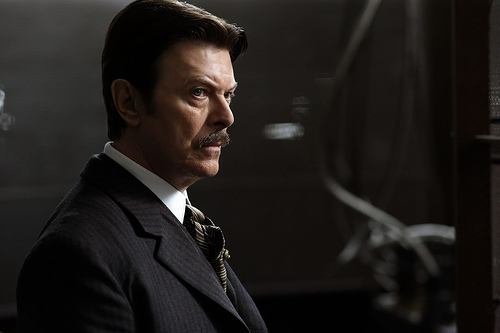
And apart from The Prestige‘s cleverness (which has a slightly arch quality to it, just as some of the voiceovers), there’s something admirably goofy about casting David Bowie as an aging Nicholas Tesla, perhaps the truest magician of the piece yet the least mysterious, least self-dramatising character in the film.

Is there life after Mars?

It is not a coma!

Yesterday my love came back from her holidays, and we watched a double bill of House, M.D. The first of the episodes, “Son of Coma Guy”, was one of the best, sharpest written episodes in a long time (and that on a series that has no shortage of sharp writing). Like many of the best House episodes, it broke the usual pattern: I like the series, but 95% of the episodes have exactly the same plot, the only difference being names, faces and illnesses. You can imagine a licenced version of the Clue board game: “Mr Smith, in the MRI room, with the lupus.”

 The other thing it shared with my favourite episodes: “Son of Coma Guy” had a strong foil for Greg House in coma guy Gabriel Wozniak (John Laroquette). Two, even, if you count Wilson who’s definitely benefitting from the Tritter storyline. It’s quite heartrending to see Wilson’s friendship with House being brought close to breaking point, but it’s showing us a side of Wilson that we haven’t seen yet: he may be strong enough, and hurt enough, to draw the line at some point.

The episode benefitted from an effective performance by Laroquette (if only I could remember where I’ve seen him before…) who gelled very well with Hugh Laurie. And I loved House’s subtle screwing with Coma Guy’s head, suggesting that the future he’d woken up to was weird and wonderful in so many ways. And, of course, it’s got ip-ods!

Weee are alien magicians!

Videogame critics keep saying that there’s precious little humour in video games (or at least humour that isn’t unfunny at best and cringeworthy at worst). Now, it may be true that the humour in most games is made up of stale wisecracks and one-liners that make you groan… but then, most movie comedies aren’t really very funny, are they? There’s little good comedy in games as in films, but there are of course gems in both media. The games I’m thinking of, for instance, are many of the old LucasArts adventures (Grim Fandango, Sam & Max Hit the Road, the Monkey Island titles minus Escape from…), No One Lives Forever, Psychonauts – and Anachronox.

I never finished Anachronox when I originally played it; the pre-patch version was so buggy that it started to crash frequently halfway through the story. Now, thanks to some new tech and inofficial patches, I’m finally able to play it again, and in spite of the engine showing its age, I’m riveted. The game’s the strange offspring of Japanese RPGs, The Hitchhiker’s Guide to the Galaxy and Raymond Chandler crime novels. It’s got some of the best writing and voice acting ever in computer games. Even though I don’t particularly enjoy the gameplay itself, I still can’t stop playing, no matter that I’ve got newer games waiting for me both on my computer and on PS2.

It’s a shame the game didn’t sell very well at all, since it was meant to be followed by a sequel. As it is, Anachronox ends on a cliffhanger, and it’s unlikely that we’ll ever get the follow-up. Which is roughly like ending Lord of the Rings on The Fellowship of the Ring, with Frodo and Sam going off to Mordor – THE END. NO, WE WON’T TELL YOU WHAT HAPPENS. It’s a crying shame that good writing sells less well in videogames than big boobs, big guns and uninspired franchises.

P.S.: Anachronoxis a good illustration of my theory that humour is usually funnier when the characters aren’t just Punchline Delivery Agents(tm), but are actually fleshed out. There are moments of surprising poignancy in the game, which make the comedy shine more brilliantly.

P.P.S.: Here are some more trailers of genuinely funny games – because it’s these kind of games the medium needs if it wants to be more than just adolescent (male) power fantasies. I also hear that the new game Portal, scripted by Eric Wolpaw of Psychonauts fame, is very funny, and very good.

Psychonauts

Grim Fandango:

Portal:

I’ll throw you the whip…

Today’s entry is very short (for a change). Since I went on at great length yesterday about appreciating great craftsmanship, here’s an example of brilliant genre cinema that isn’t deep or existential – but it may just be the best film in its genre.

I still get the same kick out of watching Raiders of the Lost Ark as I did when I first saw it, even though Indiana Jones and the Last Crusade was my first Indy movie. Arguably, it’s one of the most fun films ever.

And who couldn’t love a film that has this scene in it?

Why you, you doidy rat…!

There’s exactly one thing I would change about Martin Scorsese’s The Departed: the last thirty seconds or so. The rat on the balcony railing. To me, at least, it felt like an insulting wink to the audience: “This is what the movie’s been about. Get it? Get it?”

 I probably found it more insulting because the rest of the film is nearly perfect: the casting, the acting, the cinematography, the editing, the choice of music. I haven’t seen Infernal Affairs, the original Korean movie that Scorsese’s film is based on, so I won’t say anything about remakes at this point, except for this: if a remake is this good, what does it matter that it’s a remake? That’s a discussion about cultural imperialism, perhaps, but it’s not what I’m interested in here. I’m interested in what may be Scorsese’s most enjoyable movie ever.

Of course, there were lots of people who complained when Scorsese was awarded the Oscar for this film, and indeed, he should’ve received the Academy Award for some of his earlier work too. But what gets up my nose is that most of those who complained felt that The Departed is somehow less good a movie because it isn’t deep – and by deep they mean existential, or perhaps they mean, “If you can enjoy it, if you can have fun watching it, chances are it isn’t that good.” Which is silly, pretentious snobism. I don’t want every single one of Scorsese’s movies to be Taxi Driver or Raging Bull. True, these films have more social depth, they’re more tragic, but I hate the knee-jerk equation of ‘tragic’ with ‘good’ or ‘important’. Please note that I also hate the reverse snobism that goes something like this: “Oh, you’re so la-di-dah with your Stanley Kubrick, Ingmar Bergman and François Truffaut, elitist gits! Go and jerk off to your boring, black-and-white arthouse bullshit, while I enjoy Die Hard!” Just like I don’t always want The Seventh Seal, I don’t always want Star Wars or The Rock either.

And I appreciate craft. In my opinion, there’s a lot to enjoy about, say, Die Hard, because it’s one of the best crafted films in its genre. There’s a lot to enjoy about the deft lightness of Soderbergh’s Ocean’s Eleven remake, just as there is a lot to enjoy in Jules et Jim. The things you’re enjoying are simply very different, but all of these films are by filmmakers who are amazing craftsmen. And quite often it’s genre cinema where you get great examples of the craft: Blade Runner, The Godfather, Out of Sight, Aliens.

And it is in terms of craft that The Departed absolutely excels. From the first few shots in the movie, you know that this was made by people who know what they’re doing. When I saw the film at the cinema, it was the first time that I had an inkling what critics mean when they talk about “muscular filmmaking”. In spite of the clumsy allegorical rat at the very end, I left the cinema energised and wanting to see it again. So, for all those who thought that the film wasn’t ‘deep’ enough, here’s another clip. It expresses quite neatly what I think about arrogance towards genre cinema. Enjoy.

P.S.: I am not saying that all quality is relative; I hope you understand that. As far as I’m concerned, the difference between, say, Raiders of the Lost Ark and Citizen Kane, or indeed between Raging Bull and The Departed, isn’t one of quality. It’s not that one film is better than the other – it’s the subject matter and its treatment that are different. Arguably one is deeper than the other, but in the end depth is something I can take or leave. Sometimes I want an intricate seven-course meal, and sometimes I want a hamburger… but I want a good hamburger.

Bourne to be shaken, not stirred

Eugh. Okay. I apologise for that double-whammy of a pun. But I promise, it’s appropriate. Sort of.

I like the Bourne movies. I like how they’re set in the real world, in places I recognise and may even have been to. I like how they’re not about over-the-top villains out to rule the world – or otherwise destroy it. I also like Jason Bourne’s resourcefulness, his efficiency, and Matt Damon makes the character and his action man exploits feel credible.

I also like shaky cam. I thought it was effective in the first two Bourne movies, and when it’s done well it gives films an immediacy and a documentary feel that fits certain stories very well. In my opinion, Battlestar Galactica makes it work really well, for instance.

Yesterday I saw The Bourne Ultimatum at the cinema, and fifteen minutes into the film I started to develop a slight headache. At first I thought that the shaky cam was more pronounced than in the earlier films in the series, but then I realised that I’d seen those on DVD only. Now, I’ve got a fairly big, 42″ television, but it’s still different. The entire screen is in your field of vision. It’s much less dizzying. And that’s when I started to understand why many people compained about the shaky camera work. It’s quite a strain, on your eyes, your neck and your brain. I’m sure that if I’d just seen the film on TV to begin with, I again would have thought: “What on earth are these people complaining about?”

It took me perhaps an hour to get used to the cinematography, but I persisted, mainly because the film never lets up. The story isn’t highly original – basically it’s the first two movies all over, with some of the names and faces changed – but it bursts with kinetic energy, and it is choreographed brilliantly. There’s an early sequence at Waterloo station that is almost balletic in its elegance.

Unfortunately, the film has lost some of what made its predecessors better in the end. For one thing, Bourne is less vulnerable. He survives when he shouldn’t, or at least he shouldn’t be able to get up and go after the bad guy. In the first two films Bourne felt more real because you could always just about believe that this highly trained ex-agent could escape from this or that predicament, but you weren’t 100% certain he’d make it. This time he crosses the line into Superman-dom too often.

The other thing is that Bourne is emotionally less vulnerable. Bourne – the character and the films – has never been about emotions, yet there was the additional impulse that Franka Potente’s Marie gave the story. The main character was made more human due to her, and her death – one of the few shocking demises in US action cinema – did pretty much drive the second movie. It gave Jason Bourne a tangible reason to pursue his goal. THere’s a scene early in the third film, in which Daniel Brühl (of Goodbye Lenin fame) plays Marie’s brother. Unfortunately it is so subdued, it feels like it’s only paying lip-service to Marie, like no one’s heart was really in it. The scene might have been more effective if Brühl’s character had been introduced in one of the earlier films, but with no run-up there’s also practically no pay-off. The scene feels like it should be in the DVD’s “Deleted Scenes” section.

P.S.: The Bourne Ultimatum ends with a remix of Moby’s “Extreme Ways”. The original’s much better, though. Enjoy!

It happened at the movies… (2)

28 Days Later and Millions – these films couldn’t be much more different in terms of what they’re about, yet they’re so obviously directed by the same person… I missed the former at the cinema due to middling reviews (and probably also the agonised moans of zombie aficionados all over the internet). Then, after I’d already pretty much forgotten about the film, a friend lent it to me on DVD. I didn’t expect much when I popped the disk into the player, but I was very positively surprised to find one of the most atmospheric, effecive, thrilling and beautifully paced films I’d seen that year. Yes, the ending is a mess, but it can’t ruin what the first 75% of the movie has built up. The shots of a deserted London alone deserve to become one of the iconic images of British cinema.

Millions, too, was an unexpected joy. The film is wildly inventive and balances its sentimental elements (that feel truthful and are never overplayed) with a sly sense of humour. It’s on a very short list of Christmas films that don’t make me feel like throwing up my eggnog all over the prezzies. And it’s got two of the best child performances I’ve ever seen on film.

Add to these two cinematic surprises directed by Danny Boyle that I’d seen a marvellous stage adaptation of Alex Garland’s evocative novel The Coma, which you can find a trailer for here. Garland also wrote the script for 28 Days Later, so when I heard that the two of them had teamed up again for Sunshine, a sci-fi movie, I was excited.

After seeing the film at the cinema, I was disappointed. I’d wanted to like, even love, Sunshine, and again, the first 3/4 gave me a lot of material to love. If you submit to its slow buildup of tension, it’s one of the strongest films of a space mission going horribly wrong since 2001: A Space Odyssey. And then it attempts to become a metaphysical thriller – but it slips and becomes a somewhat more restrained (but not much better) take on Event Horizon. When I read the script afterward, I realised what they were going for, but unfortunately they didn’t quite manage. On a larger scale, it was 28 Days Later all over, but moer disappointing, since this time I expected something great to begin with.

Still, do the final 30-40 minutes destroy what came before? They almost did on my first viewing; nevertheless, the preceding scenes are what stayed with me. Boyle and Garland succeed at impressing something of the immensity of the sun, and of the astronauts’ task, on us. This isn’t Armageddon or Deep Impact, it’s not heroic Bruce Willis going off to save the world to the strains of Aerosmith. These are normal people who’ve been given a task that, if you think about it too much, will drive you mad.

And while the film’s sort-of-villain verbalises the metaphysical implications less than successfully, the visuals of the dying sun actually convey some of what he says. Staring into the annihilating fires is perhaps the closest you can get to looking at the face of God. It’s interesting, though, that Garland, an atheist, and Boyle, more of a doubtful theist, read their film, and its metaphysical dimension, in completely different ways: the movie is wise not to come down on any one side of the God issue. It just sits there, like the dying sun – and if you stare at it for too long, it may just burn off your face. Now didn’t your mother warn you not to sit too close to the telly?

P.S.: Here’s the film’s international trailer. I do apologise, though, for the criminally overused orchestral piece nicked from Requiem for a Dream. (How anyone can think it’s a good idea to use music from that film to evoke ‘epic-ness’ is beyond me.)