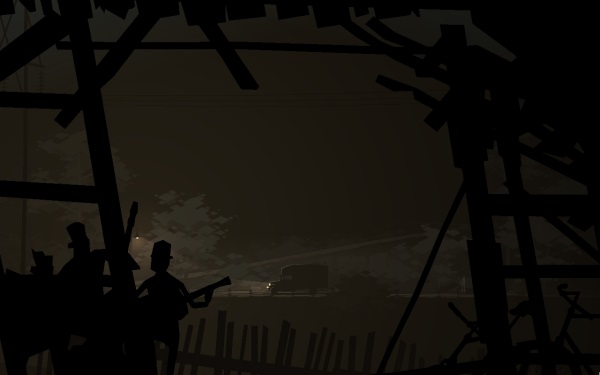
Look at the size of those pixels!

I’ve written about pixel art before, but as someone who was playing games already when pixels were bigger than my hand there’s something about them that speaks to me, and it says things other than, “Put that away! It’s horrible!” I’m wondering to what extent this is nostalgia talking – big pixels remind me of the time when I was young, full of promise and had hair on my head rather than my ears. What does a non-gamer, or someone whose gaming career started at resolutions beyond 320×200, see when they look at pixel art? Do they see technical limitations, or do they see what I and my fellow gaming Methusaleas see?

Sword & Sworcery

For me, the stylistic choice made for instance by the developers of Superbrothers: Sword & Sworcery EP (yup, that’s its actual title) is a valid one, since its pixel-heavy goodness achieves a unique effect. It’s not just retro-hipsterish affectation – it’s a valid form of abstraction that is particular to video games. When I look at a screenshot from Sword & Sworcery, I find a highly evocative quality in the image that reminds me of Scott McCloud’s writing on comics. In that medium, the reader is engaged to some extent by the elliptic quality of the frame-by-frame format: we fill in the blanks that are between the individual images. Retro pixel art asks us to fill in the blanks between the pixels; it’s a very specific stylistic cousin to blurring an image for artistic effect. A simple high-resolution paint job would make the picture more specific, more precise, but that evocative potential would be lost in the process. If I think of films that work largely through allusion and ellipsis, such as Andrej Tarkovsky’s Stalker, I imagine something akin to the pixelscapes of Sword & Sworcery more than the more realistic (though also evocative) vistas of the Stalker computer game, a distant cousin of Tarkovsky’s film with very different intentions.
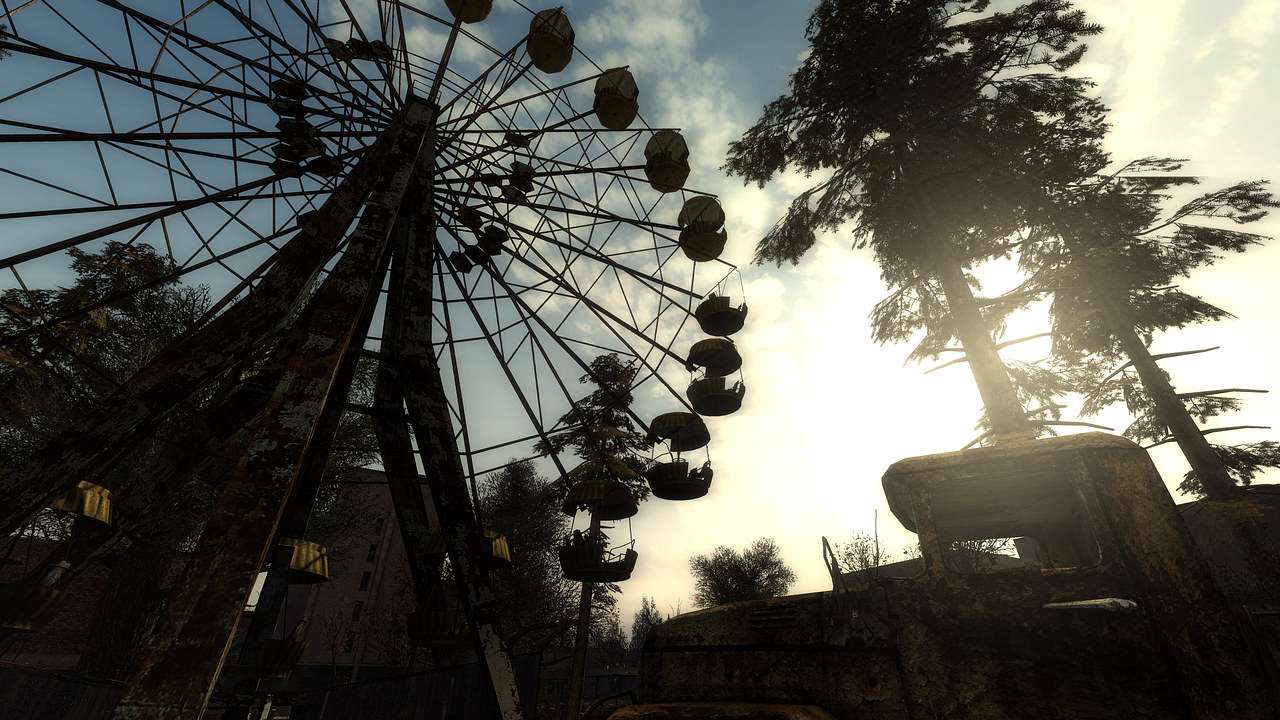
Stalker: Call of Chernobyl

Undoubtedly there’s an economic side to pixel art in indie games: the resources needed to create a game featuring old-school graphics are on an entirely different scale than what goes into flashy, hyperdetailed 3D environments. Beyond this, though, I don’t think that titles such as Papers, Please, Echo of the Wilds or Hyper Light Drifter (you’ll find trailers for all of these below) went with pixel-based artwork because it’s cheaper – all of these aim for a specific effect, an abstraction that at its best can be as gorgeous and evocative as high-detail photography. Even the purposeful ugliness of Hotline Miami and its grotesque ultra-low-res ultra-violence aims for a visual quality that I expect does not only speak to the oldtimers clutching their gamepads. The bigger the space between some pixels, the more space for gamers to lose themselves in.

P.S.: It’s quite fitting that today Rock Paper Shotgun posted an interview with Dave Gilbert, whose Wadjet Eye Games develops old-school low-res pixel art adventure games; in the interview Gilbert says the following: “The great thing about pixel art is it can, how do you explain it? It’s more like your mind fills in a lot of the details when it’s done the right way. When it’s done the wrong way it just looks ugly, that’s the case with any art.”

 

If war is hell, and hell is other people…

… I was going to say something clever about my new mini-obsession: playing multiplayer matches of the Arma series of games, military simulators focusing on combined operations. While that’s still what I’ll be writing about, I thought I’d drop the attempt at wit. Let’s face it, the joke would have faced the same fate as many of my Arma adventures: fifteen minutes of creeping up slowly, only to die in a display of futility.

I’ve never really been into playing multiplayer games, at least not online. I remember a long, fun night of playing Jedi Knight against a friend who’d brought along a computer, but most of my forays into online MP were brief: some Battlefield 2, some Ultima Online and Star Wars Galaxies beta testing, the occasional coop game of Splinter Cell: Chaos Theory, that sort of thing. Not that it’s not fun, but I’ve always been drawn more to story-heavy single player titles.

Over the last year, though, I’ve discovered why some people get into multiplayer almost to the exclusion of single player goodness. It all started with GTA V‘s online modes – and it’s not the whole “shoot other players in the face” aspect that got me hooked: no, what made me reconsider was the more serene moments of coop. Yes, I confess, I got some of my greatest online enjoyment out of starting a cooperative mission and hopping into a car driven by another person clutching their PS3 controller on a different continent. There’s something about inhabiting a living, breathing virtual world and interacting with others that aren’t controlled by a computer – it’s basically the Matrix, if that classic of Keanu-y goodness was about driving around a pastiche of Los Angeles in a convertible. Yes, usually that drive ended in an ambush by assault gun-wielding gangsters and swift death for my online avatar, but sharing a virtual space with other, real people makes that space feel more real too.

Arma is a strange case, actually: I’m pretty far from a fan of heavy militarism, doubly so if it’s po-faced militarism. It’s not the dudebro, Michael Bay-style kind of military porn (“Is that an M16 in your pocket or are you just happy to see me?”), but the games are definitely designed to appeal to those who know the difference between an AK-47 and an AK-74 (and no, I don’t think the answer is 27!). It’s also a game that can be unforgivingly difficult – you can spend twenty minutes crawling through the undergrowth on your belly only to be spotted and shot by an opposing soldier from 200 metres away – mind you, a soldier you haven’t even seen yet, let alone shot at.

Yes, no one could claim that Arma is a friendly game – if something like Plants vs. Zombies exists at one end of the spectrum, Arma sits at the other end, readying an artillery barrage in the direction of those singing sunflowers and cartoony undead. However, I’ve found that the people I play with are very friendly and welcoming. They also make up for the game’s seriousness with laconic, self-deprecating wit, which makes for a perfect counterweight to Arma‘s seriousness. I especially remember a session with about 30 others, starting with us sitting in a transport helicopter flying us closer to the location we were supposed to attack, and the joking, singing and general silliness of that flight was what made the game for me at least as much as the following ambush we got ourselves caught up in. Probably more so.

This doesn’t mean that I’ve given up on story-heavy single player games – I still enjoy those. But I’m pleasantly surprised that some of the most fun I’ve had as a gamer of… fuck, has it been that long?!… 30+ years consists of virtual road trips. If only I’d known all those years ago when I found long car drives to holiday destinations sheer torture – and those didn’t even end with ambushes, mass slaughter and slow motion death scenes set to Samuel Barber’s “Adagio for Strings”. If only.

A shout-out to the crazy people at Folk ARPS. It’s always an honour to be shot up while in your company!

Planes, trains and automobiles

Let’s get it out of the way: GTA V may just be the best Grand Theft Auto game. It may also be the most disappointing – and it is probably one of the dumbest games in the series. Credit where credit’s due: Rockstar Games do one thing amazingly well, better than anyone else out there, and that’s creating living, breathing worlds. Their obituary to the Old West, Red Dead Redemption, is one of my favourite virtual worlds bar none, the sort of place that I enjoy inhabiting and navigating, even without following the story or sidequests. Just being in the world covers so much of what I look for in games.

Red Dead Redemption also works in one key way that GTA V flubs, and that’s the character writing: yes, there are the joke characters, the broad caricatures of two-faced hypocrites, but Rockstar’s western knew when to take its cast seriously. It didn’t work all the time or with every single character, but by and large the dramatis personae of what could perhaps be called Grand Theft Horse carried the weight of its narrative. I understand that Rockstar might not want to write tragedies all the time – something that Red Dead Redemption ended up being quite effectively – but when it comes to humour the company’s writers tend towards the lazy, obvious joke… and then they flog it until way past its expiration.

I admit, there were moments in GTA V where I laughed out loud, and there were others where I sniggered. There are storylines in the game that work due to a combination of fine voice work and their sheer absurdity, but for each of these storylines there’s a character whose venality and stupidity is so drawn out, so overplayed it’s cringeworthy. What’s worse, perhaps, is that these characters are essentially all variations on the same theme: people who are smug and think they’re the best thing since sliced bread, yet they are essentially hollow. Which is fine until you realise that GTA V is 90% populated with such characters – and no, this does not strike me as a convincing parody of Southern California, and it’s most definitely not an interesting parody – and that the writing itself exhibits the same smugness. By comparison, Rockstar’s previous foray into Los Santos and surroundings in 2004’s GTA San Andreas (it’s already been ten years? now I definitely feel old) also had the broad jokes and the caricatures, but it brought together a band of mismatched characters that genuinely felt like family by the end of the game. By comparison, I don’t miss any of GTA V‘s cast of misfits and murderers, since with so many of them it’s clear that the punchline will always precedence over the character. There are exceptions: moments that show genuine wit and complexity, and jokes that don’t rely on the nth variation on the theme of “Haha, aren’t Californians/Americans/people stupid, vapid and easily fooled?”, but compared to Red Dead Redemption it all feels too much like a middling sitcom writer had watched The Sopranos and decided that they could pull this off.

Much was made of the lack of female protagonist in the game, especially since GTA V‘s main innovation is that there’s not just one but three playable characters. Seeing how limited Rockstar’s palette is in their latest, I have to say I’m glad they didn’t try to write their first female protagonist in this one. In fact, my main recommendation to the company would be this: they’ve pretty much perfected the creation of living, breathing worlds and mechanisms to enjoy being in that world. They have great artists, they choose fantastic music to add another dimension to their worlds, and they have ideas. What they should do is bring in new writing talent that doesn’t just do what they already do. They should get writers whose skills can shake up the by now rather stale mix of HBO Lite (imagine the worst moment in the weakest episode of The Sopranos) and Southpark-style loud parody. They don’t need to go for Greek tragedy or the Dickensian sweep of The Wire – but they should stop telling what is essentially the same joke. In brief, whatever they do next, I’d rather not think that it’s an improvement on their track record to date in every respect other than the writing. If that’s the case, I might just stay in GTA Online, because when the lines are provided by other players I don’t expect the writing to be good.

P.S.: For the record, GTA V‘s most maligned character, Trevor, is actually the most interesting at times. Yes, much of the writing is lazy and repetitive, but there are moments when his lines display a self-awareness that, while not particularly deep, does stand out compared to his usual lazy “Ooh, isn’t this edgy, offensive and craaaaaazy?!” shtik, the aftermath of the infamous playable torture scene (ah, to be a gamer in 2013…) being a case in point.

Gone Home – a guest post

The following is a guest post by Johanna Bucher, a friend and fellow gamer who has a keen eye for the potential of the medium. Thanks a lot to Jo for this end-of-year treat!

One aspect I love about video games is the potential for escapism. More so than film or literature video games enable you to be someone else, a powerful wizard, a Jedi knight, a bad-ass bomber pilot. In video games you fight dragons, fly spaceships, have super powers, and travel through time saving entire galaxies from impending doom. In short: you have a chance to do grand things you never can in real life. And the further away the setting of a computer game from the here and now, the better for me. Or so I thought.

Gone Home has none of the above. It takes place in the real world, it evolves around completely ordinary people leading ordinary, not to say, drab lives. Their fears and hopes are all too familiar. There is nothing striking about them at first, other than perhaps the big mansion they live in. So, what possible attraction could this game offer which puts you in the shoes of 20 year old Kaitlin Greenbriar, returning from a long trip to Europe, expecting to be greeted by her family only to find the house abandoned?

Gone Home

What the game “lacks” in grandeur or exotics it makes up in characterisation and attention to detail. Through audio diary entries at specific points in the game, notes and artefacts found in the house, the mystery (what happened to everyone?) slowly starts to unravel. Not all of the clues found in the house make sense at first but with each new room discovered, a more coherent picture can be drawn, of the goings-on and of the people involved in them. The rewards in this game, then, are not shoot-outs, levelling up or collecting loot, but picking up the threads of strangers’ lives and in the process of getting to know them discovering that you start to care for them and their small lives because, more often than not, they strike a familiar chord.

It is no coincidence that the game takes place in 1995: this is pre-internet, pre-cell phone. It’s the age of VHS, vinyl and audio cassettes, where people write notes and letters by hand, or maybe, if it gets really fancy, send a fax. This leap back into analogue times is more than a nostalgic walk down memory lane (although the game’s creators clearly revel in that.) It also sets a different kind of pace: it slows the game down to the sound of your footsteps pacing about the rooms, the rhythm of the written and spoken word (masterfully supported by wonderfully restraint music and great vocal acting). In a strange way the physical exploration of the space also becomes a mental one.

In a review to the game I read that calling Gone Home a video game is doing it a great disservice. And I agree, this game is not for everyone. It demands a certain amount of patience, the willingness to do rather a lot of reading and rummaging through drawers and armoires. But I would claim that although the game deliberately goes against many video games conventions it is the perfect and only medium to be told in. This story only fully comes to live through the narratology of video games.

Gone Home, then, is not so much about what the story is about and its conclusion (although the topic is not a trivial one and the conclusion is rather touching) but much more abut about how it is told. And summing it up would be the greatest disservice done to it. It has to be experienced. So, sod escapism, this time at least.

Review: Charlie Brooker’s How Videogames Changed The World

Ah, video games. The love that dare not speak its name, at least in many mainstream media. According to TV especially, gaming is about bleeps and bloops as well as about blood and guts. Games are inherently male, inherently adolescent, inherently about power fantasies – and lest the gamer protest too much, that’s how the medium likes to present itself, at least when it comes to marketing. Boys play video games where they wield massive guns that would have made Freud go “Hmm…”, girls play video games that are pink and feature ponies, right?

How Videogames Met Your Mother. Or something.Charlie Brooker’s latest on Channel Four, the feature-length How Videogames Changed The World, was refreshing, mainly because TV seems to see games in very generic ways: either we get the embarrassing dudebro image of Call of Duty gaming, the stereotypical manchild living in his parents’ basement eating crisps and playing World of Warcraft, or we get handwringing worries about how gamers are desensitised by their chosen medium and turned into ticking timebombs just waiting to shoot up some high school. Brooker’s show looked as games as if *gasp!* they were a cultural good, for better or for worse, and should be seen as exactly that. Regardless of their cultural worth, games have become too big to ignore – and that may be one reason why they’re still presented as the sort of endeavour waiting for us to go 1 Corinthians 13:11 of them: “When I was a child, I gamed as a child. But when I grew up, I put away childish things, like controllers and such.”

Brooker, together with a whole bevvy of talking heads, took the programme’s viewers through games from their bleepy inception to their social-media-infused present day. Far from po-faced (or should that be Pong-faced?), HVCTW was largely about memories: from Peter “I voiced Darth Maul, so don’t you dare misspell my name!” Serafinowicz to Jonathan Ross, with various comedians and games journalists filling the ranks, talking about growing up on Space Invaders and GTA. One thing that was clear from the show: video games may slowly be growing up, dealing with issues more weighty than whether to shoot that terrorist in the face with an assault rifle, shotgun or grenade launcher, and that’s because video gamers and developers are growing up. A 30-something dev changing diapers on a nightly basis may make very different games from the guy in his 20s, and that’s definitely a good thing. The medium has become increasingly diverse over the last years, with a growing indie scene experimenting with what games can say and how they can say it differently from films or books.

Charlie BrookerFor me as a long-time gamer – ah, those heady days of writing BASIC code in between bouts of International Soccer! – HVCTW was nevertheless a qualified success at best. It was great to see Channel Four taking the medium seriously, but Brooker and his team delivered a show that didn’t quite know what it wanted to be: was it meant for general audiences without much of an idea of the medium, or was it by gamers for gamers? It was each of these at different times, but as a result it often fell between two stools. I wonder how the programme was received by non-gamers, because I’d imagine that they lacked the context to make sense of, say, the ultra-gory Mortal Kombat footage, or to understand the importance of the rise of the indie scene as told by Brooker, yet gamers who’d lived through most of the games mentioned are likely to have found much of the show rather “been there, done that”. Perhaps this could have been averted by giving HVCTW more breathing space and turning it into a series, or by ending it with an actual conversation between gamers, developers, experts and (most importantly, perhaps) people who don’t see what all the fuss is about (as long as they’re not called Jon “You know nothing!” Snow). As it was, HVCTW was several things at the same time – documentary, primer, nostalgic look back – without being any of these altogether successfully. The programme may have worked better as a statement – that video games are culturally relevant – than as an argument supporting this statement.

Now, gentle reader, you may be wondering, “Can I watch this programme myself, so I can tell this Goofy Beast guy how he doesn’t know what he’s talking about?” You can – provided you’re in the UK, or your computer is suffering from MPD and believes it’s in the UK. Just follow this magical link. For those of you unblessed with UK residency, though, here’s a short clip:

P.S.: The true test of whether you’re a real O.G. (Original Gamer)? It’s this – does the Robocop theme tune (Gameboy or C-64, I don’t mind) make you wax nostalgic?

City of digital angels

There’s food porn. There’s nature porn. Apparently there’s even porn porn, out there on what is laughingly referred to as “the internet”.

I have virtual timelapse porn.

Since video games have become less Mondrianesque (read: big pixels in primary colours) and more visually rich, more and more bloggers, game photographers and videographers have been exploring their visual appeal beyond the simplistic “Great graphics, most realistic blood splatter, coolest lens flares, 9.5/10!” (I recently posted about the YouTube project Other Places.) It’s not so much about showing that games are approaching photorealism, at least not to me; it’s about getting to a point where the worlds created by games become interesting and arresting in their own right, and where they can be explored in various creative ways.

Are time lapse videos of game locales creative? Let’s put it like this: they can be beautiful, evocative, eerily poignant. There’s more to a good time lapse video than sticking a camera, virtual or otherwise, in one place and shooting one frame per second. And some games lend themselves more to such videos than others – I’ve previously posted about such videos made from the likes of Red Dead Redemption and Assassin’s Creed. To my mind, just about the best worlds for video game photography and videography are those created by Rockstar Games, and their latest, Grand Theft Auto V, is a gorgeous case in point. Ignoring the controversy around the game for once (there are already more than enough articles out there on whether GTA V is misogynist, racist, homophobic, or even (yikes!) a bad game), I am yet again amazed at how well Rockstar can take a real place and boil it down to its essentials. Their Los Santos, while clearly a fictionalised Los Angeles, is more than a Reader’s Digest version of LA – it’s as if the Rockstar artists had taken the world’s collective dream of Los Angeles and put it into textures and polygons. To me, there’s a touch of the hyperreal, and even of Neil Gaiman’s dream of the city in Sandman, and of Calvino’s Invisible Cities (sadly Marco Polo never talked about “Virtual Cities”, but then again, each of his invisible cities is virtual), in how these places resonate, even more so when put into the format of (wait for it…) a timelapse video. They make me want to inhabit Rockstar’s dream of LA, especially at night, when the street lights shimmer through the distant haze.

Do yourselves a favour. Let the entire video download before you watch it. Go for the highest resolution. And definitely, most definitely, go for full screen. If you still don’t see at least a fraction of the fascination these have for me, I’ll spring you a drink. I know this great little bar just off Vinewood Boulevard…

Flash fiction of the dead

Telltale’s The Walking Dead was a surprise to most critics. While many of their earlier adventure games received moderately positive reviews, no one expected them to deliver one of the critical successes of 2012, and they definitely didn’t expect anything as emotionally engaging and harrowing as what we got. I was just as surprised myself; I’d read the comics and seen some of the TV series, but to my mind the game was by far the most effective of the three incarnations of The Walking Dead. The TV series delivered on the action, but it meandered and had too many characters it didn’t know what to do with, whereas the comics to my mind decided that the most effective way to get to the readers is to shock them.

Myself, I quickly got bored with the escalating brutality and gruesomeness of the comics. It very much felt like they were telling variations of the same story, turning up the volume as the story progressed. The underlying emotional arcs, though, remained the same – and progressively got drowned out by the visceral cruelty.

The Wlaking Dead

Telltale’s game series didn’t skimp on bitey walker-on-human action, but it didn’t rely on shock to carry most of the weight. It mainly worked on the strength of the central relationships that developed slowly, decision by decision. Would you have the protagonist side with this character or that one? In a split-second decision, who would they save? In the long run, your decisions didn’t change what happened, but they changed how you felt about things. They made the story personal, and this was reinforced by the quiet moments. Similarly to Cormac McCarthy’s The Road, the story was less about “Will you be butchered horribly by cannibals and your flesh devoured by crazed survivors?” than about feeling responsible for another person succumbing to despair or clinging to hope. Yes, there were crazed cannibal survivors, but they were the background to a story that was relatably human.

Time was an essential factor in the game, however. The Walking Dead got players to care about its characters over several storylines, developing relationships slowly. You didn’t feel the same way about little Clementine at the end of the first episode as you did when the final credits rolled when you finish episode 5. When Telltale published the extra episode “400 Days”, with few direct links to the game’s first season, they decided to do away with what had worked so well: “400 Days” tells five stories, in chunks of no more than 15 minutes, starring five different sets of characters. By the time you’ve got to know one of them, you’re whisked away to play a different character. It’s zombie flash fiction, basically, and it’s a strange choice, coming from a developer whose most successful game depended on slow, gradual character development.

“400 Days” is not an unconditional success. Not all of the storylines are equally engaging, and as with all zombie fiction, there’s a risk of diminishing returns – there are a handful of tropes that stories of the undead keep returning to – but I was surprised by how effective the extra episode was nevertheless. The game ends with another survivor trying to recruit the protagonists of the individual episodes for a settlement up north, and they accepted or declined based on the decisions I’d made a few hours earlier. It didn’t feel like winning or losing the game: and when several of the characters decided to decline the offer and set off on their own, it felt like I’d failed them. I’d failed to show them that even in a world of the dead trust was something worth pursuing.

Both players and reviewers, while largely intrigued by “400 Days”, noted that whatever emotional resonance the game had was less strong by its end than the ones developed in the original five episodes of the first season. This is undoubtedly true – but as developers experiment with different story formats and different ways of engaging the player, we only benefit. Not all such experiments work, and few work 100%, but there are many as yet untried methods of telling stories with the medium. Doesn’t mean that every game has to tell a story in the first place, or that every game must be a formal experiment – but games are a literal playground for storytellers, from the likes of Braid and Journey to Dear Esther and The Walking Dead. Personally I’m excited to see where they’ll take us next.

The Walking Dead: 400 Days

Oh, the places you’ll go!

I’m sure I’m not the only one who finds it difficult to make it clear to non-gamers what I enjoy so much about computer games at their best. While I think the medium has made great strides, it’s still quite alien to people who don’t get the same kind of enjoyment out of games. They see the silly writing, the weird genre conventions, the way that so much gameplay seems to be about doing the same thing over and over and over again, which should bore any sane grown-up, one would think.

For me, the main attraction of playing games is that it takes me to worlds I couldn’t go to otherwise. I’m not even talking about escapism, at least not in any conventional sense: just like fiction allows me to meet and spend time with people I wouldn’t meet otherwise, at its best gaming can put me in places that, whether they’re subtly or wildly different from our world, I could otherwise only enter in dreams. A good game is like a lucid dream. It’s not the power fantasy, at least for me – I can get as much enjoyment out of walking around a virtual deserted island exploring its nooks and crannies as I might get out of running and gunning.

This is also one of the attractions Virtual Reality – or rather, VR done right *coughOculusRiftcough* – has on me. It’s about putting me there in those worlds, with no obvious demarkation line where the screen ends. And that is why projects such as YouTube user ultrabrilliant’s Other Places hold such a fascination for me. Other Places shows video game worlds through the same eyes as Alastair Fothergill’s BBC documentaries show our planet.

So, since it is tritely said that pictures speak a thousand words, here are three epic monologues. Enjoy! (Ideally in full screen and with the resolution turned up as high as possible.)

It’s the idiom, stupid!

In the conversation about the artistic legitimacy of video games, it’s sometimes instructive to take a step back and consider what any given game looks like to a non-gamer. Take the current big-budget game with artistic aspirations du jour, Bioshock Infinite: this is a game that addresses big issues such as racism, revolution, free will and redemption. It throws around allusions to quantum physics, US history and philosophy. Its art design and music are beautiful and filled with a wide range of allusions.

Yet it is also a game where you run around shooting gaudy bad guys in the face with a shotgun just before searching a trashcan to find a hotdog and some popcorn. You scarf them down, healing the damage you’ve taken from being shot at. And then you throw an exploding fireball at your opponents with a flick of your wrist, just before jumping up 20 feet to catch a ride on a metal rail.

BioShock-Infinite

So, to someone who isn’t into games much of the actual gameplay may look grotesque. Why is the player eating from trashcans, and why does this heal him? Why is he spending 90% of his time inflicting grievous bodily harm? And doesn’t all of this rather hobble any aspirations the game has to resonate with the player’s emotions one moment and tickle his grey matter the next? Bluntly put, how can anyone take this sort of tonal mess seriously?

I’d say that there is some justification to this line of argument. As someone who’s been playing games for, oh, 30 years, I don’t see this sort of thing as weird anymore – I’ve become largely inured to what has been called ludonarrative dissonance, unless I choose to. But yes, gameplay and plot – or gameplay and a game’s striving for meaning beyond “I have big gun. He has big gun. I shoot him. He dies.” – do often clash. Take Grand Theft Auto IV‘s guilt-riddled Nico Bellic and his quest for redemption for the horrible things he’s done in his past, which sit oddly next to the multiple killing sprees he engages in during the game’s missions.

Ideally games either explore ways to reconcile their gameplay and whatever meaning they aim at, or they use the tension between the two to interesting effect. However, I’m wondering whether to some extent the discussion ignores one important thing: each medium develops its own medium. Yes, to non-gamers a lot of the medium’s particular idiom is strange – something that is rife for parody – but then, films and TV series have their own idiom, as do books, and to some extent those idioms don’t strike us as weird and ridiculous because we’re used to them. They’ve become invisible to us. (Check out TV Tropes for a comprehensive, time-consuming list of tropes that make up the idiom of various media.)

Compare, for instance, someone who watches his first opera. Is the tragic heroine’s extended death aria, possibly while she’s clutching the dagger in her ample bosom, any less silly than the trashcan hotdog imbued with healing powers? Or Shakespeare: are end-rhymed heroic couplets or stage directions expressed via dialogue any more believable than conventions in games?

Seriously, guys, can we wrap this up? I'm supposed to go out tonight... Oh, okay. One more arrow, but then we call it a day, 'kay?I’m not saying that we should give games a free pass because we’re so used to the medium’s tropes that they’re invisible to us. Tropes can be useful shorthand, but they can also be a crutch – and ludonarrative dissonance is something games have to contend with. After all, how would we react to a big-explosions, brutal action flick doubling as a harrowing intimate drama if the tonal inconsistencies weren’t addressed, let alone resolved? At the same time, critics have to accept that all media and all genres rely on cultural conventions and tropes to some extent, and a certain familiarity with (and, indeed acceptance of) these conventions is required when it comes to enjoying games as much as movies, TV series, stage plays, ballet, opera – and even paintings. After all, wouldn’t I be silly to dismiss most of the paintings of St. Sebastian out there because the arrow-addled martyr usually looks mildly bored rather than in agony?

So, rather than pointing at gaming tropes and saying something along the lines of “This is why we can’t have nice things”, perhaps it would make more sense to become more aware of these conventions, how they are used, and how they can be used better, more intelligently, more subversively – how they can be played with, for want of a better word.

Insert Coin to Arthouse

Computer games are a strange medium for art, and gamers are a strange audience for it. As soon as a game comes out that aspires to art, it takes about five seconds before someone on the internet gets out the big word: “Pretentious.” Give it another ten seconds and someone will say, “Ah, but is it a game?” It’s as if too many gamers would prefer their medium to be one thing only, forever, with no potential to become something more. And that’s ignoring the other side of the debate, the old-timers shouting, “Get off my MOMA-curated front lawn, you kids!”

I wonder what Old Man Ebert would say about Kentucky Route Zero, an indie adventure game whose first part (or Act – the game wears its many artistic inspirations on its sleeve) came out a couple of months ago. It’s as if David Lynch, Edward Hopper and Gabriel Garcia Marquez had collaborated on an old-school point-and-click adventure – but while it’s easy to point out how Kentucky Route Zero derives from a number of artistic traditions, in its first act it already manages to become something entirely its own and entirely of the medium, doing things that wouldn’t be possible in this particular way in any other medium.

Kentucky Route Zero

The game excels at atmosphere, evoking a mood that is homely and uncanny at the same time, nostalgic and unsettling. As much as Lynch at his best, Kentucky Route Zero is dreamlike, surreal around the edges, but without giving in to the facile randomness that surrealism is sometimes prone to. The art, the writing, the soundscapes and music – all of these come together to create one of the most unique, compelling experiences I’ve played, well, since I took hold of a joystick in the early ’80s.

Kentucky Route Zero

It is likely that hardcore old-school gamers without an interest in unique experiences with, yes, artistic pretensions will have issues, though. Compared to the classic games of the genre, Kentucky Route Zero doesn’t offer challenging puzzles. In fact, there are hardly any puzzles in the conventional sense as well. What the game does offer, though, is exploration – in more than the expected way. The characters, the conversations, even such simple things as a ride through an old mine on a cart, all these offer glimpses into a world one step away from our own.

Kentucky Route Zero

It’s difficult to give any criticism that seems adequate. Yes, Kentucky Route Zero Act I is a short pleasure; in the conventional terms of game longevity, it does lend itself to multiple playthroughs so the different conversation choices can be explored, but for the asking price of $7 it offers a couple of hours of gameplay only. However, for gamers in any way receptive to the moody, fascinating world the game evokes, those couple of hours will linger long after Act I closes.

P.S.: Act II is to come out within the next month or two; the entire game can currently be bought for under $20. For anyone who’s simply curious to check out the look and feel of Kentucky Route Zero, the developers have released a free tech demo called Limits & Demonstrations that provides a glimpse especially into the project’s overall artistic sensibilities and the writing. Well worth checking out, which shouldn’t take more than half an hour.