Bereavement: a game

What exactly makes video games different from other mediums? The go-to answer to that question is obviously interactivity – games require their audience (their ‘readers’, if we want to use the word in an extended sense) to interact. Now, clever-clogs will say, “Aren’t films and books interactive as well? After all, the reader is always engaged in co-creating meaning together with the text. Eh? Eh?” At which point you kick the clever-clogs in the nuts and send them back to the literature departments whence they came. (Please note that I myself was one of those clever-clogs for a long time, and I still have a fair amount of affinity with them. Doesn’t stop me from the whole nut-kicking thing.)

Granted, there is no such thing as an entirely passive audience. The interaction that games require, though, is of a different kind; it is not purely mechanical (like, say, flipping pages or working the DVD remote), nor is is purely a mental process (which covers anything from mere comprehension to interpretation to other forms of intellectual, psychological or emotional engagement with a text). It is tied in with the concept of agency: the player is more directly, more immediately involved in generating the actual text, although the freedom he has in this can be immense or minimal.

Where does this leave games such as the recent indie title Dear Esther, in which the player-reader-person holding the mouse (and wondering when he’ll find his first automatic weapon) is little more than a floating camera with ears? Playing Dear Esther, if “playing” is indeed the right term, means using the mouse to select where to look and the keys to move around. There’s no jumping, no shooting, no meaningful interaction with the environment – and more, there aren’t any goals, puzzles or challenges other than navigating the environment and looking for the spot where the next level or chapter begins. You walk around a foggy, damp island and look at things, and every now and then the narrator speaks his next monologue, about some guy called Donnelly, a long-dead shepherd called Jacobson, about Paul – and about Esther, the narrator’s wife. Over time, it becomes clear that Esther is dead, most likely killed in a car crash. Walking across the island, the narrator gives a voice and shape to his feelings of loss, sometimes through metaphor, sometimes through a simple retelling of events, sometimes through associative, allusive stream of consciousness.

Discussing whether this is a game risks being as pretentious as this short description of Dear Esther already sounds, most likely… and, truth to tell, I’m not particularly interested in finding a definition of what constitutes a game. On a very personal level, I wouldn’t say I “played” Dear Esther, I experienced it – and there I go again, skirting pretentiousness. Thing is, there’s no way around this. Dear Esther sets out to be artistic, from its themes (loss, mourning, life and death) to its visuals, to its writing, as this excerpt illustrates:

I collected all the letters I’d ever meant to send to you, if I’d have ever made it to the mainland but had instead collected at the bottom of my rucksack, and I spread them out along the lost beach. Then I took each and every one and I folded them into boats. I folded you into the creases and then, as the sun was setting, I set the fleet to sail. Shattered into twenty-one pieces, I consigned you to the Atlantic, and I sat here until I’d watched all of you sink.

Now, since the interactivity that Dear Esther offers is minimal, couldn’t the same be done in a short story or a film? Why make this a game (in the loosest sense of the word), other than in an attempt to help the still fairly young medium gain seriousness or credibility, to save it from the accusation that video games are reserved for adolescents looking for escapism or intent on enacting their power fantasies (save the princess, save the world, shoot turbaned bad guys, that sort of thing)? My own personal answer is no. Even if walking around the island and looking at ruined houses, painted symbols and snippets and texts, the lighthouse in the distance doesn’t constitute agency in the sense that you’re affecting the story or the characters in any way, you’re still experiencing it in a way that is inherently different from reading a story or watching a film. In fact, what Dear Esther (and similar games) remind me of most, perhaps, is theatre – and specifically the sort of theatre that says, “Screw the fourth wall” and requires its audience to experience what is going on in a more direct way. I remember reading a review of a play performed in a series of rooms, and the audience walks freely from room to room, witnessing scenes that exist separately from the audience’s journey; the sequence in which you see the performance, the points at which you enter or leave a scene, all affect your experience of the play.

Games like Dear Esther go further than this, in that they can create a theatrical space and experience involving elements that are difficult or even impossible in live performance: the voice you hear as you explore the island is disembodied, it isn’t the player’s, but nor is it a third-person narrator – it takes up a space in between. In some ways, games are that weird beast, the second-person narrative: you don’t become a first-person narrator, you put them on like a mask, and you’re always aware that there is a distinction between you and your character even while you perform this character. For me at least, when talking about a game, I usually slip into second person: “So, you’re this guy who’s lost his wife, and you explore this island that he’s withdrawn to. You walk up the hill to the ruined house, hoping to find… something. Some sign, something that will help you understand. Dunno… You play it, okay?”

Playing, reading, experiencing Dear Esther isn’t like being an audience, nor is it like being an actor. It is more like a lucid dream, and this dream-like state lends itself to experiences that none of the other mediums can provide in this exact way. Theatre can perhaps come closest, but traditional theatre, with its literal actors and spaces, cannot recreate that final, heartbreaking, soaring moment that Dear Esther delivers. The game isn’t its medium’s Citizen Kane, its The Dubliners or Starry Night, but it is unlike anything I’ve read or seen in the way it uses its means to make me think and feel. Doesn’t mean I want all my games to be like this – but I’m looking forward to others exploring the medium to see what it can do, what it can be. Others can call this pretentious all they want – I’m quite happy to soar with Esther.

P.S.: I very much like Eurogamer.net’s review of Dear Esther. Well worth reading, whether you’re generally interested in games or not.

When in Arkham…

Sometimes I am just a tad embarrassed to be a gamer. Make that more specific: sometimes I’m embarrassed to be a male gamer. Apart from superhero comics, is there any medium whose depiction of women tends to be this much on the adolescent fetish fuel side of things? Seriously, the average depiction of women in games makes Michael Bay’s female characters and their depiction look positively mature.

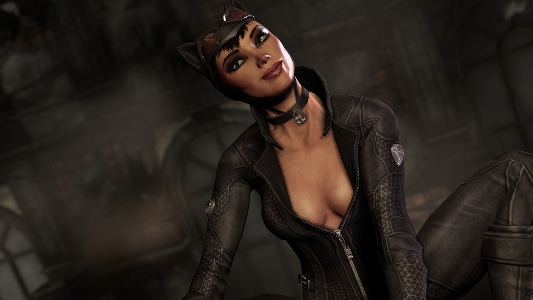
One of the games I played recently, the sequelific Batman: Arkham City, is a good case in point, being the offspring of both of those media… and boy, does it ever meet the stereotype. Witness Exhibit A:

Possibly an argument could be made that Catwoman’s open-hearted display of her, ahem, cuddly kittens is there to distract the various henchmen she faces – but no, seriously. We all know why Ms. Kyle is presented in this way, and it has little to nothing to do with tactical advantages fighting testosterone-riddled thugs.

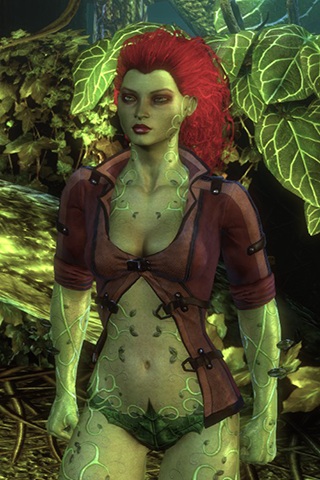
In comparison, Poison Ivy is almost demure, right? Wrong.

The sad thing is this: in terms of writing, Arkham City isn’t bad, and this includes its female characters. Sure, it’s no Ibsen, it’s pulpy as hell, but within the over-the-top, Grand Guignol genre they inhabit, the characters, their motivations and their actions make sense. And, what’s more, they become surprisingly compelling. I’m not a big fan of comic-book superheroics as such – I like some select examples of the genre,* but I don’t feel any specific attachment or nostalgic yearning for the various Adjective Men and Single Defining Attribute Women bursting out of phone booths in gaudy costumes (and in half the cases practically bursting out of gaudy costumes in phone booths). But over the 20+ hours of playing the Caped Crusader (AKA World’s Greatest Detective – I bet you thought it was Sherlock Holmes, didn’t you? – AKA The Man Who Manages To Remain Po-Faced When People Call Him Silly Names) it’s difficult not to become engaged in the story and in the silly, silly characters.

A large part of this is the voice-acting. Again, we’re not talking about masterclass material – this isn’t Ian McKellen at the Old Vic – but the cast manage to infuse the often pathos-laden, convoluted storyline with wit, humour and, yes, a sense that these freaks in costumes are real. At least for the duration of the game, I found myself wanting to know what happens to the Joker, Rhas Al Ghul, Mr. Freeze and the whole menagerie. Admittedly, I’d still feel a burst of shame if my girlfriend had walked into the room while I was playing with Catwoman (anyone who even thinks of making jokes about joysticks will get a kick in the Johnny Szazs…), but the game almost, almost made me see the appeal of these eternal schoolyard fights that are half semi-mythological epic, half soap opera.

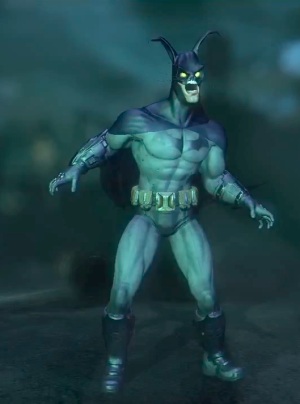
Also: how can you not love a game that features this Donnie Darko-meets-March Hare version of the Batster?

But seriously, folks – this is what Catwoman looks like! Not like two melons pressed into a zip-up leather overall – this is the one, true Catwoman:

*Okay, I’ll come clean. While I wouldn’t call myself a fan of superhero comics per se, I have enjoyed Watchmen, Mark Millar’s Red Son, Joss Whedon’s run on X-Men, Hellboy (does he count as a superhero?), Brian K. Vaughn’s Runaways and Ex Machina, several of Moore’s other ‘science hero’ works, Chris Nolan’s Batman films, and I will want to see the new Spiderman at the cinema, although that’s entirely because of Andrew Garfield. And, hey, good old Jed Bartlett is in it too!

When in Rome…

For all the amazing places I’ve visited vicariously through cinema, last week that was spent in actual, real Rome made me realise that I haven’t seen all that many films set in the Eternal City, in spite of its obvious cinematic qualities. I’ve seen Antonioni’s Roma, Città Aperta, and I’ve watched Matt Damon trying to figure out whether he wanted to be Jude Law or whether he simply wanted him in The Talented Mr Ripley – but other than that, cinematic Rome has passed me by. (Televisionary Rome, on the other hand…) Having recently walked past the house where Frederico Fellini and Giulietta Massina lived for the last years of their lives, I am resolved to check out La Dolce Vita and Roma, at least. Film Four, couldn’t you throw a Fellini retrospective our way?

However, I did spend a couple of weeks earlier this year exploring the place – albeit neither in films nor in the real world, but in Assassin’s Creed: Brotherhood, a game that carries the DNA of both Dan Brown and Umberto Eco according to some critics (I’m afraid that Eco, other than The Name of the Rose and some essays, has passed me by so far – another omission I’m hoping to correct). It’s set in Renaissance Rome, and it’s a near perfect example of how video games, in terms of technology but accordingly also in terms of ambition of what can be depicted in games, have developed in the last couple of years. Obviously seeing the real Pantheon or Colosseum or Campidoglio isn’t the same as seeing them in the game – and indeed, when I fired up Brotherhood this morning to check out the locations with Rome fresh in my memory, I did find them all to look considerably smaller in comparison – but letting you explore places that feel alive and that are inaccessible to you otherwise is something that games are doing better and better.

What games cannot do, though, and won’t for a long, long time, is deliver that perfect Granita di Caffe con Panna. Time for Nintendo to make a deal with Nespresso, methinks!

P.S.: In Brotherhood, the Colosseum and the Pantheon are probably my favourites. In actual Rome, it’s the wonderful Caravaggios (can he lay eggs?), the restaurants and that perfect tagliolini cacio e pepe at Le mani in pasta in the Trastevere part of the city. Molto delicioso!

You’re a mean one, Mr Kratos!

It is strange that I should enjoy God of War III so much. I’m not a particular fan of hyper-violence – and with a game that features Zipper Tech, a subroutine that calculates innards spilling out of a disembowelled centaur, it’s fair to say that it’s a tad on the violent side. I’m also not the biggest fan of puerile sex scenes in any media – and banging Aphrodite (off-screen) by Quick Time Event while two of her bare-breasted attendants watch and get all hot and bothered in the process doesn’t strike me as a particularly mature depiction of human (or indeed mytho-divine) sexuality.

And yet, in spite of me slaying more Olympeans than I care to shake my blades at (come to think of it, most of them I killed by shaking my blades at them, repeatedly), none of my pinko liberal borderline-pacifist sentiments complain the way they do when I hear about how much Jack Bauer rules. It’s not that I fist-bump every time Kratos tears some satyr’s head off or impales a minotaur on his torn-off horns… but damn, if the game doesn’t make those things enjoyable! And even though I’m about the greatest story-whore there is when it comes to games (two fingers to you, ludologists!), I guess my enjoyment of God of War III comes down to gameplay, first and foremost. I don’t know how Sony Santa Monica did it, but the Ghost of Sparta (known as Krony-Poo to those friends of his who want to have a close look at their lungs) and his arsenal of mythological weapons of mass destruction control so well. For non-gamers, it may be difficult to understand just how much a game can pull you in with a reactive, easy-to-learn-hard-to-master set of controls – and the God of War series has always been extremely good at this.

While story isn’t the game’s main attraction, it is pretty well told – and eminently pretty, in a “Look at the shader effects on that flesh wound!” way – and Kratos’ butchers tour of ancient Greece features some memorable re-interpretations of the big names, from snide but doomed Hermes to bruddah Hercules who gets his face Gaspar Noéd in to poor doomed Hephaestus who only wanted to protect his daughter, Pandora. But the visual beauty of this game doesn’t come from the characters (although it’s impressive to see Kratos’ scars in realtime HD) or the cutting-edge (pun intended) blood and guts – it’s the amazing, epic scale that each of the games has managed to put onto the screen. From fighting the Colossus of Rhodes to the Steeds of Time to climbing around on Gaia’s ample back fighting harpies… and don’t even let me get started on the architecture! In effect, God of War III may dress up as splatter, but at its heart it’s scale-porn – it gets hot and bothered showing tiny little figures climbing around gigantic buildings and creatures. It’s what a model railway built by Peter Jackson would look like. And, pinko lefty liberal that I am, I eat it up like it’s going out of style… and if it means pulling the heads off another 99 hydras.

Do hackers dream of digital love?

Can one fall in love with a fictional character? More to the point, can one fall in love with a character in interactive fiction, experienced only through (fictional) e-mails? And what if that character turns out to be an Artificial Intelligence?

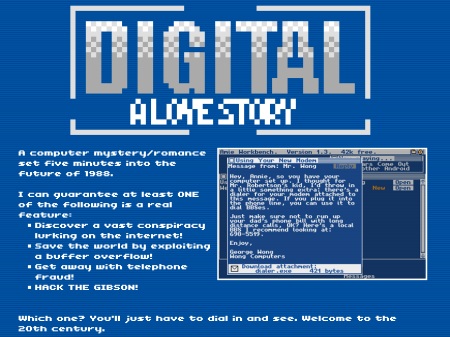
Welcome to the nostalgia soaked world of Digital: A Love Story, an interactive fiction by the improbably named indie game designer Christine Love. Interactive fiction: does that mean Digital is a game? Well, it is, although it lacks many of the conventional traits of games – it cannot be lost, it isn’t difficult as such (there are a handful of puzzles that are well integrated into the plot, but that’s that), in many ways its not all that much more interactive than HTML pages filled with hyperlinks. The notion of an indie interactive fiction, especially one concerned with a theme as weighty and overdone as love, may strike some as pretentious, that most overused and pointless of critical words.

Don’t let any of that keep you away from Digital, though. I’d imagine that Love’s beautiful, intelligent and moving game works best for those who used computers in the late ’80s already and who are at least not completely opposed to the cyberpunk fictions of William Gibson. Digital‘s use of cyberpunk sci-fi is subtle and her interest is always in characters and emotions rather than in technology (at least as anything other than the vehicle for relationships). Her main interest, at least on the basis of this and its successor, the wonderfully titled don’t take it personally, babe, it just ain’t your story, is relationships and feelings – though not in a soppy way, as her writing and especially her use of the medium shows her to be eminently smart at what she’s doing.

The whole of Digital happens in the low-tech environment of BBSes or bulletin board systems – basically the pre-internet versions of webpages and message boards. As the player exchanges messages with other users of a number of BBSes, a plot emerges… and a romance develops between yourself, the player, and another user called Emilia. One of Love’s smartest decisions is that the player’s messages are never spelled out. You learn from the replies what you must have said, but the exact words, the details, everything that makes up your personality, is left up to you. It’s this specific kind of gaps in the narrative that is unique to games, pulling you in a way that is very different from how prose fiction engages its readers – and it’s difficult to imagine such compelling experiments in interactive fiction in big-budget mainstream games development. It’s the low-tech environment of indie gaming that makes gems such as Digital feasible.

There’s a twist roughly halfway through Digital, and (perhaps due to half-remembered spoilers in reviews) I’d figured it out fairly early into the game, but it doesn’t matter: Love deftly tells her story with the player’s help in a way that makes it much less about what happens than about how you react emotionally. As Digital came to an end, I found myself sitting there almost crying. A synopsis of the game, even a more detailed retelling, could not evoke the feelings I was going through: it was the sensation that this was my story, that I was living it as it happened, and that it would always be a part of me. Even as I could see the strings by which the puppets were manipulated (me included), there was an emotional reality to Digital that is rare in most fiction, whether interactive or not.

And if I haven’t already turned you off the game, consider this: it’s free. Want to see whether there is anything to my effusive praise? Download Digital here, play it, and then come back and tell me what you thought of it.

More than fine

I’m not a big fan of Heavy Metal. Perhaps it’s that I’ve never had the hair to go with headbanging. Perhaps it’s that I dislike the sexism that often seems to go with it. Perhaps it’s simply that I was raised on Prokofiev’s Peter and the Wolf and that has influenced my entire musical development. I’ve always been more into borderline pretentious psychedelic prog rock, if anything, and then lots of indie singer/songwriter stuff than the leather-and-studs bridgade. I enjoyed This Is Spinal Tap, but half the jokes probably went straight over my head. Other than Ozzie, I’m not sure I could pick any of the greats of Metal out of a police line-up.

Imagine my surprise, then, when I started playing Tim Shafer’s Brütal Legend (savour that umlaut!) – and immediately fell in love with the world and atmosphere of the game.

Tim Shafer could be called the Tim Burton of the videogame world – if you disregard Burton’s creative stagnation, his repetitiveness and his increasingly mannered goth shtik. His games are strong on character, world building and storytelling, to the point where the gameplay becomes secondary. He’s the guy who spliced together Casablanca and the Mexican Day of the Dead and who created a summer camp for the psychic. And he’s the mastermind behind Brütal Legend, a game that takes as its inspiration Heavy Metal – not only the music, but the aesthetic, the ethos, the feel of it all (minus the “Smell the Glove” misogyny, mind you). Its world is designed to look like all the Metal album covers you can imagine, turned up to 11. It’s inhabited by laser-eyed black panthers and mastodons with gleaming metal tusks. It should be tacky – but instead it pulls off its loving hommage with style, with a little help from Jack Black. I mean, how can you not warm immediately to a game featuring lines such as these:

– Ever feel like you were born in the wrong time – like you should have been born earlier, when the music was… real?
– Like the seventies?
– No. Earlier… like the early seventies.

What is perhaps most amazing is that in a game featuring KISS-faced Amazons, phony big-haired rock stars (even the guys from Spinal Tap would find General Lionwhyte embarrassing – and yes, he’s one of the game’s villains) and a very familiar-looking Guardian of Metal, Shafer manages to pull off a story that takes turns being funny, thrilling and finally poignant. It’s difficult not to wipe away a manly Metal tear at the game’s ending. In a medium that’s full of teenage male wish fulfillment gone wrong (or just stale), that’s a rare gift.

Le retour du sous titre

You know what’s almost as bad as not having any subtitles in a series of films filled by mumbling Yorkshiremen? (Note that in the meantime a friend’s lent me the German edition of Red Riding, which features subtitles along with the English audio track. Blessings upon their Teutonic heads!) Buying a DVD that advertises, right on the back, subtitles in every language under the sun, or at least in English, German, French, Russian and a fair number of other languages – but then the actual DVD bears little resemblance with what’s promised on the box.

Other than featuring Andrei Tarkovsky’s enigmatic Stalker, that is. I’ve been interested in the film for, oh, about 15 years now, ever since a friend mentioned to me that it’s one of his favourite movies. My interest was piqued even more when I played the Stalker games, although they’re based less on the movie than on the novel Roadside Picnic (and ironically, while the games are relatively thoughtful, they still look like an ’80s action movie next to Tarkovsky’s film). I ordered the DVD on Amazon.fr ages ago – precisely because the edition promised subtitles in lots of different languages – but only got around to seeing the film now.

First impression: man, my French sucks. I was never very good at it, but after letting what ability I had rust for 15 years I understood perhaps 40% of what was being said. (Or rather, 40% of the subtitles; I understood even less of the Russian dialogue, although I did understand “бутерброд”!)

Second impression: even if I understand fairly little and the film is extremely slow – there’s something eminently compelling to Tarkovsky’s style. Even more than Solaris (which suffered somewhat from being set in an outdated future, the fate of so much sci-fi) Stalker is hypnotic… and gorgeous to look at. It is atmospheric without going for any of the predictable tools of atmospheric film makers. The world of Stalker is ominous and eerie, yet at the same time naturalistic, creating an effect I haven’t seen in any other film. There’s something almost documentary in its visuals, yet there’s a dream-like quality – and it’s this seeming contradiction, this tension, that is utterly fascinating.

More than that, perhaps it helps to see the film in a language I don’t fully understand. Films that are put in the ‘art film’ box tend to have a certain portentous, somewhat affectated quality to them; as much as I like Bergman, for instance, a number of his films have a certain self-aware heaviness that can be more alienating than is necessary. Perhaps Tarkovsky’s work has this same quality if the viewer understands the dialogues enough to realise that they’re unintelligible – but my impression was that while the world and themes of the film are portentous, the characters feel real. Not 100% and not all the time, but they’re more than just vehicles for themes.

In the end, though, I can really only judge Stalker as a visual experience until I’ve rewatched it (after a French refresher, perhaps), and on those terms alone it’s well worth seeing. Even if there’s a relative scarcity of Ukranian mercenaries, radioactive mutants and frantic gunfights.

But if I get my hands on the people responsible for that mendacious DVD edition, je m’occupe de vos miches à la médiévale!

Light sabres… for kids, you know?

I’m one of the lucky ones – I was a kid when the original Star Wars trilogy came out, so I like the Star Wars movies that it’s okay to appreciate. Like so many boys of my age I wanted to fly an X-Wing or a snowspeeder, bringing down the Empire one AT-AT at a time. I got really good at making bad light sabre noises. It took me a long time to see anything other than A New Hope, because my parents were decidedly uninterested in anything sci-fi or fantasy; I still haven’t completely forgiven them for taping over the original movie the day after we got the Betamax tape from my uncle, recorded from ITV. By the time I watched Return of the Jedi, I still thought that TIE Fighters, Death Stars and raspy-breathed evil space samurai were cool, but Ewoks were just overgrown teddy bears.

I remember the original teaser for The Phantom Menace giving me goosebumps at the cinema. This wasn’t just nostalgia, it was nostalgia distilled, and then the distillation distilled again. It was all the best things from my childhood without the stuff I’d worked hard to forget or repress. It was Star Wars, for crying out loud.

Well, we all know what happened when the prequels came out and millions of nerd voices suddenly cried out in dismay. Let’s face it, though, Teddy Bear’s Picnic should have prepared us for Jar Jar & Co. In any case, if I wanted to write about the disappointment of the prequels, I’d be even more ludicrously late than I am with most of my blog posts.

What I really want to write about is this: that fine distillation of childhood with all its best bits left in exists. And next to Rock Band, it’s the best fun I’ve had with any video game playing with my girlfriend.

Lego Star Wars gets the appeal of Star Wars: its universe is a playground for overgrown kids – but while it’s childlike, it isn’t childish. It isn’t embarrassing the way the Gungans are in Episode 1, nor does it take itself as seriously as the worst moments of Episodes 2 and 3. The trials of Anakin are more relatable when he’s a mute toy figure… and the “I am your father” moment in Lego is simply perfect.

The Lego series of games extended to other fictional universes after covering the Star Wars movies in bric-a-brac glory: there’s Lego Batman, Lego Harry Potter, two Lego Indiana Jones titles… and Lego Pirates of the Caribbean is in the works. The games are all basically the same, with small variations in the designs – but for someone who grew up trying to imitate the roar of an Imperial fighter screaming past your cockpit, it’s the Star Wars game that carry a special magic. And sitting on the sofa, teaming up with my girl to dismantle the Empire brick by evil brick is bliss.

As is the ability to hit Jar Jar with an itty bitty light sabre. Again and again and again…

True West

I’ve made a couple of posts on the subject of games, films, art, yadda yadda yadda. Boring stuff, and anyway, who cares whether Roger Ebert knows a gamepad from a Wiimote?

Rockstar, the makers of the infamous Grand Theft Auto series, take a strange position in the whole game/film argument. There are few games that borrow as liberally, and as successfully, from the movies and from TV as Rockstar’s. This has never been as obvious as in their latest, Red Dead Redemption, which is in equal measures Once Upon a Time in the West and Deadwood. The ghost of Sergio Leone haunts the game’s arid landscapes. I’ve rarely seen as effective and evocative an interpretation of the West as the one Rockstar have conjured up. Yet their games never become that most frustrating of hybrids, the interactive movie. They are both grandly cinematic and great games.

More than anything else, Rockstar excels at creating worlds to explore that feel alive: the faux ’80s Miami of GTA: Vice City, the parallel LA, San Francisco and Las Vegas of San Andreas and the not-quite-NY that is Liberty City.

None of these measure up to the accomplishment of Red Dead Redemption, however. I’ve played the game for five to ten hours, and in terms of gameplay it’s nothing revolutionary – missions here, duels there, horse riding, cow herding and poker minigames elsewhere – but it creates a sense of place that is simply amazing, as the video of the game’s time-lapse day/night cycle shows:

John Hillcoat, director of Australian neo-western The Proposition and the film adaptation of Cormac McCarthy’s The Road, was asked to direct a short film using footage from the game – possibly a gimmicky way of advertising its release, but one that’s pretty gutsy, speaking not only of Rockstar’s confidence in their creation but also in their chosen medium. Is Hillcoat’s half-hour take on Red Dead Redemption an overly idealistic barrage in the Great Movie/Videogame War of the ’00s? Is it just something to do in between directing grim, gritty and depressing movies? Judge for yourselves.