Meet the new Bond…

… same as old Bond.

I have to admit this up front: I’m not a big fan of James Bond or the series of films he features in. I liked Casino Royale a lot, but even apparent series classic Goldeneye didn’t do anything for me, and while I could tolerate the Sean Connery films I wouldn’t want to sit through Roger Moore’s panto-style movies ever again.

Skyfall is both a call-back to old-school Bond and a deconstruction of the films and the character. In terms of both form and theme, it’s the most ambitious film in the series. At the end, as the credits were rolling, I was exhilarated and excited – yet I’m not sure I’m looking forward to what the Broccoli Gang will come up with next. For, see, Skyfall ends at a point where we could very easily segue into Dr No. Craig’s Bond at the film’s close is Connery’s original Bond, for all intents and purposes, complete with a male M and trusty Moneypenny.

Regardless of this, I come to praise Bond, not to bury him. After a boring, confused Quantum of Solace that barely works as a companion piece to Casino Royale – and that even then doesn’t add much to its predecessor – Sam Mendes has a much better handle on… well, everything. I haven’t yet seen a Mark Foster film that has convinced me the man deserves the praise he’s received, and he was most definitely the wrong man for Bond. Mendes hasn’t really done any action films, the closest being Road to Perdition, but he knows how to stage scenes effectively – and he knows how to pick his collaborators, with Roger Deakins turning in the most gorgeous film in the series yet. His aesthetic sensibilities complement Mendes’ directorial eye well, especially in a fight silhouetted against Blade Runner-esque Shanghai facades and in the Macao scenes. (Also, is it just me or is Mendes more overtly theatrical, though effectively so, in this than in any of his previous films?)

Skyfall

There’s more to like about Skyfall: the phantasmagoric-to-the-point-of-becoming-apocalyptic intro sequence (I didn’t like Adele’s song all that much until I saw it matched to the intro visuals), Craig’s co-stars (let me single out Javier Bardem who succeeds at being camp and chilling, gentle and deranged), a smart, witty script that doesn’t shy away from pathos when it is called for. It’s the first Bond film I’ve seen at the cinema that I wanted to see again as soon as the credits rolled, and it’s the second that has made me emotionally invested. Yet there remains that niggling feeling that Skyfall succeeds all too well at making everything that’s interesting about it superfluous for the next film in the franchise. Bond mentions at some point during the film that his hobby is resurrection – let’s hope that what this film has resurrected isn’t one of the undead, a revenant of the Bonds of old and nothing more.

P.S.: Ben Whishaw’s Q, while not much more substantial than a cameo, was much appreciated, as were Naomie Harris, Ralph Fiennes and Albert Finney.

Christmas Variety Pack – of one!

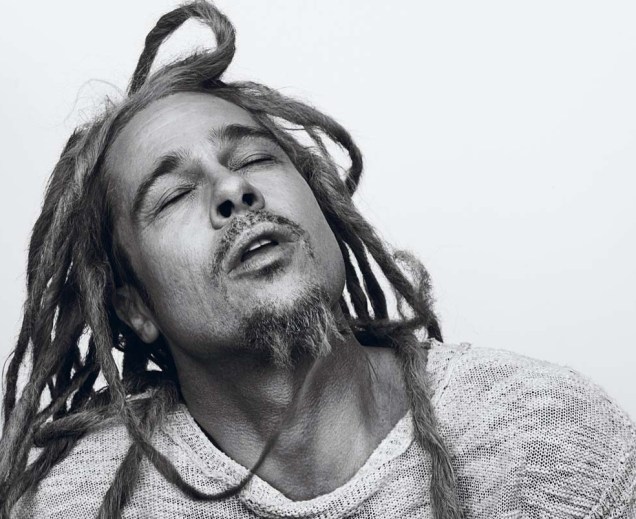
I’ve managed to catch a few films at the cinema in the last few weeks and I wanted to get them off my plate before a big steaming turkey landed on said plate… or something to that effect. Possibly something less ewwy. However, since WordPress just played a naughty pre-Christmas trick on me, gobbling up what I’d written for the second and third item, here’s a shorter variety pack, featuring the silliest picture of Brad Pitt in a long, long time.

Killing Them Softly

For anyone who’s forgotten one of the zillion times I’ve mentioned it, Andrew Dominik’s The Assassination of Jesse James by the Coward Robert Ford may just be my favourite film of the last ten years. I was accordingly excited when I heard that its director and star were getting back together for a darkly comic gangster flick, and the trailer looked intriguing – as well as pushing several of my movie- and TV-loving buttons. James “Tony Soprano” Gandolfini? Richard “Late Nate” Jenkins? Henry Motherfucking Hill himself, Ray Liotta? Count me in!

Talk about killing a film, not softly, but with unrealistic expectations. I loved The Assassination… for its sure-handed direction and for Pitt’s performance (although it’s Casey Affleck and Sam Rockwell who were the biggest revelations), but also for its elegiac tone, its hauntingly beautiful images, the writing largely taken from the original novel. Killing Them Softly may have been directed by the same man and shares the star of Dominik’s earlier film, but it is entirely different in tone and setting. It’s grimy, and it rarely evokes any emotions for its characters other than sarcastic pity. They’re a largely pathetic gang of losers, and Pitt’s pragmatic blue-collar hitman is the best of a sorry bunch. Which is exactly what the script requires and what Dominik goes for, and he’s very effective at this – but I wasn’t exactly engaged by all of this. Several Sopranos alumni turning up didn’t exactly help, replacing one set of expectations (something that would pull me in as much, and in similar ways, as The Assassination… had) with another (will this ever crawl out of the shadows of The Sopranos?).

Maybe someone should tell him that Bob Marley was black?

Is Killing Them Softly a good film? I didn’t mind watching it, even while my expectations deflated like a sad seaside toy punctured by an urchin. Does it do anything special or new? Not particularly. There’s a sustained political subtext, a commentary on today’s America that, at least in my opinion, doesn’t work and comes across as fairly facile. There is a beautifully tense robbery scene, and the mis-en-scène is generally interesting – but damned if I know what, if anything, Killing Them Softly adds up to. Perhaps that’s the jaded, cynical point.

And that’s it for now. Tune in soon for my thoughts on Argo and Skyfall – and in the meantime, happy holidays, one and all!

Love in the unconditional

Michael Haneke is what I would call the anti-Spielberg. He is a director who consistently avoids even a trace of sentimentalism or pathos. Based on the Haneke films I’ve seen, his goal is primarily to make people think – and when he wants to make them feel, he never dictates the specific feelings they should experience. Haneke’s work has been described as cool, distant, even clinical.

Amour

His most recent film Amour, winner of the Cannes Palme d’Or, doesn’t exactly break with this tradition; the film maker’s style, both in terms of his direction and his writing, is still very much in evidence. Nevertheless, I’ve found Amour one of the most affecting, profoundly emotional films, definitely of the year and possibly of the century so far. It is brutal and raw as much as it is tender and loving, and it is perhaps one of the best cinematic examinations of what it is like to watch a loved one die.

The immediate praise must certainly go to his duo of actors, Jean-Louis Trintignant and Emmanuelle Riva, both of whom don’t show a trace of obvious acting: they simply are the characters on screen. It is impossible to say which one is more impressive; while Trintignant captures the anguish, frustration and fear of a husband who can only be there for his dying wife but not help her (except in one way, ultimately), Riva is uncannily convincing as the wife who, after first one stroke and then another, slowly crumbles away and fades into the darkness like a latterday Eurydice. They occasionally share the screen with other characters, primarily the high-strung daughter played by Isabelle Huppert, but the film is entirely theirs.

Amour

For me, it was impossible to watch the film and not be reminded of my mother’s death three years ago. I’ve talked to others who found it brought back the death of their loved ones: parents, grandparents. Yet while Amour captures something that seems universal about death and bereavement, at least in our culture and society, it is at the same time entirely specific to these characters. It does not go for vague, and essentially rather cheapening, generalisations along the lines of “Aren’t we all…” and “Don’t we all…”. And differently from some of Haneke’s earlier works, it never feels didactic or cruel. Its unflinching eye on the process of dying is hard to take at times, but it’s this commitment to the act of bearing witness that is finally tender and beautiful.

November Variety Pack

I was originally going to write about Michael Haneke’s Amour here, a film that I wouldn’t hesitate to call one of the best I’ve seen this year, but I think I may need to think a bit more about Haneke’s latest and how I feel about it. So, to play for time and keep my fingers warm in the meantime, here’s a Variety Pack to go with the bookbag I posted recently.

Stalag 17

I wouldn’t say I’m an expert on Billy Wilder by any means, but I definitely appreciate the man’s work – although if there is something to that deleted scene from Pulp Fiction, if there are Some Like It Hot people and The Apartment people, I belong firmly in the latter group. There are a number of Wilder films I’ve never seen, though, in spite of hearing a lot about them, one being his DDR comedy (that oldest of genre chestnuts!) One, Two, Three, the other Stalag 17. (Perhaps it’s a case of The Great Escape having taken up the slot of POW camp film in the DVD collection in my heart.) However, while One, Two, Three still remains unseen by me, I’ve now filled in that other gap in my Wilderography.
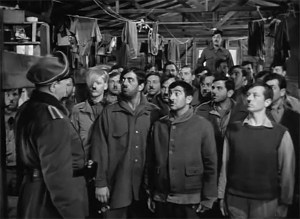
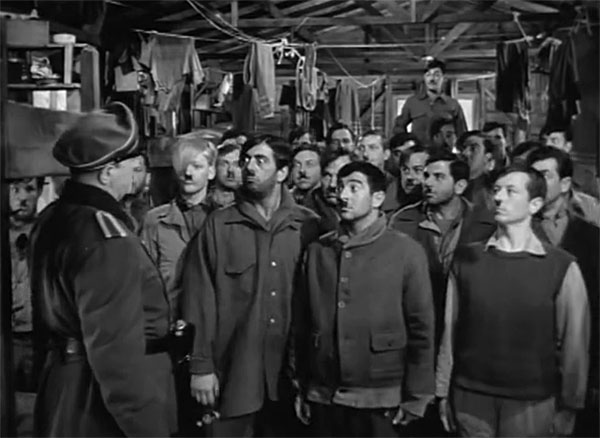
The film’s an odd one, especially in terms of tone. Wilder often mixed comedy and drama, and to great effect – The Apartment is sweet and funny, but one of its central plot points is a suicide attempt, and Some Like It Hot begins with a Valentine’s Day Massacre-inspired scene that gets the film’s story started. Similarly, Stalag 17 begins with a doomed escape attempt that sees two American prisoners of war shot by the German camp guards – but differently from several other films by the director, I don’t think this one is as successful at blending different tones. It’s especially the characters, several of which are too broadly drawn and too cartoony to evoke much empathy, something that distinguishes the Wilder films I like best. Yes, they’re cynical, and yes, they use moments of slapstick and broad comedy, but the characters are usually still human, even the most excessive ones such as Norma Desmond. There are a handful of such characters in Stalag 17, but the film spends most (and, in my view, too much) of its time with the clownish comic relief characters, to the extent where it feels more like the meat of the plot is the dramatic relief from POW clownery. William Holden is great, both his character and the acting, and there are some beautiful, witty scenes (one involving more Hitler moustaches than you can shave your whiskers at), but the writing on the whole is uneven, making the film feel like lesser Wilder to me. But then, as mentioned, perhaps that’s just because the place in my heart reserved for POW camp movies was taken decades ago by The Great Escape.

Belle de Jour

For being a film nerd with a certified diagnosis of Criterion Addiction Syndrome, there are a number of notable gaps in my library, such as Pasolini… and Buñuel. I’m not 100% certain, but I think I’ve even avoided Un Chien Andalou, although it is just about possible that I saw it when I was an insomniac teenager and they were showing it on some forlorn TV channel at 2am and I’ve been repressing the memory ever since.

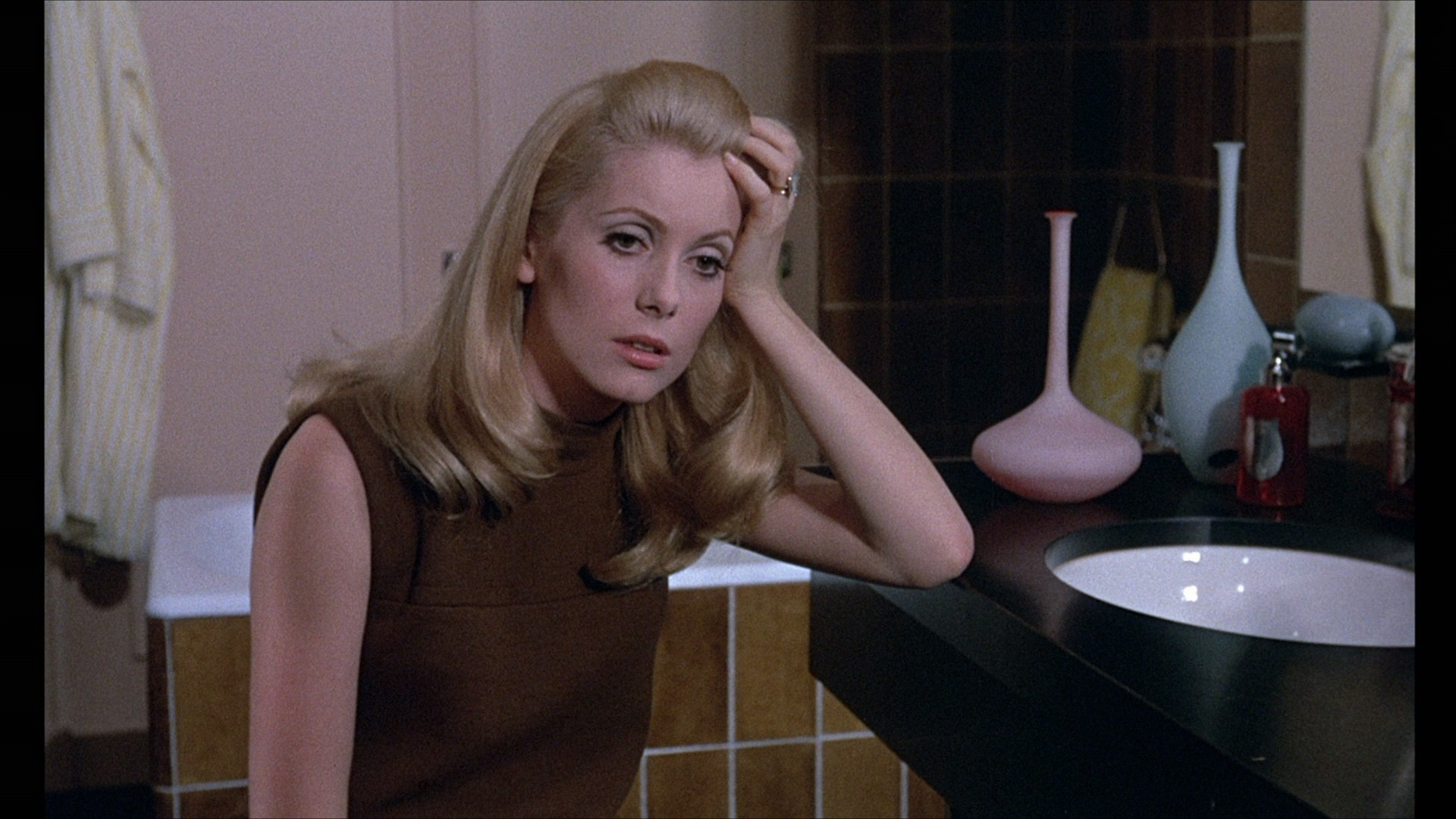
So, when Criterion brought out Belle de Jour on Blu-ray, I pounced. A satire of the bourgeoisie, repressed sexual fantasies coming to life, Catherine Deneuve… what’s not to like?
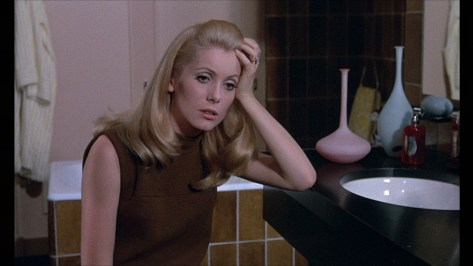
One Blu-ray later, colour me disappointed. The film is interesting, it’s well shot, it’s got actors that are worth watching – but why oh why does it feel so tame? Why do Deneuve’s character and her sexual explorations seem so trite? I expected a film with the power to shock, but apart from being moderately intriguing Belle de Jour didn’t shock me – nor was I sure it was trying to. If the film’s satire intends to make fun of even the most repressed sexual fantasies of bourgeois housewives being fairly banal, it succeeded – perhaps you need to be a member of the ’70s bourgeoisie to be shocked by the film.

It’s still an interesting work and has some effectively surreal moments, not least in the dreams that the protagonist has, whose weirdness is amplified by their deadpan presentation. But trés choquant? Pas vraiment.

Bonjour Tristesse

How’s this for bookending this blog post: Otto Preminger plays the camp Kommandant (ooh-er, missus!) in Stalag 17 and he directed the third movie in this variety pack. It’s almost like I have a plan here! (Briefly ponders renaming this blog “Cylons on Pogo Sticks”…)

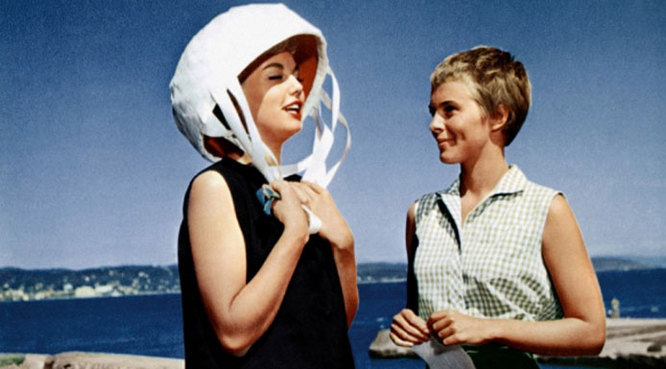
Bonjour Tristesse is an odd duck in one particular way: all the characters are supposed to be French, yet the main characters, the aging Lothario dad and his precocious teen daughter, are played by Brit David Niven and American Jean Seberg, neither of which sounds in the least French – though the French people surrounding them for the most part have French accents. What is strange, though, is that after the initial irritation this works fairly well: the two characters are so much in a world of their own creation, in which they are somehow the only real people… or, by the end of the film, the only ones as thin and flimsy as paper.

Perhaps it’s because this is an American film and doesn’t come with the same sort of baggage as Buñuel’s Belle de Jour, but I found Bonjour Tristesse more, well, not shocking so much as simply able to make me think, feel and have some sort of reaction beyond being mildly intrigued by its treatment of sexual themes, even though the film is much more overtly tame. It also manages a fairly difficult trick, namely making the audience care about selfish, callow characters who use others unthinkingly and whose charm is shown to be increasingly threadbare.

Another effect the film had on me: I now want to rewatch A Bout de Souffle, Goddard’s turn at being infatuated with Seberg. I didn’t particularly like Goddard’s film when I first watched it, but he said himself that A Bout de Souffle can be seen as a quasi-sequel to Bonjour Tristesse. Perhaps the earlier film will make me appreciate the later one more by tickling my intertextual taste buds! If it does, I’ll make sure to let you know.

Childhood’s end

I was seven… and five minutes into the film I was already bawling, as those nasty men with big cars and jangling keys were running after the space gnome with the glowing chest. Just leave the guy alone! He’s already stuck on a planet that isn’t his with little chance of ever getting home.

E.T. was when I became a fan of the cinema. Before that I’d seen movies – it was a tradition of our family to go and see a film, usually Disney, on the second Sunday in December – but Spielberg’s classic was the first time I had an inkling that how a film is done is at least as important as what it’s about. I didn’t turn into Little Man Criterion all of a sudden, but the seed for my love for film (and my constant worry of running out of shelf space for DVDs and Blu-rays) was planted.

In the meantime I have been disappointed by Spielberg repeatedly. Obviously the guy is a consummate craftsman, but I can’t help thinking that he peaked in the late ’70s and early ’80s and never reached those heights again. Jaws, Raiders of the Lost Ark and Close Encounters of the Third Kind – those films do what they set out to do almost perfectly. Later Spielberg still has his moments, and many of his later films are still good, but his great skill at evoking a sense of wonder (no other film manages this as well as Close Encounters and some of E.T.) was marred by his increasing tendency towards mawkishness. Early Spielberg was already sentimental, E.T. being a perfect example of this, but he also knew when to be ruthless with his characters. In Jaws pretty much anyone could die – in Jurassic Park it’s bad guys and side characters that get munched on while especially the kids get a free pass, surviving even high-voltage fences that would probably have turned a velociraptor into fried dino.

After the 20th anniversary edition of E.T., with its walkie-talkies and check-out-my-CGI moments, I felt a bit burned on the film and on Spielberg’s older films. What next? A Jaws where Alex Kintner gets a good scare by the mean old shark but escapes unharmed otherwise? Spielberg himself admitted that he’d made a mistake Lucasing his film, promising that the 30th anniversary edition would be a return to the original, shotguns, rubber puppet and all.

So, like the good little film geek consumer that I am I toddled off to Amazon and ordered the Blu-ray – and yes, it’s the E.T. I remember bawling at when I was a kid. No walkie-talkies, no memory hole for Elliott’s immortal “Penis breath!” line (can you imagine this in a PG film nowadays?).

What seems to have changed, though, is me. This time around, the gap between my nostalgia and my actual enjoyment of the film was too big not to notice. It’s still an example of Spielberg at the top of his game, but perhaps that game is no longer for me. Spielberg’s sentimentality, John Williams’ bombast, the cuteness of the kids, it all gets a bit too much and isn’t modulated nearly is well as I’d like it to be: it’s as if Spielberg & Co. only know piano and forte fortissimo but nothing in between.

Which is sad – but I have the sneaking suspicion that I already felt like this ten years ago when I saw the re-release at the cinema. Back then I probably put it down to Spielberg’s regrettable edits, but more likely it’s that I’ve outgrown the film. The good news is, though, that I just need to give it a year or two and I’ll have forgotten how I felt about the film this time around, remembering only the nostalgia.

And if I then, in another ten years or so, re-watch the film, I’ll make sure to do so without subtitles – there’s something disconcerting about having the little brown space guy’s sounds described as E.T. moans and E.T. pants, as if he needed to phone not home so much as the Intergalactic  Party Chat Line.

P.S.: Almost equally disconcerting is this E.T.-themed ad for the 1985 Special Olympics, which make it all too likely that the wrinkly gnome from outer space uses Reese’s Pieces to lure kids into his white van when he isn’t healing plants and drinking beer.

Taking the blood out of the barbershop

After last week’s instalment turned out quite a bit longer than expected (a bit like the wait for Max Payne 3, in fact), here is a shorter tidbit – which, apparently, should be spelled “titbit”, but that sounds too much like a snack or breakfast cereal for sex-obsessed psychopaths to me. I’ll be on holiday next week, so I’ve got a good excuse for the next post to be a couple of weeks away, but in the meantime…

I used to consider myself a Tim Burton fan. Around the time when the man made Edward Scissorhands and Batman Returns, his goth-romantic style clicked with me, so much so that I considered his second Batman instalment one of my favourite films. (I still have a great fondness for the movie, but I’m more aware of its flaws at this point.) Then came Mars Attacks!, a perfectly okay half-hour comedy stretched into a feature film, and Sleepy Hollow, which looked like the most gorgeous Tim Burton film ever but felt, well, hollow. Planet of the Apes didn’t have much going for it beyond the make-up and Big Fish angers me with its twee, needy sentimentalism that would give Steven Spielberg a toothache.

Fast-forward to Sweeney Todd. I am not all that much into musicals and had heard of Sondheim but didn’t know him at all. The trailer and stills for Sweeney Todd looked like Sleepy Hollow all over – more so, in fact, with the film’s production design being so Tim Burton, it felt like someone had taken his earlier films, boiled them into a thick, black ooze and used this to paint the sets. When I saw the film at the cinema, mostly for old time’s sake, I was surprised that despite the ultra-Burton look the direction felt… more adult, I’d have to call it. Less of the cartoon exaggeration that Burton had fallen to (and would return to in later films). Even Johnny Depp looked like he was acting rather than simply doing his Depp/Burton spiel.

I’ve just recently rewatched Sweeney Todd, after catching it on stage at the Edinburgh Fringe, and I still consider it to be one of the better of Burton’s recent films, perhaps even the best – yet it is held back by the director’s visual style. Sondheim’s play, for want of a better word, has a certain meatiness. There is a charnelhouse vitality to it, yet in spite of the gallons of gore Burton’s visuals are bloodless. They are designed within an inch of their life. More than that, they make Todd and his accomplice-paramour Mrs. Lovett one of a kind, a sort of Goth His’n’Hers, which hurts especially the pie maker’s characterisation. It’s a shame, really: while I think that Sweeney Todd is proof that Burton still has talent and doesn’t just imitate himself, he also keeps the film from being as good as it could be. And, frankly, while I used to love the typical Burton look, by now it feels less like a style and more like a brand. Predictable, safe, and not a little boring.

P.S.: You know who’d make a very effective Sweeney Todd? Mark Strong. Unfortunately the poor man is typecast and only plays sweet, loveable good guys.

P.P.S.: YouTube is acting up, so instead I went to Vimeo, not expecting to find anything much… except it looks like someone uploaded the entirety of Tim Burton’s film, with Spanish subtitles. Weird, huh? And probably more than just a little legally iffy… Still, while it’s up it’s up, eh?

http://vimeo.com/26811104

Tyrannosaurus wrecks

Some men know precisely where the fine line between right and wrong lies. That doesn’t prevent them from stepping across it. Joseph seems to be a borderline case. He kicks his dog to death outside the betting shop, and immediately regrets what he’s done. Later, he collects his unemployment money at the post office, spouting forth racist crap at the Pakistani behind the counter who tells him not to come back here. That scene must play out regularly because he might have been out of a job for a long time. Joseph apologizes immediately, and I think he means what he says. Outside the shop, he finds a rock and throws it through the shop window. That scene reminded me of a Roger McGough poem: I am sorry, but this is the way things are.

Joseph is not a racist – worse, he hates everybody. One day, he hides behind the clothes rack in Hannah’s second-hand store in order to escape a beating. She lets him stay and offers him tea. He insults her with precise, well-aimed words. He comes to apologize the next day. She throws him out, but he is… curious about her. He sees her and wants to clean up his act. Then she turns up with bruises on her face.

This is the point where the movie gravitates towards a temptingly easy solution. Joseph could give Hannah’s husband a good thrashing – just as a warning to stay away, of course – and hook up with her. She would feel safe, and he could let his shoulders slump. They would make a nice couple. A lesser movie would go for that solution. “Tyrannosaur” has other plans for its characters. At first, I thought the title referred to Joseph’s predatory nature. It doesn’t. He crumbles in the presence of Hannah’s good side. There is a spellbinding scene where Hannah prays at his dying father’s bedside while Joseph is looking on. She does what he should do, but can’t. Maybe he can return the favour, but he knows she will never agree to him beating up her husband. Their need to find help is overpowering to them both, and if they cannot help each other, they must help themselves, or it might be too late.

“Tyrannosaur” is Paddy Considine’s first movie. It’s about violence and guilt, but doesn’t get bogged down in either. It sidesteps all the cliches of similar movies: Joseph and Hannah are alcoholics, but they behave erratically also when they are sober. Drink is not the trigger, but the drug to numb the pain and the guilt so they can go on for a little while longer. None of the characters reveal their past and present us with the reason they are the way they are. There are hints at Joseph’s family, but they don’t even begin to explain him. The same is true for Hannah. That’s as it’s supposed to be. What if the reason you are the way you are comes from a trivial event? What if the fact that you cannot change your past breaks your spine? What if the reason for your behaviour has gone missing or been forgotten? What if there isn’t any, and that is just the way you are – abusive and violent? In most cases, atonement is impossible. There is no closure – closure is for those who need a shiny cover. You don’t miraculously heal thyself. You go do what you have to – sometimes that means revenge, sometimes it means leaving for good. You have to live with the fact that you might be past saving.

Joseph and Hannah don’t play house, pretending everything is fine now, because they still are who they are. They don’t sleep with each other. They don’t take in the boy from across the street who is afraid to go home because of his useless step-dad’s pit-bull. Joseph tells Hannah in no uncertain terms to leave after she has taken refuge in his living room, and she complies with his demand because she understands him, and she understands what having her in his house means to him, and to her.

The performances are flawless. Peter Mullan has a way of projecting hurt and guilt while only standing there. His Joseph is a man who is twisted back on himself because of all the rage he carries around. Olivia Colman has only turned up on my radar with this movie, but she is on my watchlist now. Eddie Marsan goes to unknown human depths with his role as the husband. There is a scene where he apologizes to Hannah for having beaten her. Listen to how he speaks rather to what he says. Then watch Hannah’s face. Paddy Considine may know that neighborhood – it is only three doors down from Shane Meadows’ “Dead Man’s Shoes,” in which Considine played the lead.

The ending caught me cold, but movies like this are not about their ending. If you need a happy ending, look elsewhere. In situations like this, almost any change is an improvement. There is no real ending to stories like this, and the movie’s ending is far from happy, but not one of the characters would ask for happiness; they get some kind of relief, and must be content.

July Variety Pack (2)

Have I mentioned before that Criterion is planning to ruin me financially? As a matter of fact, I have my suspicions that the company was created entirely for that purpose. This guy’s version of a honeytrap? A life-long subscription to Criterion. I just haven’t figured out yet what the incriminating pictures would look like – although now that I’ve brought it up, I sort of wish I hadn’t…

The thing about Criterion (often in combination with the A.V. Club or with DVD Verdict) is this: it gets me to watch stuff I wouldn’t even have heard of otherwise, like A Night To Remember (discussed here). Or…

Make Way For Tomorrow

… a film that, if I’d read a plot synopsis beforehand, I would probably have avoided, because it sounds like sheer melodrama (even more so in black and white): an elderly couple losing their house and ending up separated, each staying with another one of their less than understanding children, and their final day together before they’re split up permanently. Yet it’s turned out one of the most poignant and sad films I’ve seen in a while, and the sadness of its last half hour doesn’t bear a trace of melodrama. Don’t let the text panel at the beginning fool you into expecting a moralising story about how children should honour their parents – the film is astute about the difficult relationship between parents, especially of the elderly kind, and their grown children, and it doesn’t ignore that its two protagonists aren’t the easiest of people to be with. What elevates the film from a good, though probably not special film to something great is the final act, which doesn’t make any concessions to an audience expecting a happy ending – or at least a clear denunciation of the children and an easily understood lesson in morality along the lines of “Thou shalt…” and “Thou shalt not…”. Instead what we get is an emotional honesty that hurts by being entirely unvarnished.

Jane Eyre

“Cary Fukunaga… Didn’t he do that film about gang brutality in Mexico, Sin Nombre or something? Sounds like just the right guy for that Jane Eyre flick we’re doing!” I don’t know what the producers were thinking when they hired Fukunaga for their adaptation of Charlotte Brontë’s classic – but they were absolutely right to do so, as the result proves. Jane Eyre is difficult to do right, as there’s a major temptation to streamline it into a generic historical romance, Jane Austen with less humour and more madwoman in the attic. The casting of two misfits who supposedly aren’t conventionally attractive with Michael Fassbender and Mia Wachowski would have suggested an audience-pleasing approach, but Fukunaga, his cast and his crew, while cutting their source down to the essentials (you can’t afford not to, unless you’re doing a BBC-style miniseries) get to the heart of Brontë’s novel. The casting and acting work wonderfully, the script is respectful of the original novel without being beholden to it, and the cinematography is breathtakingly gorgeous at times. I’ve sometimes described films as the moving equivalents of paintings – you’d want to frame them and put them on the wall, but you don’t necessarily want to pay attention and listen to them. Fukunaga’s Jane Eyre is the sort of film you want your eyes to feast on but there’s plenty to listen and pay attention to as well. And for all its beauty, it’s not your conventional pretty costume drama, thank god.

Benny’s Video

I know that at least one occasional reader of this blog hated this film with a vengeance when she saw it years and years ago. Myself, I wouldn’t say I’m a fan of Haneke’s, but I’ve found all of his films intriguing. It’s easy to get pissed off at what the films often do at a first glance: there’s something both didactic and smug about their themes and tendencies, as if Haneke judges you for watching, say, Funny Games and dares you to switch it off, while at the same time wanting you to continue watching to validate its thesis. At the same time, there’s usually more going on underneath the surface, and Benny’s Video is a good example of this. Going in, I expected a film about a young man desensitised to violence by the videos he watches, and there is some of that – but at the same time the videos are partly a red herring, as especially his parents prove at least as compromised as him, and they don’t have the convenient excuse of “Slasher flicks made me do it!” The film has some rough edges and some of the director’s decisions are questionable – at times the characters and their actions are sketched too cursorily, turning ambiguity into muddledness – but even at this early point in his career Haneke is masterful at staging scenes clinical yet uncomfortable without pushing any gratuitous viscera in your face. Even when I end up angry at Haneke’s manipulations, he makes me think more than most directors do… so perhaps he’s not doing such a bad job at being didactic after all.

Great visuals…

… shame about the writing – especially since I’m talking about the adaptation of a novel.

I’ve just watched the Cloud Atlas trailer, and it looks amazing. It would look even better if I hadn’t also been listening to the lines from the film that are intoned in the trailer – most of which strike me as portentous yet facile drivel. Was the book like this? I have to admit I don’t remember; when I read Cloud Atlas, it didn’t particularly click with me. Still, the trailer is well worth looking at. Visually the film would seem to risk becoming garish, but it definitely looks very intriguing.

Link to the Cloud Atlas trailer on iTunes Movie Trailers (sorry, not on YouTube yet!). Make sure to go HD!

P.S.: There’s a Variety Pack coming soon(ish) – watch out for it by next Wednesday!

Artifice, authenticity, affectation

If there’s one word I wouldn’t mind seeing banned from use for the next, hmm, fifty years, it’s this one: authenticity. Yup, that’s the one, the word I’ve come to dislike as much as its closeish relative, the phrase “Based on a true story!” What’s my beef with it? It’s either phony, self-aggrandising or both. A certain doddering old father once told his son, “To thine own self be true,” and as a motto it sounds quite nice, except – I think this notion of an “own self” to which you should be true is silly. Do something because you want to do it, because you think it’s right to do it – but talking about an authentic self that you should honour? That’s fine, as long as your “own self” is one of the good guys – but what if you consider your authentic self to be that of a xenophobic bastard who hates those bloody foreigners? Does the notion of authenticity* ennoble your arseyness? People’s identities, their characteristics, are fluid, and pretending that there’s a ‘real you’ inside you that’s a yardstick for all your actions is romanticised claptrap at best, disingenuous bullshit at worst.

If you’re still reading after this rant, you’re probably wondering: why does a geek blogger who usually writes about movies, games, books and comics post a diatribe against the word “authenticity”? Doesn’t he have first-person shooters to play and pretentious wankery to write about them afterwards? Bear with me, gentle reader – relevance (of some sort) is just around the corner. It’s basically this: the overuse of the A word extends to art critics and the culture pages of newspapers and magazines. “Authenticity” is used as a word of praise for movies, when usually writers use it as a way of making their “it’s, like, for real, man!” comments sound sophisticated. Let’s be frank: authenticity in art – including any art form that’s primarily about narrative fiction – is an effect. It’s an artifice. It’s like a Photoshop filter: turn up the authenticity to 10, eh? It’s the fashionable, and often trite and superficial, name given to works that used to be described as being in the style of realism or naturalism. It’s an author’s conscious choice on how to present their material. It’s a style, an artifice, pretending not to be one.

So, what’s brought on this tirade? Probably the fact that I recently re-watched Drive, a film I greatly enjoyed the first time and downright loved the second time. How does it tie into this extended waffle on authenticity? Pretty much by eschewing the Authenticity Effect altogether. Nicholas Winding Refn uses a decidedly theatrical style – perhaps not as much as in his earlier film, Bronson, but Drive is still markedly focused on its own artifice, in its visuals, its central performance, its choice of music. The director’s hand is visible throughout. Refn is clearly not interested in the pretense of reality – yet his film, for all its artifice, resonates with me. While I’m watching it, the Driver feels real to me – not in spite of the artifice but because of Refn’s immense skill at using artifice as one of the colours on his palette.

Art, at its best, doesn’t try to replicate the look of reality in a facile way. It embraces its own stylisedness, using whatever style is most suited to achieving a certain effect – and yes, that effect can be realism or naturalism… but neither of those automatically makes a film more authentic, unless our understanding of authenticity is hopelessly naive. “Based on a true story” doesn’t make that story more real, documentary visuals don’t render the subject more authentic. After all, what we’re looking at here is art, and the moment art denies its own artifice, it becomes schizophrenic or shallow. If art wants to be true to its own self, then it is most authentic when it accepts its own dependence on skilled, intelligent, passionate artifice.

*I seem to dislike the word so much I keep spelling it as “authenticify”… To mine own self spell true, eh?

P.S.: Having grown up in the ’80s, the aesthetics of Drive may very well feel more ‘real’ to me, because that’s what my childhood, filtered through TV, looked and sounded like.