We do the same. – The same? – Exactly the same. (pause)

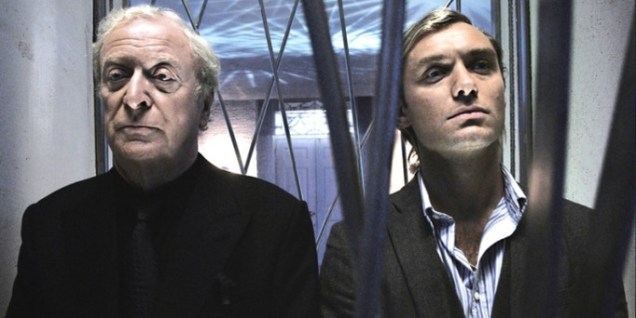
I’d be curious: did Michael Caine and Jude Law talk about Alfie on the set of Sleuth? Did they compare performances? Did they get drunk and watch the Stallone version of Get Carter? Or did they just stare at each other threateningly until Kenneth Branagh shouted “Roll camera”?

The Sleuth remake sounds like quite a compelling proposition at first: one of the grand old English actors facing off against a glittering, promising young guy. (Admittedly, Jude Law hasn’t quite followed up on the promise of his early films, has he?) Directed by Kenneth “Four fucking hours of Shakespeare” Branagh, who has a deft hand behind the camera when he isn’t trying to showcase his own thespian ego. And the original play and film adapted by Harold Pinter, master of intellectual menace and keeper of the weasel under the cocktail cabinet.
Alfie? Never seen it. Sounds like rubbish.

In practice, though, Sleuth is dead as a film. It has occasional moments where the individual contributors flare up and come to life, but it’s like putting an electrical current into a dead frog. Its twitches are easily mistaken for signs of life, but the poor little green guy is still as dead as, well, a dead frog.

Michael Caine probably fares best. He slips into the Pinteresque dialogue with ease and manages to make it sound relatively natural. Caine comes closest to convincing us that the film has a beating heart – but even he cannot sustain this against the wooden staginess of the proceedings. The script might work on stage, with the immediacy that a live performance brings to things, but if some scripts jump off the page, this movie lurches back onto the page.

I’ve liked Jude Law in a number of films, first and foremost Gattaca, The Wisdom of Crocodiles and The Talented Mr Ripley, and he’s got moments in Sleuth where he shines – but all too many of his line deliveries sound as if he imagined that This Is What Pinter’s Supposed To Sound Like. It gets worse in the second part of the film, after the first major twist, which I felt was badly handled; I sat there wondering whether it’s a genuine twist or whether the film suddenly decided to go all post-modern on us. I would have prefered the latter, since the twist made the characters even less credible. In any case, after half an hour Law turns up as a new character, but while his body language is convincing, his accent couldn’t be more fake. Yes, he’s supposed to be fake, but if it’s so transparent to us that this is Jude Law in disguise, it makes the Michael Caine character look stupid if he doesn’t get it… and since the film tries to convince us that the characters aren’t stupid while showing them doing utterly stupid things, it’s difficult to take anything happening on screen seriously.

The third act introduces a homoerotic component that seems to have popped in from a different film altogether. While the casting should work brilliantly here – Law has always had a peculiarly feminine quality – seeing Michael Caine trying to get his menacing paws on the younger man rarely feels anything other than awkward because the development comes out of left field, from another game, in a different country altogether.

Would the film have worked better for me if I’d seen the original? Perhaps – but I doubt it. Branagh’s main mistake in the end was to think that the staginess of the script could be counteracted by ‘clever’ (read: obvious) cinematographic choices. However, no weird camera angle will distract from the script and the performances if they’re geared towards the stage. Seeing this live might have been riveting. Seeing the film? Well. Dead frog.

Princely update

In case anyone’s interested, Rock Paper Shotgun has a “Wot I Think” on Prince of Persia. They say much of what I think about the game, putting it much more succinctly. I guess that’s why they are professional games journalists who get paid for this sort of thing, and I’m a lowly fan with a big mouth.

Also, after seven games and two reboots, the Prince of Persia series gets a movie  version, which will make any film afficionado rejoice. Or regurgitate. It’s one of the two. In any case, it’s got proper actors and even a director who’s made good films – which is more than most video game movies can say for themselves. It even features good ol’ Satipo:

You throw me the idol and I throw you the whip... as soon as I stop screaming, that is.

Could this be an actual video game movie that is worth the admission? Or will we be wishing afterwards that we could use the Sands of Time to rewind the previous two hours?

Habemus PS3…

… and a stomach bug brought home from Egypt. All in glorious HD.

So why have I, a stalwart PC gamer (with a PS2 obtained originally for entirely academic purposes, I swear!), got myself one of those newfangled PS3 Slims? Two reasons, really: 1) Blu-rays and 2) The Last Guardian. Obviously I had more reasons than that, but they’re the main ones.

1) When we originally got digital TV, I was told that our connection was fast enough for HD channels. And yes, it was pretty glorious (in a nerdy way) to be able to record and watch both volumes of Kill Bill in high-def. Even boring old football (that’s “soccer” for y’all yanks out there) just popped off the screen in a way that made it watchable. For five minutes. At most. But you could see every blade of grass, and every pore on people’s faces! (Makes you feel all Walt Whitmanesque…)

But then our digital connection was downgraded. Why? They couldn’t tell; in fact, they were pretty mystified why I’d been told to begin with that the connection was fast enough. Guess I imagined all those red pixels in Kill Bill…

In any case, yesterday we watched our first complete Blu-ray disk, Sunshine. To paraphrase another brainy sci-fi flick, “My god, it is full of details.” While I still have problems with the film’s ending, this visually stunning film becomes doubly so in HD. Almost makes you want to dive into the sun yourself… in a good way.

(If you’re interested in seeing a good comparison of DVD vs. Blu-ray, check out this YouTube video. Make sure to watch it in HQ though.)

2) This one is a bit more esoteric, perhaps. Two of my favourite games on the PS2 are called ICO and Shadow of the Colossus, and they may just be the main reasons why I got the PS2 to begin with. I was writing a paper on games as art (Et tu, Roger?), and both of these seemed to fit the bill, combining subtle storytelling, beautiful art direction and gameplay in ways that few other games have managed. The developer’s new project is called The Last Colossus, and the trailers definitely have left me more than curious:

Love, death, life and the silly sublime

To be fair: watching The Fountain recorded from digital TV, the compression turning any dark scene into black (“none more black”) with a handful of flecks of light, isn’t really the best way to see the film for the first time. Darren Aronofsky’s follow-up to his much-lauded Requiem for a Dream, the kind of film even I can’t describe as bitter-sweet, is intensely visual, and if the first five minutes turn into a frantic game of “It’s a… it’s an elephant, I think. A black elephant. At night. No, it’s a spaceship. At night. And it’s black. Is the TV on?”, the film suffers. (Or, depending on how you look at things, the audience suffers.)

The rare moments when I could not only see what was going on on-screen but actually saw enough of the image to appreciate it, the film definitely proved to be a feast for the eyes. And it wasn’t just pretty – much of what Aronofsky shows us is evocative and beautiful. (Pretty is to Beautiful as Liv Tyler is to Cate Blanchett, if you ask me.) There’s one image in particular, Queen Isabella’s chamber lit by hundreds of tiny lamps hung from the ceiling, that I found quite stunning.

Kitschy or sublime? You decide.

But while some of the imagery is sublime, some – especially in the last half hour of the film – are plain silly. I don’t mind the latent (or not so latent) ‘New Ageyness’ of The Fountain, because as a visual poem on love, death and a man’s inability to let go the film works for me. But then you got bald yoga master Hugh Jackman in the lotus position, floating towards some cosmic birth canal, and awe is replaced by incredulous giggles. Same goes for the scene where Jackman, as a Spanish conquistador, is consumed by flowers sprouting from his torso as if he was the world’s sexiest, silliest Paul Daniels magic trick. I get what the scene’s trying to do, but it just looks… well, naff. Combine that with the film’s po-faced tone and the film doesn’t do itself any favours.

At some point I hope to watch the film again, with subtitles (so I can figure out what those Spaniards are shouting in the rain) and adequate visual quality. I expect that it’ll pull me in more, which in turn might make me forget (or at least forgive) the unintentional humour of scenes that would have had Dr Manhattan raise one implacable, blue eyebrow. Clint Mansell’s lyrical score will definitely help – it did the first time, to the extent that I was more captivated by the end credits than by what had been going on ten minutes before.

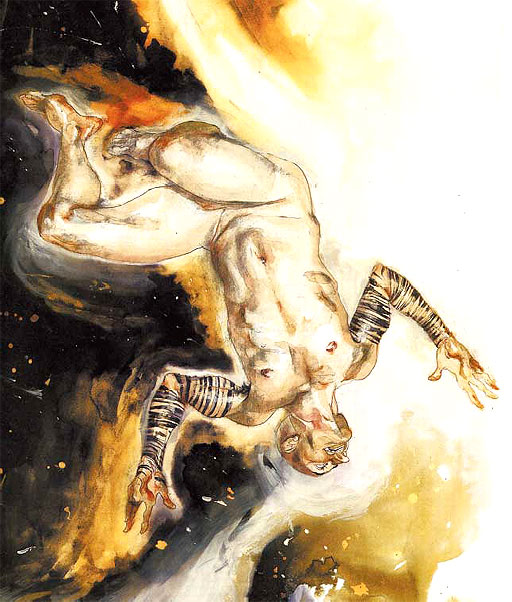
Right now, though, I think that The Fountain works much, much better as the comic book version, which the script was turned into after a first attempt to film it failed. It has all the elements of Aronofsky’s movie, but what looks silly in the film works much better in the stylised drawings (somewhat reminiscent of Dave McKean’s work on Arkham Asylum, although less abstract). It still borders on New Age kitsch, but as far as I’m concerned it pulls it off. Perhaps the best thing would be to read the comic while listening to Mansell’s soundtrack. And, if that’s your cup of tea, fantasising about Hugh Jackman.

Naked dude floating in space. Trippy.

P.S.: Much more nudity in the comic. (Both Rachel Weisz and Hugh Jackman remain chastely dressed throughout the film.) But it’s artistic nudity (“and in the end, isn’t that the real truth?”). And not even close to the full-on pornography of a Lost Girls.

Whatever happened to Steven Spielberg?

Yes, I’m a pretentious film geek who salivates at the sound of “Criterion Collection”. I like Bergman’s The Seventh Seal (a little known Swedish children’s movie about a boy and a seal at the local circus – it’s basically Free Ølåf) and Fellini’s La Strada – but I love the great popcorn movies. For me, there are two almost perfect representatives of that hallowed group of films: Raiders of the Lost Ark and Jaws.

What happened to the man who made those films, though? Spielberg is still one of the best craftsmen in Hollywood, but the thing that was exhilarating about his early films was their sheer energy. There was a joy to the filmmaking, a childlike sense of fun, that made Spielberg unique. It’s there in the two films mentioned, and it’s also there in E.T. (mixed with a generous dollop of sentimentality) and Close Encounters of the Third Kind – but the biggest failure of Indiana Jones and the Kingdom of the Crystal Skull was that it was tired and felt forced. There was little of the exhilaration of the earlier films in the series, especially of the first. Obviously this could be attributed to Indy having aged himself, but that’s a disappointingly humdrum explanation that pretty much begs the question: why have a fourth Indy movie in the first place?

More than that though, rewatching Jaws over the weekend I was made aware of how Spielberg in his early days was much more ruthless. He didn’t have qualms about having a young boy be chomped by a shark, he didn’t think twice about having a number of pretty gruesome deaths in Raiders of the Lost Ark. It wasn’t the childish sadism of Temple of Doom, but it basically meant, “Yes, horrible things can happen. Anyone can get it in the teeth.” And as a result the films were more exciting. If even a kid can be eaten by a shark, well, then nobody’s safe. (Compare Jurassic Park, where the kids and the heroes are never really in jeopardy – it’s pretty much nobodies and evil lawyers that get eaten. It’s amazing that a cheesy, bad film such as Deep Blue Sea gets this better by making it clear from the first that anyone can die – even Samuel L. “Badass” Jackson.)

The much-ridiculed CGI retouching of E.T., replacing guns with walkie-talkies is symptomatic of this fretful, overly squeamish Spielberg. The BMX chase in the original version of E.T. is exciting, and the moment when they get out the guns, we know: Uh oh. Something bad could happen. Compare the same moment in the ‘remastered’ version, where the impression we get is that the worst that could happen is, they might be caught by the grown-ups and given a severe talking-to. Where’s the danger? Where’s the sense of actual risk? If you take that away, characters that we care about become invincible video game characters with the god mode turned on.

I’m in a minority in that I quite liked much of War of the Worlds, but it’s a prime example of a film that suffers from Spielberg’s “playing it safe” doctrine. It’s pretty clear, in every single scene, that he wouldn’t kill off Dakota Fanning – and while her brother puts himself in a situation where he’s almost sure to die, we get an unbelievable, corny deus ex ending that many filmmakers who are much less skilled than Spielberg would have scoffed at.

Obviously Spielberg isn’t the young man he was when he made Jaws or Raiders. He’s older now, so it’s only to be expected… but did he have to become so damn po-faced? Where’s the glee? Reduce Spielberg to his (considerable) skill while taking away his sense of joy and adventure, and you get Zombie Spielberg.

And everyone knows that only Godzilla Lucas can fight Zombie Spielberg.

Late Nate and the Swedish vampires

While I still don’t see why there needs to be a US remake of Let the Right One In, it seems that at least they’re getting an interesting cast. Richard Jenkins, Nathaniel Fisher Sr. (and Walter Abundas, Scarlett Johannson’s narcoleptic dad in The Man Who Wasn’t There – “Reidenschneider!”) himself, will be playing the old man who is the girl vampire’s familiar. My problem is that when I look at him, I see sardonic Late Nate, always just a moment away from an inappropriate remark – but at least they’re getting someone who has repeatedly proven himself to be interesting and different.

But will they be able to match the sheer horror of all things Swedish?

P.S.: When I read the headline (“Richard Jenkins cast in Let Me In“), I was sure it was either a romantic comedy or an indie drama. Perhaps both. Obviously child vampires and indie rom-com can go together pretty nicely. Or something.

E, S, A, R, I, N, T, U, L…

In the hands of a different cast and crew, The Diving Bell and the Butterfly (Le Scaphandre et le Papillon) could have been bad – or worse, it could have been absolutely nothingy. Of course the real-life premise is memorable and impressive – locked-in syndrome, being a prisoner inside your own body – but making this work as a magazine article or even a book is very different from making it work as a film. Without a keen directorial vision, this would’ve turned into the worst kind of movie-of-the-week.

I’ve never seen any other films by Julian Schnabel (the sheer silliness of his name may have kept me from watching his earlier work), but based on this film I’m definitely going to keep my eyes open for Basquiat and Before Night Falls. The movie isn’t overburdened by directorial flourishes, but Schnabel has a strong sense of the visual, in the real scenes as much as in those that take place in Jean-Do’s imagination or are inspired by his words. Talking of which, The Diving Bell and the Butterfly, based on Jean-Dominique Bauby’s memoir (the film could be described as a sort of making-of of the memoir, but that would be far too banal a description for what Schnabel achieves), strikes a deft balance between the visual and the verbal. It hums with the energy of words – Jean-Do is filled with language, even if his condition doesn’t allow him to express them easily. Each word is a battle, each phrase is a war – at least at first, but one of the refreshing aspects of the film is that the women who help the man express himself are all French beauties of the Emanuelle Seigner type (and one of them looks like a Gallic dead ringer for Naomi Watts), and Jean-Do is the kind of man who falls in love, at least a bit, with every woman he sees.

The lightness that the film has, derived equally from Bauby’s ironic tone (he isn’t afraid of laughing at himself and his situation) and Schnabel’s visual idiom, doesn’t detract from its darker side, though. Quite the opposite, in fact. The horror of Jean-Do’s situation makes especially the first twenty minutes almost unbearable at times. Schnabel doesn’t need to emphasise this – he shows, quite simply and unflinchingly.

I’ve only just finished watching the film about an hour ago, so my first impression is still fresh and might change. However, throughout the movie I kept thinking of another film, this one by Alejandro Amenábar: The Sea Inside (Mar Adentro), also a true-life story, based on the struggles of a Spanish quadruplegic fighting for his right to die. Both films are centred on men who have been taken prisoner by their failing bodies; both men are full of life, yet have been deprived of the ability to life as fully as they desire; and both The Diving Bell and the Butterfly and The Sea Inside use similar imagery, especially the ocean and seaside. To some extent they feel like a French and a Spanish take on similar issues and would make near-perfect companion pieces.

Isn't the resemblance uncanny?

On a different note: we’ve added another HBO series to the already considerable list. It’s called Wome, at least if you ask Michael Palin:

And like so many HBO series, it’s got a pretty cool title sequence. Enjoy!

Hanging on to the chick habit

I’m okay with people disliking Quentin Tarantino’s movies. I have no problem with those who find him annoying as a person. His films aren’t for everyone.

But those who call him talentless? These I have a major issue with.

It may be tempting to say that all Tarantino does is cut and paste old films into fan-wankery collages – he is in effect a collage artist, and you can watch almost any scene in any of his films and point to an original he’s ripping off – most likely some forgotten ’70s B movie of dubious taste. But like all the most compelling postmodernists, Tarantino knows that there is nothing new under the sun… except in the recombination of old things. Kill Bill, for instance, is a collection of hommages, clichés, parodies, pastiches, but Tarantino pulls all these disparate bits together in a way that invigorates them. I came out of both volumes of his worship at the feet of Uma Thurman feeling energised in ways that few other films have managed.

Is Tarantino self-indulgent? Definitely. But more than almost any director who can be accused of this, he’s also usually in great control of his material. The films are more tightly constructed than is usually acknowledged, in ways that make it easy for audiences to underestimate their sheer formal accomplishment. Yet, in spite of this, the films breathe freely.

Chick, chick, chick, chick, chick, chick, chick.

Death Proof was much maligned when it came out, and it’s perhaps Tarantino’s most self-indulgent film. Its first half is misogynist, its characters unlikeable, its humour sadistic and misanthropic. But it’s almost a textbook case of postmodern pastiche vs. parody. Again, I fully respect people who dislike or even hate what Tarantino does, but he does it oh so well: the second part of Death Proof desconstructs the male sex-and-death fantasy of the first half. Stuntman Mike’s wet dream of fucking over sexy but annoying chicks with his car (and yes, sometimes a dick extension on wheels is not just a cigar) is turned on its head when the girls of the second half fight back. And god, is it exhilarating to watch as they turn the tables on Kurt Russell’s leathery prick of a man.

And then the ending comes. And it feels like Tarantino ran out of ideas and the script just read: “And then they beat the shit out of him.”

That they do, indeed. But, as so often in Tarantino, the rewarding bits aren’t the bursts of violence – his reputation of wall-to-wall, bloody violence is undeserved, but he likes to punctuate his films with bursts of it -, it’s the conversations leading up to the violence. People who say they liked such-and-such film of his, “if only there wasn’t quite so much talking”? You might as well say, “I like Michael Bay’s films, if only it wasn’t for the explosions. And the stupidity.”

Sugar, ah, honey honey

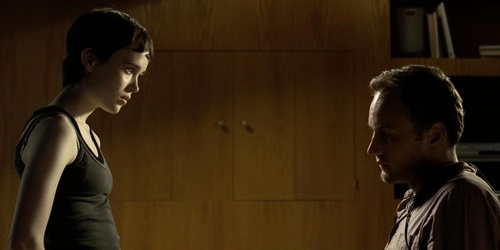
Hard Candy is one of the most uncomfortable films I’ve seen lately. Is it a good film? I don’t know. It’s an interesting film, and it’s definitely well acted. It’s a courageous film for the most part because it doesn’t go for an easy judgment of its characters, but neither does it go for an equally easy moral relativism. And then, in the last twenty minutes or so, it commits a couple of serious blunders that take away from its ability to disturb.

Like some of the most disappointing films, its first quarter of an hour is probably the strongest part of the film. The way it establishes the relationship between its two main characters – photographer Jeff and precocious 14-year old Hayley – and then turns this relationship upside down is very well done. Jeff isn’t an out-and-out creep, yet he is way too keen to play along with the teenage girl’s flirtation. He deserves it when she turns the tables on him… at first, but does he deserve the emotional and physical torture she puts him through? How far does his guilt go, and what puts her in a place where she can take it upon herself to be judge, jury and quite possibly executioner?

Hard Candy

Jeff is too much interested in teenage girls, and he lets his interest go too far. He is guilty – but so far his desires are only different in degree from those who check out porn that advertises itself with “Hot Teen Sluts” or “Barely Legal”. You don’t have to go to the pornographic industry to see how teenage female sexuality is used to sell, well, just about anything, and how the line that delineates legal desires from illegal ones is blurred. Does this lessen Jeff’s guilt? No, but it puts it in context, and it makes it less easy to draw a line between him and they guy you work with who has the hots for the Olsen Twins or early Britney Spears or any number of nymph used by the marketing industry. If Jeff deserves castration, what do guys deserve who count down the days until some teen starlet becomes legal, or who fantasise about the high school cheerleader dressed up to be a sexual fantasy?

All of this only works so far, though. Throughout Hard Candy the question of a teenage girl who’s disappeared comes up, and Hayley insinuates that Jeff was somehow involved in this disappearance. A (chaste) photo of the vanished girl serves as incriminating evidence. Unfortunately the film comes out at the end and says that Jeff was either there when the girl was killed (by another pedophile) or that he killed her himself. Does it matter which of the two is true? Not really. He is culpable in either case, and his culpability is different in kind from the many, many men who have a hard-on for teenage girls. At this point we can easily draw the line, and Jeff is on the other side of the line. He’s a murderer or an accessory to murder. And at that point it becomes much easier to watch Hayley drive him to commit suicide. Most of the ambiguity of the film falls away, and with it the discomfort. And the movie’s previous courage to let its ambiguity stand gives way to a much more conventional moral simplicity, leaving us with just the window dressing of ambiguity.

Och fasa, och fasa…

… or whatever the Swedish use for “The horror, the horror”.

I missed Let the Right One In at the cinema, but I made sure to catch up with this well-received Swedish horror movie (that old chestnut!) as soon as possible. And I’m glad I did. It’s one of the most poignant, disturbing films I’ve seen in a long time.

In many ways Let the Right One In felt familiar: the look of the film – the faces, the clothes, the haircuts – was that of an urban Astrid Lindgren without the nostalgia. Critics with a thing for Freudian theory could probably have a field day talking about heimlich and the uncanny and the like; for the purpose of this blog, suffice it to say that Tomas Alfredson’s movie uses the familiarity and banality of the setting to great effect.

And it’s always great to see a film where the main characters are kids that are both well written and well acted, something that only a handful of directors can do. (Danny Boyle comes to mind.) The two protagonists, Oscar and Eli, are two of the most credible children I’ve seen in a movie, which is saying something considering that one of them is a vampire. Let the Right One In especially gets one thing right: its young protagonists are not idealised. Oscar’s reaction to being bullied viciously is a set of violent revenge fantasies not at all uncommon to boys of his age; I know that at times I was one good bullying away from going all Travis Bickle on some of the kids at my elementary school. Eli, the trickier character of the two because there’s no real template (there aren’t too many eleven-year-old-but-they’ve-been-eleven-for-a-long-time vampire girls-who-might-actually-be-castrated-boys that could have acted as consultants for this film), but the writing, the direction and the acting make her work. She’s both utterly believable as a girl (and it’s clear why someone like Eli would fall for her, possibly his first real love) and immensely unsettling as a vampire.

What I appreciate most about the film is how bravely it maintains its ambiguity. The relationship between Oscar and Eli is touching, and the feelings between them seem genuine, but there are enough hints suggesting that the old man Hakan that Eli travels with was once an Oscar. How much of Eli’s actions is actual love, and how much is her manipulating the boy into becoming what she needs him to become? In fact, with her forever stuck at eleven, how much of their continued fate together is inevitable, as long as they stay together? There are hints of Interview with a Vampire‘s Claudia in this thematic strand, but Let the Right One In arguably does something deeper, more poignant with it.

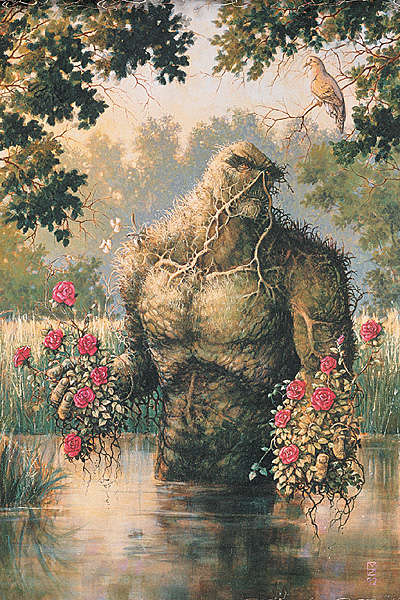
While we’re on the subject of horror: after League of Extraordinary Gentlemen: Century: 1910, I decided to give in to my Alan Moore cravings and got myself the first three volumes of his run of Swamp Thing. It’s fascinating to read these, because you can pick out themes and motifs that Moore later used, usually to better effect. At the same time, while Moore’s Swamp Thing (both the comic and the character) are complex, with richly metaphysical overtones, I have similar problems with it as I have with much of the first volume of Neil Gaiman’s Sandman. Both take the old staple of the horror comic and infuse it with mythology, deeper characterisation than you’d expect from the genre, and a degree of relevance, moving away from pure escapism, but they’re still both caught in the confines of the genre. The end result, at least for me, is a comic that tries to be more than just horror but just about not succeeding.

Still, it’s bound to be better than Wes Craven’s Swamp Thing movie. When all a film has going for it is Adrienne Barbeau’s breasts, well, then…

Swamp Thing (duh duh, duh duh!), you make my heart sing!