 It’s possible to have great fun in a predictable formula movie. My daughter and me went to see Yesterday, about a luckless singer who has a road accident and wakes up in a world without the Beatles songbook. It slowly dawns on poor Jack that he is the only one who remembers the Fab Four. Screenplay by Richard Curtis, directed by Danny Boyle. That’s a pretty snazzy premise, innit? We went during a sweltering hot day, the movie theater was cool, and it was the tiniest viewing room in our city. “It’s just like a movie theater people would have at home,” she exclaimed. We were the only ones sitting there, and so we sang along to all the tunes. Great fun. Continue reading
Movies
Burying the Lead
 Karyn Kusama’s Destroyer fails for me (and maybe for me only) on a mere technicality. Consider Nicole Kidman’s character, a police detective by the name of Erin Bell. She walks as if she is in constant pain, or medicated, or both. There are flashbacks with her partner and later boyfriend Chris, where she looks younger and healthy. It’s just that it is implied that she has to take drugs and/or alcohol in order to infiltrate the bank heist crew run by Silas (Toby Kebbell). There are only very few scenes, and very late in the movie, that really let us know what it cost Erin to stay in Silas’ crew. What drungs did she have to take in order to keep her disguise? And what about Chris? And her lower jaw seems wired or dislocated – is that from the car crash she produced herself long ago? We just don’t know. And it’s Erin Bell’s face that the whole movie rotates around. On the whole, Destroyer raises far more questions that it answers. Continue reading
The Rear-View Mirror: The Time Machine (1960)
Each Friday we travel back in time, one year at a time, for a look at some of the cultural goodies that may appear closer than they really are in The Rear-View Mirror. Join us on our weekly journey into the past!
In Switzerland, where I live, this happens once a year, in early February: all public sirens across the country are tested, sounding the signal for ‘general alert’. When I grew up, in the last dozen years of the Cold War or so, most people would have associated the signal with their fears of nuclear war. If we heard these sirens on any day other than the first Wednesday in February, we’d most likely have to head for the nearest shelter because some hot-headed madman in Moscow had pushed the big red button.
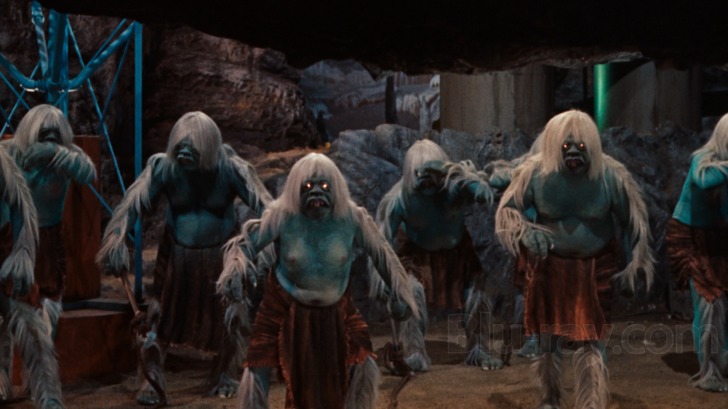
For me, though, that’s not what the sirens meant. For me, they always meant this: the Morlocks are coming.
Slow Deaths in the Sun

The situation for movie theaters in my hometown is dire. The inner city places are closing up one after the other because the rent is said to be too expensive for the two chains, Kitag and Quinnie. The Capitol, where I saw Return of the King, is boarded up. So is the Gotthard, where I once took a girl who was way out of my league on a date. The Jura triplex is closed, the City triplex is a provisory pub, the Royal has reopened as a vegan burger restaurant. The Splendid, the only inner city theater still showing undubbed blockbusters in 2D, is said to close soon. Instead, soulless multiplexes have sprung up at the edge of town where it is cumbersome to get to by public transport. Their viewing rooms are bigger, so the small number of viewers seems even more lost. They are run by companies that have profit as their priority, not fine movie-making programmed along a common theme or name for an appreciative or even regular audience. Granted, Pathé is a movie production and distribution company, but their multiplex is just as anonymous as that by Swisscom, the national number one telecommunications company. I only go to either of them when I have to, for instance when I want to see Jordan Peele’s Us in its original language.
Continue readingA Damn Fine Cup of Culture Podcast #25: Psychopaths (2)
Sometimes they come back: since our last episode, where we discussed black and white movie psychopaths, couldn’t contain all the cinematic psychoses, we’re dedicating a second episode to our favourite psycho killers. Starting from the question what we consider the archetypical pop culture psychopaths, our three intrepid pop culture baristas embark on a journey, beginning with the capo of New Jersey from HBO’s The Sopranos. Is Tony Soprano a narcissistic psychopath or does he really care about those ducks? We then move on to ’60s and ’70s San Francisco and gaze into the absence at the centre of David Fincher’s Zodiac, before the episode finally ends on American Psycho and the dark, cold, empty heart of Wall Street psychopathy.
If you haven’t already done so, make sure to check out episode 24, where we talked about movie psychopaths and psychopath movies, from Night of the Hunter via Fritz Lang’s M to the psycho granddaddy of them all: Norman Bates and Alfred Hitchcock’s Psycho.
Continue readingThe Rear-View Mirror: Jules et Jim (1962)
Each Friday we travel back in time, one year at a time, for a look at some of the cultural goodies that may appear closer than they really are in The Rear-View Mirror. Join us on our weekly journey into the past!
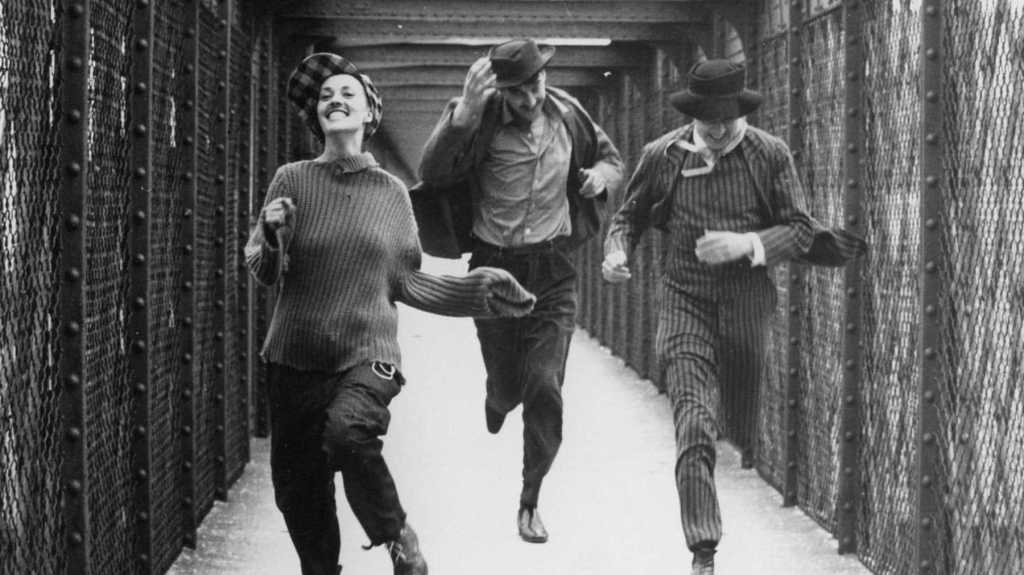
Jules et Jim (1962) wasn’t my first film by François Truffaut, but it might as well have been: while I saw The Last Metro (1980) earlier, it didn’t fully register that this was a film directed by Truffaut, one of the founders of the French nouvelle vague, and I only remembered The Wild Child (1970) very, well, vaguely. In fact, I was more aware of Truffaut in Spielberg’s Close Encounters of the Third Kind (1977).
The Compleat Ingmar #6: Summer Interlude (1951)
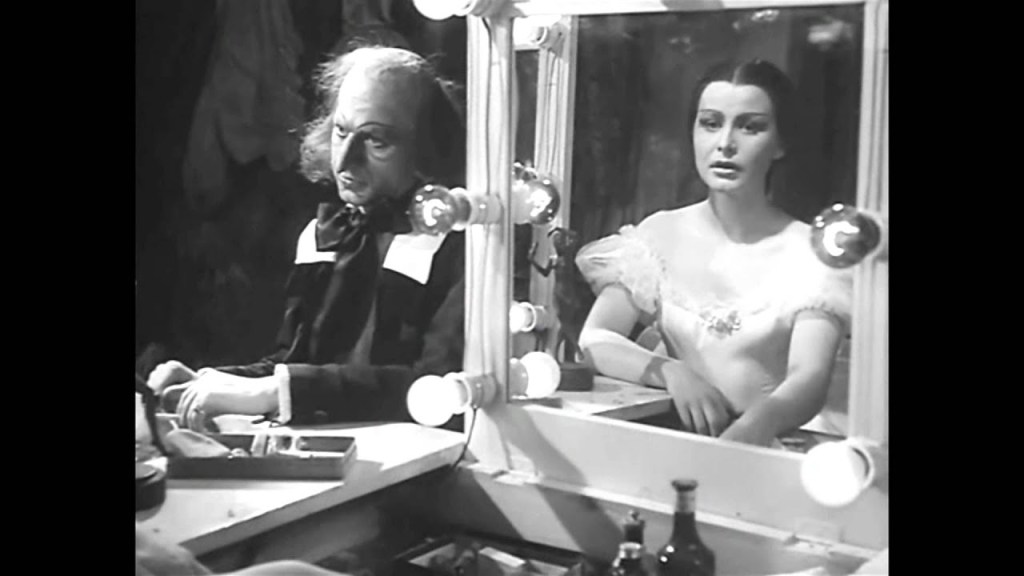
Summer Interlude (1951) came out only one year after To Joy, and in some ways it’s a remarkably similar setup. Again, we have an older character looking back at a youthful romance and its consequences. Again, the protagonist is an ensemble artist: where Stig (Stig Olin), To Joy‘s protagonist, was an orchestra violinist, Summer Interlude‘s Marie (Maj-Britt Nilsson, who also starred with Olin in the earlier film) is a ballerina. In both films, love and death become intertwined. However, while To Joy is an often bitter film that suffers from a grating manchild protagonist, Summer Interlude is a much more joyous film and perhaps the first of Bergman’s early works in the collection that is not just engaging in parts but a pleasure to watch as a whole.
Bridging the Gaps
 Maybe I am not the ideal audience for Martin Witz’ Gateways to New York. On the one hand, it’s a documentary about some of the bridges of New York. Since I have absolutely no spatial orientation, I was at a loss as to where these bridges are and which two areas they connect. Here’s an easy question: what does the George-Washington Bridge connect? I only faintly remembered that the answer is New York and New Jersey, maybe because of The Sopranos. And what does the Verrazzano-Narrows Bridge connect? Aha, see? I have no clue, and if you are not from the Eastern Seaboard, or an acolyte of architecture, you might be as lost as me. There are maps in Witz’ documentary, but they are gone before you can really grasp which bridge we are talking about now. Continue reading
The Rear-View Mirror: The Great Escape (1963)
Each Friday we travel back in time, one year at a time, for a look at some of the cultural goodies that may appear closer than they really are in The Rear-View Mirror. Join us on our weekly journey into the past!
My mother’s favourite movie genre was war movies, in particular old, English ones. My uncle would send us Betamax tapes with titles such as Battle of Britain, Sink the Bismarck!, Reach for the Sky or The Longest Day scribbled on the side, films about (usually) heroic Brits fighting Jerry. I was never all that much into those, but there’s one that I remember loving from the first time I saw it, and that’s The Great Escape.

All the Roads Lead Elsewhere
 Road movies are, in a way, like interconnected short story collections, no? You learn of a reason to take to the road – first story. You get to another place because it’s the way to get to your destination – second story. And another place, and another, a seemingly random sequence of loci, until you reach your destination, which makes for your last short story. Yeah, I know, my analogy holds up only roughly, but my point is: there should be an arc from the first to the last story, otherwise you get accused of fillers. And no-one, no filmmaker, no author, wants to get accused of producing fillers. Continue reading
 A Damn Fine Cup of Culture