It’s the darnedest thing with Kurt Cobain: Montage of Heck. I can see that it’s a good documentary, but I have no idea what it wants to do or where it wants to go. It latches on to the biographical details as a red thread, and everything in it – the music, the drawings, the puppets and statues – is by, or at least featuring, Kurt Cobain. A bio-pic would feature a lot more interviews. Ok, so maybe it’s all about Kurt Cobain as an artist. Hardcore Nirvana fans will appreciate that, but all others must be warned: Cobain’s artwork is as uncompromising as his music. Since the movie is 130 minutes long, that means a lot of monsters. I grew slightly tired of exploding entrails and erected penises.
TV and Streaming
Will The Returned Return Again?
Sometimes the end should be the end. Some stories should remain concluded. There’s a reason why revenants are creepy, and TV land is full of evidence for this. No, I’m not talking about existential French horror – I’m talking about ITV’s Broadchurch, which came to its second end this week, though with a promise of more.
The first season of Broadchurch was nearly perfect in terms of what it was aiming for. Certainly the cast was one of the things going for it, but more than that it had a theme it committed to, and practically everything served that theme: the slow unravelling of a microcosm – a family, a community – due to a horrific deed. It’s not the most original of themes, granted, but Broadchurch handled it smartly and with honesty and the seriousness it called for. It stumbled towards the end, but it nevertheless ended up one of the most poignant British TV series in recent years, and definitely more consistently strong than the BBC’s uneven output in quite a while.

Obviously it was tempting to bring back that world, those characters and especially those actors for a second series. A large part of what made Broadchurch so enjoyable was the David Tennant/Olivia Colman team-up; who wouldn’t go giddy at the chance of watching them for another eight episodes? Except that way lies fan service, which rarely makes for compelling storytelling. Broadchurch went into its second season with a proven cast of characters and actors that were enjoyable to watch the first time round, and there were enough story strands to pick up – but obviously no driving idea, no theme, that would give the continuation the sense that this is a story that has something to say. In fact, series 2 never felt like they started with anything other than the decision to do a second series, much to its detriment. The whole thing reeked of desperation and last-minute panic, resulting in a story that felt made up from one week to the next on the basis of some shaky brainstorming. What if DI Hardy had one of the people involved in his previous, failed case hidden away in a cottage in Broadchurch? What if that Susan Wright woman comes back to wreak ineffectual revenge against her estranged son, repeating what we already had in the first series? What if we got Charlotte Rampling but had no idea how to use her in an interesting way, so let’s say her character goes blind, her mother dies and she’s a closeted lesbian?
One of the what-ifs had more potential: what if Joe Miller, the man who turned out to be the killer in the first series, pleaded “not guilty”? What would this do to the community and to the family left behind? What goes on in a man who is culpable but desperately wants himself to be proclaimed innocent of the crimes he’s committed? Instead, this was wasted as we didn’t get character-driven drama so much as badly written courtroom melodrama with characters that wished they had even a second dimension. And we spent so much time with the underwritten dramatis personae of Sandbrook, Hardy’s previous case and a whodunnit that it was difficult to care about. The murder that launched the first series was meaningful, because it was specific: the victim mattered, the murderer mattered, because it was all about bringing a community close to its breaking point. Sandbrook, on the other hand, happened far away and could have been any case, really. It was irrelevant to Broadchurch. There were attempts at connecting the two cases in terms of themes and motifs, but they were half-hearted and ineffectual to the point of being a nuisance rather than an asset.
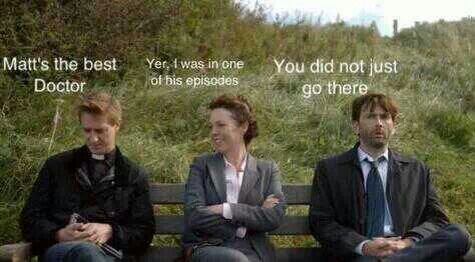
The first series of Broadchurch still stands as graceful, moving TV, and a wasted second series doesn’t change that much. However, it doesn’t exactly fill me with happy anticipation to see, at the end of the final credits, the caption “Broadchurch will return”. Do they have a story worth telling? Or do they simply have a great cast in need of work and the hope that people will tune in on the strength of the original series? Do the makers of Broadchurch even have a clue what made the series work in the first place? I don’t think so, and no number of scenes with Tennant and Colman acting the hell out of a leaden script will make for a strong reason why Broadchurch needed to continue.
In fact, if a third series of Broadchurch is made and ends up as utterly superfluous as the second one, I’ll personally go and beat up the people responsible with my box sets of the fourth season of Deadwood and my 14-disk Complete Firefly.
You can find my previous comments on the second series of Broadchurch here.
Manly men doing manly things
Tony, Tony, Tony… You’ve spoilt me. After watching your intrepid adventures in gangland I’m finding it difficult to enjoy stories of bad men doing bad things that we’re supposed to cheer on. I want my hitmen and mobsters and soon-to-be legit businessmen, honest!, to be morally ambiguous and psychologically interesting. Tony, you’ve ruined me when it comes to enjoying a simple story of hard, ruthless men with chiseled jaws thugging for the camera.
Peaky Blinders is a handsome series, and it knows it. It preens and flexes, often in slow motion. It loves the fact that it got Cillian Murphy as a lead, and it loves watching Cillian be vulnerable yet ruthless as he rides horses, drives vintage cars, wields guns and punches other hard, though less pretty, men. It’s also this preening that is most frustrating about the series. Peaky Blinders has a hell of a lot going for it, from its production values to its fantastic cast. It’s gorgeous to look at and charismatic to boot, but it’s a guilty pleasure: guilty, first and foremost, for not making more of the potential it has.
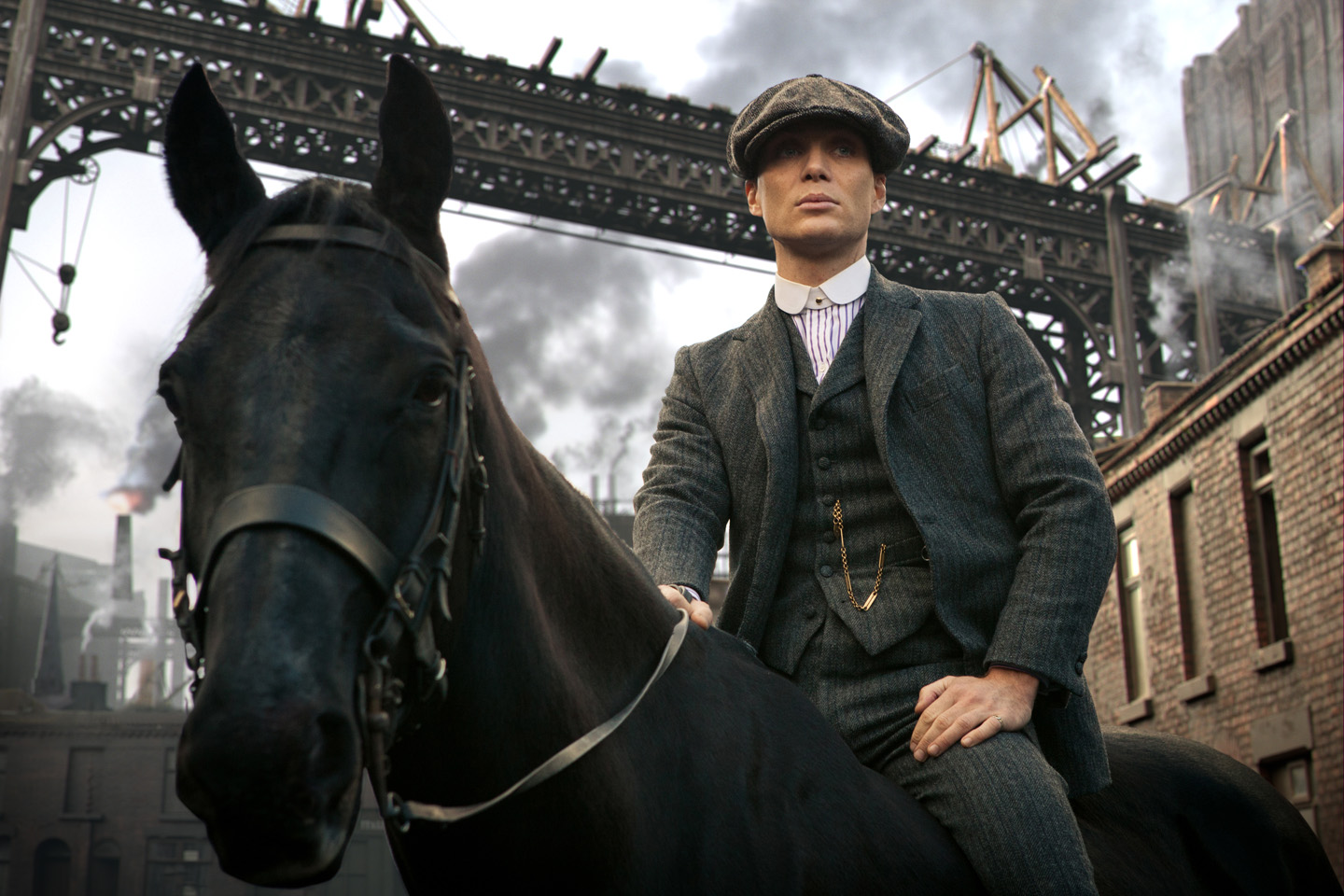
Perhaps it’s that I’m getting more moralistic as I get older, but I have to admit to finding the unreconstructed macho bad-boy attitude of Peaky Blinders tiresome. One of the innocent bystanders tells Tommy Shelby, played by Cillian Murphy (whose cheekbones could still cut through phonebooks), “You’re bad men but you’re our bad men.” That’s fine, but I’d like to have that badness examined. Instead, that line is exactly as far as it goes – in the world of Peaky Blinders, tribalism rules but it’s rarely called out. The exact same action is presented as slo-mo, hyper-masculine badassery if it’s done by our bad guys and as brutal thuggery if it’s the other side.
The series’ biggest potential lies in Helen McCrory’s Aunt Polly, who could put the fear of God into each and every one of the male Peaky Blinders, but at least as of the beginning of season 2 she’s also something of a cheque that yet needs to be cashed in. McCrory’s performance is magnetic, but the material is often thin, paying lip-service to complexity: we hear about past traumas, but we see too little of this reflected in her behaviour and personality. The same is true for most characters, in that they’re all given the veneer of three-dimensionality, but in practical terms they largely revert to stereotype, in the hope that the sheer handsomeness of the production makes up for the lack of depth.
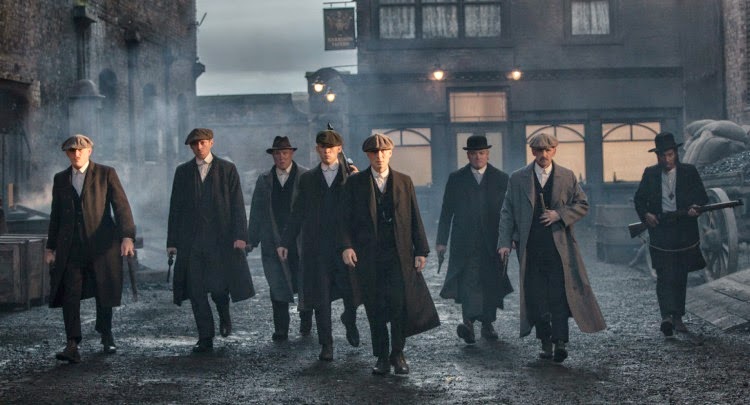
In general, the series tries to give its female characters agency, but all too often it defaults to the rule of macho: the women comment on the power differential, but in the end it’s usually the men with their fists, guns and posturing that are in the driving seat. Certainly, the world Peaky Blinders evokes is an ultra-male one, but then so is that of Game of Thrones, and that series manages to both show the powerlessness of its women characters and still give them agency. Peaky Blinders undermines the latter in ways that suggest it’s not entirely aware of doing so; in one of the climactic scenes in the first series, a woman with a baby carriage puts herself and her child between two warring factions, facing down both sides, but finally it’s not her who determines what happens next but the men with their guns. The scene plays as one of female agency – until that agency is shown to be irrelevant and of no interest to the characters or the series itself. We’ve had our scene of showing girl power, just don’t expect it to pay off.
As I’ve said: the potential is there. The actors are most definitely there, and the series has style up its smoke-shrowded wazoo. The character dynamics are also there, they just need to be committed to. The Rule of Cool is strong with Peaky Blinders – what it needs is to indulge a bit less in the music video slo-mo aesthetics and show a bit more of an interest in scratching the surface of its world and characters. Yes, Cillian Murphy sure is pretty; how much better would it be if the show put as much of an effort in making him complex? The material is there, the actors are game – what the series could do with is the ambition to be more than a pretty face.
Objection? Thoughts on continuing Broadchurch
How does one continue a show like Broadchurch? One of the things I appreciated most about the recent, deservedly acclaimed BBC crime drama was that it ended: as all stories that aim to reflect the real world to some extent, there was a degree of openendedness to Broadchurch‘s conclusion, but there was nothing that called for a sequel, a second series. Except, of course, Broadchurch‘s success with critics and audiences, so as soon as the series had ended there was talk about continuing it. In the absence of a clear need for continuation, a second series faced an uphill struggle to begin with. What storyline could justify bringing back the characters?
The solution that the Broadchurch writers came up with is both ingenious and risky: at least judging from the first episode, the second series changes gear by changing genre. The first series of Broadchurch was a character drama through the lens of a crime story, and it’s the crime story that provided a clear structure: suspects come into focus, doubts are raised, secrets are revealed, and the murderer is uncovered. The series deftly balanced this structure against the drama of a little town where everyone knew everyone else, or at least thought so, and where you can scratch any surface and find some hidden or forgotten (but rarely forgiven,) guilt. It seems that guilt will also be one of the central motivators for the second series, as the first episode suggests its central hook will be the trial of the murderer uncovered at the end of the previous series. Legal drama can be as strong a structuring device as the tropes of crime stories.
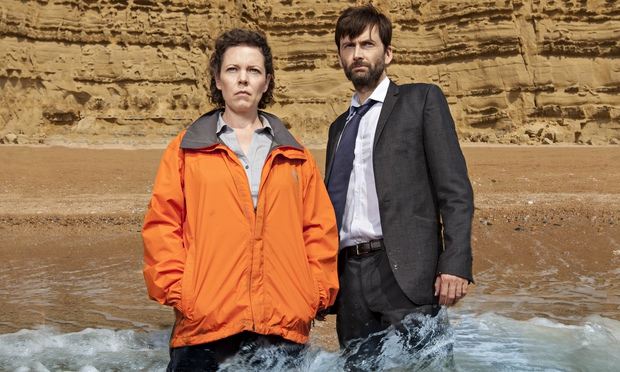
There is a risk that audiences who previously enjoyed Broadchurch as a crime story first and foremost will reject the change, although there are hints that the second series will have a parallel plot strand to the trial, focusing on the botched murder investigation that was central to David Tennant’s character and his motivations. There is another risk, namely that of retconning: the writers may be tempted to revisit and reexamine the events of the first series. Did what we were told happened really happen? If handled well, this can be intriguing, forcing us to reinterpret what we thought we knew. This is extremely difficult, though, and the more likely result of a retcon is a loss of trust in the story: if what we were previously told with relative certainty turns out to be inaccurate, why should we believe what we’re told with similar certainty going forward? There are degrees of this effect: it can already be problematic to fill in blanks in the earlier story, since this changes how the different elements of the story fit together.
So far I trust the creative team of Broadchurch – and a large part of the success of the first series was due to the actors as much as the writers. Or, perhaps more accurately, I don’t distrust them. However, they will have to prove that there were good reasons to continue this particular story beyond its success.
Unhappy happy valley
Poor Catherine Cawood. She is police sergeant of a small Yorkshire village. She sleeps with her ex-husband. She looks after her sister, a recovering heroin addict. She takes care of her grandson because his mother, her daughter, has committed suicide after being raped. The man responsible has returned to the valley, and Catherine is very, very alert, up to the point of breaking a few police rules. Happy Valley might just be the misnomer of the year.
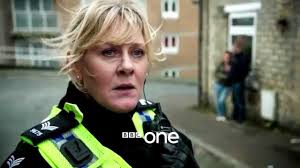
The reason I want to admire this six-part series is the main performance by Sarah Lancashire. She plays her scenes matter-of-factly, but without being hardened or cynical. She is so good that the scenes she is not in feel slightly off. It will be hard to watch her in anything else and not think of this series. On the whole, Happy Valley might not be as even or as suspenseful as Broadchurch, but Sarah Lancashire is more memorable than most of the coppers on TV lately.
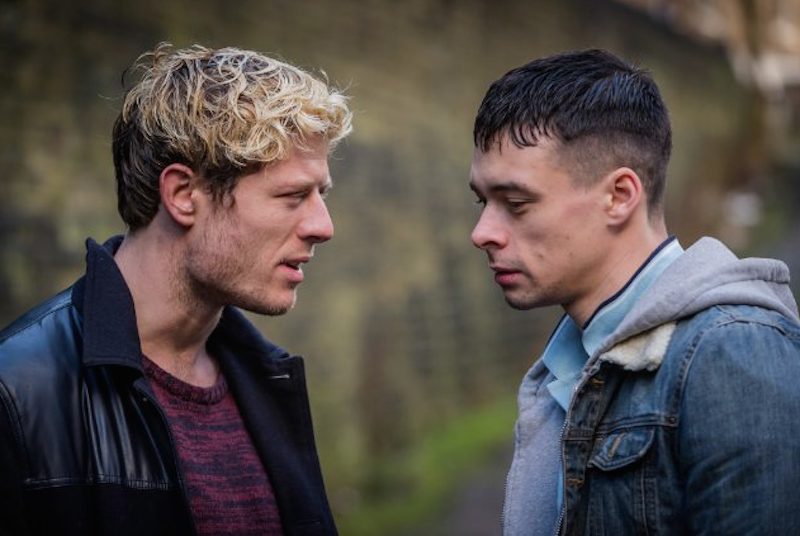
Unlike Broadchurch, Happy Valley is not a whodunit. The audience has to wait for the police to latch on to the fact that someone has been abducted. It’s also bleaker and gorier than Broadchurch, but nowhere near The Fall. I like Gillian Anderson as much as Olivia Colman, but it’s Lancashire’s performance that stands out. There is a drunk guy who wants to set fire to himself. Sergeant Cawood arms herself with a fire extinguisher and a pair of sunglasses and goes to talk to the man. Just in case.
Episode 5 is a slight disappointment because there are too many moments of soul-searching and too many family resentments coming to light. Episode 6 is slightly too neat and, at the same time, too undecided about how it wants to end. Never mind – Catherine Cawood is as interesting as was Jane Tennison in her time.
Doctor Noo
Confession time: before this summer I’d dabbled in Doctor Who, but only very occasionally. A couple of Chris Eccleston episodes here, the occasional David Tennant or Matt Smith one there – and most of the time I came away from it thinking that it’s like Marmite in that you have to have grown up with it to have a chance. It always felt too much like an in-crowd thing, like a more British and less sex-obsessed Rocky Horror Picture Show, with Daleks instead of Tim Curry in suspenders. (It gets even worse, and this may just get me ostracised by any Whovian friends: while Doctor Who didn’t click for me, I really enjoyed the “Children of Earth” arc on Torchwood, the much-reviled spinoff series.)
Then again, give me a Scottish accent and I’m anyone’s – so the news that flappy-handed Smith would be regenerated as Mr Scary Eyebrows himself, Peter Capaldi, led to me checking out Capaldi’s first outing and staying for the rest of the season. Am I a convert to the Church of Who, though? Not entirely.

There’s still an element there that for me (and, I’d imagine, for most newcomers to the series) is difficult to get into, and that’s the weight of worldbuilding the series carries around with itself. It’s one thing not to know who the Daleks or Cybermen are, but if you see your first Dalek episode less than a year before you turn 40, it’s not easy to get around the fact that, well, they’re more than a little naff. One man’s revered iconography is another person’s incredulous “And we’re supposed to find these scary?” – Which leads to a related issues I had, on and off, over the course of the season, and that’s the issue of tone and intended audience. “Is Doctor Who a children’s series?” seems to be one of the big questions in human existence, alongside “Who are we?”, “Where do we come from?” and “Where shall we have lunch?” From my newbie perspective, the series seems to want to have its child-friendly cake and eat it in a decidedly more adult way. I’m okay with children’s stories being sad and frightening, but at times the tone of the season’s episodes veered so much between make-believe fun for the kids, with a randomness and lack of coherence that can be liberating in storytelling but that can equally make it difficult to suspend your disbelief, that it was difficult to believe in the emotional reality of the stories and characters. Added to which, Doctor Ex Machina doesn’t necessarily make for better storytelling than its more theological cousin.
In spite of this, though, and in spite of some uneven writing, I was surprised to find how much the season’s core relationship, between the Doctor and his companion Clara, pulled me in. In the couple of episodes I’d seen starring Eccleston, Tennant and Smith, I felt there was often something too self-aware to the respective actors’ performance, a knowing wink to the audience. Capaldi’s Doctor isn’t a muted, realistic character, and he does enjoy his broader moments, but I bought the character, and I bought the not always entirely healthy but always interesting interplay between him and Clara.

There would be more to say about the individual episodes and about the season-spanning antagonist, Missy, who in theory I would’ve liked if she hadn’t felt so exceedingly like a regeneration of another Moffat baddie, namely James Moriarty as played by Andrew Scott, and like Sherlock‘s Moriarty I felt she overstayed her welcome. I was surprised by how much I enjoyed an outing featuring a mummy, that most hoary and least frightening of monsters, and on the whole I’d say that while I’m not a full convert I’m definitely seeing the potential in the series, its setup and its set of characters. Admittedly, though, half of that may be due to the accent, the eyebrows and the memories of one Malcolm Tucker – at this stage Capaldi seems to be turning the air blue even when he’s delivering perfectly PG-rated lines. So perhaps that’s the solution to my issues with those laughable Daleks and Cybermen: make them Scottish.
The Leftovers, S1E10 – The Prodigal Son Returns
You know you are in the country of ending seasons when the soundtrack starts to be inventive. This is why we hear Nina Simone’s Ne me quitte pas when Kevin, with Matt Jamison’s help, ties up loose ends in Cairo. There is something very spooky in the cleric’s practicality: “I have shovels in my trunk.” Another quitter is Christine, who leaves Tommy to find the baby in a public lavatory. Jill quits her former life by joining her mother and the smoky ranks of the GR.

These are powerful scenes, but they are all upstaged by the Guilty Remnants’ final project. Nora Durst gets up, brushes her teeth and goes down for breakfast, only to find her family united at the breakfast table again. But wait – no. These are the departeds’ hollow imitations with dead masks modelled after the stolen photos and dressed in their own clothes stolen by the GR. These are puppets that spark a tiny glimmer of hope that your beloved ones have returned, and then you realize how grotesque these fucking puppets look.
So the season’s finale is a very good one for a long time. Kevin Garvey dreams one last dream, maybe the most disquieting one, involving a certain National Geographic, Patti, and his dad. There is a conversation between Kevin and Matt where Matt’s questions are as revealing as Kevin’s answers. It’s clear that just because you don’t believe, you can still feel entirely guilty. Or you can believe and still go wrong.
And then, of course, there is the meeting between Kevin and Wayne in the men’s lavatory of a roadside diner. With his guts hanging out and only minutes left to live, Wayne fears he might have been a fraud, and wants Kevin to wish for something. If Kevin gets his wish, Wayne has been a real healer, like a twisted djinn. We can only guess what Kevin wishes for, but Wayne seems convinced he can grant him that wish. Then Wayne crosses the bridge.
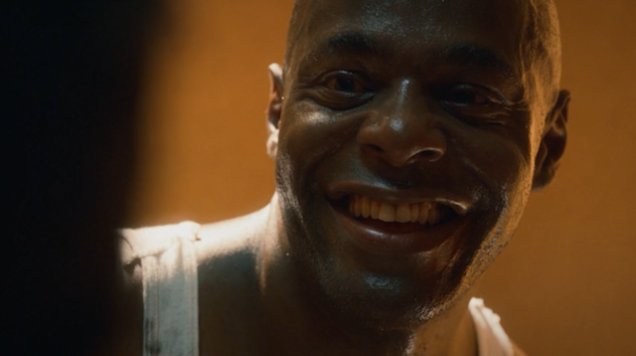
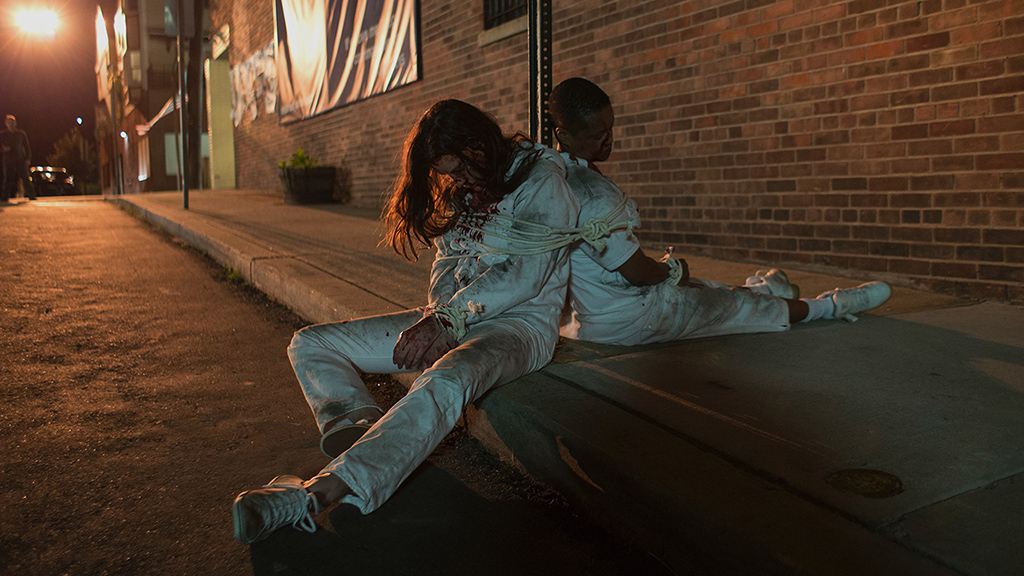
Kevin and Matt return to a Mapleton in turmoil. People want to hurt the GR and to burn those grotesque puppets. Megan is badly beaten up and tied to a lamppost; people with guns run through the streets, mad with anger and grief. The GR headquarters are aflame, and the fire brigade and the police are not in a hurry to help them. Kevin looks on as a couple throw their son’s eerie avatar into the fire. Just imagine: you are angry enough to throw that puppet in the flames, but you still watch your beloved one’s likeness melt.
Then Laurie appears, her voice hoarse from disuse, and yells her daughter’s name because she is in the burning house. That scene and her rescue are over the top, and they didn’t involve me the way they could or should have. Nora’s goodbye letter is touching, but then the ending comes around and twists the plot in a weird direction. Nora is on her way out of Mapleton when she finds Wayne’s and Christine’s baby on the Garveys’ front porch. Kevin and Jill look on with their soot-covered faces. Is this what Kevin wished for?
The longer I think about it, the less I like it. Give a despairing woman a baby and she finds new meaning in her life? Really? I cannot believe that this is Kevin’s wish. This is an abysmal ending to an otherwise pretty decent final episode.

There were plotlines I could never warm up to. Christine and Tommy are uninteresting and could be cut. Jill should be better written. All three roles need better acting. There is only one episode that really stinks, the one with the baby Jesus, mainly because the weak plot and the bad editing screw up things. There are scenes from the pilot that remain unexplained, for instance Tommy’s vision of someone jumping from a rooftop. I also would like to know why Garvey Sr. went loopy. But I guess it’s better to know some of the questions than all of the answers.
Oh, but the good things. I like the cast. Ann Dowd. Carrie Coon. Amy Brenneman. This series has a lot of strong women. Justin Theroux. Scott Glenn. Christopher Eccleston. The quiet, threatening presence of Dean (Michael Gaston), who thinks he is one of the good people. Aimee’s forward comments on the Garveys’ family life, played by Emily Meade. The GR are annoying and creepy and cruel on a good day, and they need to be kept in check, but apart from those whistles, they have always been interesting to watch. A special mention goes to Max Richter, who composed the score. If you’ve seen Waltz with Bashir, you know what he is capable of.

I am glad I watched the series, but it didn’t leave me gasping from one week to the next. I am not big on symbolism – when Kevin Garvey pours a gallon of water over himself, I don’t think of baptism -, but the series works without it, too.
I’ve heard that the Departure will never be explained. That’s just as well, but it’s also a risk. The series cannot rely on a denouément of the main event, so it must invent and re-invent things for those people who are still around – and it is, after all, a series about the ones left behind. The lack of a return to the main event is a freedom only sure-handed screenwriters can handle, and I don’t know how much they can rely on Perrotta’s book. For instance, what is in store for season two? More sadness and sense of loss? I doubt that this will work, so they have to think of something. Will the GR still exist? If not, is there another collective way of dealing with the Departure?
Well, why not? If the departure has taught me one thing, it’s that there is no closure. Fuck closure. There are ways of dealing with stuff, and ways of not dealing with stuff, and it’s no matter if it’s October 14 or March 9 or any other day. You change either way. Apparently, the latter way prevails, because parts of Mapleton are aflame. In a way, everybody is worse off than during the departure. I wanna know where they go from there.
The Leftovers, S1E9 – The Garveys at their Best
Don’t be fooled by the modern interior of the Garvey home: what looks like an alternate version of the pilot is really the few hours before the Departure. It’s October 13, the day before. Laurie Garvey speaks and Jill is a happy teenager. Tommy, however, confronts his biological father and is arrested. That’s news – Kevin and Tommy aren’t father and son. This episode goes some way towards understanding the Garveys and others. It also answers the question of Where were you when…?

In a nice twist, we learn that Laurie is a psychiatrist and has Patti as her first client this morning. Patti is afraid that something terrible is about to happen. Laurie is convinced it’s all about Patti’s abusive husband Neal, and she suggests that Patti dump her troubles in a paper bag with Neal’s name on it and put it on his front porch. Both things will happen.
But, to use Patti’s words, a bag of doo-doo won’t stop the world from ending. Something’s wrong. Kevin Garvey is after a deer that has wreaked havoc in a school room. (Note that the teacher is the woman with whom Nora Durst’s husband has an affair.) Chief of Police Garvey Sr wants to put the animal down, but his son convinces him that, for the moment, tranquilizer darts are the better solution.
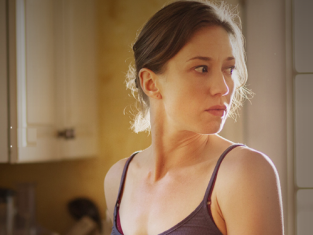
Nora Durst applies for the job of campaign manager for Councilwoman Warburton, who wants to become Mayor of Mapleton. Judging from that episode alone, you would think it’s normal American TV fare, if it wasn’t for the sense of foreboding that gets heightened by Patti’s confession. There is also some suspense in the expectation about when and how some of the minor characters will turn up. Gladys is breeding dogs and will maybe sell one to Laurie. Matt’s wife is still alive and well. Other than that, an hour-long episode for a Mapleton that has its standard problems and hails the Chief of Police for Man of the Year is barely enough.
There is the moment when Kevin Sr tells Junior that he should stop worrying – this is it, and it does not get any better or different. That’s exactly the opposite what Dad will tell Junior when he hands him the National Geographic.
Some of the scenes feel rushed in. Matt, for instance, comes out of the doctor’s examination room, tells his wife he does not have cancer and that he wants to get drunk, and maybe she should drive. Kevin Jr goes on his runs, but indulges a smoke and then a breath mint. He is dissatisfied with his marriage, but we never cleary understand why.
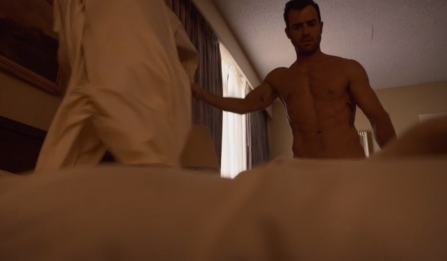
It’s the last few minutes that blow this mediocre episode out of the water. It’s October 14, and we get to see the major characters in the very moment when the departure takes place. Tommy and Jill’s moment is weak and badly handled. Nora Durst has her back turned on her family and swears and curses because her son has spilt juice over her cellphone, and then the room is far too quiet. Kevin Jr has a fling with the woman who runs over the wayward deer, and while they roll around in the motel bed, she disappears from right under him. No wonder Kevin is confused and damaged.
Laurie Garvey’s moment is the strongest by far. She has guessed, maybe even feared, for some time that she is pregnant, but has kept it a secret. She is at her obstetrician’s when she sees the outlines of her kid on the ultrasound screen. It’s enough that we only see Laurie’s face. We hear the heartbeat. Then nothing.

Episode nine is something of a near miss. Those characters that were able to thrive on strong writing kept on being interesting, but two of the weaker ones, Tommy and Jill, had such a weak scene that it feels like a missed opportunity to add something interesting to their storylines. The ending takes a risk: it could have been the season’s beginning or its ending, but it takes guts to place it at the end of the penultimate episode. There is one more episode to go, and I wonder what’s in store there. I expect we get to see the GR’s big event, and maybe Wayne will meet his fate. Let’s see.
The Leftovers, S1E8 – Cairo
This episode is all about Patti. The screen lights up when Ann Dowd is in the frame, and everything else in Cairo takes a backseat. It starts with intercutting scenes of Kevin setting the table for a nice dinner, and Patti placing clothes on the floor of the otherwise empty church floor. We’re not told what her ritual means, but nothing good or simple can come from it. I thought that these were clothes from the raid, but let’s see.

Kevin’s dinner is for Jill and Aimee, and with Nora as their guest. What should be a nice evening quickly turns into Jill’s inquisition about why Nora would carry a gun, but, oh surprise, Nora’s handbag is devoid of all firearms. There is also the plotline about Megan beating up Father Matt, then apologizing to him. He knows that Megan’s Mom died the day before the departure, so “her grief was hijacked.” Jill falls out with Aimee and breaks into Nora’s home and finds the gun, realizing that life probably won’t get any better, and Kevin finds his missing shirts hanging from the trees near a hut in the woods, but the real center this time is Patti.

The evening ends with Garvey’s dream that turns out to be real. It’s morning, he is in the woods near Cairo, NY, with Dean awaiting his Kevin’s orders. Turns out that the dog in Kevin’s backyard is from a bet he made with Dean: if Kevin can civilize the dog, Dean gets a dollar, if not, Dean gets to shoot the animal. If you think this is bad, think about this: Patti is in a nearby hut, tied to a chair. This is real. This has happened, and it’s still happening. Kevin, as his evil alter ego, has beaten and abducted her, much to Dean’s delight, and to his own horror. The chief of police hides the leader of the Guilty Remnant in a cabin, against her will, and against his own will, too, if you can believe it.
It’s spellbinding how Patti seems to have a few tricks up her sleeve. Somehow, she’s still in charge because if he sets her free, she will report him to the real authorities: “You will have to finish what you started here, my friend.” She drives a wedge between Kevin and Dean and is so successful that Dean tries to suffocate her, but paradoxically, Kevin saves her life. Which makes Dean leave, disappointed in Kevin’s lack of decisive leadership.

So now it’s only the abductor, Mapleton Chief of Police and undiagnosed schizophrenic Kevin Garvey Jr, and the abductee, Patti, leader of the Guilty Remnant, who is holding the upper hand, in a cabin in the woods. What a set-up. Patti has the right words for it: “It’s a pickle. Can’t let me go, won’t let me die.” Then she explains the philosophy of the GR: shed everything that’s unnecessary and focus on the vanishing, pure and simple. It’s beautiful and sickening at the same time, not least because it makes Garvey realize that the GR have killed Gladys. Which means that Laurie might have been part of the lynch mob as well. When Patti starts quoting from a W. B. Yeats poem, you know that things won’t end well. Kevin’s decision to cut Patti loose is somehow inevitable – there isn’t anything else he could have done.
But it’s Patti’s suicide that got to me. I never liked her – who would? But there was something to her that made me look and listen. Ann Down has a commanding presence. While watching, I was surprised, even somewhat overwhelmed by her death. Afterwards, I found it confusing: what does her death prove? How does it help the GR and their cause? Is everything prepared to an extent that even Patti doesn’t have to be there? What the frack have the GR planned?

Megan and Laurie receive a trailer-load of something wrapped in plastic that the GR place in the church among the empty clothes. Those packets look too light to be bodies, but what the hell are they, and what are they for?
This episode had me glued to the screen as long as Patti was there. The rest was unspectacular, and Tommy and Christine were not greatly missed. Jill joining the GR did not have a great impact because Jill is simply underwritten and badly cast. I am eager to learn what Kevin will do in his large, empty house now that Jill and Aimee have gone and even the dog has been cut loose and vanished in the night. Maybe his episodes will increase. But most of all, the series will have to make up for losing Ann Down. We’ll see.
Serial captivity
One of my favourite films, and most definitely one of my favourite cinematic comfort foods, is John Sturges’ 1963 POW classic, The Great Escape. It’s one of the films I remember watching with the rest of my family at an early age, and one of the few that (at least in my increasingly unreliable memory) we all enjoyed. There’s something about the methodical heroics of the prisoners working on an escape plan, in a situation where passivity means safety but also surrender, that still very much appeals to me.

Could such a story work in a weekly format? That was my main question when a while ago I got the ’70s BBC series Colditz as a present. Wouldn’t it get boring to watch the same characters trying to escape in more or less ingenious ways, knowing that most of them would have to end up where they started off, prisoners of the Wehrmacht or the Luftwaffe?
Colditz is dated in a number of ways: much of it has that flat, badly lit look that BBC drama of the time had. The acting, while generally good, is also very much recognisable as the sort of acting TV drama had at the time. There are none of the action setpieces that The Great Escape had. In short, I didn’t get started on the series with particularly high expectations, in part exactly because of my liking for Sturges’ film.
What I didn’t expect was that these apparent limitations of the series were also some of its greatest strengths. The Great Escape is an exciting movie, but it’s very much an action movie. There is drama in the film, and it’s effective too, but it’s designed as escapism (no pun intended). The grind of being behind bars day in, day out is depicted, but a series is better at doing justice to the repetition, the routine and even monotony that comes with the situation.

Colditz‘ strengths go beyond this, though. It forgoes many of the clichés; its Germans aren’t Nazi bogeymen, they’re permitted to be three-dimensional characters with actual personalities. The English characters, too, grow beyond their first impression – and as much as I like The Great Escape, the film works with archetypes and charming performances rather than with nuanced characterisation. The writers draw interesting ideas and situations out of a very limited premise. Could Colditz have remained interesting for more than two seasons and two dozen episodes? Perhaps not, but for its run it remained engaging, and it definitely left me wanting more. About ten years ago there was a remake, reboot or whatever re- is the rage these days, but I don’t see what could be substantially improved about the series. For all its ’70s BBC lighting and what may seem like slightly wooden acting these days, Colditz has stood the test of time and stands up well – as well as Dickie Attenborough, Gordon Jackson and Steve McQueen digging their way out of Stalag Luft III.
P.S.: It seems that this YouTube channel has all the episodes available. I don’t know about the legality of this, but they’ve been online for a year, so it seems the BBC is okay with this. The individual episodes are mostly stand-alones, and I can very much recommend “Tweedledum”, one of the strongest in the first season.

