Today is a good day to watch others die (or is it?)

Yup, Sunday. It’s Six Feet Under day.

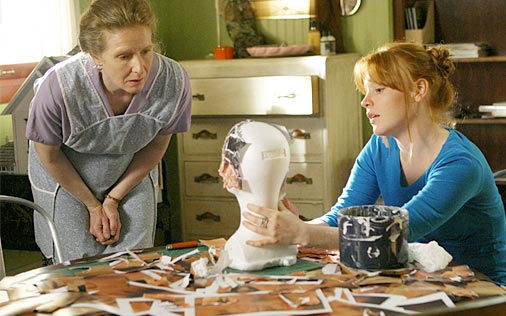
Today’s episode – the first one in season 5 – feels like it continues straight from the end of season 4, emotionally, even if enough time must have passed for George to have undergone ECT treatment and Rico to have started dating again. (He doesn’t seem to be very good at it…) There’s the same mix of tentative hope and deep sadness, the former perhaps most in David and Keith’s decision to try for surrogacy, the latter especially in the aftermath of George’s illness and Ruth’s fears of what her life will be like, tied to a sick person. Her hold on her life has always been precarious, but now she seems to lose against her fears.

David and Keith

What else is there? Billy’s rapidly becoming much more likeable than bitchy Claire (although she didn’t necessarily deserve the hard slap her mother gave her for something very minor). The Death of the Week(tm) was one of the uglier ones in the series, uglier even than the Elevator of Doom at the end of season 4. (Definitely the kind of thing that could put anyone off psychotherapy…) And Rachel Griffiths once again shows what a great actress she is.

Brenda and Nate

On a slightly different note: we watched Sergio Leone’s The Good, the Bad and the Ugly yesterday. Can’t say I like it as much as Once Upon a Time in the West. It’s a much lighter, fluffier piece, and it forgoes the pathos of the later movie. But, like Once Upon a Time…, it’s got a great final showdown – and the music, like many of Morricone’s works, is iconic. It even survives being played by a ukulele orchestra. Don’t believe me? See for yourselves:
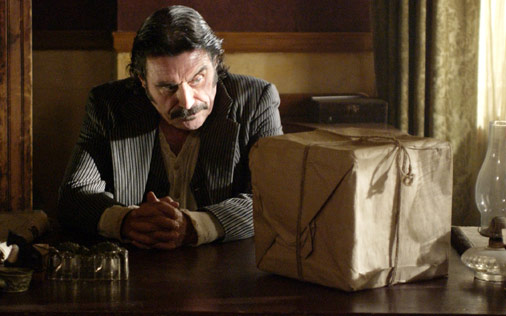
What’s in the box?!

I’ve thought before that Al Swearengen would make a good shrink (if shrinks took to stabbing their more annoying patients or slashing their throats, that is). I now think that the Indian head in a box he’s got might do an even better job; at the very least, it’s doing a great job of calming down Swingen’s temper. Or perhaps it’s gleets that do that to you.

A man and his head

I have to admit though that I wasn’t too keen on “Childish Things”, last night’s episode of Deadwood. There was something off about the writing and some of the acting – somehow it felt more like someone trying to imitate the Deadwood style and not quite managing. I wonder whether that’s also down to the director, Tim van Patten, who’s done quite a lot of Sopranos but no Deadwood. Added to which he directed some of the weaker episodes of the late, great HBO mobster series.

Still, there was a lot to like or even love about “Childish Things”. There was the gripping scene between Francis Wolcott and Joanie Stubbs in the darkened front room of the now defunct Chez Amis. (One of the things that make Wolcott so fascinating is that you really never know what he’ll do next. He doesn’t seem to know himself, and there’s this subtle trace of sadness at his own ignorance in him.) There was the priceless scene where Dan finds out about Al’s favourite rotting head-in-a-box. There was the moving scene where Charlie Utter confesses to Wild Bill’s grave just how worried he is about Calamity Jane. And there was Ellsworth sweet proposal to Alma Garrett.

But damn, boy, Bullock and his wife ought to go and see a marriage counsellor real soon. Who knows, perhaps Al and his amazing head could give the two of them a good talking to…

P.S.: No points for those who guessed what film the title quote is from. Anyway, perhaps you specifically need an Indian head to get the positive effects; Gwyneth Paltrow’s may have more of a “Must shoot the smug bastard several times and then go bonkers!” effect on people. Or at least on Brad.

What’s that? Jennifer Aniston?

Untitled

Good bye, Six Feet Under season 4. It’s been a wild ride, and it’s been emotional. What with graphic suicides, kidnappings by lunatics, illegal burials in the desert, and men getting squished in half by elevators.

I’d forgotten how much the last episode of season 4 sets up things for season 5. In between the second and the third season, there was such a strong break, and the same can be said to a lesser extent for the end of season 3. “Untitled”, however, the fourth season finale sets up most if not all of the pieces for the next season.

And it delivers the strange but compelling mix of tragedy, black humour and hope like no other series ever has. Yes, there’s some of the darkest material we’ve seen in the series so far, but there’s always rays of sunshine somewhere in between the clouds. Otherwise it would be unbearable at times.

Father and son

I’m both looking forward to and dreading season 5 now, because I know that it’ll affect me just as much as the first time I watched it. And chances are my reaction to the last episode will be pretty much the same. I hope my love is ready for the spectacle of her guy being a weepy heap for an entire Sunday…

Season 4, I liked you. Perhaps you’re the weakest, most meandering of all five seasons, but being the weakest of such a strong bunch is nothing to be ashamed of. Season 5 – looking forward to seeing you!

Western promises

The title should already give it away: The Assassination of Jesse James by the Coward Robert Ford is not the kind of movie you watch in order to find out what happens at the end. If that’s why you go to the movies, don’t see this film. If you tend to use the words “pretentious” and “artsy” fairly often when talking about films you didn’t like, don’t see this film. If slow equals boring when it comes to movies as far as you’re concerned, don’t see this film. If you’re hoping for gunslinging action, don’t see this film.

The Assassination of Jesse James by the Coward Robert Ford

However, do see this film if you want to see a beautifully written and shot, psychologically fascinating, immensely atmospheric and deeply sad movie, and especially if you’re interested in good acting. Down to the last part, The Assassination has an impressively talented cast; for instance, even the few scenes that focus on Garrett Dillahunt’s Ed Miller (I’ve been a fan of his ever since watching Deadwood) tell volumes in themselves. But the film stands and falls with the two title characters, and they both carry their share of the load with distinction. I’d only seen Casey Affleck in the Ocean’s Double-Digit films, where it’s difficult to judge his acting, but his Robert Ford is a complex, riveting creation: in turn wheedling, puffed up, disturbing, pathetic, deluded, but finally truly tragic, he’s a relative of Matt Damon’s Tom Ripley. At one point James asks him: “Do you want to be like me? Or do you want to be me?” Their relationship recalls that of Tom Ripley and Dickie Greenleaf (Jude Law) in Anthony Minghella’s movie, but it goes further than that. And Ford’s longing, loathing looks at Jesse James carry so much.

I must admit that I am also becoming quite the Brad Pitt fan. I used to think that he was a star, but not much of an actor – and there are films where you need stars. It was only in Babel that I recognised he could play a part that was in no way that of a movie star. In that film I forgot for the first time that he’s a pretty boy, and I saw him as the character. The star quality is back in The Assassination, but it needs to be – Jesse James is a myth, so Pitt has to portray that facet of the character – and it’s made deeper and richer by Pitt’s performance. This quasi-mythic outlaw is also a paranoid, superstitious and at times cruel and petty bastard, and he’s got a deep streak of self-loathing. When he turns his back on Ford for the last time to wipe the dust of a picture, we’re basically seeing a suicide at least as much as a murder. While James is no Christ figure, Ford is as necessary as Judas to complete the narrative – and to some extent this is because James lacks the courage himself to end it all, nor to live on. It’s by no means clear whether Robert Ford is really the coward that the title suggests.

I don’t want to go on too much, because otherwise this blog entry will rival the film in length. If you don’t mind slow, long films, if you don’t mind portentousness, if you think that the western genre can do tragedy successfully; if you don’t mind hearing the same three pieces of music repeated frequently (and they fit very well), if you don’t mind artsy choices in the photography, editing and writing. Or simply if you want to see Nick Cave hamming it up with a guitar in a Brad Pitt movie. If any of these apply, go and see the film.

Art School Confidential

I usually don’t mind characters that do unlikeable things. One of the reasons why I like Six Feet Under as much is because it doesn’t ingratiate itself to the audience. The protagonists’ flaws are part of what makes the series what it is.

Nevertheless, with all the things that happen in the last two seasons of the series, I must say that I came to find Claire’s character arc fairly grating at times. The art school self-centredness and pretentiousness is obviously shown in a critical light, but even with that distancing mechanism I feel so often that someone should shake Claire, or failing that, someone should slap her. Interestingly enough, though, she’s now become so irritating that I even feel a bit of sympathy for Russell, her git of an ex. And that’s saying something. And ironically, only as Claire becomes the art school bitch of the end of season 4 and beginning of season 5 do I find her art visually interesting. Hmm.

 It’s art, innit?

Yesterday, we watched Garden State, which I hadn’t seen before. Since the film was quite the indie darling at the time, and everyone and their grandmother raved about it, I won’t say too much. I liked it, and I think I’ll like it even more on a second viewing. What struck me was how similar the plot was to Elizabethtown (which came later), but whereas I only somewhat liked Elizabethtown when I saw it at the cinema but afterwards came to feel more and more that it was phoney as hell, Garden State manages to pull off the quirkiness much better – mainly because it’s not infatuated with it, as so many ‘quirky’ indie flicks are. At its heart it’s about real people with real feelings, whereas Cameron Crowe’s variation on the theme was about ‘characters’.

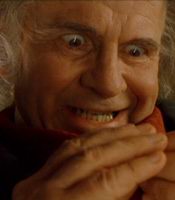
P.S.: I’d be scared by my father too if he looked just like Bilbo Baggins…

Scary Ian Holm

A season too far…

We watched another two episodes of the second season of Life on Mars yesterday, and while they were more enjoyable than a couple of the ones earlier this season, they still felt like variations on a theme – and minor variations at that. The impression I got was that they had material for a total of eight or nine episodes, at most. Instead they decided to stretch it to two seasons and 14 episodes altogether, and as a result much of the impact was lost. This could have been a little gem of a series, and instead it turned out to be an okay execution of a clever premise, extended past its sell-by date.

You doity rat (redux)

Quite a few series are milked, the episodes becoming tired, stale rehashes of earlier material. Even fans say that The Simpsons have been going on for too long (although they also argue that the last season has been a marked improvement). Same seems to go for Spooks (another BBC series by Kudos, the producers of Life on Mars), Buffy (I’ve seen few defenses of season 7), The X-Files or most of the Star Trek series.

And then you get series that are killed untimely. Firefly and Deadwood come to mind, but I’m sure there are other examples as well. (Futurama, perhaps, ending with one of the best episodes of the entire series, but it’s being revived right now, so I’ll wait and see.) Series that, quite simply put, had much more to say. Series that quite often also expected something from the viewer, that made demands – for instance, that you tuned in every week. You can’t really tell a good, sustained story if viewers may look in once a month, at best.

Death by trampoline?

To be honest, I can only think of a handful of series that managed to end when they should have. Six Feet Under is a candidate. M*A*S*H, perhaps, although the jury’s out on whether the series maintained its quality, got better, or simply got smug and self-righteous. Most people loved “Goodbye, Farewell and Amen”, but there are some who hated it with a vengeance for being Alan Alda’s soapbox.

I guess that, given the choice, most fans would prefer more material of their favourite series even at the price of diminishing quality. But it is frustrating to see them putting out yet another cop series or medical soap but at the same time not allowing more complex, more ambitious – and, admittedly, less audience-friendly – material the breathing space it needs.

Deadwood is other people

There’s many things you can say about Deadwood – many very complimentary things – but “endearing” may not be the first thing that comes to mind. Seeing Al Swearengen all dressed up and trying his best to be polite (and do without his usual colourful idiom) in his first face-to-face meeting with Alma Garrett was exactly that, though: endearing. Even when he asks Alma to tell her ward, young squeaky-voiced Sophia that there are “no hard feelings”. No hard feelings, that is, about his plan to have her killed back in season 1, since she could have put a spanner in his works. I’m still amazed at the tonal range this wonderful series has (or rather, had – more on that below), and at the complexity of the characters.

In general, these characters play eminently well with, and off, each other. You don’t even need much plot to enjoy what happens when you put Al and Alma together in a room. Or E.B. Farnum and Calamity Jane (although if they were in a room together, chances are only one person would come out). Personally, I wouldn’t mind putting Cy Tolliver in a room with Dan Dority, just to see Dan’s famous impulse control do its thing with the boss of the Bella Union.

Sadly, it’s looking less and less likely that the post-season 3 TV movies will ever be made. With so much garbage and generic rehashes of rehashes on TV, it’s sad that an intelligent, tough, beautifully crafted series such as Deadwood is shelved. But what can you do?

Perhaps David Milch should create a series about a team of forensic crime-scene investigators in the Old West. That should sell like handguns…

It’s never lupus

Yesterday’s TV series evening was fun. First “Finding Judas” on House, M.D., then Lost‘s “Flashes Before Your Eyes”.

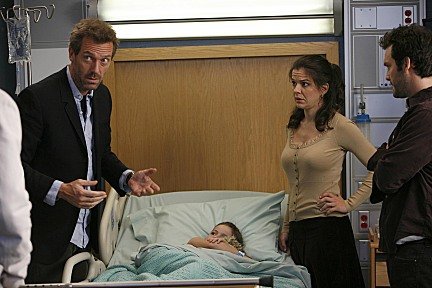
Slap the parents and House both, please…!

Actually, I tell a lie. The “Judas” episode wasn’t fun, though it was eminently watchable. For the first time, House really seemed to lose it completely, becoming a strung-out bastard who used his incisive mind not to help his patient but to hurt those who are on his side. If Tritter wasn’t so clearly a bastard himself, he would have proven that he has a point in much of what he says. House’s words to Cuddy, for instance, were cruel and his general behaviour shitty. His suffering from withdrawal explains it, but it doesn’t excuse it.

Obviously the episode was manipulative (even more so than most of House), but effectively so. I knew they wouldn’t amputate the little girl’s arm and leg, but part of me sat there thinking “Ohshitohshitohshit…” nevertheless. I’m curious to see where they’ll take the Tritter plot and Wilson’s friendship with House, as that storyline seems to be coming to a head. And I wonder whether it’ll ever be lupus…

“Flashes Before Your Eyes” was an intriguing episode of Lost, and a heavy focus on Desmond is always welcome. For all its meandering and self-indulgence, the series has been fairly good at introducing new and interesting characters: Ben, Mr Eko, Desmond. The episode also had some interesting twists, such as the Precog Scot trying to save Charlie (and not Claire, as it appears at first), and the clever use of the flashback convention.

It’s oh-so-British, innit?

I could have done without the fake Englishness of some of it, though. The series’ England feels as if its makers only know the country from bad movies and TV. Especially Fionnula Flanagan’s character felt fake, when she should have been eerie. Still, though, it looks like Charlie – possibly the character who annoys me most – is heading for a rendezvous with the Grim Reaper. Can’t say I’m going to be too sad. Then again, they made me kinda like Shannon and Boone just before killing them off. The Lost writers are obviously bastards.

It is not a coma!

Yesterday my love came back from her holidays, and we watched a double bill of House, M.D. The first of the episodes, “Son of Coma Guy”, was one of the best, sharpest written episodes in a long time (and that on a series that has no shortage of sharp writing). Like many of the best House episodes, it broke the usual pattern: I like the series, but 95% of the episodes have exactly the same plot, the only difference being names, faces and illnesses. You can imagine a licenced version of the Clue board game: “Mr Smith, in the MRI room, with the lupus.”

 The other thing it shared with my favourite episodes: “Son of Coma Guy” had a strong foil for Greg House in coma guy Gabriel Wozniak (John Laroquette). Two, even, if you count Wilson who’s definitely benefitting from the Tritter storyline. It’s quite heartrending to see Wilson’s friendship with House being brought close to breaking point, but it’s showing us a side of Wilson that we haven’t seen yet: he may be strong enough, and hurt enough, to draw the line at some point.

The episode benefitted from an effective performance by Laroquette (if only I could remember where I’ve seen him before…) who gelled very well with Hugh Laurie. And I loved House’s subtle screwing with Coma Guy’s head, suggesting that the future he’d woken up to was weird and wonderful in so many ways. And, of course, it’s got ip-ods!

Lost, but not forgotten

Since my love went on holiday today, we caught up on the series we’re watching yesterday, starting with Six Feet Under. One of the things I appreciate about the series is that neither the writers nor the actors feel that a story is only good if the characters are likeable. They have the courage to make the protagonists truly flawed – not the sort of flaw that you’re secretly supposed to like. (Did anyone mention Gene Hunt?)

Is that you, Butch and Sundance?

Nate, especially, has become a lot less instantly likeable. In the first season, he was the closest to an audience stand-in. He was, or seemed to be, the most normal member of the Fisher family. By season 4, he’s become self-righteous and self-pitying, but he’s still the character. He wasn’t rewritten or changed, he simply grew. And that’s one of the reasons why the series feels so real to me, in spite of a couple of melodramatic twists and turns: the characters aren’t static. Life has an impact on them, gradually shaping them, moving them in interesting directions. There are few series that manage to pull this off as well. No, scratch that – I don’t know any series that do it this well.

Lost, the second item on yesterday’s TV menu, doesn’t really do subtle character development (although it may be there, sometimes, in a handful of the characters). What it does, though, is this: the characters who die are given great send-offs. I remember finding Boone really boring… and then they went and made him interesting, and then they killed him off! It was pretty much the same with Shannon, arguably the most annoying character in the series, but then they made me think, “Hang on, perhaps she’s not that bad after all!” And then, BLAM! Cue one paranoid, pissed off Latina with a handgun, and bye-bye, Shannon!

Yesterday we watched Eko’s Last Stand. Now, Eko… Him I liked more or less from the very beginning. He was an intriguing character, and Adewale Akinnuoye-Agbaje has charisma. Eko’s spiritual side was a great foil to the increasingly fanatical Locke in season 2. His backstory made for a nice change from most of the more ‘whitebread’ character bios. But yesterday we watched him being picked up by Smoky, slammed against trees and then tossed to the ground like a broken toy. And what do we get in the way of new characters? Nikki and Paulo, the Slumber Twins. Almost makes you wish that the two of them meet a sticky end very, very soon…

The last in the trio of TV series we watched yesterday was Deadwood. I’ve written about the characters before, apart from which I’m way too tired to make this entry much longer. Let me just say, though, that I love the series’ casting. And I get a certain sly, postmodern kick out of Milch’s casting of Garret Dillahunt, first as Jack McCall in season 1 (he’s the one who shot Wild Bill Hickock), and then as Francis Wolcott, geologist, sexual deviant and the person who buys Wild Bill’s very last letter. I imagine their casting calls come on a Moebius strip.

Jack McCall…

… and Francis Walcott - twin brothers separated at birth?