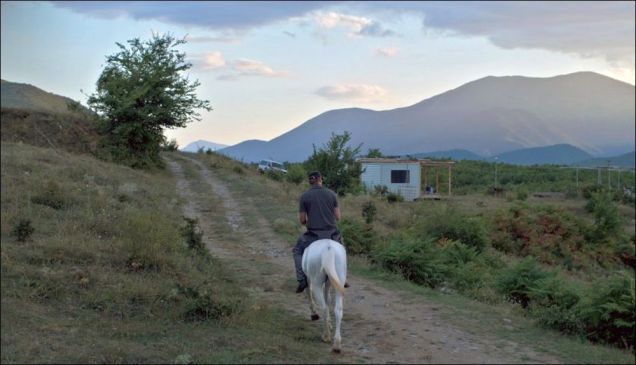
The man doesn’t talk much. Mostly he smokes his cigarette and looks out over the untamed land. He’s come as part of a group planning to harness nature, to bring electricity and industry to these apparent outskirts of civilisation – one of several men who never question their right to be where they are and take what they want – yet he stands apart from them. They are not his tribe. He rides a horse into the small town where the natives eye him, not quite knowing what to make of the man. They don’t share his language and he doesn’t understand theirs, but that’s unimportant. Perhaps it’s even the point. The frontier feels like home to him.
It is 2017. The frontier is the Bulgarian-Greek border, and the man is one of several German construction workers employed to build a hydroelectric power station. The film is called Western – a surprisingly apt description for a surprising movie.
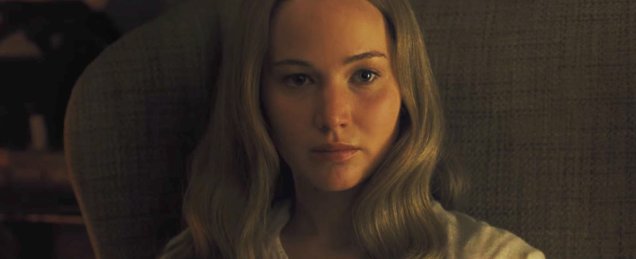 Let’s face it: Darren Aronofsky’s mother! is not the best nor the worst movie of the year, or the decade, or of all of movie history. It’s an average piece of art from a filmmaker who, after making Noah in 2014, has used another narrative from the Bible, i.e. the Garden of Eden, mixed it with ecological concerns, and made a mildly interesting story out of it. The main problem I have with mother! is its lack of surprise for all of its two hours. Once you get that the Jennifer Lawrence character is some kind of Eve and ecological earth mother whose universe is the house she lives in, the rest sort of falls into place. The movie has only three kinds of scenes: Lawrence’s point of view, Lawrence in the frame, or shots over her shoulder. It’s the earth mother’s story and how her realm gets invaded by careless, selfish humans. She has built that house herself and will never leave it – the porch is as far as she will go. She can feel the house’s beating heart getting poisoned by unwanted intruders. The invasion is gradual, but unstoppable, and you know well before the end that we will be back at the beginning, where the house is in flames, with the earth mother dying in it, and her husband placing a diamond on its little altar so that the house can heal again. And so on.
 On the outside, Julia Ducournau’s Raw seems like an endurance test. There are reports of audience members fainting and vomiting, interrupted screenings and official complaints. And all of these people have seen the R-rated version, not the original, unreleased NC-17 version. During the show I was in, a guy left twice, his girlfriend stayed on, but all three of us fidgeted and squirmed more than once. Yes, Raw is hard to watch, but once you think you can cope with the blood and guts, you will find one of the best-told horror flicks in a long time. Like Lady Macbeth last week, Raw is a feature debut in a double sense: Julia Ducournau directed her own feature-length screenplay, and Garance Marillier, who plays the main role of Justine, is a newcomer. (SPOILERS AHEAD)
  Reader, we are not in Jane Austen country anymore. Any Austen adaptation must end in a marriage, whereas Lady Macbeth starts with one, not a happy affair, and it gets worse from here on out. The source of this story is, of course, that famous Scottish play, and then there is Nikolai Leskov’s novella Lady Macbeth of the Mtsensk District from 1865, which is said to be loosely based on a real crime. William Oldroyd’s movie, from a screenplay by Alice Birch, could have approached the character of Lady Macbeth from one of those angles. Instead, the movie shows us a young bride called Katherine who initially does not object to be married to a wealthy nobleman who resides in a bleak, solitary country estate. The troubles start during their wedding night: the husband is a gruff alcoholic and under his father’s thumb. He orders her to undress and face the wall, and then he puts out the light and goes to sleep. She discovers that he is impotent and wants to keep her indoors. The mood of the movie has more in common with Wuthering Heights than any Merchant-Ivory movie.

 A Damn Fine Cup of Culture