Round and round, underground

I don’t go out of my way to watch films about the Second World War, and this is even more the case with respect to Holocaust-related movies. That’s little to do with the subject matter and a lot with the way such films often turn out to be samey in terms of form and content. Especially when it comes to the Holocaust, there’s a certain iconography, at least in Western films, that is rarely escaped or at least varied. The topic is an important one, undoubtedly, but important topics don’t automatically make for good films.

When Agnieszka Holland’s In Darkness was shown on TV recently, I was nevertheless interested. On the surface it sounded like a story we’d seen before, of how a simple, flawed man finds his own humanity to save a group of Jews at risk of being killed by the Nazis and their helpers. Holland, though, is an interesting director. I’d greatly enjoyed the episodes of The Wire and Treme she’d directed, and I’d heard very good things about Burning Bush, the miniseries she’d done about Jan Palach, the student who immolated himself in 1969 Prague to protest the Soviet occupation. While she’s worked in America, In Darkness is a Polish film, and the film is told from a perspective we don’t often see, without excusing or minimising Polish anti-semitism.

In Darkness

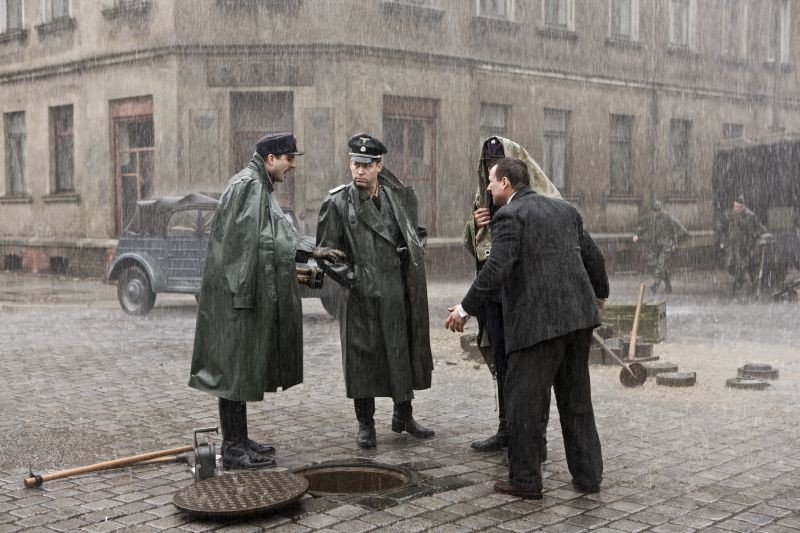
The story of a sewer worker protecting a dozen Polish Jews fleeing the massacre of their families and friends in Lvov and looking after them in the sewer system, first for money but later because he comes to see it as the right thing to do, is interesting in itself, but apart from the details it’s not altogether new. What makes the film effective even when it follows fairly well-trodden ground is what Holland gets out of her actors and how she portrays all of them as essentially human – though not in a sentimental way. The characters she shows us are flawed, petty, jealous, shallow, selfish, craven, and this is as true for the Jewish refugees in the sewers as for Leopold Socha, the Polish sewer worker. There’s often a tendency, not only in films, to idealise the persecuted and the victims, and while the impulse is understandable, such idealisation can be dehumanising. Holland never loses sight of the humanity of all her characters, the good and the bad, and the film benefits greatly from it.

In Darkness is not perfect, and its story, while closely based on the real events, doesn’t always ring true; a near-disaster late in the film may have happened the way it is shown, yet it doesn’t feel altogether believable as part of the film. Yet more than any film about WW2 and the murder of European Jews I remember watching since, well, The Pianist, I found it affecting. Holland’s film doesn’t come across like it wants to communicate a message, but in refraining from doing so, at least up until the very end, it succeeds all the more.
In Darkness

P.S.: There is a message in the title cards that close the film: after the war, Socha died saving his daughter from a runaway army truck. At his funeral, the screen text relates, someone said that perhaps this was God punishing Socha for protecting the Jews during the war. Holland ends on an angry, sad and bluntly timely note: “As if we need  God to punish each other.”

The Leftovers, S1E3 – Two Boats and a Helicopter

First of all, I thank my fellow blogger and altogether excellent friend who explained this episode’s title to me. This title and the one from last episode remind me of Lost with its polar bears and planes and boats and other means of transportation, and I am sure a helicopter is in there somewhere. It’s my own personal joke that some of the disappeared have boarded an Oceanic flight and have crash-landed on a strange island. Which is not a complete coincidence, because Lost as well as this series are master-minded by Damon Lindelof. Lost was co-created by him, whereas Leftovers has its origins in Tom Perrotta’s book of the same name.

the-leftovers-matt-jamison

Perrotta is also the novelist behind Little Children and Election, so he might know how to combine the personal with the political, two aspects of existence that keep on crashing into each other in The Leftovers. (This is a good place to tell you that I haven’t read Perrotta’s novel and will only talk about the TV series episode for episode. I don’t know more than you. There are spoilers, but fewer than in other blogs.)

Fans of Christopher Eccleston have reason to rejoice, because this episode is mainly about his character Matt Jamison. We’ve already seen him handing out leaflets at Heroes Day, and he and Nora Durst seem to be friends.

My impression that he is a man of the cloth are confirmed in this episode. He is a dedicated Episcopalian priest, his wife Mary got severely hurt in the car crash from the pilot episode and is now in a waking coma. The pews in his church are far from full. His take on the disappearance is that it was not a rapture: some of the disappeared were bad people, and he feels he must distinguish the sinners from the good people by printing leaflets about the crimes of the former, and people need to know. Some of them feel compelled to punch him, and some will. Observe the pit boss at the casino – he has Matt’s whole appearance figured out in two seconds.

leftoversjamisonflyer

Matt is broke personally, and his church is threatened with foreclosure. To him, that might be the same thing. Nora Durst is willing to help him on condition that he stop printing his leaflets. He replies by telling her that her husband Doug had an affair. Some people are better off not knowing everything about their loved ones, but there you go. Nora seems… relieved.

Matt lies down to sleep beside his unresponsive wife when he has an idea from above how to get money to save his church. He drives to Kevin Garvey’s house, where Garvey Sr. has buried a jar some time ago with a wad of money for Matt (which hints at another, older story). It’s interesting that he sees Laurie sitting on a swing in the backyard of the place she once called home; apparently she’s there for old times’ sake, but asks Matt to not tell anyone. That might work because Matt is not supposed to be there either. He takes the cash to the casino, where he keeps winning. I could go on about the plot, but that’s a thing that I will leave to the viewer to discover. Let me just say that it is a terrible thing to see a man’s dedication turn into hate.

leftoversintro

If I remember correctly, Lost often dedicated one whole episode to one of the main characters. This third episode works the same. I have to say I quite like it, if only because I don’t have to remember at which point we’ve left this or that character. There are a few characters who can carry the series on their own, and I hope we get to see a whole episode about Nora Durst or about Laurie Garvey. My guess is that there will be a point at which we get to know more about what happened on that fateful October 14 – a metaphorical hatch buried in the ground, if you like. But not yet. Let the characters evolve. For now, following Father Jamison on his odyssey has been the series’ highlight. I’d like more of that, please.

Mad about the boy

Most of what I’ve read about Richard Linklater’s Boyhood has been complimentary to the point of gushing. Recently, though, I read a forum post that compared the film to a dancing bear – it’s not such much what it does than the sheer fact that it does what it does that makes it remarkable. The post concluded that people should go and see Boyhood, but it still came across as somewhere between condescending and dismissive. Go and see the dancing bear, because you won’t see another one any time soon!

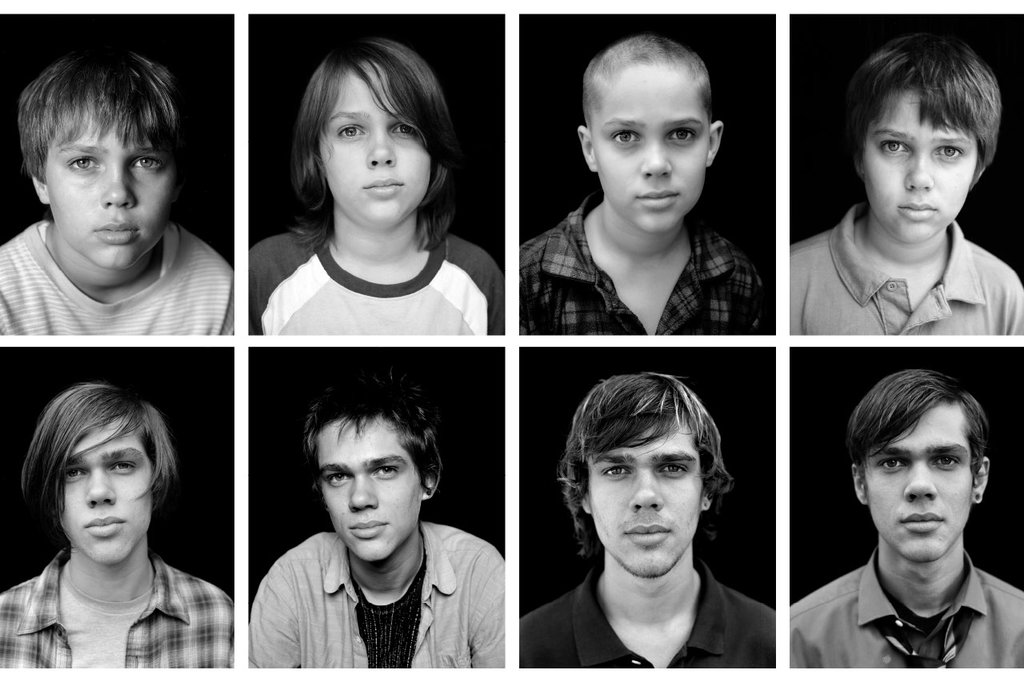
Growing up in front of our eyes

Yet, while I don’t want to be dismissive of a film that obviously resonates with many people, part of me sees what the poster was saying. Boyhood is a good film by a talented filmmaker – though one that is rather hit-and-miss for me – but take away its most defining feature, and what remains? The movie’s biggest asset is that it was filmed over more than ten years using the same actors, so we literally see the people on screen growing up before our eyes. Gone is that often distracting effect of a shift in time being indicated by a change in actors who, at best, look kinda similar to their younger or older selves. Gone is that even more embarrassing effect of changing age being indicated by uneven makeup, clothes and wigs or bald caps, which is convincing one out of 99 times and laughable and sad the rest of the time.

It’s not altogether fair to ask what is left of a film if you take away its defining feature – but few films have one single defining feature. Boyhood is well crafted and serviceable throughout, with some elements standing out (for a film that’s as long as this one, it flows remarkably well) and others falling short (some actors who may or may not be related to the director may not always be altogether convincing in their parts). It’s enjoyable, engaging and altogether likeable, and it is too smart and self-aware to fall for the faux-depth that coming-of-age films focused on thoughtful, artistic young people can have.

Still, none of these are altogether exceptional – the one exceptional thing that Boyhood undoubtedly has is its sheer verisimilitude. The actors become the characters, not so much by dint of their acting but because they do one of the things that is always, and usually not particularly well, faked in films. The effect is engaging and intriguing – yet is verisimilitude what I look for in films? It works for Boyhood, but it does most of the heavy lifting. The ghost of Goddard’s “The cinema is truth 24 frames per second” (though I doubt he meant it all that literally) haunts the film, but if truth and reality become the same the medium leaves me behind. The logical development of the film would seem to be documentaries along the lines of the Up series, yet cinema can never be a complete, unadorned reproduction of reality – if indeed it should aim for this to begin with. Does verisimilitude come closer to truth, or even to a more partial, incomplete though still relevant truth? Other than the stylistic effect of one element of reality, what do we get out of watching Ellar Coltrane – rather than Ellar Coltrane as well as two or three actors looking somewhat like him – grow up?

It looks like I’ve ended up being similarly condescending towards Linklater’s latest. Ironically, I would still say I very much enjoyed Boyhood; I just don’t think I am particularly interested in what it does. Like Mason, Boyhood is likeable and engaging – but in the end I don’t think its standout feature is all that far from being a gimmick. If it is used again, I hope it’s put to the service of a more ambitious film.

________ will remember that.

The recent Telltale Games series – The Walking Dead, which is currently in its second season, and The Wolf Among Us, based on Bill Willingham’s Fables – make great use of that phrase. They provide the player with relatively limited choice, but they put you in control of how you behave towards others, how you treat them. You may just have tried to cement a shaky alliance by siding with a frightened father over the rest of the group: Kenny will remember that. Or you have just had your character, Sheriff Bigby Wolf – yes, that’s the Big Bad Wolf of fairytale fame in human shape -, beat up a murder suspect in the hope of scaring a confession out of him: The Woodsman will remember that.

The Telltale games, especially the recent ones, have mostly received good to great reviews, but there’s been criticism of what they do since the beginning. Choice and consequence: these are one of the Holy Grails of many gamers, and a fair number of them see the choices in the two aforementioned series as shallow at best, false at worst: the plot largely remains the same, regardless of what you do and what the other characters remember. If someone is fated – or, more accurately, written – to die, they will die. Sometimes the plot may branch in small ways, but these branches are usually closed quickly in favour of a tightly constructed story arc.

What changes, though, is your relationship to the characters you interact with. Kenny will remember that you sided with him at a time when he felt most alone – and, perhaps more important, you will remember. You’ll feel like a good guy, or conflicted over siding with a decent but choleric man who acts before he thinks. The interaction may be shallow in one sense, but in another it is far more nuanced than the binary, “Choose your own adventure”-style story choices in some games lauded for giving the player agency. I don’t dislike those games, but I find Telltale’s, let’s say, relationship-based interactivity more engaging. Their games give you the sort of choices that at least I can relate to: in real life, I rarely am faced with deciding between remaining loyal to a corrupt lord that nevertheless provides stability or joining a rebel army whose dedication to the cause borders on fanaticism. The choices I have are usually about my attitude towards others and how I express this: do I snap at someone because I’m tired and they pushed the wrong buttons, or do I let it go? These are the decisions that in aggregate shape who I feel I am.

The Wolf Among Us

Obviously games are often escapist fare, and many enjoy making decisions that they are unlikely ever to face in real life. I won’t deny that the escapist side of games appeals to me too – yet I like some reality in my escapism. I like to feel with characters in unreal worlds that nevertheless resonate and feel real to me. In that respect, I usually stand with good old Marianne Moore, not just with respect to poetry: I want “imaginary gardens with real toads in them”, and not just toads but Kennys, woodsmen and Big Bad Wolves that, for their red eyes and sharp claws, are relatable, are people. Telltale’s choices aren’t epic, they’re human-scale, and they are a large part of what makes their tales of the zombie apocalypse and of exiled fairytale characters trying to make a life in ’80s New York interesting to me: the premises come to life most in how they juxtapose the fantastic and the real, the supernatural and the essentially human. Being an asshole or a nice guy, taking the easy way or sticking to your beliefs, even if you can’t change where things end up, perhaps especially when these choices end up not making a dent in reality – they nevertheless define who you are. Games, perhaps more than other media or art forms, offer interesting ways of expressing yourself.

Clementine will remember that. As will I, because that decision was mine in a meaningful way. When I choose to side with one faction over another in The Witcher II, I do so because I want to see all the material the developers created, to get my money’s worth. I know I will go back to choose the other faction later on. When I make choices as an ex-con trying to do right by his surrogate daughter in a dangerous world, or as a sheriff with deep-rooted anger issues trying to solve a murder, most likely I won’t go back to listen to the other branches on the dialogue tree. I’ve made my choice, and I, too, will remember that.

P.S.: There’s one instance where The Wolf Among Us uses, and subverts, the “_______ will remember that.” trope to great comedic effect. The game’s almost worth playing just for that.

The Leftovers, S1E2 – Penguin One, Us Zero

Welcome to episode two of The Leftovers. We know now that the Amy Brenneman character is Laurie Garvey, a member of the Guilty Remnants and, more importantly, Kevin’s wife. To Kevin, that’s another form of loss, hardly better than a disappearance. And we also know that Meg Abbott has joined the Guilty Remnants, at least provisionally.

s1e2lauriegarvey

An organisation called AFFEC has some inside skinny on Wayne, and our worst fears are confirmed: he has lost a kid, has recruited his mainly young followers in shopping malls and on campuses and claims to be able to hug the pain out of people, but needs to recharge his batteries by using teenage girls of preferably Asian descent. What a bastard. He is wanted for statutory rape in another state. No wonder that the AFFEC raids Wayne’s retreat by shooting on sight. It’s a bloodbath, although Wayne, Tom Garvey and his latest victim Christine are able to escape. I don’t think the AFFEC are a governmental organisation, so who are they? A special force to deal with the paranoid aftermath of October 14?

s1e2tommyandchristine

We get to see the intro to the series, which looks like a modern version of Michelangelo’s Last Judgment. That intro gives the whole disappearance issue a religious streak which, for some of the characters, is precisely wrong, but at least the segment looks haunting, if only because of the slighty weird nudity.

Kevin Garvey might see people who aren’t really there and ask stray deer if they broke into his home, so it’s hardly surprising that we see him on a shrink’s sofa. That shrink is not really worth his money, so Garvey does not tell him about his latest dream: he is woken in his bed by a half-naked Aimee, his daughter’s best friend, who leads him outside into the wintry woods, where the dog-shooter has upgraded his game and now shoots at little children. Then Garvey discovers that his feet are on fire. He wakes. Captain, you have more problems than you might realize. Get a new shrink. (There is also a toy penguin in the shrink’s practice, but that doesn’t fully explain the episode’s title. Maybe it means that rage wins every time against any other feeling.)

We also learn more about Nora Durst. Jill and Aimee discover that she has a gun in her purse and uses her sad popularity to get free coffee. The two teens follow Nora to a house where she is ringing the bell. She works for an insurance company and has to conduct interviews on camera so that the leftover people qualify for “departure benefit”. There is an abyss of pain in that seemingly simple scene where Nora is interviewing that elderly couple whose son has disappeared. Nora (Carrie Coon) is intriguing: she could have left Mapleton, but is still around, and even conducts interviews that must bring back the pain of her own family’s disappearance. Why is she still doing this? I want to know more.

nora-durst-1024
This episode is full of surprises. The first surprise is that we get to see Kevin Garvey Sr., former police captain until his meltdown and now an inmate of the psychiatric ward, played by Scott Glenn. He insists he is sane, but hears a voice from someone who isn’t there, telling his son that help is on the way. I’m sure Junior will keep that in mind. Another surprise is that the Mayor (Amanda Warren) is his girlfriend. The surprise is not that she is much younger than he is, but that the Mayor still visits the ward so she can see her boyfriend, the former police captain. You would think that a political high-flyer would choose her partner more carefully, if only for PR reasons, but no. That Mayor Lucy Warburton doesn’t care if anyone sees does make her rather more sympathetic in my eyes.

Next surprise: The dog-shooter’s car turns up in Garvey’s driveway. Then the dog-shooter turns up on Garvey’s doorstep with a six-pack, wanting to be Garvey’s friend and stating that they are doing God’s work. Garvey sends him away, but is relieved when he realises that Jill can see the shooter, too. You realize life is brittle when your sanity depends on the existence of two bagels.

s1e2scottglenn

I might have lost count of all the surprises, but there are lot of them. Another good episode, but I am expecting somewhat more. Three moments that stand out: Tom refuses to be hugged by Wayne who has just killed, kissed and licked a guy (in that order) who looks like his former bodyguard, and Wayne’s reply that Tom is “all suffering and no salvation.” Did Wayne shoot him? Garvey almost slips on the false teeth of his neighbour’s missing brother, and I surprised myself by thinking that it is somehow very touching that people disappear, but may leave their false teeth behind. And the Mayor tells Garvey Jr. that she never should have told him “to watch the fucking Wire” when she sees his elaborate info-boards about the Guilty Remnants. Shieeeet – HBO, I even know what y’all are talking ’bout.

Comic book = tragedy + time?

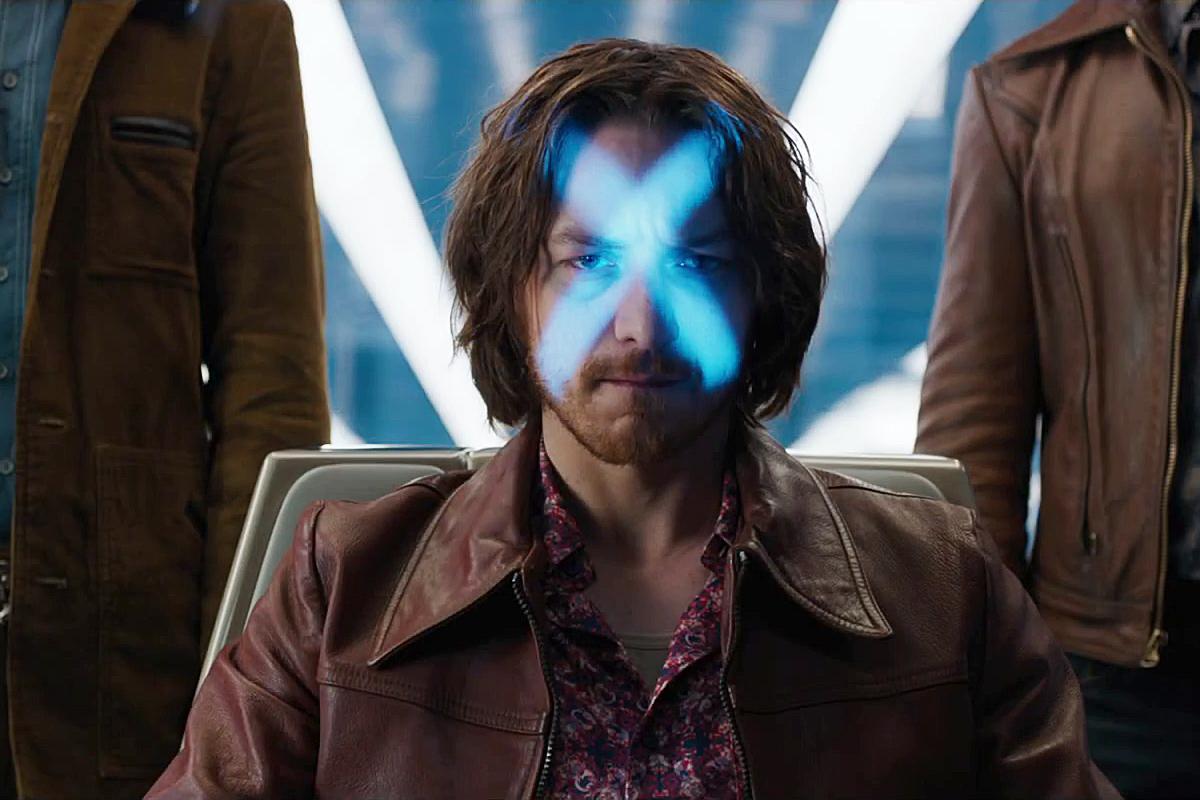
There’s a scene roughly halfway into X-Men: Days of Future Past that is a great example of CGI used to do a setpiece scene that is witty, exhilarating and tells us something about the character involved. It is definitely one of the best standout scenes in all the X-Men films and a contender for the top spot. It also sadly highlights how perfunctory the rest of the film is – it’d stand out even in a good X-Men movie, but in a humdrum one it’s almost sad to see.

I was prepared to like Days of Future Past. I’d had a tiring day and was looking forward to some action and excitement with charm and likeable characters. While Marvel’s mutant chronicles aren’t at the top of my list of favourite superhero movies, it’s usually been fun visiting with Professor X, Magneto, Wolverine and the gang, not least because of the cast these films have. When has it ever not been enjoyable watching Patrick Stewart and Ian McKellen playing off of each other? I was also a surprise fan of First Class, which, while still a disposable popcorn movie, upped the charm and personality with the likes of James McAvoy and Michael Fassbender. McAvoy can be too smug by half, but in the right role he is charming – and Fassbender is one of the most interesting actors of his generation, capable of immense charm too but always with an intensity coiled just underneath the surface, ready to explode. In First Class, he took a character we’d seen many times before and made him scary, something that McKellen’s Magneto, for all of McKellen’s acting chops, had never been.

"Charles, you've got something... on your face..."

You’d think that Days of Future Past would have it made: not just those crazy kids Stewart and McKellen, but also McAvoy, Fassbender – and, as a trump up their sleeve, Peter Dinklage. Has there ever been more personality, charm and charisma in a superhero movie that didn’t star Robert Downey Jr.? However, charm is worth little with a script as leaden as that of Days of Future Past. The plot would be fine – it’s overblown and complicated-yet-simple in the way that superhero stories often are, but that can work well enough – but the dialogues are dull, clunky and preachy. There’s always been the latter element to X-Men, but usually they made it work (as in X-Men 2‘s “Have you ever tried not being a mutant?” scene), but in the latest film in the series it never feels like there’s much of an underlying reality to be preachy about. The result of anti-mutant bigotry in Days of Future Past is one of those generic, bland yet tacky post-apocalyptic scenarios that feels like bargain-store Terminator. The executors of this future, the Sentinels that apparently are a mainstay of the comic books, are ominous enough in their design and animation, but watching them kill their way through a bunch of C-list mutants that we haven’t established any relationship with feels utterly empty.

As the film’s subtitle suggests, Days of Future Past uses that most overused of sci-fi tropes, time travel, and soon we’ve got Wolverine in the funky ’70s. That should make for a sense of personality, no? Sadly, that’s exactly the answer: no. The film does pick up somewhat, but a number of decisions by the writers that could be interesting work against the film: young Professor Xavier, played by McAvoy, is deep in a depression, Fassbender’s Magneto has lost the intensity that was constantly lurking under the surface in First Class – and Wolverine has become the most balanced, mature character on the screen. Yes, he still has a number of fights and quips, but they’re subdued. All of these could work as character development, but they don’t: Wolverine comes across more as apathetic than as reasonable, Professor X is dreary much of the time, and Fassbender tries to imitate McKellen, which may work in a talkshow but doesn’t work for the character – Fassbender and McKellen both have very different energies and performing styles, and neither the script, the director nor the performer manage to make Days of Future Past‘s Magneto into a very interesting missing link between the young Erik Lehnsherr and the old one. And Peter Dinklage, that master of smart snark? It’s nice that his role is not just a different take on, say, Tyrion Lannister, only in a suit and with a moustache, nor is he cast in any way for his stature, which is commendable. However, his part is underwritten and lacking in personality, making one of the main antagonists of the film pretty much a non-entity. There’s also the usually reliable Jennifer Lawrence, and her performance is fine, making her the one character who’s visibly got a stake in the events of the film, but there’s little here that we haven’t seen in First Class, making her scenes suffer due to diminishing returns.

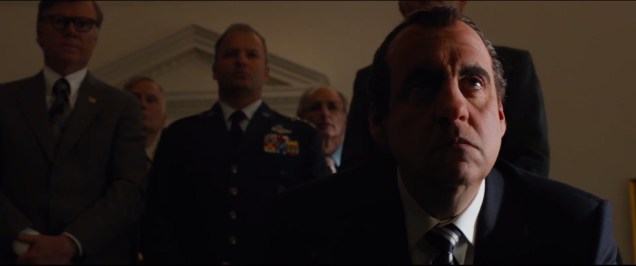
"Mutants in the White House! Aroo! Get me the headless body of Agnew!"

I won’t fault any of the actors: to my mind, it’s clearly the script that is lacking. The characters are written so flatly that they practically rely on audiences bringing their feelings based on the earlier films and the comics to the table – which means that Days of Future Past may work for the fans who care deeply about Wolverine & Co, but other than that there’s little here that is engaging. It’s not the inherent silliness of the proceedings, nor is it the seriousness that the real-world context and doom’n’gloom of the scenes set in the post-apocalypse try to invest the film with: both of these can work, as they did in, say, Iron Man (which embraces the silly, adolescent energy that superhero comics can have) or The Dark Knight (which makes the grimdark grittiness work). What this film needs is someone with the skills of a Joss Whedon at writing the self-awarely operatic dialogues that the most enjoyable superhero comics have, at balancing the grandiose and the intimate, at injecting much-needed personality and wit. There’s little of that to be found in Days of Future Past, and the wittiest scene is the aforementioned CGI setpiece that works entirely without dialogue.

As it is, I’ve never been enthusiastic about the X-Men films. I’ve liked a number of them well enough. However, in principle I could be a fan; I very much love Whedon’s Astonishing X-Men arc, and while his own contribution to the X-Men movies hasn’t exactly been great, someone with his sensitivities could make a huge difference to the films. I hear that Brian K. Vaughan is done working on the Under the Dome TV series – perhaps he could take the potential in this big, crazy, dysfunctional family of mutants and misfits and make their dialogue crackle with wit and energy? In any case, I hope that the makers of X-Men: Apocalypse watch the “Time in a Bottle” scene and understand why it sparkles, while too much of the rest of the film is dull.

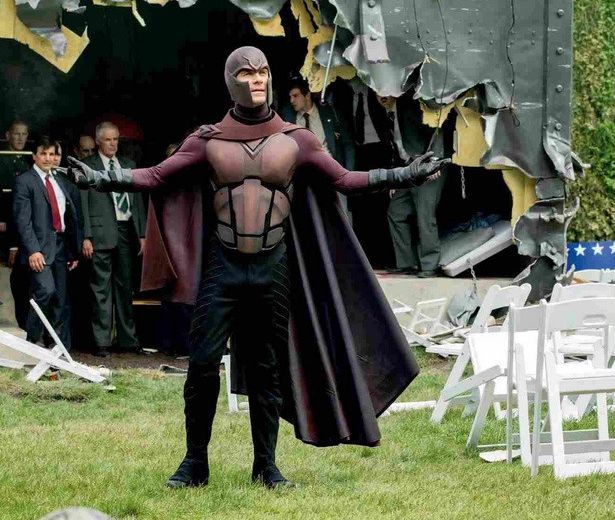
"I am the very model of a/Modern mutant general..."

The Leftovers, S1E1 – Pilot

One fine October day, two percent of the world’s population disappear. There are no warnings, no explanations. One moment, people go about their daily business, and the next second, beds, chairs and cradles are suddenly empty, orphaned shopping trollies trundle downhill in the parking lot, and driverless cars cut into oncoming traffic. This is the starting point of HBO’s new series The Leftovers. Everything else follows from there.

justin-theroux-leftovers
Three years later, no-one is the wiser, but society has changed profoundly. Everybody is looking for answers: politicians instrumentalize the disappearances, cults have sprung up, scientists are bewildered. Was it an act of God? If so, what did God intend? Can we know what that intention is? Some people try to rationalize the event by repeating that two percent are not that much, at least compared to an epidemic, and while this is mathematically true, it is still almost a lie. People are missing. They are gone. Where the hell are they? Fuck math. The numbers aren’t the point – not knowing is.

Ironically, we see life now through the eyes of the Garvey family from Mapleton, who haven’t lost anyone, except maybe each other. We meet Kevin Garvey, captain of the local police force, played by Justin Theroux, an actor who is really good at playing unstable. The police have their work cut out for them: the Mayor has declared that the third anniversary of the disappearance is called Heroes Day, with a meeting in the town park and the unveiling of a statue, but some people are against that meeting because some of the disappeared were said to be idiots, not heroes. Garvey is also against the meeting because he can foresee clashes between townsfolk who want to mourn their losses, and the cult of the Guilty Remnants.

giphy
The GR are a piece of work. They dress in white, never speak and constantly smoke as a proclamation of their faith, which seems to consist of feeling guilty and humble. The picture frames at their headquarters are eerily empty. Their only activity seems to be silently standing in your driveway, smoking, as a means of recruiting you. In this pilot episode, they are trying to get at Meg Abbott (Liv Tyler), without much initial success.
The storyline of the daughter, Jill Garvey, is not exactly a disappointment, but she does the usual teenage stuff: staying out too long and going slightly too far with the wrong boys. Tom Garvey, on the other hand, is trapped as the left hand of a slick, violent cult leader called Wayne (Paterson Joseph). This is an intriguing storyline. Wayne has a reputation of being able to “take your pain away,” whatever that means. We have yet to see how he does that, but even an out-of-state Congressman comes to see him and feels unburdened afterwards. Tom Garvey starts out as the driver for Wayne’s, erm, customers, but gets, erm, promoted to being Christine’s bodyguard because she is very important to Wayne. Christine is a 13-year-old teenager. Wayne is a creep, and I don’t care what his method is, he is a phoney, and nothing healthy can come from him. The fact that Christine loves him makes him even creepier.

The-Leftovers-season-1-episode-2-annie-and-wayne
I could criticize the series for introducing not just one, but two cults, but at least they differ vastly from each other. The GR are essentially humble and repentant, while Wayne is a rapist and abuser. Both seem to have their origins in October 14.

These are trying, painful times. Watch how Nora Durst is holding her speech on Heroes Day. She has lost her husband and her two kids. That’s 75 percent – don’t even think about talking to her about how two percent are almost nothing. And then the GR interrupt Heroes Day – they can be outspoken if they want. There is a bloody scuffle, and the GR lose because they seem to renounce violence. Somewhere in the throng, there is Christopher Eccleston telling people that this wasn’t a rapture, and distributing leaflets about a woman who deserved to disappear because she beat her kids. Is he talking about someone we already know? There are many open questions, but this is a pilot, and so the answers must wait.
I am impressed with the pilot. I am mainly cast-driven, and there are a lot of names in this series that are on my wish list: Justin Theroux, Amy Brenneman (more of her next time), Ann Dowd, Paterson Joseph. One other plus is the list of celebrity disappearances on the TV in the pub where Garvey drinks his beer. Who would want to live in a world without Bonnie Raitt? How am I ever going to listen to Nick of Time without thinking she has left this world? And I like that bartender – he is the only one who is still able to quip about the disappearance.
There are two weak spots in these 72 minutes: Meg Abbott is mainly just sad without knowing why, and I really need something more here than just Liv Tyler looking sad. The second is Jill Garvey’s storyline, which, at the moment, is not much more than generic teenage drama.

hbo-warner-bros
The pilot ends with Garvey changing his mind. I like the roughness of the scene, and there is the underlying thought that just when you think you are trying to protect and to serve one way, you might just as well do the opposite and still do your job. And protect you must, because the opposite is unthinkable to you. The mourners on Heroes Day, the GR, everyone who has lost anyone has some kind of point, according to you. How do you stay just and neutral? How don’t you let your personal worries get in the way of the law, or in the way of justice? Here, in Mapleton, as anywhere else, protection or justice is hard to come by, and sometimes both, or all, sides need protection. Another homepage has called this series post-apocalyptic. That’s true in a way – it’s just that you can’t see the devastation. There are no smouldering ruins, no conspirators, no trials, no nuclear fallout, no peace treaty. It’s been three years, and nobody is anywhere near getting better in any way.

Fake history will teach us even less

Confession time: even though I’ve a degree in History, I’m actually pretty okay with films, books and games that aren’t above playing around with historical facts. I quite enjoyed how the Assassin’s Creed games gave the Middle Ages, the Renaissane and revolutionary America the Dan Brown treatment, pretty much deciding that everything’s better with a healthy dollop of conspiracy theory. If you’re telling a story, don’t let history get in the way too much of what works and what doesn’t work in storytelling. Let’s face it, more often than not history has pretty bad plotting, even if there may be good overall ideas.

Bang, bang... or: Everybody's got the right to their dream.

Nevertheless, Das Attentat: Sarajevo 1914 the TV movie produced and shown by the ZDF, one of Germany’s two national public-service broadcasters, made me angry. It didn’t help that the film mistook having an earnest tone for having something to say, and that it became duller as it tried to ratchet up the tension. What bothered me most, though, was this: here we’ve got a film shown on the 100th anniversary of the assassination of Archduke Franz Ferdinand, the act that triggered the First World War. It’s produced by national television, which comes at least with an implicit stamp of officiality. Its tone suggests that it purports to be important. Yet, and that’s the thing that stings, it’s largely a fabrication, a piece of historical revisionism. The set dressing is nicely historical, but the story that claims the assassination to have been orchestrated by German and Austrian military, government and, most importantly, industrials is silly hogwash.

It’s also unnecessary hogwash: the European elites by and large were rearing to have a go at their enemies after a century that was rife with conflict over nations, resources and colonies. Did the German government want the war? Very likely yes, but that is true for pretty much every major government at the time. Yet the film’s writers decided they wanted a different story, one of the fin de siècle Military-Industrial complex, though only the German one, manipulating things to their own capitalist ends. While I sympathise with the politics, what bothers me is this: the film was placed to look like an officially endorsed rendition of historical events in good faith. I don’t think the ZDF or the film makers consciously wanted to mislead people, but history syllabi being what they are I doubt that most people in the audience know, or care, enough to question Sarajevo 1914‘s version of what happened to see it as a “What if?” scenario.

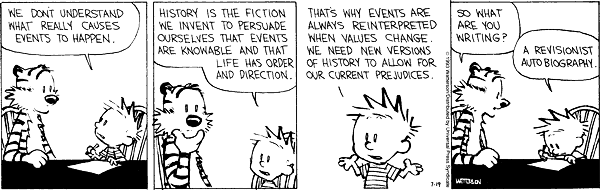
Historical Revisionism

And that, to me, makes this different from many other examples of historical fiction that takes liberties with the source material. Games of “What if?” are most fun if you know how they change history to tell a different story, they pretty much depend on the historical foil. Alternatively, history is full of question marks, and there’s a lot of space to present different takes on what happened – I’m by no means looking for an official, monolithical History, seeing as I’m a big believer in multiple lower-case histories that form capital-H History with all their gaps, contradictions and ambiguities. But presenting utter invention with the veneer of authenticity and official truth? Perhaps I’m not the only one who finds this problematic, actually – the ZDF followed the premiere of Sarajevo 1914 with a documentary that looked at the causes and motivations behind the assassination, and they were presented to be considerably more murky and less black-and-white than the fictional version suggested. Still, realistically speaking: how many people stuck around to watch the documentary, which didn’t even contain a completely made up, generic love story to spice up the tale of murder and intrigue?

Then again, while I’m being jaded and cynical: how many people watched the first minute of Sarajevo 1914 and thought they’d rather watch something modern – where 90% of the men don’t wear big, bushy moustaches?

As that noted philosopher once said...

From Brighton to Croydon

Here’s a question for you: Do you think that movies can thrive on their limitations? I think they can. The series 24 takes place in real time – Jack Bauer is very aware of the tick-tock of the clock. The movie Buried is set entirely in a coffin. The movie Russian Ark consists of one single 99-minute shot. These limitations are technical, wilfully compressing their stories in temporal or spatial ways and also in the way they get made. It’s a risk: if you don’t like watching a man lying in a coffin for feature lenght, then you won’t like the whole movie. There is no B-story here.

locke1

Of course, there can also be dramatic limitations. The movie Compliance is about the staff of a fast-food restaurant where the shift manager gets a phone call from a cop who tells her to detain one of her employees because she might have stolen the purse of one of their patrons. The cop asks more and more of the manager, the employee keeps insisting that she is innocent. It’s basically two women in a backroom, one of them receiving orders over the phone. The movie loses all tension when the cop is made a visible character in the film.

Movies with such huis clos situations need perfect casting. Robert Redford is great in All is Lost. Jack Bauer is saving London, and it’s his ninth day. Buried is a good enough movie, but I don’t think Ryan Reynolds is the right choice for the role. Ann Dowd and Dreama Walker are fantastic in Compliance as long as the cop is only a voice over a phone.

Locke-Movie

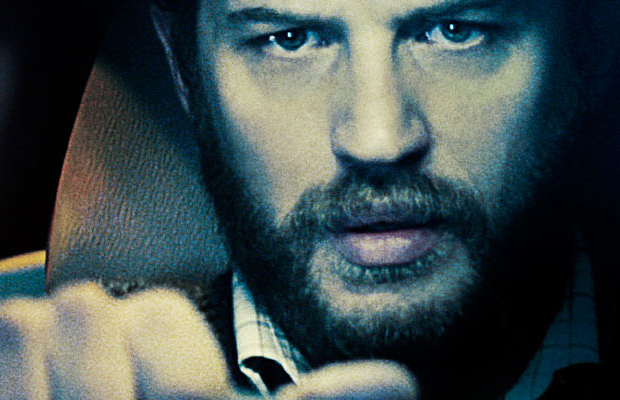
If you like Tom Hardy, then Locke might be a movie for you. It shows you a character by the name of Ivan Locke, probably named after the syndrome, because he is the only visible character you are going to see in the next 85 minutes. He is a construction manager, driving in his car from Brighton to Croydon. The only communication he has is over his carphone. On a very basic level, that is all that happens: a bloke driving and talking over the phone. It’s Tom Hardy’s acting that turns Locke into a really good movie.

Locke seems very detached at first, almost distant. He backs out of his job, takes care of the woman he got pregnant and then tells his wife about his affair. All in his car, all over the phone. It sounds pretentious, and in about 38 ways, it could all be handled the wrong way. Tom Hardy finds the right mood; I never got tired of looking at him or listening to the conversations he has. I wanted to know what he did next. Some people think that the plot is too thin and everyday. I disagree. The movie does not push your credibility, but it leaves you to think about what you would do were you behind the wheel.

locke-poster

There’s another thing Locke made me aware of. Going in, I knew that Olivia Colman would be one of the voices I was going to hear. I thought she would play Locke’s wife. I was wrong. I was also surprised by who played Katrina, Donal, and Gareth, and Eddie, and Cassidy. I only realized whose voice I had been listening to when I read their names in the end credits. Which just goes to show that we mostly rely on someone’s looks first, and their voice second.

If Locke has a flaw, it’s that it shows us slightly too many blurred traffic lights and half-lit cityscapes, but that’s a minor thing for a movie that decides to use very few resources and does a lot with it.

J’ai une âme Lynchian

Wow, Bob, wow. I’ve posted in the past on Twin Peaks, especially in the early days of this blog, but darn it, if it isn’t that time of the year when you just need a post on Lynch’s special slice of pie, with or without a damn fine cup of coffee. The occasion? The imminent release of Twin Peaks: The Entire Mystery Blu-ray. I’d heard about this one before, and so far I hadn’t even been on the fence: I am the proud owner of the slightly tacky-looking complete Twin Peaks TV series on DVD, so why upgrade an early ’90s series shot for television to a storage medium that, more likely than not, wouldn’t make it look or sound all that much better?

Cue this preview for The Missing Pieces, which is exclusive to the new release. Now, the following may not be particularly exciting or indeed mean anything much to non-fans of the series, but I remember in the early days of internet coming upon a newsgroup FAQ of Twin Peaks, and that FAQ outlined the many, many scenes that had been cut from Lynch’s follow-up/prequel to the series, Fire Walk With Me. When the film came out, many fans complained that there wasn’t enough of, well, Twin Peaks in it: many series favourites were relegated to mere cameo appearances, if indeed they were in Fire Walk With Me at all. The Missing Pieces doesn’t completely remedy that, but it comes close: it consists of 90 minutes of deleted and alternate scenes from the film, edited by the mad man himself.

If anyone had asked me a month ago if I was excited for the show’s Blu-ray release, I would have found it difficult to muster more than a profound “Meh.” I like the series, but with more than twenty years since it originally came out (and with absolutely packed DVD/Blu-ray shelves covering 1 1/2 walls of our living room), I thought that I’m absolutely okay with what I have on DVD. And then came the preview video, and it hit me right in the talking log. The circle of sycamores. Leland Palmer stomping through his living room like an ogre. The Little Man jiving it up. Agent Dale Cooper blowing someone (his eternally unseen assistant Diane, perhaps?) a kiss.

Garmonbozia

The funny thing is, there are things about Twin Peaks that is deeply iffy, first and foremost the acting. Some of it works in that stylised, surreal way that Lynch’s characters have. Some of it is middling at best. And some of it is downright painful. Yet somehow, to Pavlovian me, that doesn’t even matter so much, and that is probably exemplified best by Laura Palmer. When the series came out and I first watched it in my late teens, was I in love with poor, doomed Laura? Quite possibly a bit, as much as one can be in love with a character who is dead by the time the series begins. Not for me the lure of sexy Audrey Horne, the all-American beauty of Shelly Johnson or the more mature charms of Norma Jennings: no, for me it was all about the girl wrapped in plastic – which may explain a thing or two about my romantic history.

I don’t know what exactly I’m expecting from The Missing Pieces, and it’s unlikely the added pixels will reveal anything more about what exactly Bob is or what fate has in store for Agent Dale Cooper. Twin Peaks, even in HD, is the opposite of high definition: it gets blurrier the closer you look at it… but in the static, you may just see the sycamores swaying in the wind. And you may just see me in the branches that blow.