Hollow Men

Francis, Francis, Francis… I tried to like you, I really did – or, more precisely, I tried to like House of Cards, the American reimagining of what may have been Ian Richardson’s best performance. It had excellent production values, good actors and a lot of potential, but in the end I failed to warm to it, which may well have been by design, but neither was I chilled by the series or its calculatingly evil protagonist. For too much of the time I was left deeply indifferent to the intrigues in Washington DC.

It’s a shame, really: the raw materials were there. Kevin Spacey has proven that he can play lying, scheming yet deeply human monsters such as Richard of Gloucester, and he’s adept at the kind of character Francis Underwood is and how he relates to the audiences: making them his confidantes and, eventually, implicating them in his cynical plans. However, as Richard III he had one of the best scriptwriters ever, and that’s what was missing in House of Cards, doubly so because compared to its BBC predecessor it had roughly three times the screen time to fill. I often complain about US series with 20+ episode seasons needing to build in filler material, turning flabby in the process, but House of Cards was flabby at thirteen episodes. Plots meandered, characters went through the motions, repeating variations on the same scene over and over – and where the series could have scored points with witty lines, it fell flat with dialogues and asides to the audience that, quite simply, weren’t smart enough. Frank never made the prospect of the audience’s complicity fun, and as a result I never felt I was made complicit in his crimes. The trick to pulling off a Richard III has to be a long con, charming the audience into rooting for you even when it knows you’re no good for it in the long run.

House of Cards

Perhaps House of Cards wasn’t trying to go for what made the BBC version tick, but if so, it should have dropped the UK version’s (and Shakespeare’s) formal strategies. Frank Underwood isn’t charming in that coldly droll way that Francis Urqhart was. It’s not fun watching him construct his schemes and bringing them to fruition. House of Cards flirts with being a pitch-black comedy, but in the end it goes for drama, which weighs it down to an extent that makes too much of the series leaden. It has moments of genuine drama when it deals with flawed human beings that can evoke our sympathy – most of all in Peter Russo, the doomed, sad pawn in Underwood’s game – but too often the drama comes across as perfunctory and generic. The main victim of this is Frank’s wife Claire, played better by Robin Wright than the clichéd material deserves.

In the end, the drama doesn’t work for me because the character at its centre is hollow, yet the series fails to understand this. Protagonists that are revealed to be empty can work, but this requires smarter writers than House of Cards has, and while the series occasionally hints at things going on inside Underwood, this comes across as lip service. We get an episode which is obviously supposed to reveal that there’s more to the character than is immediately apparent, but the episode seems to have wandered in from a different series, and it wanders off again as soon as it’s over. Having seen season 1, I’d say the potential is still there – but I can also say that I have little confidence in the series’ writing team to pull off that potential. In the end, I could never shake the feeling that I’d rather be watching Ian Richardson – or that grandpappy of powerhungry schemers, Richard III himself.

Paradise: Hope

The last movie in Ulrich Seidl’s Paradise trilogy, Paradise: Hope, has, at its centre, the relationship of a teenage girl with a doctor. She is about 17, he must be at the far end of forty. The girl is Melanie, and she is the daughter of Teresa from the first movie. Melanie is curious about her effect on boys; her bunkmate’s tales about blowjobs and shaved vaginas not only educate her, but seem to make her eager to go out and explore on her own.

Melanie is pretty. She is also overweight. The movie takes place at a camp for overweight teenagers. One of the saddest scenes I’ve seen lately is the one where the teenagers stand in line in the courtyard and have to sing: “If you’re happy and you know it, clap your fat.”

Melanie is aware of the camp’s doctor. He is a bit of a joker, not bad-looking, but far too chummy with Melanie. She fakes mysterious stomach aches in order to see him. There might also be moments where he engineers their encounters in the camp’s changing rooms. That guy is trouble of the creepy kind.

The camp is full of teenagers trapped in a loveless environment, dumped there by their parents. They sneak food, fags and booze into the camp. They get caught, and Melanie is mortified because the doctor tells her off like an unruly child.

There is an away day at a lakeshore. Melanie wanders off into the nearby woods, maybe hoping for the doctor to follow her. He does so. It’s a very uncomfortable scene, because Melanie is looking after company, a kind word, a connection, some appreciation. The doctor might hope for more. He follows her to a clearing, and she approaches him. Then she hugs him, which seems to come as a surprise to him. After some hesitation, he hugs her back. That must be enough. This time.

Later, he sneaks into her room and goes through her things. He lies in her bed, then leaves before she comes back. The same evening, she waits by his car until he appears. He tells her off – not because they are off limits to each other, but because he could be seen talking to her.

Melanie and her bunkmate escape to a local bar where they get picked up by two horny teenage boys. They slip something in her drink, and her friend takes off because Melanie gets all the attention. They feel her up while she tries to dance under the effect of the drug. Then she collapses and is saved by the barkeeper. This time.

The barkeeper calls the doctor to pick up the unconscious girl; he must have seen this kind of thing before. The doctor appears, and one danger of abuse is replaced by another. He drives into the woods and stays there with an unconscious Melanie until morning. He lays her down gently in a mossy clearing, lies down beside her and starts sniffing her. This time.

He brings her back to the camp and tells her that they cannot have any more contact. High time for that, but get this: He severs ties not because she is infatuated with him, but because he is afraid that he cannot handle her infatuation much longer.

I struggled a bit with the movie, because there seemed to be little hope: Does Melanie really still hope for good friends and acceptable partners? Maybe, but that would be against the odds. On the other hand, it must be an excellent kind of hope, with such a long shot.

One thing that still bugs me: In all three films, the women are somehow exploited by men, and they barely recover. Maybe it’s one of the formal points Seidl makes; maybe it’s also his way of finding out how his characters fare under pressure. But the coincidence haunts me, and it is only partly solved by the fact that he made all three protagonists women. There seemed to be so little joy in any of their lives. Teresa is still in Kenia at the end of the movie. Anna is whipping her savior, and Melanie is still at fat camp, having no clue how close she was to being raped. Neither of the three women has escaped their trap, but did anyone really think they would?

Or maybe Melanie is hard-wired like her mother and her aunt. They do what they must, and joy or relief doesn’t really have anything to do with it. Like Teresa, who will go on looking for love in dubious places. Maybe the paradise of the title is the one time where you really find what you are looking for. Like Anna, who might come to some kind of truce with her religion, which demands everything of her, whether she gives gladly or no. For Melanie, hope is the one red line going through her life. At least that. Living without it must be hell. There is no sure way to reach paradise, and most of us won’t reach it, but the movies seem to suggest that we must at least try, or we will fail miserably. It could be possible that some kind of truce is the best we get. Maybe hell isn’t other people; maybe hell is you, but it’s not your fault. It’s just the way you are.

Great Expectations

I’ve seen both of the main winners at this year’s Academy Awards, Gravity and 12 Years A Slave – and I came away from both of them feeling just a bit underwhelmed. Don’t worry, this isn’t going to be one of those “Why the Oscars suck!” posts, not least because I don’t really feel particularly invested in them to begin with. What I want to talk about instead is this: expectations.

With 12 Years A Slave, I went in expecting to be as much bowled over as I was with Hunger and Shame. I was stunned when I caught Hunger on TV a couple of years ago; his visual language and his storytelling, combined with Fassbender’s amazing performance (is the guy ever any less than very good?), struck me as something I’d never seen. Shame built on this, engaging me both emotionally and intellectually in a way that’s rare in films. 12 Years A Slave is by no means a bad film, in fact it’s very good, a beautiful example of moviemaking craft on all fronts – but it didn’t stun me. It felt less unique than McQueen’s previous films.

Gravity

Gravity, too, is an exquisitely crafted film. It’s been criticised for being (allegedly) thematically shallow, all spectacle and no substance – which I don’t agree with. No, my beef with Gravity is this: I watched the trailer on a large screen in HD, and it pulled me in, evoking a real dread of floating in outer space, untethered, with nothing there but stars that are trillions of miles away. It’s not that the film itself didn’t summon this dread, but it didn’t build on it: basically the thing I liked best about the film was already there in the trailer. More so, actually, because it was distilled into two minutes. It doesn’t help that I’m not a big Sandra Bullock fan, finding her bland rather than relatable, but mainly my disappointment was similar to what I felt after 12 Years A Slave. I was disappointed, not because the films were bad, but because they didn’t, and perhaps couldn’t, meet my expectations.

In some ways I think those expectations weren’t entirely fair, if fairness indeed comes into the matter. If I hadn’t seen and been so receptive for that particular Gravity trailer, the actual film might have wowed me more thoroughly. If I hadn’t been stunned by Hunger and Shame, I might not have expected 12 Years A Slave to be stunning in that particular way, and this in turn might have allowed me to appreciate it more for what it was rather than being disappointed at what it wasn’t. Then again, without the trailer I might not have gone to see Gravity to begin with; I might not have gone to see 12 Years A Slave at the cinema just because of Chiwetel Ejiofor (no doubt a great actor, but I don’t go to the cinema just because of a particular actor).

12 Years A Slave

How many films could I have appreciated more if it hadn’t been for very specific expectations? And how do you manage your expectations anyway? I’m not sure I could, or would want to, watch a trailer and go, “Yeah, fantastic trailer, but I’m sure the film won’t live up to it. I’ll go and see it, but ho hum…” I want to be enthusiastic about things, I want to have that feeling of anticipation – and when such expectations aren’t just met but surpassed, it feels amazing. If anything, the problem may not be how much I expect but how specific my expectations are.

Anyway: sometimes when I rewatch films that underwhelmed me the first time, I enjoy them all the more the second time around. I’m sure that in a couple of years’ time Film Four will show 12 Years a Slave and Gravity, just in time for Cuaron and McQueen’s latest works – and if I go to see them expecting to be just a bit disappointed and underwhelmed, perhaps I’ll come away enjoying them all the more.

If war is hell, and hell is other people…

… I was going to say something clever about my new mini-obsession: playing multiplayer matches of the Arma series of games, military simulators focusing on combined operations. While that’s still what I’ll be writing about, I thought I’d drop the attempt at wit. Let’s face it, the joke would have faced the same fate as many of my Arma adventures: fifteen minutes of creeping up slowly, only to die in a display of futility.

I’ve never really been into playing multiplayer games, at least not online. I remember a long, fun night of playing Jedi Knight against a friend who’d brought along a computer, but most of my forays into online MP were brief: some Battlefield 2, some Ultima Online and Star Wars Galaxies beta testing, the occasional coop game of Splinter Cell: Chaos Theory, that sort of thing. Not that it’s not fun, but I’ve always been drawn more to story-heavy single player titles.

Over the last year, though, I’ve discovered why some people get into multiplayer almost to the exclusion of single player goodness. It all started with GTA V‘s online modes – and it’s not the whole “shoot other players in the face” aspect that got me hooked: no, what made me reconsider was the more serene moments of coop. Yes, I confess, I got some of my greatest online enjoyment out of starting a cooperative mission and hopping into a car driven by another person clutching their PS3 controller on a different continent. There’s something about inhabiting a living, breathing virtual world and interacting with others that aren’t controlled by a computer – it’s basically the Matrix, if that classic of Keanu-y goodness was about driving around a pastiche of Los Angeles in a convertible. Yes, usually that drive ended in an ambush by assault gun-wielding gangsters and swift death for my online avatar, but sharing a virtual space with other, real people makes that space feel more real too.

Arma is a strange case, actually: I’m pretty far from a fan of heavy militarism, doubly so if it’s po-faced militarism. It’s not the dudebro, Michael Bay-style kind of military porn (“Is that an M16 in your pocket or are you just happy to see me?”), but the games are definitely designed to appeal to those who know the difference between an AK-47 and an AK-74 (and no, I don’t think the answer is 27!). It’s also a game that can be unforgivingly difficult – you can spend twenty minutes crawling through the undergrowth on your belly only to be spotted and shot by an opposing soldier from 200 metres away – mind you, a soldier you haven’t even seen yet, let alone shot at.

Yes, no one could claim that Arma is a friendly game – if something like Plants vs. Zombies exists at one end of the spectrum, Arma sits at the other end, readying an artillery barrage in the direction of those singing sunflowers and cartoony undead. However, I’ve found that the people I play with are very friendly and welcoming. They also make up for the game’s seriousness with laconic, self-deprecating wit, which makes for a perfect counterweight to Arma‘s seriousness. I especially remember a session with about 30 others, starting with us sitting in a transport helicopter flying us closer to the location we were supposed to attack, and the joking, singing and general silliness of that flight was what made the game for me at least as much as the following ambush we got ourselves caught up in. Probably more so.

This doesn’t mean that I’ve given up on story-heavy single player games – I still enjoy those. But I’m pleasantly surprised that some of the most fun I’ve had as a gamer of… fuck, has it been that long?!… 30+ years consists of virtual road trips. If only I’d known all those years ago when I found long car drives to holiday destinations sheer torture – and those didn’t even end with ambushes, mass slaughter and slow motion death scenes set to Samuel Barber’s “Adagio for Strings”. If only.

A shout-out to the crazy people at Folk ARPS. It’s always an honour to be shot up while in your company!

Back to the Roots

I have a confession to make: I was underwhelmed by 12 Years A Slave.

Don’t get me wrong, the film is extremely well made. It’s beautifully shot, the acting is impeccable, and I would go as far as to say that Steve McQueen’s latest may just be the best, most accomplished slave narrative on film. My problem with it is that I was entirely bowled over by his earlier two works, Hunger and Shame. Especially the former of these took me completely by surprise, its style amplifying its story to an almost unbearable extent, and Shame, while perhaps not being quite as immediately striking (no shit mandalas in this one, for one), was similarly effective. 12 Years A Slave deals with what I’d consider a historically more major issue, but the film didn’t surprise me. In fact, it felt weirdly predictable.

12 Years A Slave

Not every film has to be surprising, and I can’t think of anything that 12 Years A Slave does wrong, but I came out of the film thinking that I’d basically seen a more cinematic, nearly perfectly executed version of the early episodes of Roots. There’s absolutely room for such a film, but McQueen being the director made me expect something, well, more, or perhaps rather something different. I expected something more unique – and I want to stress that this is my problem more than the film’s. However, I came away thinking that McQueen could have done more with what’s unique about the story he’s working with.

The big difference to other slave narratives is that the film’s protagonist, Solomon Northup, was born free in the USA and abducted into slavery. This is touched on in 12 Years A Slave: Northup, as played by Chiwetel Ejiofor, holds himself differently from his fellow slaves, he sees himself as separate from them for a long time. His situation, from his perspective, is immediately wrong to him in ways that the other slaves’ situation might not be in his eyes. This is alluded to occasionally throughout the film – but it is of much less interest to the film McQueen has made than the shared reality of what being a slave must have been like. There is clearly a purpose in depicting this universal reality, but I couldn’t help wanting more of what made Northup’s story different as much as what made it universal.

Does 12 Years A Slave deserve the accolades it gets? Absolutely. It is, as I have mentioned, a beautifully made, engaging film. It just isn’t the surprising, unique work that I expected from McQueen.

Paradise: Faith

I’ve been in love a few times, and I imagine I’ve been loved a few times as well. Sometimes the feeling wasn’t mutual. That’s the way it is sometimes. With belief, it’s a different story: I am not really a religious person. The things I believe don’t believe back in me. This is a suspicion, not a complaint: Belief seems to be such a one-sided affair.

This explains already why I had more difficulty in understanding Ulrich Seidl’s Paradise: Faith, the middle film of his Paradise trilogy. There are other problems with this installment, but we’ll come to that eventually.

05

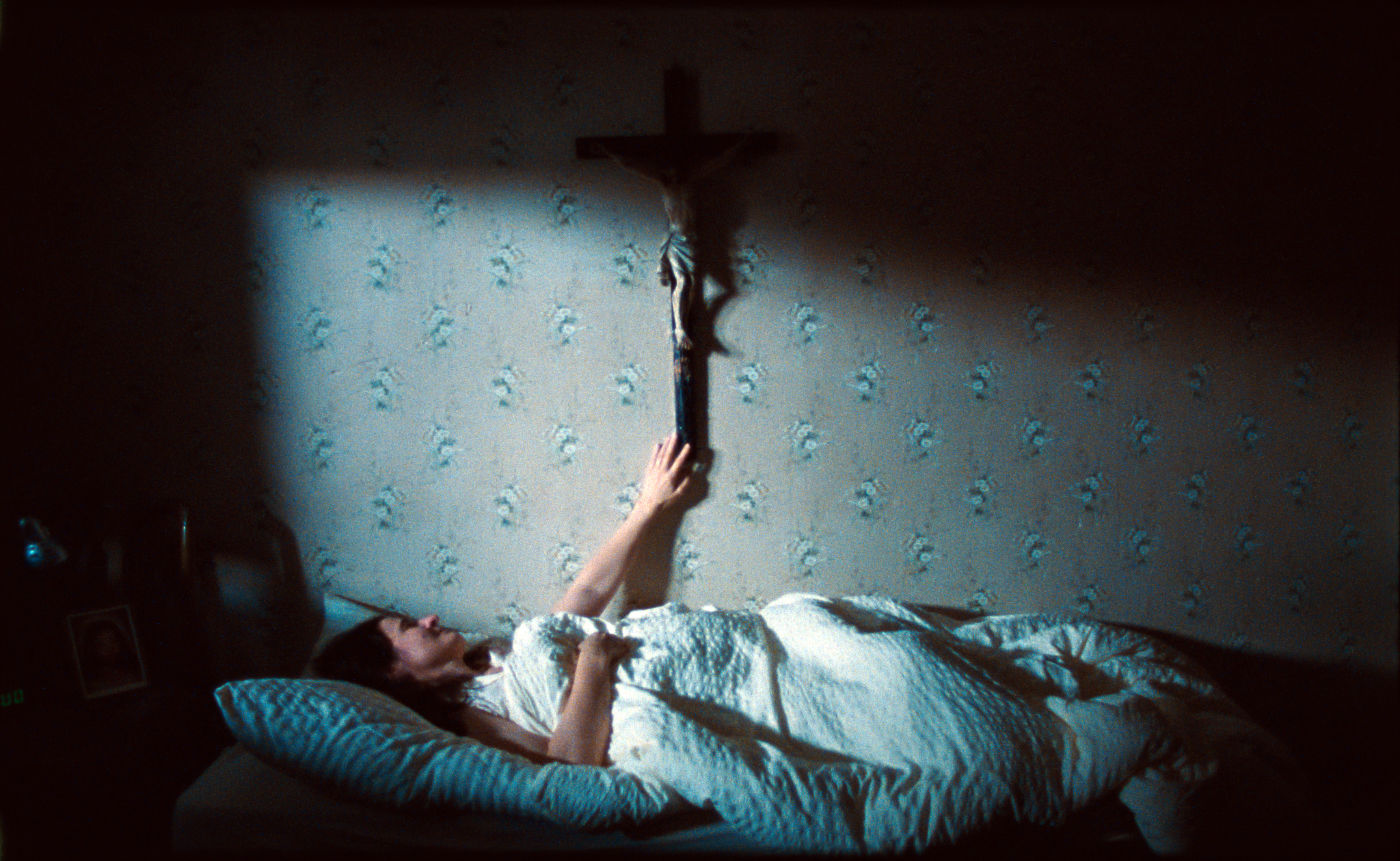
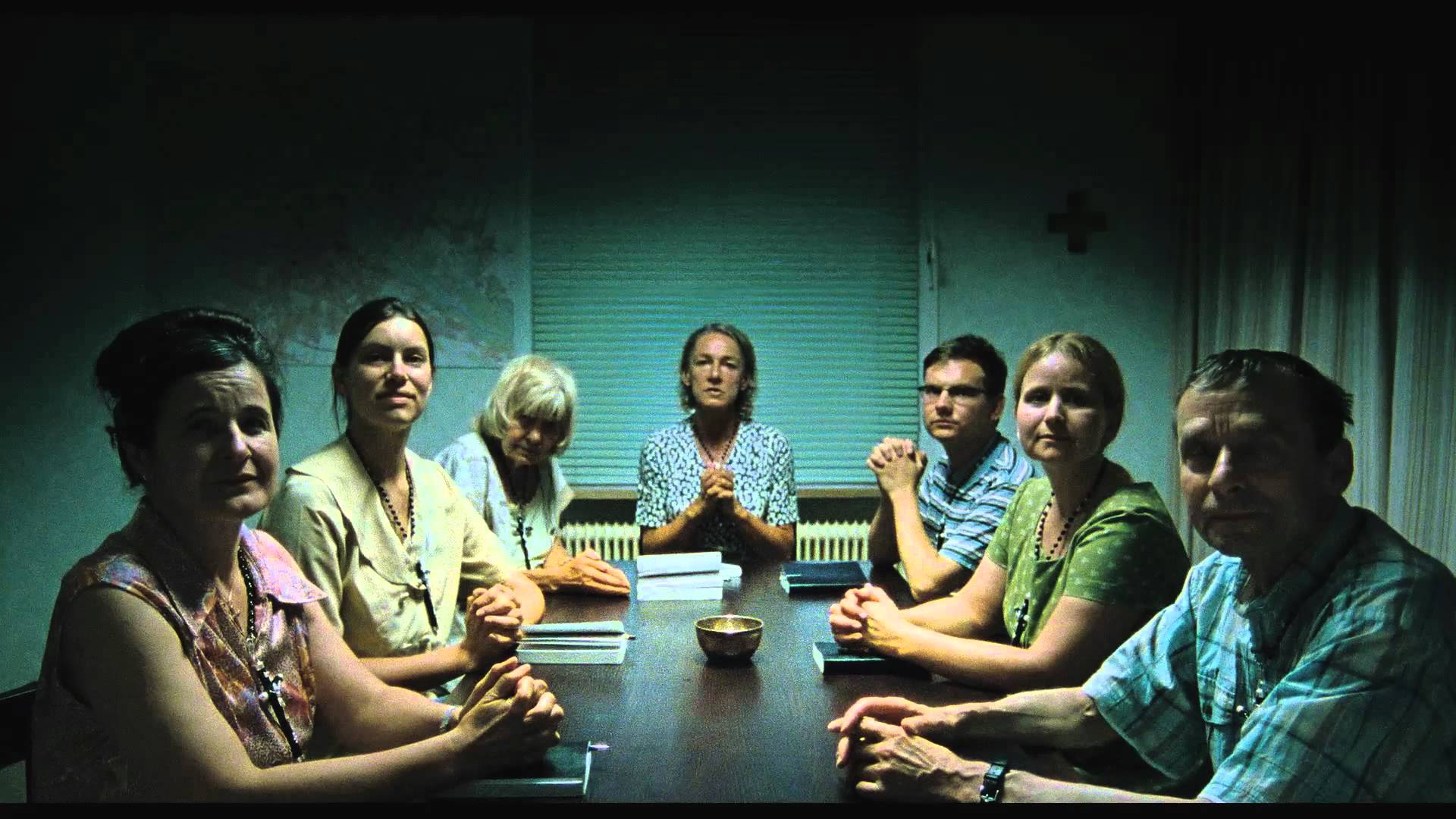
This film’s protagonist is Anna, Teresa’s sister. She is devoutly Catholic, and it is her and her bible group’s sworn objective to make Austria wholly Catholic again. Anna herself is convinced that the world is full of sex-obsessed people, and she asks that they be forgiven by whipping her own naked upper body with a whip while kneeling in front of her crucifix in a cheerless room in her house. Then she thanks her savior for the chastisement. Sometimes she goes as far as to tie a belt with iron thorns around her waist and make rounds through her flat on her knees while praying, and the kitchen timer telling her when to stop. She works as a radiologist’s assistant, but during her holiday, she goes from door to door in run-down apartment complexes and tries to convert people. She doesn’t stop at anything – there is a family of foreigners, non-Christians, of which only the eldest daughter speaks German. The whole family kneels in front of the Mother Mary statue. Anna can be very convincing.

One evening she comes home, and a Muslim is sitting on her living-room sofa. This is Nabil. They seem to know each other. It will later transpire that this is Anna’s husband. To Anna’s mind, this not at all a contradiction to her Catholic zeal – it is simply a test of her faith. She is happy to be married to her pet project, and she thinks it’s an excellent thing that two years ago, her husband had an accident and is now in a wheelchair – if only Nabil could see that true faith has entered her life that way.

Nabil, of course, is less delighted about his situation. He can no longer have sex with her, which is what Anna considers the right path: no sex, but a test of faith instead. Nabil thinks that a wife must serve her husband in all walks of life, and Anna agrees – except that Nabil asks for intimacy and a little more of her time. He is her project and is not supposed to develop human needs, and particularly not such disgusting ones like sex. Nabil’s every attempt is thwarted by Anna; although she can brush him off easily, she must bear his presence because her faith tells her to. Turn the other cheek. She politely refuses him at first, but when he insists, they trade blows. He wants sex he probably cannot have, she has a country to convert. This relationship will end badly.

maxresdefault

One night, again on her way home from trying to convert people, Anna’s greatest conviction seems to become real in her own neighbourhood. She walks past a public park and sees a dozen people involved in a gangbang. She knows she must interfere, but she cannot, and while not really consciously aroused, she must become aware of her own suppressed sexuality. Nabil asking her to sleep in the same bed and those gangbangers entail the same horror to Anna: the world is really only after one thing. It is here that Seidl’s strictly geometrical, static camera lets go and adopts Anna’s point of view. There is a possibility that Anna might only imagine the orgy. There is very subtle irony here: Anna is the one person who cannot tell whether she imagines the whole thing or not because for her, this was bound to happen. She staggers back home, utterly shocked, but proven right.

Anna’s zeal remained impenetrable to me. This movie must play like a horror flick to some Catholic audiences. To me, a former Protestant, Anna is very far from my own walk of life. That’s not to say that I don’t know about being passionate about something, way more passionate than is good for me. I understand obsession. I utterly empathize with trying to fulfill that passion, but I also empathize with the despair of not getting any rest about being passionate all of the time. I seem to be able to stop before I damage myself or others; for Anna, it’s all or nothing. She has subscribed to her faith, and if that involves more than she can take, so be it. It’s God’s will. She is so far out there that I can hardly see her. The actress playing her, Maria Hofstätter, disappears completely in her role. She is Austrian, friendly, with a quick smile. There is nothing in Anna of her.

Back at home, there is undeclared war. Nabil takes down her crucifixes, asks to watch TV, listens to Islamic prayer tapes and even puts a framed photograph of their wedding on her nightstand. He insults her faith and asks her, not to convert to Islam, but simply to find a better religion. He has a point, of course, although if you look past the object of her obsession, religion is not Anna’s problem. She enters a similar situation as her sister Teresa: She might still love Jesus, but there are moments when she despises her faith, but she cannot not believe. She is hard-wired that way, and there is no escape. The movie ends with Anna not whipping herself for a change, but whipping the crucifix on the wall.

Philip Seymour Hoffman 1967-2014

Well, fuck. I remember a few years ago, just around this time, hearing about Heath Ledger’s death and believing it to be some internet-era hoax at first. Yesterday was very similar: I quickly go to check Facebook and see a handful of posts that Philip Seymour Hoffman had been found dead in his apartment, and my first instinct is not to believe it. He can’t be dead. He’s too good. This is some sad internet joker’s idea of a good joke.

If it’s a joke, it’s definitely one of the worst I’ve heard in a long time – or the Great Big Casting Agency In The Sky decided to up its game considerably, because Hoffman was one of the strongest, most unique and least vain actors to come out of Hollywood. Here’s hoping he’s sitting next to Maximilian Schell right now, going through his lines with that half-amused, half-exasperated half-smile of his.

In Memoriam Philip Seymour Hoffman 1967-2014

Like so many people, I first noticed Hoffman on my radar when I saw Magnolia. He’d been in earlier films and had a poignant part in Paul Thomas Anderson’s Boogie Nights that was indicative of the work to come, but Anderson’s Magnolia put him in one of the leading parts, and rightly so. There was something seriously weird about the performance, but not in the quirky indie style that we’ve become accustomed to; there was no trace of that cutesy self-centredness in him. Magnolia: now there’s a film that was almost impossible to act and act well, for all involved. In the wrong hands, its lines would be overblown melodrama. Its too-decent-to-be-true character Phil Parma, among many others, would fall flat. Not so in Hoffman’s hands.

By the time The Talented Mr Ripley came around, it felt like Hoffman had always been there. Even though it was only shortly after Magnolia, I remember looking forward to the film because, damn, Philip Seymour Hoffman, one of my favourite actors! The part was smaller, but it’s one of the most memorable performances in a film packed with unusually strong performances. And again, that weirdness: Hoffman could turn on the most disturbing brand of camp that shouldn’t ever work, but he made it work – more than that, he made it essential to the character and so right it hurt.

It would be difficult not to go through the man’s filmography and pick scenes from practically every single movie he’d been in; personally I’m partial to his shlubby teacher in 25th Hour, an underrated film and a beautifully judged performance, and he was fantastic in Almost Famous or providing one of the main voices in Mary & Max, but also in uneven and mediocre films like Red Dragon or Mission: Impossible 3. Charlie Kaufman’s Synecdoche, New York is a film that works better on paper than on the screen, but when it works it’s because Hoffman made its central character inject an almost unbearing humanity into a story that constantly risks being tripped up by the meta Chinese Boxes it leaves lying all over the place.

For me it started with Paul Thomas Anderson, so it’s only right it ends with him. I’m sure Hoffman’s performances after The Master were as watchable as everything he’d done, but his Lancaster Dodd is all the proof that’s needed that American cinema has lost one of its most unique, generous and powerful voices – and while we have many indelible performances to choose from, it’s difficult not to be greedy and wish we could have had many more.

Rest in peace, Philip Seymour Hoffman.

Paradise: Love

Ulrich Seidl’s Paradise trilogy takes three basic needs – the need to love, the need to believe in some higher power, and the need for company -, and then shows how we fail most of the time. That doesn’t make Seidl a pessimist – maybe he is just very curious to the point of intrusion. I am not so sure why he chose two women and a girl as his main characters, and I am not sure what the paradise of the title means, but these are three movies that ask the right questions and wisely avoid giving any clear answers.

This trilogy may not be easy to watch. Seidl’s gaze doesn’t flinch, his camera rarely moves or zooms. There is a rigid geometry to his frames: many shots feature some sort of symmetry or at least horizontal or vertical lines of reference – the horizon, train tracks, the roof of a house, a window. His characters are often shown to inhabit the centre of the screen, within clear sight of the audience.

This clarity and order is at odds with some emotional or moral dilemma of one of its protagonists. Sometimes it looks like the edge of the screen is some sort of protection, but more often than not, these three women, and other characters, desperately try to break out of it. The two first main characters are played by renowned Austrian actresses; everybody else seems like they were picked up in the street and put on set. Some of them are.

Paradise: Love

The three main characters are introduced at the beginning of Paradise: Love. Teresa and Anna are sisters, while Melanie is Teresa’s teenage daughter. Teresa takes care of a group of people with special needs; there is, for the whole trilogy, a fitting first scene with bumper cars, not moving at first, then jolting to life and trying to find their route without any clear destination. Everyone has special needs – not because everyone thinks they’re special, but because we are all individuals, looking for something.

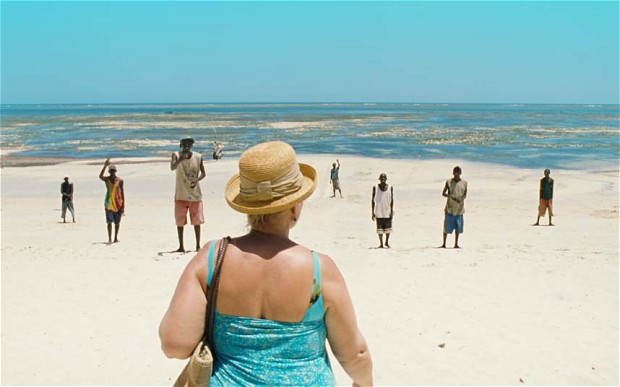
Teresa goes to spend her holiday in Kenia. She is egged on by a group of friends to get herself a toy-boy, who will make love to her for money. Both parties are in on the deal. You pretend to like me, and I will pay you and pretend to like you, too. This offer is subject to mood and need and can be cancelled anytime without prior notice. Seidl uses a chilling shot to establish that situation: there is a line along the beach along which men in uniform are patrolling. On the land side, there are rows of deckchairs, where the female tourists lie. On the other side stand the local vendors. They are not allowed to cross the line, and none of them do. The watchmen must exercise a very strict rule over that line, although we never see them at it.

Teresa is shy at first, almost reluctant, and an initial encounter makes her feel used, and she dumps the guy before he gets into bed with her. There are the salesmen on the beach with their beads and keyrings and souvenirs who are crowding her, and when her refusal to listen to them doesn’t work, there is Munga, unmistakable with his dreadlocks, who sends those overeager guys away. She suspects that this is his spiel. He does not ask her for anything, but is happy to watch over her while she wades in the water, and later show her his village, his flat, his bag of weed and his bed. They have sex. Teresa falls for him because Munga treats her as a human being. He seems inexperienced when it comes to touching a woman, and she teaches him how to. There is a sort of grim comedy to those scenes. A guy that inexperienced, he must be… different.

Let me digress here for a moment. There is a fair amount of nudity in this movie. Teresa is overweight, but she is also attractive. In some scenes, when she is on her way to Munga, she glows with the anticipation of meeting him. Other movies rely on younger and slimmer actresses to get naked. My point is this: most women’s bodies don’t look like models’, and most men are not muscle-bound athletes. Teresa looks… normal. Despite Seidl’s visual compositions, there is a realism to his environment that asks for normal people. If the physical appearance of some of his characters is a problem for you – well, what do you and the people around you look like?

To Teresa’s mind, Munga and her embark on a relationship. He introduces Teresa to his sister, who has a baby in her arms. Munga mentions another child who is in hospital and needs an urgent procedure, but Munga and his family don’t have the money. Teresa is happy to help out, and she gives him some cash. They visit a school, and Munga again asks her for money for school funds. When Teresa hands over only a small amount, the teacher gets cross and sends her away. Munga tells her off later, too, and it’s finally clear that this was his spiel. Well, she should have known that all along, but seemed to forget for a moment. He is just more patient than the vendors on the beach, and slightly cleverer as well.

Well, what did Teresa expect? Sometimes, we convince ourselves that we have found the real thing – fame, money, love – that we walk towards the snakepit with eyes and arms wide open. We need to love, and to be loved – it’s one of the most powerful drives in us humans. We can’t not love. And the promise of that makes us far too trustworthy. Some people are hard-wired that way.

The same goes for Munga. I don’t think he is indifferent to Teresa, but when you can get money out of the woman who comes and makes love to you, why not? She must have loads of it. And he must be grateful to have learnt how to touch a woman. Here’s a cruel thought: Maybe his inexperience is part of his act. Maybe his ‘sister’ is his wife, and the kid is his. And the kid in the hospital doesn’t exist. Who knows? Munga is gone, and Teresa has no clue where to put her love.

Of course Teresa is deeply hurt and disillusioned, but she meets another guy. She can’t not try. There must be some truth in her friend’s smirk when she talks about her black boyfriend. Of course Teresa knew that she wouldn’t find lasting love in Kenia, and that bitter disappointment, in herself as well as in Munga, together with her feelings of revenge, lead to the scene with the male stripper for her birthday and the sad hopeless scene where she tries to seduce the barkeeper. This was never about seduction, but about business. Teresa returns home hurt, disillusioned and with some new, shiny prejudices. She is sadder than before her holiday, and her sadness is deepened by her knowledge that she didn’t have a real choice.

Planes, trains and automobiles

Let’s get it out of the way: GTA V may just be the best Grand Theft Auto game. It may also be the most disappointing – and it is probably one of the dumbest games in the series. Credit where credit’s due: Rockstar Games do one thing amazingly well, better than anyone else out there, and that’s creating living, breathing worlds. Their obituary to the Old West, Red Dead Redemption, is one of my favourite virtual worlds bar none, the sort of place that I enjoy inhabiting and navigating, even without following the story or sidequests. Just being in the world covers so much of what I look for in games.

Red Dead Redemption also works in one key way that GTA V flubs, and that’s the character writing: yes, there are the joke characters, the broad caricatures of two-faced hypocrites, but Rockstar’s western knew when to take its cast seriously. It didn’t work all the time or with every single character, but by and large the dramatis personae of what could perhaps be called Grand Theft Horse carried the weight of its narrative. I understand that Rockstar might not want to write tragedies all the time – something that Red Dead Redemption ended up being quite effectively – but when it comes to humour the company’s writers tend towards the lazy, obvious joke… and then they flog it until way past its expiration.

I admit, there were moments in GTA V where I laughed out loud, and there were others where I sniggered. There are storylines in the game that work due to a combination of fine voice work and their sheer absurdity, but for each of these storylines there’s a character whose venality and stupidity is so drawn out, so overplayed it’s cringeworthy. What’s worse, perhaps, is that these characters are essentially all variations on the same theme: people who are smug and think they’re the best thing since sliced bread, yet they are essentially hollow. Which is fine until you realise that GTA V is 90% populated with such characters – and no, this does not strike me as a convincing parody of Southern California, and it’s most definitely not an interesting parody – and that the writing itself exhibits the same smugness. By comparison, Rockstar’s previous foray into Los Santos and surroundings in 2004’s GTA San Andreas (it’s already been ten years? now I definitely feel old) also had the broad jokes and the caricatures, but it brought together a band of mismatched characters that genuinely felt like family by the end of the game. By comparison, I don’t miss any of GTA V‘s cast of misfits and murderers, since with so many of them it’s clear that the punchline will always precedence over the character. There are exceptions: moments that show genuine wit and complexity, and jokes that don’t rely on the nth variation on the theme of “Haha, aren’t Californians/Americans/people stupid, vapid and easily fooled?”, but compared to Red Dead Redemption it all feels too much like a middling sitcom writer had watched The Sopranos and decided that they could pull this off.

Much was made of the lack of female protagonist in the game, especially since GTA V‘s main innovation is that there’s not just one but three playable characters. Seeing how limited Rockstar’s palette is in their latest, I have to say I’m glad they didn’t try to write their first female protagonist in this one. In fact, my main recommendation to the company would be this: they’ve pretty much perfected the creation of living, breathing worlds and mechanisms to enjoy being in that world. They have great artists, they choose fantastic music to add another dimension to their worlds, and they have ideas. What they should do is bring in new writing talent that doesn’t just do what they already do. They should get writers whose skills can shake up the by now rather stale mix of HBO Lite (imagine the worst moment in the weakest episode of The Sopranos) and Southpark-style loud parody. They don’t need to go for Greek tragedy or the Dickensian sweep of The Wire – but they should stop telling what is essentially the same joke. In brief, whatever they do next, I’d rather not think that it’s an improvement on their track record to date in every respect other than the writing. If that’s the case, I might just stay in GTA Online, because when the lines are provided by other players I don’t expect the writing to be good.

P.S.: For the record, GTA V‘s most maligned character, Trevor, is actually the most interesting at times. Yes, much of the writing is lazy and repetitive, but there are moments when his lines display a self-awareness that, while not particularly deep, does stand out compared to his usual lazy “Ooh, isn’t this edgy, offensive and craaaaaazy?!” shtik, the aftermath of the infamous playable torture scene (ah, to be a gamer in 2013…) being a case in point.

I couldn’t possibly comment

Well, that’s a lie. Obviously I can comment and I will. So there.

I’ve been watching the American remake? reimagining? resomething of House of Cards. On paper it seems a perfect proposal, updating the series and adapting it to the US context while giving David Fincher and Kevin Spacey something to get their teeth into. Critics largely agreed, on both sides of the pond. We’re now about half a dozen episodes into the first series, and I have to admit I’m not quite feeling it yet. I can’t even say it’s the series: my main problem at this point is that my memories of the BBC original (primarily the first series – the second and third got progressively worse in terms of writing and plot) keep getting in the way. I don’t have any issues with remakes on principle, but I keep thinking that BBC – no, scratch that, that Ian Richardson did it better. In fact, I think that’s my main problem so far: Spacey’s performance up to this point, or possibly the way his character is written, strikes me as somewhat lazy. He’s got the Spaceyisms down pat, but there’s no urgency behind it, no purpose. We’re told what this Frank Underwood wants to achieve, giving his machinations and manipulations a theoretical goal, but so far I don’t feel it. Manipulating people seems to be an end in itself to Underwood, whereas Richardson’s Francis Urqhart was a driven man, something his aloof, calculating irony sometimes covered but that was constantly seething under the surface.

I’m hoping I’ll learn to appreciate the Netflix House of Cards for what it is, rather than for what it isn’t and perhaps shouldn’t be. In the meantime, though, here’s a shoutout to Ian Richardson’s defining role, which he played to perfection even in the inferior second and third series. Is he the best neo-Richard III of all times?

P.S.: There’s a longer clip in an earlier post of mine, showing the plummy glee with which Richardson’s FU addresses the audience. Well worth checking out.