A totally non-representative, disappointingly short Best of 2014

Nope, I won’t be doing any lists. No “Best game that gamers feel insulted by, saying it’s not even a game, like!”, no “Best instalment of The Hobbit to date, even though it wastes Mikael Persbrandt” and no “Best mildly disappointing new League of Extraordinary Gentlemen comic”. Just one entry.

Or should that be entrée?

I’ve written about Hannibal before. It’s rare that my pre-release expectations of any media product are this different from my opinion of the result: when I heard that they were doing a TV series based on the Hannibal Lecter books by Thomas Harris, I scoffed audibly. Cannibalistic cash cow, anyone? I was wrong, though: Bryan Fuller and his band of assorted sickos, psychos and gourmets have created one of the most fascinating series in a long time. It’s no The Wire, Deadwood, The Sopranos or Six Feet Under – but neither does it suffer from that comparison. It’s something entirely different, and it’s remarkably different from the films based on Harris’ novels. There’s obviously an element of Grand Guignol in the artistic killings of the series, but at the same time we’re not supposed to titter and gawk at the imaginative imagery. Fuller puts a sense of terror and downright, metaphysical dread back into that most hackneyed of fictional figures, the serial killer.

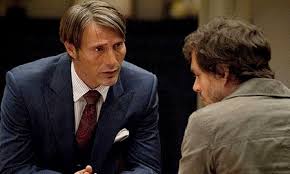
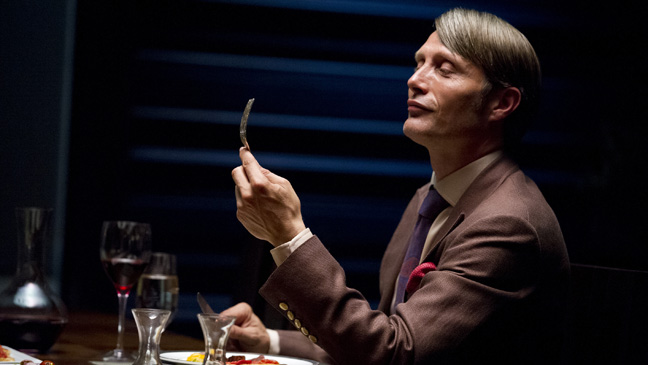
Much of the credit must go to Fuller’s two leads. I expected Mads Mikkelsen to be good, but he’s better than I’d dared to expect. He is miles away from Anthony Hopkins’ increasingly hammy Hannibal: a cold, calculating, diabolical and utterly fascinating creature, one of the reasons why Hannibal freaks me out as much. If Hopkins is theatrical in his camp evil, Mikkelsen’s culinary villain offers a much more intellectual, sharp-as-a-knife theatricality with no hint of a wink at an audience that despite themselves roots for that darn rascal Hannibal.
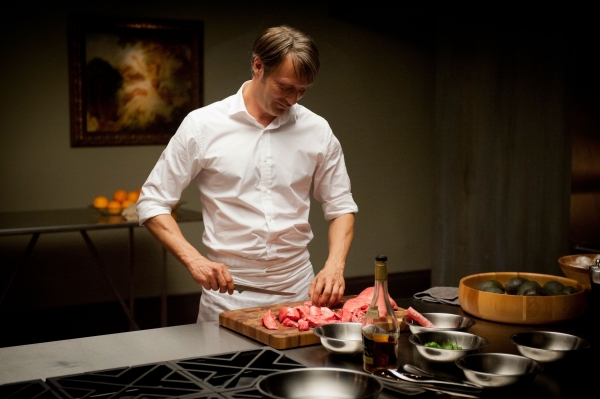
Pukka food, eh?

Will Graham, played by Hugh Dancy as a permanent bundle of frayed nerves sending messages of pain to a fevered mind, could have been the boring straight man, but instead he offers the much needed polar opposite to the series’ Hannibal Lecter. His humanity could have been boring, cloying or preachy, but Dancy brings a taut, nervous energy to the role that is constantly interesting, always watchable. The rest of Hannibal‘s cast fares well, but it’s Dancy and Mikkelsen that make it work – together with the cinematography, that is, which manages to balance fascination with repulsion with a deftness I can’t remember having seen in a long time, and definitely not in any of the post-Silence of the Lambs serial killer movies.

There have been other interesting, worthwhile media events in 2013, but nothing has captured my imagination and haunted me as much as Hannibal, and for that I owe Bryan Fuller a dinner, at least.

He may just be the main course, mind you.

And on that yummy note: wishing every one of you a very happy 2014! Except you. No, the other one. Yes, you. Sorry.

Gone Home – a guest post

The following is a guest post by Johanna Bucher, a friend and fellow gamer who has a keen eye for the potential of the medium. Thanks a lot to Jo for this end-of-year treat!

One aspect I love about video games is the potential for escapism. More so than film or literature video games enable you to be someone else, a powerful wizard, a Jedi knight, a bad-ass bomber pilot. In video games you fight dragons, fly spaceships, have super powers, and travel through time saving entire galaxies from impending doom. In short: you have a chance to do grand things you never can in real life. And the further away the setting of a computer game from the here and now, the better for me. Or so I thought.

Gone Home has none of the above. It takes place in the real world, it evolves around completely ordinary people leading ordinary, not to say, drab lives. Their fears and hopes are all too familiar. There is nothing striking about them at first, other than perhaps the big mansion they live in. So, what possible attraction could this game offer which puts you in the shoes of 20 year old Kaitlin Greenbriar, returning from a long trip to Europe, expecting to be greeted by her family only to find the house abandoned?

Gone Home

What the game “lacks” in grandeur or exotics it makes up in characterisation and attention to detail. Through audio diary entries at specific points in the game, notes and artefacts found in the house, the mystery (what happened to everyone?) slowly starts to unravel. Not all of the clues found in the house make sense at first but with each new room discovered, a more coherent picture can be drawn, of the goings-on and of the people involved in them. The rewards in this game, then, are not shoot-outs, levelling up or collecting loot, but picking up the threads of strangers’ lives and in the process of getting to know them discovering that you start to care for them and their small lives because, more often than not, they strike a familiar chord.

It is no coincidence that the game takes place in 1995: this is pre-internet, pre-cell phone. It’s the age of VHS, vinyl and audio cassettes, where people write notes and letters by hand, or maybe, if it gets really fancy, send a fax. This leap back into analogue times is more than a nostalgic walk down memory lane (although the game’s creators clearly revel in that.) It also sets a different kind of pace: it slows the game down to the sound of your footsteps pacing about the rooms, the rhythm of the written and spoken word (masterfully supported by wonderfully restraint music and great vocal acting). In a strange way the physical exploration of the space also becomes a mental one.

In a review to the game I read that calling Gone Home a video game is doing it a great disservice. And I agree, this game is not for everyone. It demands a certain amount of patience, the willingness to do rather a lot of reading and rummaging through drawers and armoires. But I would claim that although the game deliberately goes against many video games conventions it is the perfect and only medium to be told in. This story only fully comes to live through the narratology of video games.

Gone Home, then, is not so much about what the story is about and its conclusion (although the topic is not a trivial one and the conclusion is rather touching) but much more abut about how it is told. And summing it up would be the greatest disservice done to it. It has to be experienced. So, sod escapism, this time at least.

How many roads must a man walk down carrying a cat under his arm?

If you had to guess the screenwriter and/or director of a film featuring the line “Where is his scrotum?” with respect to a ginger cat, how long would it take you to come up with the name ‘Coen’? There are definitely many examples of the brothers’ trademark deadpanned quirks throughout Inside Llewyn Davis – at the same time, though, their latest is a remarkably low-key – and dare I say “mature” without sounding really old? – work, scrotum or no scrotum.

There are many things the film isn’t; for one thing, I wouldn’t call it original, as its characters and story beats are pretty familiar, nor is it as comedic as many of the Coens’ films, although it is frequently amusing. It is, however, a film that is crafted almost to perfection, knowing what it wants to be and how best to be it. This is nowhere as apparent as in Oscar Isaac’s performance as the title character, a singer-songwriter trying to find his place in the folk music scene of the ’60s. This isn’t an award-grabbing performance, remaining mostly internalised throughout, yet there’s not a single beat, line, gesture or lack thereof that could be changed without losing the character’s essential quality. Llewyn Davis is not an easy character to like, often exuding an understated mix of resentment, self-pity and arrogance underlying his lack of direction or drive, but Isaac, working with a strong script, makes him engaging – and that’s when he isn’t singing. When he is, you want to keep listening to Davis’ voice.

Inside Llewyn Davis

Just as essential to the film’s success as the central performance, the script and the music, is its beautiful cinematography, for once not by longtime Coen collaborator Roger Deakins but by Bruno Delbonnel of Amélie fame. I’ve long been annoyed with the nostalgia porn of so many films set in the ’60s or ’70s, but while Inside Llewyn Davis looks beautiful, it’s not the usual commodified attractiveness of the past that cinema tends to peddle. Delbonnel’s images are gorgeous to look at, but that doesn’t keep his New York and Chicago, his big city streets and smoky clubs, from being cold, dingy and unwelcoming. The film has an artist’s view of the ’60s, not a tourist’s.

So, in short, the film is surely one of the Coens’ most accomplished features – though I’m not sure the film will stay with me to the same extent that some of the Coens’ earlier works have; Fargo will always be special to be for being the first of the brothers’ films I’ve seen (and with my later wife, so it’s loaded with personal significance), and movies such as Barton Fink, The Big Lebowski and The Man Who Wasn’t There have probably left more of an imprint due to who I was when I saw them. As much as I liked Inside Llewyn Davis, it didn’t resonate with me the way that these other films did – but I wouldn’t hesitate to say that in the Coens’ oeuvre, Inside Llewyn Davis may just be the most pitch-perfect, beautifully made.

Review: Charlie Brooker’s How Videogames Changed The World

Ah, video games. The love that dare not speak its name, at least in many mainstream media. According to TV especially, gaming is about bleeps and bloops as well as about blood and guts. Games are inherently male, inherently adolescent, inherently about power fantasies – and lest the gamer protest too much, that’s how the medium likes to present itself, at least when it comes to marketing. Boys play video games where they wield massive guns that would have made Freud go “Hmm…”, girls play video games that are pink and feature ponies, right?

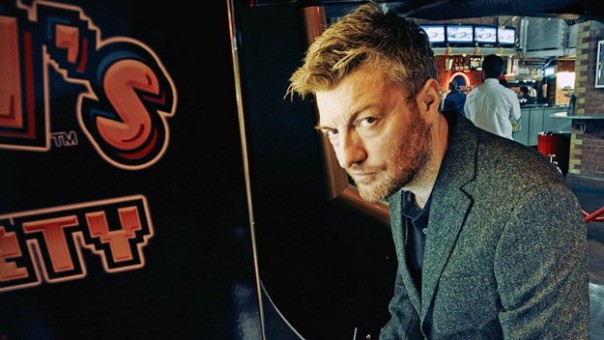
How Videogames Met Your Mother. Or something.Charlie Brooker’s latest on Channel Four, the feature-length How Videogames Changed The World, was refreshing, mainly because TV seems to see games in very generic ways: either we get the embarrassing dudebro image of Call of Duty gaming, the stereotypical manchild living in his parents’ basement eating crisps and playing World of Warcraft, or we get handwringing worries about how gamers are desensitised by their chosen medium and turned into ticking timebombs just waiting to shoot up some high school. Brooker’s show looked as games as if *gasp!* they were a cultural good, for better or for worse, and should be seen as exactly that. Regardless of their cultural worth, games have become too big to ignore – and that may be one reason why they’re still presented as the sort of endeavour waiting for us to go 1 Corinthians 13:11 of them: “When I was a child, I gamed as a child. But when I grew up, I put away childish things, like controllers and such.”

Brooker, together with a whole bevvy of talking heads, took the programme’s viewers through games from their bleepy inception to their social-media-infused present day. Far from po-faced (or should that be Pong-faced?), HVCTW was largely about memories: from Peter “I voiced Darth Maul, so don’t you dare misspell my name!” Serafinowicz to Jonathan Ross, with various comedians and games journalists filling the ranks, talking about growing up on Space Invaders and GTA. One thing that was clear from the show: video games may slowly be growing up, dealing with issues more weighty than whether to shoot that terrorist in the face with an assault rifle, shotgun or grenade launcher, and that’s because video gamers and developers are growing up. A 30-something dev changing diapers on a nightly basis may make very different games from the guy in his 20s, and that’s definitely a good thing. The medium has become increasingly diverse over the last years, with a growing indie scene experimenting with what games can say and how they can say it differently from films or books.

Charlie BrookerFor me as a long-time gamer – ah, those heady days of writing BASIC code in between bouts of International Soccer! – HVCTW was nevertheless a qualified success at best. It was great to see Channel Four taking the medium seriously, but Brooker and his team delivered a show that didn’t quite know what it wanted to be: was it meant for general audiences without much of an idea of the medium, or was it by gamers for gamers? It was each of these at different times, but as a result it often fell between two stools. I wonder how the programme was received by non-gamers, because I’d imagine that they lacked the context to make sense of, say, the ultra-gory Mortal Kombat footage, or to understand the importance of the rise of the indie scene as told by Brooker, yet gamers who’d lived through most of the games mentioned are likely to have found much of the show rather “been there, done that”. Perhaps this could have been averted by giving HVCTW more breathing space and turning it into a series, or by ending it with an actual conversation between gamers, developers, experts and (most importantly, perhaps) people who don’t see what all the fuss is about (as long as they’re not called Jon “You know nothing!” Snow). As it was, HVCTW was several things at the same time – documentary, primer, nostalgic look back – without being any of these altogether successfully. The programme may have worked better as a statement – that video games are culturally relevant – than as an argument supporting this statement.

Now, gentle reader, you may be wondering, “Can I watch this programme myself, so I can tell this Goofy Beast guy how he doesn’t know what he’s talking about?” You can – provided you’re in the UK, or your computer is suffering from MPD and believes it’s in the UK. Just follow this magical link. For those of you unblessed with UK residency, though, here’s a short clip:

P.S.: The true test of whether you’re a real O.G. (Original Gamer)? It’s this – does the Robocop theme tune (Gameboy or C-64, I don’t mind) make you wax nostalgic?

Silence of the blog

I’m afraid that this year autumn and the onset of winter got to me, much more than in other years and surprisingly so. The result was that the cold, grey weather sapped my physical as well as mental energy – which meant no blogging for the weary. Can’t say that my energy’s back, but I’m hoping to use this post as a gentle kick in the backside. Since it’s been a while, I thought I’d do a Variety Pack of sorts, on TV series for a change, so without much further ado…

Orphan Black

Orphan BlackI read the AV Club reviews of this one when it showed in the States; even though it was a BBC co-production the Beeb only showed it months later. The AV Club gang loved Orphan Black, and there is a lot to like about this sci-fi-ish conspiracy thriller, first and foremost Tatiana Maslany. Her playing several different characters isn’t flawless, relying a bit too much (especially at the beginning) on dodgy accents and costume choices, but as she gets into the parts she quickly becomes the series’ main asset. By the fifth episode I wasn’t thinking about the seamlessness of the special effects any more – I just accepted that there were several clone characters on screen who all looked more or less the same but were totally different in most ways. The plot, while perhaps too convoluted for its own good, definitely drives the series along to its conclusion/cliffhanger. Having said all of this, though, I’m not sure Orphan Black deserves the hyperbolic praise it received on the other side of the Atlantic: in terms of tone, it’s not altogether surefooted, and various characters – even the occasional clone – remain flat, uninteresting and even annoying. I’m intrigued for season 2, but it’s nowhere near the top of my list of favourite series. Entertaining, yes, but I’m glad I didn’t go for the box set.

Sports Night

Is there a TV writer as readily recognisable as Aaron Sorkin? In some ways, Sports Night feels almost like someone has fed the writer’s mannerisms into a computer and turned up the Aaron-o-meter to 150%. The cast is more than capable, but even for someone who loved The West Wing the series can be formulaic as well as overbearingly smug and self-satisfied. Still, there are moments when it clicks – mostly thanks to the likes of Peter Krause, Felicity Huffman and the rest of the cast. (And yes, there are moments when the series brings out the worst in its composer, the improbably named W.G. Snuffy Walden.) Would I have watched The West Wing if I’d started with this? I’m not sure – but there are worse ways to while away 22 minutes.

And just for the heck of it, here are seven minutes of Sorkinisms:

Real Humans

I was a bit wary of this one; there was a big brouhaha in newspapers when they started showing it here, but to me as a former(ish) sci-fi geek it all sounded rather “been there, done that”, with the main inspirations being Asimov and Blade Runner. We’re now six episodes into the first season, and while the ideas in the series may not be the most original to anyone who’s been following the genre, that’s beside the point. Being Human takes a page out of True Blood‘s book, looking at what our society might look like if this one foreign element (androids in the case of the former, vampires in the latter) were to be introduced into it – but differently from True Blood it shows relatively little interest in its lore. Instead, there are elements of allegory, but never to the extent where the series’ so-called ‘hubots’ become a facile stand-in for oppressed group X. The social critique and satire are balanced by a plot that keeps things going smoothly and by characters that are fun to watch, from the sad-sack who, after being left by his wife, blames all his misfortune on the machines to the icy renegade hubot leader who’d give Rutger Hauer a run for his money.

Real Humans

And that’s it for now. I hereby solemnly promise that it won’t be as long yet again before my next post!

Space race

Gravity is a gorgeously shot film, no doubt. It’s a film by a director who knows what he’s doing; there’s not an ounce of fat on that movie. It’s a thrilling piece of cinematic craftsmanship, and one that has rightly garnered praise from critics and audiences alike. It’s difficult not to see some of the criticism as internet-age contrariness. Is the film’s plot simple? Perhaps. Is it too simple? Well, that point was ably countered by that patron of upper-case criticism, Film Crit Hulk.

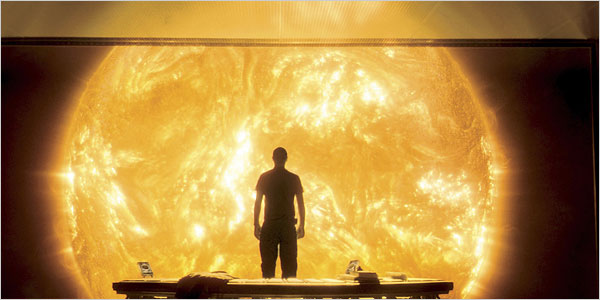
And yet, I came away from having seen Gravity being subtly disappointed. It’s a good film, definitely, and Cuaron does a great job – but already one or two days after having seen it, when I try to think about what I saw the images that come to mind aren’t Gravity‘s, they’re from Danny Boyle’s Sunshine.

Now, Sunshine… It’s a flawed film that’s almost sunk by its last third. It’s messy and confused. Yet it resonated with me to a much larger extent than Cuaron’s more accomplished, more consistent movie did. As a matter of fact, one of the reasons why I was somewhat disappointed with Gravity is this: I was immediately pulled in by the trailer, which evoked the visceral dread of floating off untethered into the infinity of space. The film itself didn’t bring back this dread, because of its structure: obviously Gravity wasn’t going to kill off Sandra Bullock, at least not before the final five minutes or so, which meant that there was little sense of risk. It’s possible for stories to solve this conundrum by involving their audience in a sleight of hand where they know a protagonist won’t die, yet they feel that they may just be wrong about that. Gravity didn’t do that, at least not for me, and I’m not sure it wanted to – its aim was to show Bullock’s character struggling and triumphing.

Gravity

That’s the other thing, though: I did care about the character triumphing, but not much. Dr. Ryan Stone, first-time astronaut, works as an audience stand-in, especially in concert with the amazing cinematography (seriously, if Emmanuel Lubezki doesn’t get an Academy Award for this, the Academy should be shot into space!), but to be honest, I didn’t particularly care about her. Part of this is Bullock’s particularly American everywoman quality: a bit like a female Tom Hanks, there’s something to calculatedly likeable about her. She works well in Gravity, but I often find her (and Hanks) bland, compared to, say, the everyman characters of Jimmy Stewart that hinted at darker qualities under the folksy niceness.

Adding to this are my issues with Gravity‘s themes: Film Crit Hulk (and other critics) liked the rebirth motif running through the movie, but I found it somewhat hackneyed and distractingly obvious. By the time we get Bullock’s zero-G fetal position and realise that the line tethering her character to various space vessels doubles as an umbilical cord, the film is practically shouting its subtext at us in IMAX-sized captions: we’re witnessing her rebirth, get it?

sunshine

Sunshine is hardly all that more subtle about its themes, but it’s less single-minded – it’s more messy, as I mentioned earlier – and for me this makes the film resonate more. It’s fair to say that Boyle’s movie doesn’t quite know what it wants to be, but the result is that Sunshine‘s themes aren’t as pushy. More than that, though, I cared about its characters and their plight much more than I did about Dr. Stone’s; she may be more likeable, but her likeability is largely predicated on the audience liking Sandra Bullock. Sunshine‘s characters are more flawed, more complicated, and to my mind more human. As a result, when those characters die it feels more like a loss, whereas Gravity‘s deaths were mostly forgotten a minute after they occurred.

There’s something else that Sunshine pulled off and that makes the film resonate more with me than Cuaron’s arguably more accomplished movie: both films have a metaphysical component, but Sunshine‘s goes beyond the individual level. It’s not just about the potential death of one audience stand-in, it’s about the possible death of mankind. It’s about the two directions in which playing God can go: the film’s protagonists are working on saving the sun and, by extension, mankind, while the antagonist wants to return us all to the stardust we came from. Both sides are torn between being flawed humans and aspiring to the kind of power that humans should not have. It is a shame that Boyle turns this metaphysical playground into a slasher movie, almost drowning the more interesting themes in a space-age retread of And then there were none, but the power of the filmmaking – always more disjointed than Cuaron’s, but for me more engaging in this – got to me to an extent that Gravity didn’t in the end.

Gravity is accomplished in ways that Sunshine doesn’t manage. It is the more coherent film, it gets more things right and fewer things wrong. But the things that Sunshine gets right – and even its noble failures – means that I’d rather sit in a tin can with Cillian Murphy, Rose Byrne and Hiroyuki Sanada than with Sandra Bullock and George Clooney. I’m glad that Dr. Stone made it, but for me her triumpant rebirth doesn’t even begin to touch Sunshine‘s final scene, which is confident enough to be simple and quiet – and all the more glorious for it.

City of digital angels

There’s food porn. There’s nature porn. Apparently there’s even porn porn, out there on what is laughingly referred to as “the internet”.

I have virtual timelapse porn.

Since video games have become less Mondrianesque (read: big pixels in primary colours) and more visually rich, more and more bloggers, game photographers and videographers have been exploring their visual appeal beyond the simplistic “Great graphics, most realistic blood splatter, coolest lens flares, 9.5/10!” (I recently posted about the YouTube project Other Places.) It’s not so much about showing that games are approaching photorealism, at least not to me; it’s about getting to a point where the worlds created by games become interesting and arresting in their own right, and where they can be explored in various creative ways.

Are time lapse videos of game locales creative? Let’s put it like this: they can be beautiful, evocative, eerily poignant. There’s more to a good time lapse video than sticking a camera, virtual or otherwise, in one place and shooting one frame per second. And some games lend themselves more to such videos than others – I’ve previously posted about such videos made from the likes of Red Dead Redemption and Assassin’s Creed. To my mind, just about the best worlds for video game photography and videography are those created by Rockstar Games, and their latest, Grand Theft Auto V, is a gorgeous case in point. Ignoring the controversy around the game for once (there are already more than enough articles out there on whether GTA V is misogynist, racist, homophobic, or even (yikes!) a bad game), I am yet again amazed at how well Rockstar can take a real place and boil it down to its essentials. Their Los Santos, while clearly a fictionalised Los Angeles, is more than a Reader’s Digest version of LA – it’s as if the Rockstar artists had taken the world’s collective dream of Los Angeles and put it into textures and polygons. To me, there’s a touch of the hyperreal, and even of Neil Gaiman’s dream of the city in Sandman, and of Calvino’s Invisible Cities (sadly Marco Polo never talked about “Virtual Cities”, but then again, each of his invisible cities is virtual), in how these places resonate, even more so when put into the format of (wait for it…) a timelapse video. They make me want to inhabit Rockstar’s dream of LA, especially at night, when the street lights shimmer through the distant haze.

Do yourselves a favour. Let the entire video download before you watch it. Go for the highest resolution. And definitely, most definitely, go for full screen. If you still don’t see at least a fraction of the fascination these have for me, I’ll spring you a drink. I know this great little bar just off Vinewood Boulevard…

Drowned sins

Jane Campion’s mini-series Top of the Lake is an odd one. Usually I’m quite comfortable pronouncing judgment on a series and how well it holds together – I wouldn’t go as binary as the proverbial thumbs up or down, but I’m rarely as ambivalent as I’ve been about Campion’s latest.

Top of the Lake

One thing I’m comfortable to say: Top of the Lake is a mess. It’s confused. It doesn’t entirely know what it wants to be. And it would be generous to describe its pacing as fits and starts. The series uses its story of a missing, pregnant 12-year old to outline a society that’s closed off, incestuous (both metaphorically and quite possibly literally), and a misogynist throwback, in spite of being set in what appears to be contemporary New Zealand. It never quite decides on the thrust of its criticism, though, as it gets tangled up in its own ambivalence: so many of its men appear to be (or, just as bad, strive to be) sexist alpha males with little regard for the women in their community, yet the series’ prominent locus of female kinship and healing rarely becomes more than a caricature of neurotic women in search of a New Age guru to follow. Which they find, sort of, in Holly Hunter’s G.J. – more on whom later.

On the whole, too many of the characters in Top of the Lake remain one-dimensional, gendered in simplistic ways: the clueless macho, the weak middle-aged woman, the brow-beaten son. The characters that escape such categories aren’t so much better written as they are elevated into something more complex and interesting by the acting. Elizabeth Moss’s young detective, Peter Mullan’s grizzled patriarch – yes, there’s a bit more meat on the bone in the way they’re written as well, but primarily the actors bring to life characters oscillating between stereotype and archetype. There’s something reminiscent of Sam Shepard and his character constellations in Top of the Lake: at its worst, it’s a jumble of clichés, at its best it achieves an almost mythical sublimation coupled with strong, compelling performances. Top of the Lake is something rarely found on TV: it’s not entirely naturalistic, and it takes a while to recognise, let alone accept, the series’ more stylised approach – an approach that is perhaps reminiscent more of the stage than the small screen.

TotL_2

Having said that, some of the series’ strongest moments would be impossible on stage, relying as they do on the images and the breathtaking landscape of New Zealand. The cinematography is striking and deserving of a big TV, if not even a movie screen. As is some of the cast: even if both Mullan and Hunter especially suffer from writing that misses as often as it hits, they almost burst the confines of TV. Hunter especially is a strange creature: her character’s lines rarely have more depth than fortune cookie wisdoms, yet she has a presence that is memorable when what she says rarely is.

Altogether, Top of the Lake is compelling. It’s fascinating. In its deeply flawed, messy glory it’s considerably more interesting and worthwhile than several other series recently shown by the BBC. It is a series that almost requires being discussed and it’s some of the more ambitious TV I’ve seen in quite a while.

TotL_3

Of serial killers, haute cuisine and empathy

So many series we’re watching aren’t exactly puppies and rainbows 24/7. There’s Top of the Lake, with its panoply of misogyny, abuse and murder. There’s Game of Thrones, whose murder, mayhem and intrigue make Shakespeare’s history plays look like A Midsummer Night’s Dream. So, obviously what was missing was Hannibal, a heartwarming story of a troubled boy, his psychiatrist and food, glorious food.

Coincidentally, at the same time we watched the first episode of BBC’s Messiah series 2 – and while Hannibal probably features the more baroque, aestheticised killings, it’s Messiah that I found more difficult to watch. Not in a positive way, mind you; I didn’t come away from Messiah feeling shocked and sorry for the victims, because I didn’t feel that the series was all that interested in the victims. It wasn’t outright sadistic, but it still used the sadism of its killers (I’m including the first series of Messiah in this) as a somewhat lazy shorthand: the killer these people are up again is really messed up. Which is hammered home repeatedly – but it’s almost entirely about the killer in question and the detectives out to find him.

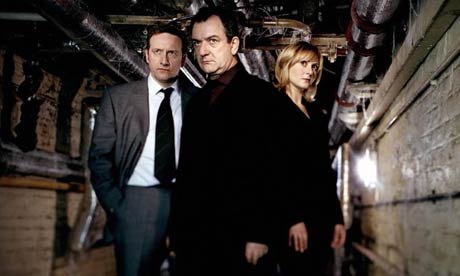
Hunting serial killers - a grim, serious business, set in grim, serious dingy basements. (Crack a smile and we'll have to do the photo again.)

I was surprised by how much Messiah‘s murders turned me off. I usually have a fairly strong stomach when it comes to on-screen violence, and arguably Hannibal‘s cannibalism and impalings are more gruesome. However, while Hannibal doesn’t necessarily spend that much more time with the victims of violence (at least not before they’re turned into Grand Guignol dioramas by Americas 10 Most Artistic Murderers), it has something that so far I haven’t really found in Messiah: empathy. While the BBC series is happy to say, “These are horrible crimes, because they look like horrible crimes, and our heroes will stop them,” Hannibal is interested in states of mind. It’s interested in the emotional consequences of these crimes. The series’ title character, eminent psychiatrist Dr. Hannibal Lecter (Mads Mikkelsen), may be cold to the point of appearing devoid of emotion, but his counterpart Will Graham (Hugh Dancy) is empathy. He’s a raw nerve, incapable of not empathising.

I used to be a fan of serial killer narratives, and I still like films like Seven, Zodiac and earlier additions to the Hannibal Lecter mythos such as Manhunter and Silence of the Lambs. However, I’ve come to realise that I find these films offputting if the violence they depict seems to be decorative first and foremost. Messiah‘s murders seem to be as elaborately symbolic as they are first and foremost for audiences who may be bored with the common or garden variety of murder. They’re elaborate because that’s what the genre demands. And, for me at least, they are cruel because they’re there for the effect. The murders tell us more about how the series wants to entertain its audience than about the murders or the victims.

Would you like to talk about it? Over some liver pate, perhaps?

What Hannibal seems to be striving for, on the other hand, is that old Aristotelian chestnut associated with tragedy: through Will Graham we’re asked to experience pity and fear. I did feel pity for Messiah‘s victims, but more so because I felt the series wasn’t interested in them. It wasn’t even that interested in the murderer, beyond providing a relatively glib, facile explanation of motive. In that sense, Hannibal is closer to Hitchcock’s granddaddy of all things serial-killery, Psycho, in that it believes in extending its empathy to the people committing the crimes – although in the case of Dr. Lecter, there may be no understanding why he does what he does.

Other than him liking his haute cuisine, that is. Because, seriously, where are you going to get that steaming fresh liver for that dish you’ve simply been dying to try out?

The joy of a well-prepared meal.

P.S.: I might take on Top of the Lake soon. That is, if I can figure out what I think about it – or if I can figure out an interesting way of saying why it confused me.

Family is murder

Wherever he is, Alfred Hitchcock must be giggling to himself. Chan-wook Park’s Stoker takes his Shadow of a Doubt and adds several layers of creepy glee that the master missed out on in his tale of a murderous Uncle Charlie, his widowed sister-in-law and his young niece – and in doing so, Park has created a poisonous treat of a movie.

I’ve greatly enjoyed many of Park’s earlier films, especially his Vengeance trilogy and most of all what I would call his masterpieces, Oldboy and Sympathy for Lady Vengeance. They’re not light viewing but they show Park to be an inventive, exuberant stylist with a good feel for striking stories and characters. His Joint Security Area, while less visually arresting (it’s difficult to top Sympathy for Vengeance in this respect), is also well worth watching, and even lesser works such as I’m a Cyborg, But That’s Okay have a lot going for them.

Stoker is Park’s latest film and his first done in Hollywood. If I’m not mistaken, it’s also the first of his movies written by someone other than the director, and that’s perhaps where the biggest differences come in.

Stoker

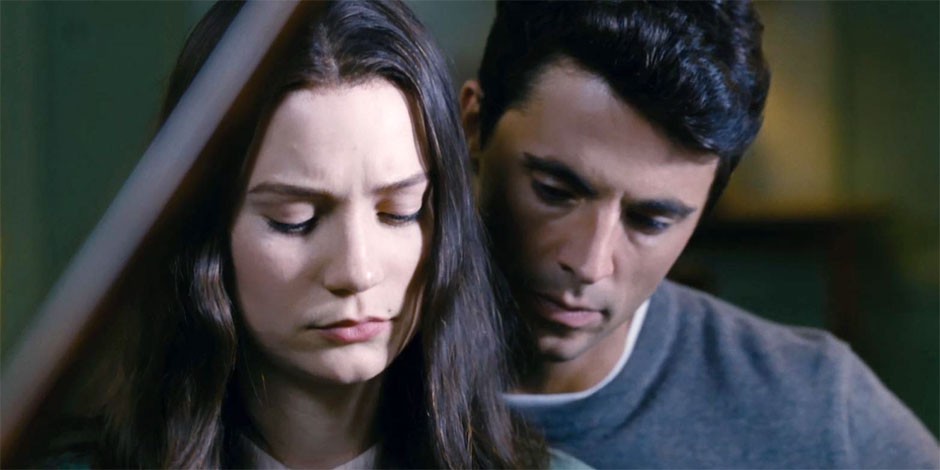
Stylistically, Stoker is perfectly delivered: Park uses his actors and his camera to fantastic effect, multiplying the story’s already considerable creepiness. There is a gothic fairy-tale quality to the images, and the acting is just the right side of the uncanny valley – the protagonists we’re watching aren’t your usual, Hollywood (faux-)naturalistic characters, they’re broken, alien and insectile, with Matthew Goode standing out especially.

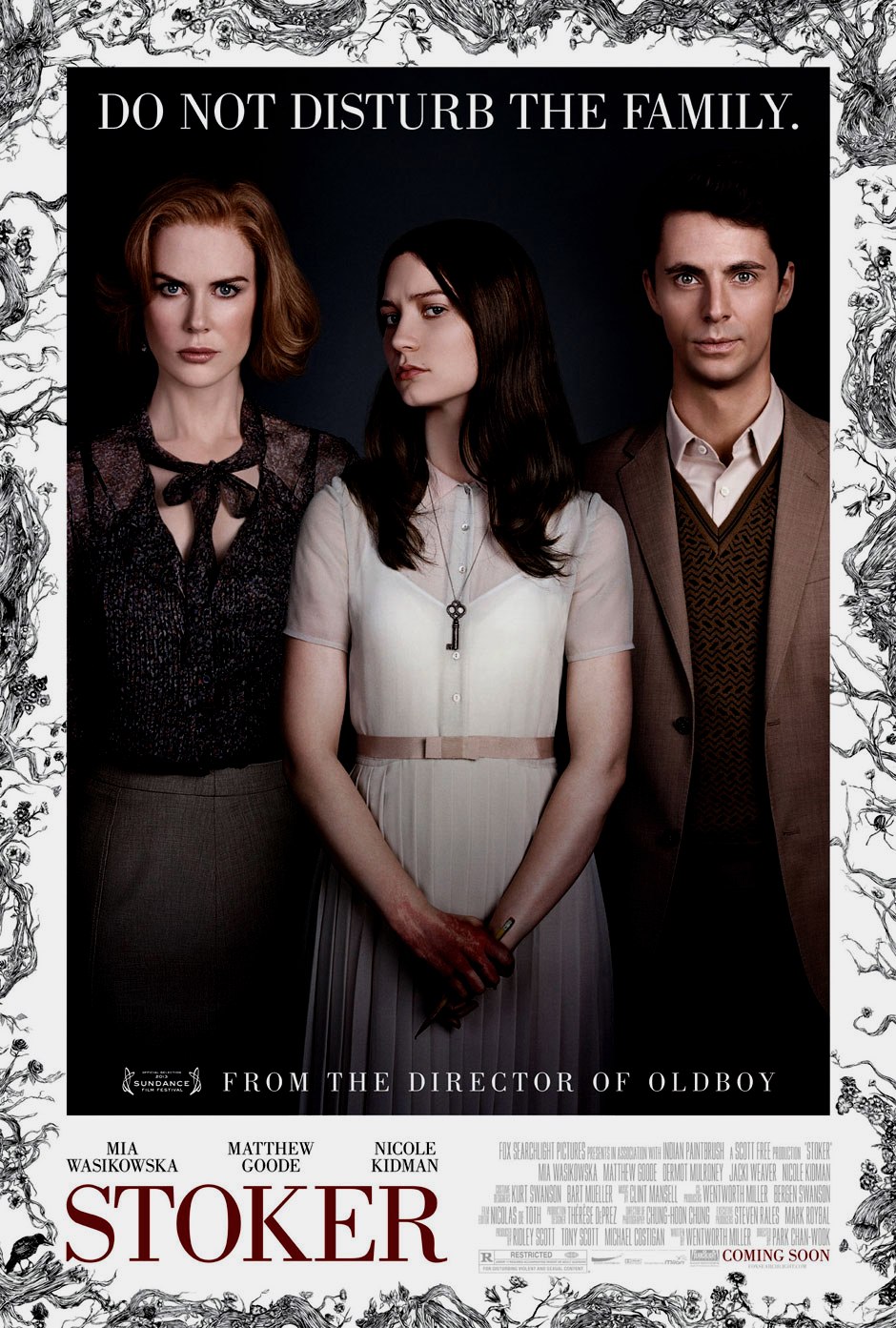
Stoker_Movie-Poster-2013It’s exactly these qualities that make it easy to admire Stoker as a stylistic achievement but difficult to care about, though. Park’s earlier films often featured emotional and physical extremes; they weren’t gratuitous in their violence, but they didn’t shrink from disturbing cruelty and Grand Guignol situations. However, at the same time Park’s directorial eye has been more sympathetic in the past: he wants us to sympathise, quite literally, with his broken characters seeking vengeance, salvation and a measure of peace. In comparison, Stoker features two protagonists especially that fall somewhere between, or even straddle, the sociopath-psychopath divide.

This doesn’t make the film less fascinating to watch, but it makes it less engaging for me than most of the earlier movies. There’s a coldness to Stoker that’s effectively chilling but comes across somewhat like a gorgeously filmed documentary about the predatory habits of praying mantises played out from the perspective of one of these murderous insects. And they’re wearing the skins of Matthew Goode and Mia Wasikowska. And yes, if that image makes you shudder, that’s pretty much what the film does so eminently well.