Don’t take the Shuttle to Eden Lake.

Here’s a complaint. I do like a good horror movie. I think that it can tell me something about human nature by putting its characters into a difficult or even impossible situation of life and death. Many stories do that, sure, but a horror movie takes the direct route to our subconscious and starts digging. It seems to know exactly where to dig, and how deep. What happens to the characters on screen seems to refer to us personally.

I have to admit that the last decade or so of horror movies has set me at odds. I’ve seen Hostel and Saw, and those are just slasher porn. That’s something I don’t mind seeing once in a blue moon, but I really prefer characters I can care about, because it makes that movie just that much scarier and memorable, while stuff like the Saw series, Hostel and many others are, well, disposable horror. They can be watched and then forgotten.
There are two horror movies that have stuck with me because they are abysmally bad not because they are such bad horror movies, but because they try to be more than just horror movies and become ruthless and sometimes careless about their characters, and even reveal some latent racism.

The first one is a British flick called Eden Lake. It is a disgusting film, steeped in sexism, racism and overall misanthropy. The fact that it tries to sneak out of its responsibility makes it also a cowardly film.
Here’s the first half of the plot from Eden Lake in a nutshell. (And don’t get me started on spoilers – here’s a movie you really shouldn’t see.) There’s that couple, Steve and Jenny, who plan on spending a few quiet intimate days on the shore of Eden Lake, in the midst of a large forest in Buckinghamshire, England. Steve plans to propose to Jenny. On the way to the lake, they stop at a roadside inn, where there are parents who verbally abuse their kids and then stare Steve and Jenny down when they look at them in frowning disbelief. They get out of there and camp at the lake shore. It would be a great love getaway for them, if it weren’t for those kids with their boombox and their dog. It’s almost a sideline when those kids hassle another kid who is in the woods collecting insects. They spit, gloat, shout, smoke, drink beer and feel provoked when Steve tries to tell them to keep it down a little. The kids trail off, but slash a tire of Steve’s car. Now Steve is provoked, while Jenny tells him to let it go, change the tyre and leave. Back in the village, they come across the home of the leader of the kids’ gang, Brett, and Steve jumps to the occasion to confront Brett, but finds himself in an empty home, with Brett’s dad coming home from work or a beer run. Dad isn’t pleased that his offspring has punched a fist-sized hole in his front door, and wants to shout at him some. At that point, it struck me that maybe dad has been doing time: beer, tattoos, mean attitude, cruel towards children, especially his own son, who is busy imitating his old man’s behaviour. The movie doesn’t tell, and that is all the psychological depth or motivation you are going to get from this flick. Steve escapes over the roof of the house. Back at the lake the next morning, the couple realize that a bag with their car keys has been stolen. They have to walk back, but come across the kids, and Steve inadvertently kills their dog. Escape scenes follow in which Jenny and Steve have to hide from the knife-toting gang. Eventually, they get their car back, but crash it, which leads to a sequence where Steve is taken captive and tied to a tree stump with barbed wire.
So far, it’s vintage horror, but there is that moment where Brett makes every member torture Steve. That violent moment is where my problem with the movie starts, and for two reasons. First, each member of the gang is egged on by Brett, but Brett seems very reluctant to torture Steve himself. And yet, Brett succeeds in making them do it. Later in the movie, there are numerous moments where any of the kids could have quit and run away. They don’t. Some of them are picked off and killed, some just disappear from the film without explanation. Brett is the charismatic leader who makes his gang do his bidding, but is a coward himself. That is an odd character build-up at best. Eden Lake shows a lot of graphic violence, but at the same time apologises for it by showing most of the kids being bullied into it against their will, while the bully himself is of two minds about his own orders. Once I subscribe to the violence in a movie, I don’t expect the movie to chicken out and apologise for it. If it does, the violence becomes gratuitous, the very thing it pretended to avoid. Eden Lake has no idea what its stance on juvenile gang violence is, but is all about exactly that. I don’t want to be confronted with torture and slice’n’dice scenes and then be told that, sorry, that is just the way it is with pissed-off idle teenagers today. Eden Lake would be well-advised to not fake any character motivation at all than to shrug its shoulders about the violence it shows.

The second problem is an ethnic one. The only character who seems eager to cut Steve’s face is the kid with African-American background, and he does not have any lines at all. Doesn’t it make you angry that the guy with the most inclination for violence is black? There is one other kid with a minority background, and that’s the bug kid with Indian background that the gang harassed earlier on. His name is Adam, and he is bullied into luring Jenny into a trap. He succeeds, and Brett says thank you by pulling a car tire over his head and setting him on fire. While one non-white kid is a mute slasher, the other non-white kid is a helpless nerd who is used as bait and then set on fire. Oh, and did I mention that there is a girl in the gang who apparently serves two purposes, namely that she can complain that Steve is staring at her boobs and later film all the violence with Brett’s cell phone?

Steve dies at some point, which leads to Jenny running, hiding or clutching the defensive weapon of opportunity to her copious cleavage. The camera makes a point of showing off her blood-soaked, gunk-stained cleavage in her bra-less summer dress. Now I know that the maiden lost in the woods is one of the oldest set pieces of horror stories, and I don’t have a problem with the female form, but the movie accentuates Jenny’s breasts from every possible angle so that I felt like a voyeur, a situation I don’t feel comfortable with. Jenny’s breasts are hardly the point of the last half hour of the movie, but while she has to slash her way back to safety, it sends a sexist message: have a look at Jenny disembowelling some juvenile delinquents in self-defense, but do not miss out on her capacious cleavage. And learn this: Jenny’s psychological dilemma seems to be that, as a teacher, she likes kids, but now must overcome her fondness by slashing some miseducated specimens.

If you think this review is full of spoilers, bear with me. Jenny finally finds her way back to the village and tries to get help from some people at a garden party who turn out to be the parents of some of the kids – and the very parents who verbally abused their kids at the roadside inn. The point here must be that in this village, there is not one single good person. Brett is also at the party, as if it was the evening of another day out with the gang. He is the one who tells everybody in the room what Jenny must have done: She is responsible for the death of some of the kids whose parents are at that party. And let’s not forget the dog, who apparently was one of a set of two bloodhounds. Do the parents question Brett how he knows who Jenny is? No, they start threatening Jenny and want to make her pay for killing their kids. They make clear that no-one will call the police, and one older guy, I think it’s Brett’s father, forces Jenny into the bathroom for a shower. The implications are obvious: we are going to give you a bath because once you are clean, we will abuse and rape you for what you have done to our offspring. (Note that the women seem to, if not to partake, then at least to greenlight, the gang rape the men in the room are about to commit.) The movie doesn’t show us any such scene, but cuts to Brett who is standing alone in front of a mirror, looking first at himself and then at his cell phone. Oh my god, is that remorse? No, of course not: he erases all the snuff files on his cell phone. The implications are also clear here: Brett erases all the traces of knowing Jenny and might, in all likelihood, join in the abuse. Here, the film fades to black, and the credits roll. For the last time, the movie chickens out of its own violent implications.

I have nothing against extreme violence in horror movies, or any other kind of movie, for that matter. Only here, in Eden Lake the unclear stance on violence sabotages the whole story, and it clearly weakens the characters who are off-the-shelf to begin with. Eden Lake has to suffer questions about its latent racism and sexism because it inserts these issues, but pretends it is not about any of them at all.

Some movies approach human nature by carefully describing and sometimes questioning all those things that may make us human. Horror movies zoom right in by undermining any certain answers to what makes us tick by taking away some aspect of a person: common sense, health, empathy, and twists that lead to something uncanny. Done the right way, that’s the source of a horror movie’s scariness. At a very basic level, Eden Lake left me stranded because I didn’t know what to make of the characters. There is precious little to go on to start with; if a movie undermines everything that it has set up, it cannot be taken seriously. If it also makes an issue out of questions of race and gender without somehow consciously taking position on them, it goes beyond lazy filmmaking and introduces questions about race and gender it feels it does not have to answer. There is no humanity in this movie: every single character either kills or is killed, sometimes both. That would be the key ingredient of film noir, but Eden Lake doesn’t seem to know that, either. There is a thin line between horror and disgust, and sadly, Eden Lake really only gets the second one right.

Shuttle is an American production, but with two British actors starring as baddies. It raises similar questions as Eden Lake: It’s about a group of young travellers who catch the red eye back from Thailand or somewhere. There is no bus and no underground, it’s raining, the airport is just too drab, and the next shuttle will be in a few hours. Help turns up: there is a private shuttle offering them a ride home for less money. The teens eventually accept. Big mistake. They get picked off one by one, only to find that the driver of the shuttle has to let the two girls survive, make them bleach their hair blond and stand in white high heels and white underwear in an empty subterranean garage, where an anonymous guy comes and has a look and decides which one of the girls is to his liking. The movie does not tell us who this man is but, once again, can he be anyone else but some perverted creep with a fetish for the very bright end of the colour spectrum? The audience is left with implications as to how that man will make use of the surviving girl; Shuttle, like Eden Lake, stops short of being consequent and veers away from the thing at the bottom of the rabbit hole. That’s cowardice. The last plot twist is that the driver takes some kind of twisted pity on the girl and, instead of delivering her into the serfdom of some fetishist, puts her in a box with food and kitty litter and has her delivered to Asia in an overseas ship container. She might get to live.

The end of Shuttle seems to suggest one of two things. The first one seems to be the driver’s perverted pity of deciding the girl’s fate by locking her up and hauling her halfway around the world after a torturous journey that will take weeks if not months and might very well kill her. The second implication is a more personal one, and I don’t have solid evidence that the movie really wants to purport this message, but it seemed to me that Shuttle, with its very last shot, tries to comment on human trafficking. See, the Western world seems to import a lot of Asian women for prostitution, which is so wrong, so why not have a Western girl shipped the other way around?

There are curious familiarities between the two movies. The driver from Shuttle is played by Tony Curran, who has starred in a movie called Red Road. Its director, Andrea Arnold, has directed another movie called Fish Tank, starring Michael Fassbender, who plays Steve in Eden Lake. Fish Tank is a good movie, and I can recommend it as a social drama, but there is also Red Road, which can be taken to be a very good horror flick, but it is certainly more than that. See it if you can.
Seeing through the eyes of a gamer – and an announcement

There are some games that, while I’m playing them, change the way I look at the world around me. I remember times spent playing real-time strategy where in my mind’s eye I’d draw selection boxes around the people I’d see, or around a herd of sheep, and I’d plan out strategies of where to send these people to do my bidding. (I was young and silly at the time.) Or, when I was a teenager and had to bike to school, I’d see everything through the lens of the X-Wing and TIE Fighter games, zooming down the deathstar trench and evading incoming laser fire. Yes, I was and still am a geek.

One of the games I’ve been playing a lot of lately, Assassin’s Creed II, has definitely taken hold of my visual cortex – not least because of where I live. Check out these videos from the first and second Assassin’s Creed games, taking place in medieval Acre and Renaissance Venice respectively:

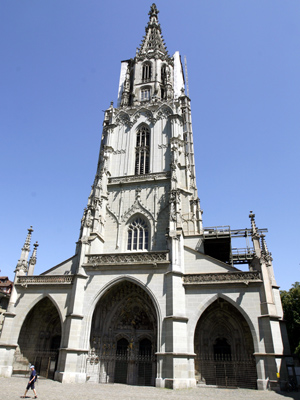
Living in Bern, I can’t help looking at the 17th and 18th century architecture and thinking, “Hmm… If I jumped up there and grabbed that ledge, then pulled myself up there and did a leap over to the other side… and the spire at the top should give me a great vantage point from which to plan my next assassination.” (Note: by ‘assassination’, I mean ‘shopping spree’. Or ‘cuddly kitten’. Or something else that’s inoffensive and doesn’t make me sound like a psycho.) Frankly, though, I think there’s only a slim chance that Assassin’s Creed III will feature the best of Swiss sandstone architecture – although Swiss banking would fit in nicely with Assassin’s Creed‘s conspiracy storyline.

More importantly than my geek musings, though, I’ve got an announcement to make that’s been a long time coming: a friend of mine will be posting book reviews on Eagles on Pogo Sticks. I asked him ages ago but then never got my act together. No more excuses, though – please give my friend a round of applause as he gets ready to introduce himself.

You better show Don Bartlett some respect, paesan!

Ah, The West Wing. Part political drama, part Whedonesque comedy (replace the supernatural or sci-fi elements with politics), part character-driven melodrama, part actors’ showcase. Part pinko liberal wish fulfillment.

I enjoyed the series from the beginning, but after lots of HBO fare season 1 often looked pedestrian in comparison. Great dialogues, great acting, but does TV have to look like TV, namely drab, conventional, boringly shot? Even dialogues can be filmed more interestingly – and no, WFTF (Walk Fast Talk Fast) doesn’t make for interesting cinematography after the nth time it is used.

We’ve now arrived at the end of the third season, and while the series hasn’t aspired to the cinematic heights of The Sopranos or Carnivale yet, it has definitely had its cinematic moments – and none more so than the season 3 finale. Not only do we get Shakespearean scenes of plotting in the shadows (okay, that’s dramatic rather than cinematic – but the dark-light contrast still looks as good as it did when the German Expressionists used it), the entire ending takes not just a page but entire chapters out of the Godfather playbook. Jed Bartlett watching a rousing Edwardian song during a performance of The War of the Roses (entire US administrations could rise and fall during the time it takes to perform all of these plays) while US operatives ambush and assassinate a Middle Eastern defense minister… The only thing missing is a few strains of Nino Rota and possibly a horse’s head, although reports have it that there was a shortage of good horses, in parts or otherwise, during Shakespeare’s history plays.

For all the homages in “Posse Comitatus”, the one scene that stands out most in my mind is the one that is quintessentially West Wing:

Give me such a scene and I’ll become a US citizen just to vote for Bartlett!

P.S.: Was “Posse Comitatus” originally broadcast before every single series decided it needed a sad scene set to Jeff Buckley’s version of “Hallelujah”?

I am not Prince Dastan, nor was meant to be…

In storytelling terms, Prince of Persia: The Sands of Time – the game, not the film of the same name – is quite possibly the most elegant game I’ve had the pleasure to play. It’s not deep, it’s neither Ulysses nor Shakespearean tragedy nor Moby Dick, but within the medium it tells a story, tells it well and does certain things that would be difficult to pull off as nicely in any other medium. Differently from the film, it also knows throughout that it’s basically a tale from the Arabian Nights. It doesn’t try to complicate things. It’s straightforward, and in that straightforwardness it finds a grace the film can only dream of.

There’s something ironic in Prince of Persia: The Sands of Time – the film this time – being more video game-like than the game that spawned it. It features a dagger with a big red button (okay, it’s a ruby, but it’s basically a button on a sharp, pointy gamepad) without even a sense of self-awareness. It does the whole slow-motion thing just to look cool. It has big-name actors called in to do very little of interest, but in grandiose RP accents.

What it mainly has, though, is a director who doesn’t know how to direct action in an interesting way, who doesn’t even seem to be interested in action scenes – which is fine, if you’re directing, say, Donnie Brasco (which I still like a lot), but I already thought that Mike Newell was the wrong man for Harry Potter and the Goblet of Fire. Funnily enough, that film felt like a video game to me: in this level, you need to retrieve the golden egg, in that level you must free your friends from the mermaids’ realm, and in the final level you must navigate the hedge maze and face the boss enemy. (Thing is, levels are okay in games, but in movies they make for clumsy, mechanical structure.)

There are many action setpieces in Prince of Persia: The Subtitle of Subtitles – but they’re largely handled in a clumsy way that breaks the flow when that is the last thing you want to do. Have a main character whose talent is for parkour? Don’t film and edit the scenes in a way that makes it hard to believe the guy is actually doing all those tricks. Tighly controlled continuity is key in such scenes (Casino Royale did this pretty well in its Madagascar sequence), but Newell insists of cutting after an acrobatic movement’s already begun and/or before it finishes, so what we get is disjointed staccato scenes that have as much flow as mud.

What is just as sad: the film aims for charming banter between its two main leads, but much of the time I found myself thinking, “The game had better banter.” Disregarding the plot differences between film and game (and there are many), if a computer game has banter that is better written than that of its big screen adaptation, you need to get a better script. I wouldn’t go so far as to say that Prince of Persia: The Thingamy of Doodah featured horrible writing – it was serviceable for most of the time, but it was oh so plodding. It was clunky. And whoever okayed Ben Kingsley’s lines and then decided to give him the direction, “Act as if you want the audience to find out you’re actually the villain five seconds into the movie”… Well, as I said: I don’t think that Mike Newell was the right man for the job. He wasn’t even the right man for the non-action scenes. And I’m starting to think that Donnie Brasco was a fugazi. Fuggedaboutit.

P.S.: One of my favourite parts of the game – the story is told in retrospect, by the Prince who has already lived through the adventure and is trying to convince the Princess of his tale. (Great reverse Sheherazade move, that one.) When his tale comes to the point where he falls to his death, is impaled by spikes or cut in half by a spinning blade (due to player carelessness), he stops himself and goes, “No, that’s not right. I didn’t die. Let me retell this part.” He basically retells those bits until he gets the storytelling (and the player the moves) right. Lovely touch of meta.

Arrivederci Roma!

The second season of HBO’s Rome was… well, let’s say that it was less than it could have been. Its main problem was this, it would seem: the series creators realised that Rome wouldn’t be back for a third season. Seeing how they had planned for a five-season arc, they were faced with a dilemma: should they speed up the plot so they could bring it to some semblance of an end, or should they let things play out at the pace they had planned and risk leaving us with yet another Carnivale or Deadwood, ending way before it was finished?

They decided to go for the first option, telescoping their plot for the hoped-for seasons 2, 3 and 4 into the second season. And that’s pretty much what the season felt like: four or five episodes into the story, someone suddenly pressed the Fast Forward button, and off we go like a rocket sled. Pacing? That’s for wimps and people whose series are allowed to run their course.

I remember how frustrated I was especially with Deadwood, where we got three quarters of a complete story. It was as if someone had ripped the last 100 pages from a novel, from every copy ever printed. And then they’d deleted the last 100 pages on every backup of the manuscript. Okay, I realise how thinly stretched the simile is – but the point remains: an unfinished story is a frustrating story.

What is similarly frustrating, though, is a story that doesn’t have time to pace itself. At times the second season of Rome felt like its own “Previously on”: okay, now Brutus is dead! Now Anthony’s in Egypt! Now Servilia’s offed herself! Most of the main characters are dead and have been replaced by twenty-somethings! The kids get half a dozen years older over night! This rushed feel wasn’t necessarily helped by the series’ replacing the young man who had played Octavian with another, slightly older young man playing the same character – while practically all other characters around the same age were still played by the same people!

The letstelleverythingasquicklyaspossiblesowecansqueezeasmuchplotintothisaswecan approach meant that we found some sort of closure, but it also meant that the characters lacked breathing space – and as was the case with so many HBO series, the characters is where it’s at. Brutus’ death, for instance, was still moving, but it could have been infinitely more so with a more generous build-up.

The last episode, though? We were rudely jarred out of Fast Forward, but that meant that at least we had an hour where Rome was returned to its former glory. I admit, I was never too keen on the character of Marc Anthony (as portrayed by James Purefoy): he had all the arrogance and cockiness but little of the charm, which made it all the more difficult for me to understand why certain characters would fall for him. Cleopatra, too, annoyed me more than anything else, striking me as an antique oversexed bimbo with the personality of a urinal.

Give these characters good, meaty deaths, though, and suddenly they become grandiose, they become tragic. They gain the ability to move us. And boy, did they take that opportunity and play it to the fullest. A couple of series have done this: make me care about a character just to kill him or her off – but here it wasn’t a cheap ploy to make us care, it was earned. Anthony and Cleopatra’s deaths, while not the near-perfect scene that Julius Caesar’s murder was, count among the series’ strongest moments, together with the death of Cicero and Lucius Vorenus saving Titus Pullo’s life in the arena.

In spite of the whiplash-inducing pacing problems of the second season, I miss the series. I miss the characters, I miss the plotting and intrigues, I miss the visceral quality of the language and imagery. My hope lies in the Rome movie that is still much more likely to happen than the fabled Deadwood film that’s supposed to wrap up the story. Hey, if HBO can greenlight Sex and the City 2, can’t they spare a few sesterces for Pullo and Vorenus, the most beautiful love story to grace the small screen in years?

Good things come to those who wait…

… but that doesn’t necessarily mean that good blog posts do.

I wanted to write about Happy Go Lucky, the Mike Leigh film that in some ways feels like the flipside to his Naked. Put the film’s main character Poppy together with Naked‘s Johnny (played to horrific perfection by David Thewlis) and you’ll get one of those matter/antimatter explosions obliterating half of London.

However, I didn’t want to write about the film immediately. I wanted my impression of it to settle. I needed some time to think about it.

About a month down the line I realise: I don’t remember the film all that well. That’s not quite true, mind you: there are scenes I remember extremely well, mostly the ones including Poppy (Sally Hawkins is pitch-perfect, and as a result veers sharply between endearing and irritating as hell) and her driving teacher Scott (Eddie Marsan deserves to have more of a career – he’s obviously no Brad Pitt, no hit with producers, but the guy has impressive acting chops). But the film has settled in my mind, a bit like soggy Weetabix. (Weetabixes? Weetabixi? Weetabixae?) And writing about it now, even if I were to highlight how compelling the relationship between Poppy and Scott is and how it develops subtly, suddenly becoming something very different… Well, I don’t think I would be doing the film or the actors all that much justice.

So, what do I learn from this? Mainly not to wait for weeks before doing a blog entry. Not to start up whatever game I’m playing at that time before I’ve done my writing. Not to be lazy and complacent. For now, though, I’ll leave you with one of the aforementioned scenes from Happy Go Lucky:

P.S.: For the record, whether my impression of the film has turned to milk-sodden mush or not: Mike Leigh, man, you need to find someone else to compose the music for your films, because the score for this one is twee and feels like reheated music for one of the more soporiphic Brit sitcoms from the ’60s. If I ever bump into you, I may just go off on a Johnny-esque rant about how insultingly bad the music in Happy Go Lucky is. So, if you wish to prevent that from happening, however unlikely it is, dump your composer. You’ll thank me.

The internet is for (green) porn

Okay, I’m still working up to that epic blog entry on Happy-Go-Lucky (now it can only be a disappointment, can’t it?), but in the meantime I want to keep you guys diverted… so here’s some deeply weird shit, courtesy of Ms. Isabella Rosselini. This woman was once an item with David Lynch, but these films make me think that she could outweird David any day of the week, and twice on Sundays. (Just don’t get D-Boy started on transcendental meditation…)

So, without much further ado, witness the true horror of the sex lives of whales, slugs, spiders etc. It’ll make you wonder how you could ever live without having seen Isabella dressed up as a whale with a 6ft. penis.

How the West was won, pixel by pixel

Nothing big to add here – I’m still working on a blog entry on Mike Leigh’s Happy-Go-Lucky in my mind (these things take time, and it’s not as if the film’s already years old), but since I’ve posted the odd entry on Ebert’s big “Video games cannot be art” shtik, I wanted to post this link: The Observer has two gamers and their regular film critic Philip French give Rockstar’s Red Dead Redemption a whirl. French is obviously not a gamer, but he knows his films, and it’s good to read a critic who’s at least willing to take the artistic potential of games seriously. He doesn’t use the A word, but that’s fine – any discussion of art that circles around what art is tends to vanish up its own backside anyway.

And now for some heavy-duty shilling of the game, because it does look quite good – western fans take note, and don’t be put off by the sucky stills below: