Lookin’ good… but does it add up to anything?

For me, Michael Winterbottom is rather hit-and-miss. I usually like the atmosphere of his films, but at the same time they tend to leave me somewhat cold. Intellectually and aesthetically I appreciate them, but I rarely care.

Tim Robbins in search of a script that makes more sense

Code 46, his foray into near-future SF (sci-fi, that is, not San Francisco), had exactly the same effect on me. It’s beautifully shot, its digital imagery more evocative than any version of the future I’ve seen since Blade Runner – more so because the futuristic effect is subtle. Winterbottom’s future is our present, just more so.

But this is a film that struggles to be a mood piece, or perhaps video art. I enjoyed looking at it, but I didn’t particularly enjoy watching it. Certainly my difficulty following the plot largely stemmed from the bad mix that left half the lines unintelligible, which wasn’t helped by the fact that in the near future, apparently everyone speaks English mixed with Spanish and other languages. But if the plot is as simple as I think it is (and the reviews I’ve read since watching the film seem to support that theory), then it doesn’t hold up very well, really. Tim Robbins’ investigator falls hard for the once more waif-like Samantha Morton who is suspected of stealing genetic passports that allow people to travel to places that would otherwise be off-limit to them. It turns out that she’s cloned from his mother’s genetic material, so their relationship is a criminal offense. Wacky hijinks ensue.

Trés artistique, enh?

I usually like elliptic films – I like not being led by the hand, whether by movies or by books. But sometimes ellipticness seems to be a cheap excuse for vague writing, directing and acting. The film intrigues intermittently, but it rarely follows up on the intriguing bits: for instance, William Geld, Robbins’ character, has his memory of  Maria Gonzalez (Samantha Morton) erased at the end so he won’t resume the genetically dangerous relationship. He goes home to his child and his wife who knows of the affair but cannot ever tell. There’s an interesting story in that. Unfortunately, the film focuses on William and Maria but never makes their attraction credible. We know that they have feelings for one another because of how they act, yet we never feel the emotions. Their love or passion or horniness or whatever it is, it remains an idea.

And frankly, I am getting somewhat annoyed with Samantha Morton’s acting, or perhaps rather with the characters she’s offered. She has this patented wild-child thing going that makes her come across as slightly funny in the head, or as someone who doesn’t do social conventions at all. But the longer the more it feels like an affectation, like a neo-punk letting us know very clearly how different she is. I could imagine that this is what attracts a number of indie directors to her, but it’s becoming tiring.

Then again, I shouldn’t forget that she was also in this:

P.S.: Code 46 was written by Frank Cottrell Boyce, who also wrote Millions. I guess I may prefer his children’s books to his adult movie writing. The Claim, which he also did with Winterbottom, shares this film’s vagueness and coldness.
The death of Cranes

Today’s blog entry is about Japanese poetry.

 Not.

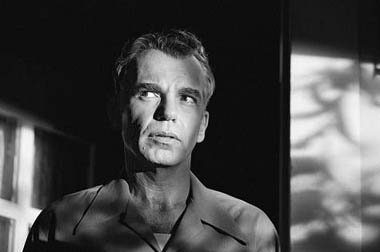
The Man Who Wasn’t There isn’t usually one of the films by the Coen brothers that people mention first. You’ve got Fargo people and you’ve got The Big Lebowski people, and sometimes you get an elitist or purist who swears by Blood Simple. Then you’ve got the ‘bad’ Coen films that most people agree to be substandard: Intolerable Cruelty, The Hudsucker Proxy (which I’ve never seen), Ladykillers. For some reason, TMWWT falls under most people’s Coen radar.

There he is! (Or is he…?)

Which I don’t get. I saw the film yesterday evening, perhaps for the fifth or sixth time, and it gets to me every time. In terms of sheer craft, it’s up there with the Coens’ best: the black and white cinematography is gorgeous to look at, as rich and evocative as the best film noir. The music – half Beethoven, half Carter Burwell (the Coens’ regular composer) – is simple and subtle, yet spot on. The script deftly intertwines film noir elements with the absurdity that many of the brothers’ films have, so that the references to ’40s and ’50s sci-fi do not feel out of place (unless you’re a stickler for Generic Purity(tm) – in which case the Coens are probably not to your taste anyway).

More than every other film by the Coens, I find that TMWWT mixes the comic and the tragic beautifully. The sort of postmodern game that they tend to play in their movies is tricky: the films foreground their parodic elements, they revel in their artifice. This film isn’t different: consider, for instance, the scene after the wedding, where Ed puts the drunk, sleepy Doris to bed, and the voice-over starts the story of how they met and got together. This is interrupted by the phonecall that leads to Ed killing Big Dave (James Gandolfini, with more than a touch of Tony Soprano), but afterwards Ed comes back home, sits down on the bed again and continues the Ed & Doris story as if nothing had happened.

No man there, definitely…

Perhaps more than the other films by the Coen brothers, TMWWT doesn’t shy away from pathos, even if there’s always the element of humour. One of the scenes with the Cranes’ arrogant, egomaniac lawyer Freddy Riefenschneider has Ed basically confessing to the killing in front of Riefenschneider but, more importantly, in front of his wife – and she realises what has happened and that Ed knew about her affair. Frances McDormand’s acting, without a single line, is masterful in conveying her heartbreak.

The film’s handling of tones and styles culminates in its final scene – a scene that only the Coens could have pulled off. If you haven’t seen the film, don’t watch the following video. If you have seen the film, watch the scene and then go and watch the film again. You’ll find gems that you may not remember.

Burial blues

I’ve had the DVD of The Three Burials of Melquiades Estrada for over a year now, but we finally got around to watching it yesterday evening only. What a weird film! I think you can clearly see the ways in which it’s related to Guillermo Arriaga’s other scripts Amores Perros, 21 Grams and Babel, directed by Alejandro González Iñárritu. There’s the playing with chronology; there’s the themes of migration and alienation; there’s the transnational cast of characters.

Melquiades Estrada, three burials earlier

In terms of tone, though, there’s a difference. Iñárritu’s films may be highly constructed and symbolic, but in terms of the acting they are firmly grounded in naturalism. Tommy Lee Jones’ first cinematic film, on the other hand, isn’t. I’m not quite sure what it is grounded in – theatricality, perhaps? Brechtian V-effect? Some of the acting feels more like the actors are wearing an emblematic mask: I am sad and distraught, I am bored, I am frustrated. The first half hour of the film, Tommy Lee Jones’ character looks like he’s about to burst into tears – and it doesn’t change.

The weird, unsettling thing is, though, that once you’ve eased into the film’s style, it’s oddly compelling. We’re so used to naturalism and, even more, Hollywood’s mock-naturalism that we expect filmic reality to have a certain style. When we get a film that visually seems to be realistic but the acting is stylised, it’s disorienting. My first thought was: the acting in this film is really, really bad. My third or fourth thought was: there’s something to it. And by the end of the film I’d fully accepted the style.

It’s also a beautiful film to look at, and an intricately written one. There are elements that are too broad, perhaps, such as all the Mexican characters being portrayed as proto-Communists willing to share any- and everything. (“Mi caballo es su caballo”, that sort of thing.) Some of the satire is heavy-handed. But then there are scenes that develop in strange, unexpected ways: the old blind man who asks the protagonists, quite reasonably, to shoot him (see the video clip above). The Mexican cowboys sitting out in the wilderness, watching American soaps. The ways in which Jones’ character deals with Melquiades’ increasing putrefaction. And the ending, which stops just at the right moment.

But, man, what a weird film!

All this, and smiles too

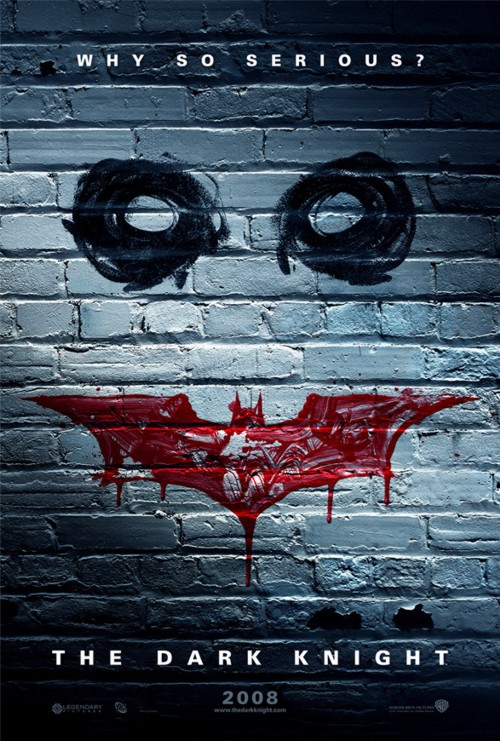
This’ll be a short one – it’s for the film buffs reading this who don’t frequent Ain’t It Cool News. I think it’s one of the coolest teaser posters in a long, long time.

Ha, ha, hee, hee, ha, ha!

There’s also a description of the first five minutes of the movie online, available here. I can admit that the Chris Nolan geek in me gets all excited at this.

Godfather of Funk

Last night we watched The Godfather Part III, for completeness’ sake. When I first watched it, I’d been prepared for something abysmal, so I ended up thinking it wasn’t very good but neither was it that bad. Rewatching it, though, I hardly could believe that it was made by the same people who’d worked on the first two Godfather movies.

Enough has been said about Sophia Coppola’s horrible acting in the film, and it’s a good thing that she’s decided to continue her movie work on the other side of the camera. What struck me this second time was how un-cinematic the film is. Both The Godfather and its first sequel are beautiful films to behold. They have an “Old Masters” glow to them. They look like they come from Hollywood’s glory days.

The Godfather 3, by comparison, looks dowdy. They’ve got some nice sets (or they were allowed to film in gorgeous interiors) – but they’re all presented very flatly, and this flatness is heightened by the often pedestrian editing. Granted, there are scenes that look good and that are edited well, but then there are so many others (especially in the half of the film before they go to Sicily) that feel like ’80s television. Especially dialogues are edited with no feel for tension or flow: character A has a line, finishes it, cut to character B doing his or her sub-standard line, cut to character A again. Yup. Bad television editing.

Checking out IMDB, I find it amazing that the film was nominated at the Academy Awards for its cinematography and editing, and I can only believe that the nominations were the Academy’s form of commiserating what had happened to the venerable series and the equally venerable craftsmen working on it.

But I have to wonder: what happened to the Francis Ford Coppola who directed the first two Godfather movies? Or Apocalypse Now? Or The Conversation, a masterfully told tale of paranoia?

P.S.: I don’t get the praises and nominations for the writing either. If the previous Godfather movies were Shakespearean, this one was largely day-time soap… and its attempts at political intrigue were muddled, implying larger schemes but ultimately feeling like so much sound and fury signifying nothing.

Twins 2: Starring Martin Scorsese and Woody Allen

I’m afraid you’ll have to wait a bit longer ’till I start going on at great length about the films that didn’t click for me. You have my sympathy, though; it can’t be easy waiting even longer for something that highly anticipated… (On a related note: Amazon recently sent off my copy of League of Extraordinary Gentlemen: The Black Dossier, according to the Moore-man “not my best comic ever, not the best comic ever, but the best thing ever. Better than the Roman civilisation, penicillin, […] the human nervous system. Better than creation. Better than the big bang. It’s quite good.” Sounds like something to look forward to.)

Anyway, the reason for today’s delay is this:

(Note: I’m afraid the YouTube video is in Spanish – here’s a link to the English video.)

While it’s probably a bit too precious for its own good, it’s still an amazingly well done advert. But what really throws me every time I see (and hear) Martin Scorsese is just how much he looks and sounds like an Italian-American, less neurotic though just as fidgety Woody Allen. And they both love New York.

Hmm.

Twins, separated at birth? Or are they actually the same person – i.e. Woody had better acting skills than we’d thought, and he’s been working on his Brooklyn accent? My guess is that this is just another one of those Hollywood mysteries that will never be solved. Like Ben Affleck’s success. Or William Shatner’s hair.

Spooky, huh?

Films that didn’t click – the introduction

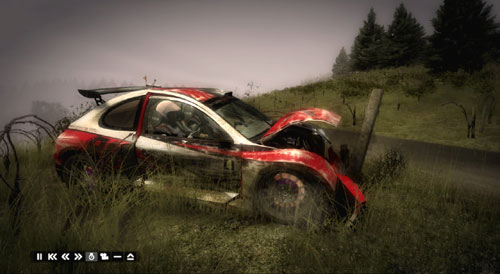
No news on the game front, really; I’m still playing Stalker (pure nukular goodness!), Neverwinter Nights 2 (it’s okay, but I still don’t get the enthusiastic reviews), Anachronox (slowly getting to the end) – and a rallye game called Colin McRae DIRT, best proof that the streets are safer with me off them.

Don’t drink and drive. Or, in my case, don’t drive.

I also haven’t watched any new films (or rewatched old ones), so I’ll take this opportunity to write about films that I expected to like – but didn’t. Usually when that happens, it’s that I like the director’s previous work a lot, but then fail completely to connect with the film. Or it’s that a reviewer I like gives the film a glowing review that I fall for. By the way, I don’t share the dismissive arrogance many people have when it comes to reviewers – good critics don’t necessarily share my opinions 100%, but 1) they have to recognise what a film is trying to do and 2) I have to know where they’re coming from after reading the review. What I do hate is critics who pan a genre film, for instance, because it isn’t Truffaut, critics who mistake their dislike for a certain kind of story or storytelling for its inherent unworthiness. And with a good reviewer, it doesn’t really matter whether they liked a film or not – I will have a good idea from what they write and how they write it whether I’m likely to enjoy the film.

Before I get started on this in earnest, though, I’ll have to come up with a list of films that fit. I’ve got a few ideas: Punch Drunk Love, for one, and my own favourite, Russian Ark. (Okay, technically that latter one is a “Film that this blogger hated with a vengeance”, but more of that later.) So, tune back in very soon!

P.S.: Films that – ironically, predictably – didn’t click for anyone, part 1:

Birds, rats and iron giants

I like Pixar movies, by and large, but I’m not as over the moon with them as many others. For one thing, I got extremely annoyed with John Lasseter when I got the Studio Ghibli films on DVD and had to sit through his patronising “My dear friend, Miyazaki-san…” and “You are very lucky…” intros; but also, I felt around Monsters Inc. and especially Finding Nemo that they were getting way too sentimental for their own good.

However, I loved The Incredibles. Yes, it also had that “family is the best” vibe that Nemo had, but it was done a lot less sappily. It was sweet but stayed quirky at the same time – and it was a lot darker in parts than Nemo – which basically did the Bambi thing by killing off Nemo’s mother, but apart from that there was little to no edge to the film. The Incredibles, on the other hand? Remember the scene when Mr. Incredible finds out what’s been happening to all the supers? Or the one where he almost kills Mirage? Also, there’s something very real about Mrs. Incredible’s fears that her husband is cheating on her – which is a fear you won’t find in many movies produced by Disney, I’d wager.

I also liked Ratatouille a lot – and there’s a subtle, quiet scene late in the film that brought a lump to my throat. I remembered that lump from another film by the same director: The Iron Giant. More than most directors of animated movies, Brad Bird is a deft hand at mixing the sentimental and the funny, real pathos and sheer goofiness. While Ratatouille is a very different film from The Iron Giant and indeed The Incredibles (the latter two go much more for the iconic, namely ’50s cold war paranoia and superheroes), all three of these films show a subtlety that is rare in American animation, so that a short, simple scene can break your heart.

The Iron Giant

I also liked Lifted, the Pixar short that was shown before Ratatouille. I hadn’t been that mad about For the Birds (shown before Monsters Inc., I think) or the jackalope one (Boundin’), since both of these got on my nerves after roughly one minute (they weren’t quite as clever or loveable as they thought they were, as far as I’m concerned), Lifted had a simplicity of story and design that worked very well for me. So, courtesy of YouTube, here’s Lifted:

In which I revise my opinion on Hollywood’s favourite stick insect (slightly)

About a week ago I was informed by my love that we’d be watching Pride and Prejudice on Friday. Not the BBC six-hour extravaganza – that’s still on the menu for later – but the recent film version with Keira Knightley and Matthew “I’m an MI5 agent – get me out of here!” MacFadyen. Since I’d heard good things about the film, I resigned myself to my fate with rather less grumbling than might be expected. After all, I’m secure enough in my sexuality to watch a Jane Austen film without fearing to catch “the gay”.

No, no, no… It’s not what you may be thinking now. I wasn’t secretly thrilled at the thought of 2+ hours of Keira Knightley being all witty and sarcastic and sexy. Thing is, I don’t find her very sexy at all. She’s not ugly, but a) she’s too girlish and b) she’s too thin. Back when I saw Bend It Like Beckham, I thought that there’s a very attractive woman in this film, and her name is Parminder Nagra. Keira? I wouldn’t mind cooking a proper dinner for her, but that’s about as far as my feelings towards her go.

C’mon… which one would you go for?

Also, I never thought that she was a great actress. All the films I’d seen her in, she was basically the same character: feisty heroine/modern grrrl who can hold her own with the boys. I mean, like, hello! Boring! (Or something to that effect.) However, I must say after watching Pride and Prejudice that there’s more to her, provided that the director and cinematographer and make-up artists and producers don’t keep telling me, “You must desire this woman! If you don’t, there’s something wrong with you!” Her Elizabeth Bennet was far more interesting than any of the other characters I’d seen her as.

In general, the film was surprisingly good. Now that I’m no longer teaching at an English Department, I can perhaps confess that I’m not too keen on Jane Austen. Sure, she’s witty, but I wish she’d written only one novel or perhaps short stories. Admittedly, I’ve only read Emma, but with the Austen film adaptations I’ve seen I always felt déjà vu. The 2005 P&P film has its faults: the pacing is off, with the beginning feeling rather rushed and the middle too leisurely; some of the more modern camera moves and edits fail because the film tries too hard to be “contemporary”; and there’s entirely too much giggling! But at least in the European version, there was something nicely understated about the romance: as a matter of fact, many of the romantic couplings are less about brainless passion than about a mutual liking combined with a sense of pragmatism. Or, in one case, about stupidity. And the film doesn’t try to gloss this over.

Finally, talking of gloss, or lack thereof: while the film looks lovely much of the time, it doesn’t go for the Heritage look where even dirt is disconcertingly clean. There’s mud, there’s geese and pigs (with big dangly man-bits – what a strange scene!), and things aren’t antiseptic. The film didn’t have the picture postcard look, the “Wish you were here in the 19th century with us!” feel that so many costume dramas insist on, and it was all the better for this.

What do you mean, I’m a funny guy?

Okay, lots of work today, so this blog entry will be short on me and long on my favouritest Internet video service ever – YouTube!

Just a couple of clips you may or may not have seen – but if you’re into films, subversion and felt puppets, give these a try:

Or how about this one – computer-generated misery, courtesy of Pixar and Darren Aronofsky:

(If the embedded video doesn’t work for you, try the direct link.)

And thanks to these crazy kids I can pretty much take the day off from blogging – and do the heaps of work that need to be done… Bye!

Quick P.S.: I got a kick out of reading The Onion‘s AV Club blog entry on the Madonna sex vehicle Body of Evidence. (It’s part of their “My Year of Flops” series.) Here’s a quote to get you all wet (why do I think that I’ve just lost 3/4 of my readership?):

”[Madonna’s character] is a beautiful woman. But when the trial is over you will see her no differently than a gun or a knife. Or any other instrument used as a weapon. She is a killer and the worst kind—a killer who disguised herself as a loving partner,” Mantegna thunders to the jury. Now, far be it from me to challenge the veracity of anything said by a character played by Joe Mantegna, but I would argue that the worst kind of killer is one who wears a necklace made out of puppy skulls and a rain poncho made out of the stitched-together torsos of murdered kittens. That, to me, is worse than a killer disguising herself as a loving partner.