Welcome to One Best Picture After Another – where I attempt to watch all the winners of the Academy Award for Best Picture, starting at the very beginning. And attempt to answer two simple questions – is the film still actually any good? And why did it win?
6/10
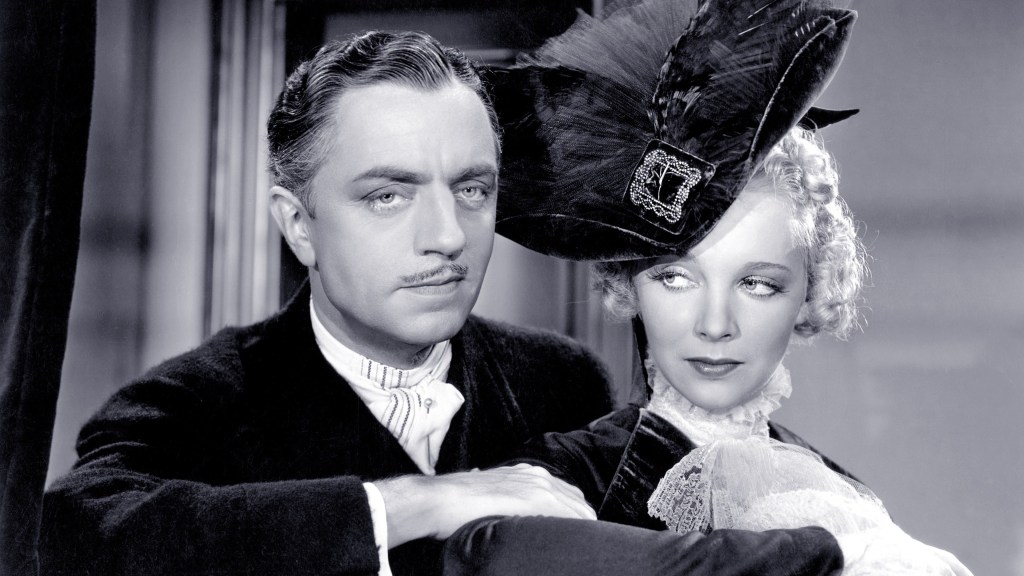
When I first looked through the complete list of films that I’d be watching for this exercise, one of the titles that stood out was The Great Ziegfeld. There was one reason for this – William Powell. He plays the lead in this film and I’m a huge fan of his. Yet despite being someone who long ago fell for the man’s charms, I’d never watched this particular film. Mainly because, unlike the likes of My Man Godfrey, How To Marry A Millionaire and especially The Thin Man, it’s not a film of his that gets remembered and rescreened alongside those classics. Even among dedicated Powell-istas (Powell-ites? Powell-ians?) its reputation is that of a bit of a dud.
So this blog gave me a chance to correct that oversight and watch the film. And, I’ll be honest, its reputation is deserved. For a biographical drama, there isn’t really much actual drama and as a musical it has some pretty vast and expensive set pieces, none of which ever get to feel remotely cinematic.
The central character in the film – Florenz ‘Flo’ Ziegfeld Jr – was, in reality, an impresario who in the early years of the 20th century put on incredibly successful shows. Most notably, the Ziegfeld Follies – lavish revues that introduced audiences to the Ziegfeld Girls. Yet despite his skills as a show promoter and scheming businessman, he spent more money than he ever earned, and he died in debt just a few years before this film was made. All of which feels like the ingredients for a fabulous film about celebrity, the perils and glamour of show business, and yet somehow it just doesn’t work. For someone so recently hugely famous and alive, his biography is surprisingly lifeless.
That’s not to say there wasn’t stuff to enjoy. Powell is always watchable, although his performance feels muted. I felt like he’d been told that this was A Serious Picture – and so some of his more usual goofing wasn’t allowed. The film clearly wants us to like this guy while also making it clear he was unfaithful in his private life and a somewhat dishonest businessman behind the scenes – and Powell is a good choice for that role. He can play a genuine rogue who is also genuinely likeable.
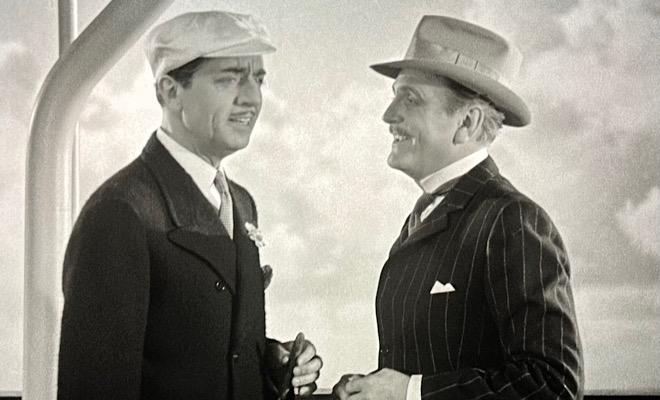
Another highlight is the performance of Frank Morgan as rival impresario Jack Billings, a thinly disguised take on real-life rival producer Charles Dillingham. It’s not a role that would suit an actor with an ego: he exists in this film to continually allow Ziegfeld to be the lead, getting outwitted by his competitor at every turn. And yet Morgan throws himself into it with gusto – allowing Powell to shine while also being just charming enough. This perfectly pitched performance then pays dividends as a sort of friendship develops between the two men, leading to a rather sweet final scene.
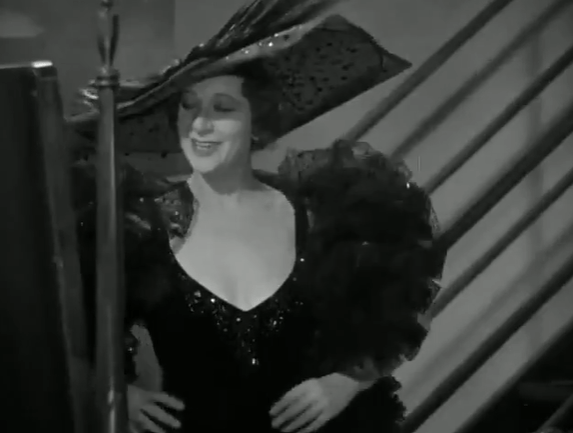
Fanny Brice also appears – playing herself – giving the film a much-needed kick up the arse when she arrives in the final third. I was aware of Fanny Brice as having once been a huge star, without really knowing what her appeal had been. Her no-nonsense, street-smart performance here really shows what that was, and it’s a great addition to the film.
However, this good stuff is more than offset by the less impressive. Both Louise Rainer and Nat Pendleton drop into this film saddled with some grating “foreign” accents. Pendleton especially seems comically out of his depth as a German, sounding like he’s just arrived on set from a sitcom. And the drama never really gets going: scenes often feel too long, and then just when you think there might be an interesting dramatic development between characters – the thing cuts to an extended musical number, and we never see the character again, nor does the idea get explored.
It’s also pretty striking how underwhelming I found those musical numbers. They are – on camera – huge. Massive, expensive moving sets, countless dancers in fabulous outfits, and none of it feels like they’re taking advantage of the cinematic medium. In the film’s defence, it is likely that they were seeking to closely replicate Ziegfeld’s real-life extravagant musical theatre shows, and I’ve no doubt that if you were in the theatre watching all this, it would have been incredible. But I missed the inventive use of the camera as part of the choreography to make a uniquely cinematic experience.
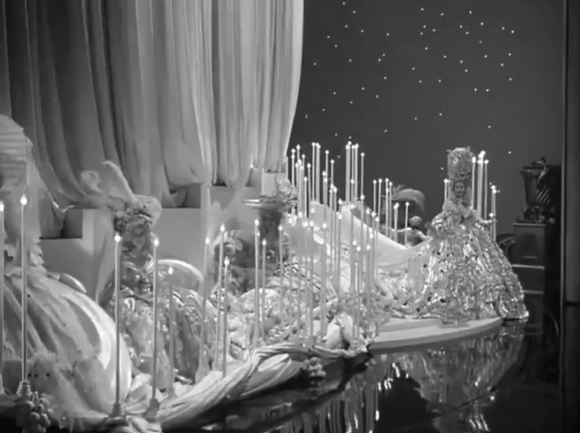
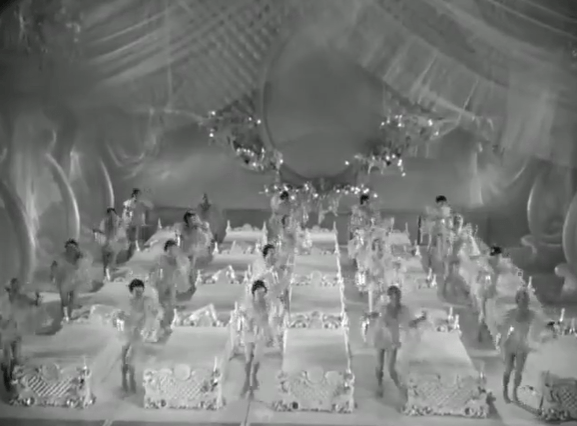
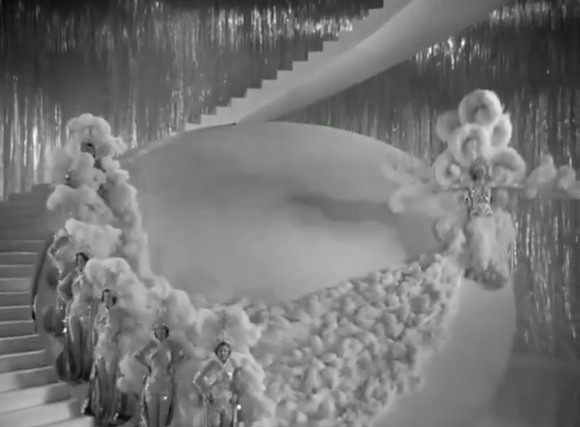
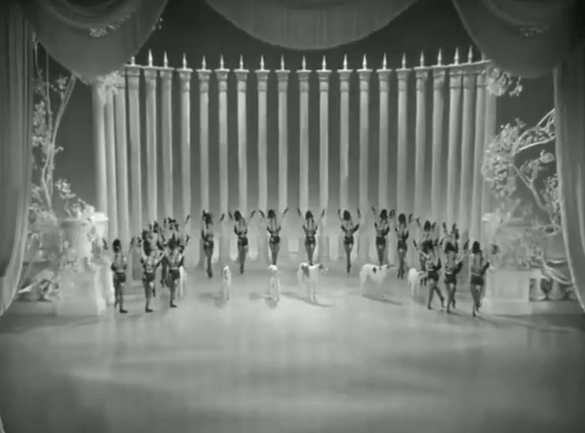
It also should be noted that this attempt to capture what Ziegfeld’s theatrical shows on camera were like also comes with its own problems. There’s a minstrel number in this film, performed in blackface. Seeing this example of a racist caricature, created by racists for a racist audience, strutting across the stage, is jarring, not least because it’s given as an example of the shows that people were going wild for at the time.
Myrna Loy appears near the end to play Ziegfeld’s second (and final wife) – a casting that seems to exist to lure audiences into the cinema to see one of their favourite movie couples on the big screen. Unfortunately, Loy gets virtually nothing to do, and seems pretty bored by the whole venture. I just wanted her to cut loose a little bit, but as with Powell, they both seem muted. I missed the early Thin Man films tremendously whenever they’re on screen.
The film’s final scenes really do hit home what I liked about the film, but also why I ultimately didn’t really enjoy it. There’s a charming scene between Powell and Morgan as elderly producers, indulging each others’ fantasies about still being relevant. I adored this, but then the next scene, in which Ziegfeld dies, undermines it. It’s a truly pretentious final visual, of Ziegfeld hallucinating his achievements while striving for more. It’s a moment that cringes the life out of the film.
Why did this take home the Oscar? For all the flaws I had with the film, it’s certainly grand in ambition and was a huge hit when released in the US. It’s a film desperately wanting the format to be taken seriously when compared to fancy theatrical shows, with an overture and an intermission (here pretentiously also titled entr’acte). Its lengthy runtime would have required commitment – this was cinema as an evening out for respectable men and women, precisely what Hollywood wanted to have been seen as making. The plot has just enough sophistication to feel adult, without anything likely to trouble the censor – and just enough incident to feel like you’ve been told a huge tale as you left the theatre to the fancy exit music. Finally, this was Powell’s heyday: I imagine the Academy wanted to celebrate one of Hollywood’s big studio stars. It’s not a great film in my opinion, but I can see why it won.
 A Damn Fine Cup of Culture