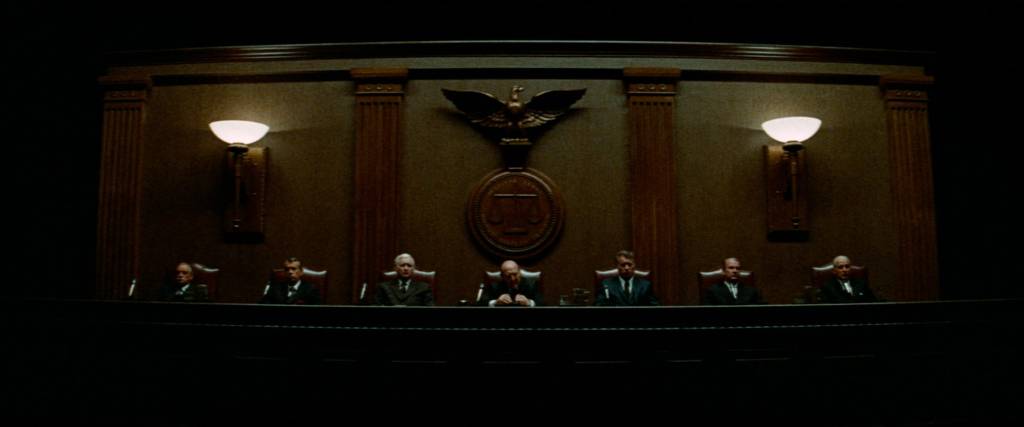
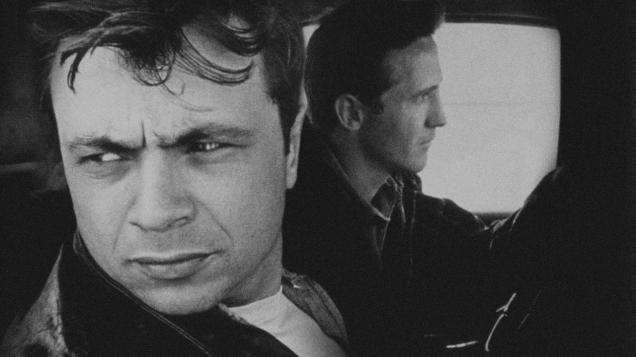
There are a number of classic paranoia films made in Hollywood in the 1960s and 1970s. The Manchurian Candidate is one of these, as is Francis Ford Coppola’s The Conversation.
The Parallax View (1974) by Alan J. Pakula clearly belongs on the list as well. It’s a classic, it’s memorable, it’s iconic. It has its finger on the pulse of a country and a culture where politics and murder have been intertwined for more than a century.
In January 2022, my favourite cinema ran a series of films that they gave the title Mythos Samurai (“The Samurai Myth”). We ended up seeing seven (how fitting!) out of eleven films, from Akira Kurosawa’s Shakespeare adaptation Throne of Blood via the Tarantino favourite Lady Snowblood to Hirokazu Kore-eda’s gentle anti-revenge film Hana – and, yes, Seven Samurai was also among the films shown. It was interesting to watch the films as different perspectives on the same motif: the samurai, the officer caste that protected the daimyo from the late 12th century to 1876. What was perhaps most interesting, however: how many of the films subverted the image of a noble warrior caste. The protagonists of these films were often ronin, masterless samurai who had lost their status, or samurai who doubted the tenets of their caste, and none of them presented a cool, badass ideal for easy consumption. The system that created the samurai was always presented in an ambivalent or downright negative light, even when the films clearly share a fascination with the aesthetics and iconography of the culture.
And that ambivalence towards the samurai, the feudal system they were a part of and the values they were meant to embody is represented best perhaps in Masaki Kobayashi’s Harakiri, a film that is grim and exhilarating, exciting and scathingly critical in equal parts.
Before watching Beau Travail, French director Claire Denis’ 1999 film, I’d seen two of Denis’ films: the 2009 (post-)colonial drama White Material and the 2018 sci-fi oddity High Life. My favourite cinema showed the latter last year as part of a series on women directors, so I went to see it – and came away nonplussed. Certainly, there were scenes that I found intriguing, and Denis’ strange science-fiction tone poem is often beautiful to look at, but I didn’t know what to do with it, and I still don’t. While I had some ideas about the overall themes of the film, it remained too fragmented and elliptic and I felt too much of a disconnect from the characters I was watching and the things they were doing. I could imagine someone else, and perhaps even me at a different time and in a different frame of mind, getting more from High Life, but I left the cinema with a vague sense of frustration – or possibly a frustrating sense of vagueness.
I may not immediately wish to revisit High Life after seeing Beau Travail, but Denis’ film, a loose adaptation of Herman Melville’s novella Billy Budd, definitely makes me think that I should keep looking out for other films by her. I could imagine that the one or the other would leave me similarly nonplussed as High Life, but I can’t think of any other director like Denis.
In 2019 (remember that time, a hundred years ago?), I nursed something of a briefish obsession with “Being Alive”, one of the songs from Stephen Sondheim’s 1970s multi-award winning musical Company – and perhaps like many others, I first heard it in Noah Baumbach’s Marriage Story (2019), performed by Adam Driver. It’s perhaps something of an ironic use of the song: in Company, it is sung by the show’s central character Robert, an attractive but commitment-phobic man who, in the course of the song, comes to the realisation that he yearns for all of those things that make him shy away from an actual romantic relationship. In Marriage Story, the character who sings it is just coming out of a marriage via acrimonious divorce proceedings, and he mourns everything that he is in the process of losing. In spite of the very different contexts, however, the power of Sondheim’s song clearly comes through.
I’ve seen seven or eight films by Akira Kurosawa, but other than Ikiru and Dreams, the latter of which I saw about twenty years ago and don’t remember particularly well, it’s all been the Jidaigeki films, i.e. period dramas set during the Edo period (more or less) and featuring samurai, ronin and the like. Even Ikiru, which isn’t clearly set in the past, feels like it is about the past to some extent, as it is the story of an old man looking back at his life.
High and Low immediately makes for a striking contrast: it is set in the present day in a big city, its protagonists are businessmen and police detectives. More than that, while the film was released in 1963, there are many elements that would easily translate into our present day, and while High and Low comments on class in specifically Japanese contexts, much of its commentary could work equally well outside Japan. All of this comes together to make High and Low feel modern, in terms of the story, characters and the filmmaking itself – even almost sixty years after its release.
Has there ever been a director as Marmitey as Lars von Trier? And, let’s be honest, that’s exactly how von Trier likes it. At least for a while, there were few directors as keen as him to cultivate their own bad boy image. Which in turn makes it difficult to consider his films independently from one’s reaction to von Trier himself – and as a result, I’m always surprised to find that I truly enjoy many of his films (though for now I keep avoiding Breaking the Waves and The House that Jack Built).
Europa, the third stop on my tour of my Criterion backlog, is no exception. Of the three films I’ve watched since beginning this series, this is probably the one I’ve enjoyed most immediately.
I’ve never read In Cold Blood – in fact, I don’t think I’ve ever read anything by Truman Capote. I have seen the two competing films about the writing of In Cold Blood, though, Capote (2005) and Infamous (2006), in which the idiosyncratic author was played by Philip Seymour Hoffman and Toby Jones respectively, so I was quite aware of what Capote’s novel, and its 1967 film adaptation, would be about. I was also aware of the whole discourse about the non-fiction novel, the genre that Capote adopted. Did Capote create, or at least shape, the format that we’ve come to know as true crime? Or did he just reflect cultural anxieties and currents that were already forming?
While I’ve enjoyed the Stanley Kubrick films I’ve seen, I couldn’t say that I have a clear idea of what makes a Kubrick film. I recognise certain aspects or qualities, certain directorial quirks, but I couldn’t say that I recognise a red thread going from Paths of Glory, Spartacus via Lolita and Dr. Strangelove to 2001: A Space Odyssey, Barry Lyndon and finally Eyes Wide Shut, to name just a few. Every now and then there are scenes that remind me of the other films, such as 2001‘s notorious stargate sequence and Strangelove‘s aerial photography – but tonally, I couldn’t claim I have much of a grasp of who Kubrick is as a director, if he even has a typical tone. If anything, I would say there is a drily, drolly, sometimes even bleakly ironic streak that I’ve found in several of his films – but not in all.