They create worlds: Grow Home

One of the things that video games can do magnificently is create worlds. These posts are an occasional exploration of games that I love because of where they take me.

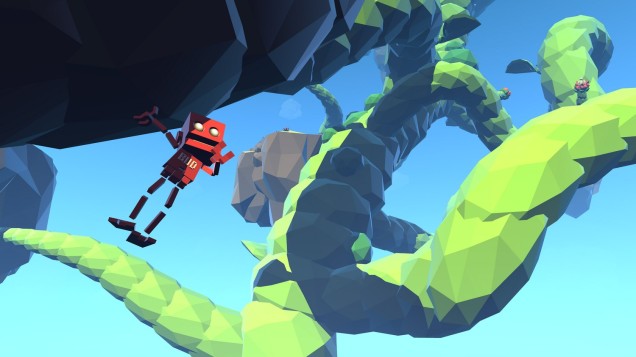
The little robot’s steps are clumsy, awkward, as if both the use of his legs and the concept of gravity were new to him. B.U.D. is miles away from the usual video game robots – they’re often metallic warriors and/or cannon fodder – and closer to the likes of WALL-E, if Pixar’s garbage collector was a toddler. And like his precursor, B.U.D. is given a momentous ecological task: he must grow the so-called Star Plant on a faraway planet, and in doing so he has to scale the plant to a height of 2 kilometres – which would be difficult enough for the likes of Mission Impossible’s Ethan Hunt, let alone someone who is barely able to walk in a straight line.
Grow Home Continue reading

They create worlds: Disasterpeace

One of the things that video games can do magnificently is create worlds. These posts are an occasional exploration of games that I love because of where they take me.

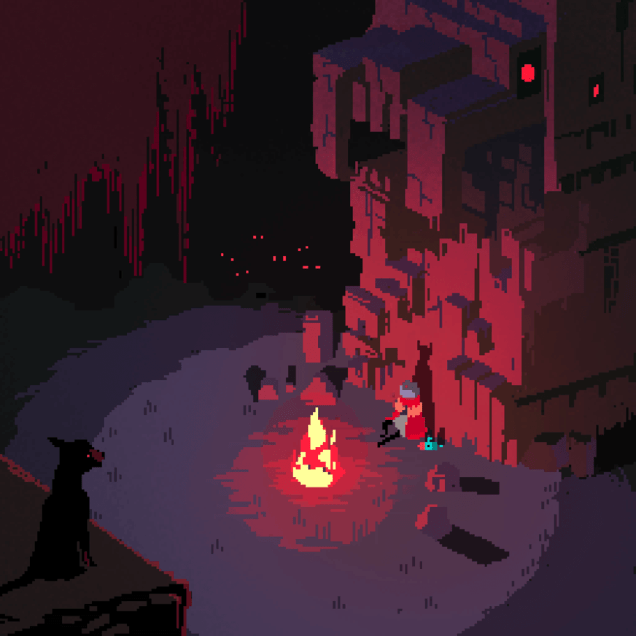
Usually when people talk about the worlds games create, they’re talking about graphics first and foremost. I’ve been playing since the early ’80s, and perhaps the most readily apparent way to see how the medium has progressed since then is to look at screenshots: it’s pretty much like first looking at cave paintings and then a Caravaggio – although admittedly a Caravaggio that’s like to have been done by a teenage Caravaggio who’s been glutting on Michael Bay movies or the Lord of the Rings trilogy.

Hyper Light Drifter Continue reading

Virtuality is the new real

The first thing that came to my mind when I put on my Oculus Rift for the first time and found myself looking around virtual reality, was a line from the original Star Wars: “You’ve taken your first step into a larger world.” Thank you, Obi-Wan, you’ve put it well. While I haven’t yet spent all that much time in VR, only the occasional hour here and there, I’ve already stared up at the jaws of a T. Rex bellowing in my face, I’ve seen the Little Prince’s planet floating in mid-air just in front of me, and I’ve navigated a one-man submarine into the wide-open mouth of a giant prehistoric fish.

The Rose & I Continue reading

Vertigo for two, or: Co-op is the new VR

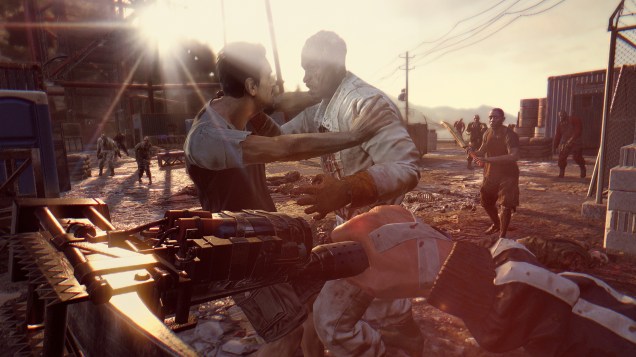
This weekend, something weird happened to me, and for the first time, I believe: I felt vertigo in a video game. There I was, running around the apocalyptic sandbox city of Harran in a zombie action game called Dying Light. A few hundred metres away was a radio tower – and as I’ve been conditioned over the last few years, towers are there to be climbed. There may be goodies at the top, or you get a better overview of the area and, more often than not, your map reveals points of interest that previously were invisible to you. So there I go, climbing the tower slowly and carefully, since no tower in video games has ever just had a single ladder taking you more or less safely from the bottom to the very top: it’s always a broken, rusty ladder here, some outside scaffolding there, and always at the risk of plummeting to your death and momentary rebirth at a safe place previously unlocked.

 Dying Light Continue reading

I call the big one Bitey! Fairness and Alien: Isolation

Perfect organism. Its structural perfection is matched only by its hostility… I admire its purity. A survivor… unclouded by conscience, remorse, or delusions of morality… I can’t lie to you about your chances, but… you have my sympathies.

This apt description by Ash, everyone’s favourite hobbity murderbot, very much fits Alien: Isolation‘s recreation of the alien originally conceived by H.R. Giger and brought to the screen by Ridley Scott and crew. The creature is deadly: it is single-minded and has no conscience. Accordingly, it lacks yet another quality, one that most people would consider essential to good video games – whatever else the alien is, it isn’t fair.

Alien: Isolation Continue reading

They Create Worlds: Everybody’s Gone to the Rapture

One of the things that video games can do magnificently is create worlds. These posts are an occasional exploration of games that I love because of where they take me.

This was a peculiarly English end of the world. No guns, no running and screaming, no heroes or monsters. Just nosebleeds, headaches, fear – and then the light. What remains of everyone is brightness, and voices… and the world they inhabited.

Everybody's Gone to the Rapture Continue reading

They create worlds: Alien: Isolation

One of the things that video games can do magnificently is create worlds. These posts are an occasional exploration of games that I love because of where they take me.

When I was a kid playing pirated games on my beloved “breadbox”, the C64, games based on movie licences tended to be ubiquitous, largely interchangeable and mostly dire affairs. Whether they were mediocre shooters or bad action adventures, if it wasn’t for the title screen and (if we were lucky) a bit tune rendition of the movie’s theme, it’d be well-nigh impossible to know that what you were playing was supposedly an adaptation of Licence to Kill (yes, those two dozen huge pixels represented Timothy Dalton) or Platoon (a surprisingly enjoyable action game, albeit one that dropped the film’s anti-war angle in favour of some more mass market-friendly Vietcong shootery). Whatever connection there was to the films that purportedly inspired the games ended up being mostly imaginary.

Alien: Isolation Continue reading

I’m Walkin’, Yes Indeed

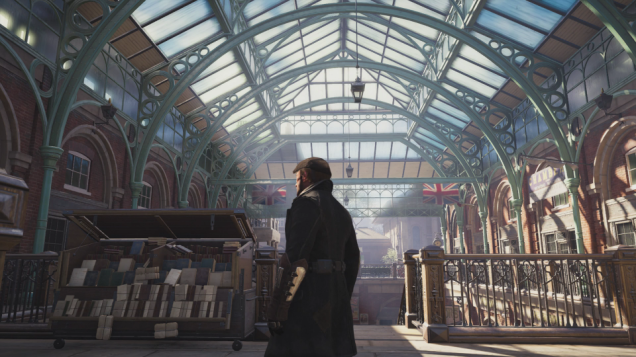
In video games, you’re usually in a hurry. You’re saving the world, trying to save the president’s daughter – or, on the other side of the spectrum, you’re running away from the cops after robbing the First Bank of Los Santos or, if you’re less criminally inclined, a horde of infected intent on tearing out your throat. Under these circumstances, it makes sense that the player’s first instinct is to look for the run button or sprint command. More than that, though, so many games are about getting from A to B. This kind of behaviour is reinforced by secondary objectives like “Get to da choppa in less than 2:00” or by rewards inversely proportional to the time you took to do what you were supposed to.

Assassin's Creed Syndicate Continue reading

Making for a Happy Medium

While it should be self-evident that different media allow for different kinds of storytelling and different forms of expression, it’s good to be reminded of this in enjoyable ways in this Age of Adaptation, where so many films, TV series, games are adaptations of material in other media. Last week I saw the London production of Gypsy, which was brilliant, startling – and a great example of a story that works best on stage. We’d previously seen the ’60s film version of Gypsy, which works well in its own right, but it’s on the stage that the story came truly alive.

Gypsy Continue reading

War games

I was predisposed towards liking Valiant Hearts: The Great War. I mean, here’s a game about a war that is rarely seen in video games (the First World War), there’s no shooter gameplay in it, it is not about winning, the game has a distinct anti-war streak, the overall tone is melancholy, and Valiant Hearts even does a good job of educating its players about WW1 without turning into a moralising lecture. Whereas the vast majority of games set in wartime put you behind a gun or inside some vehicle equipped with guns, Valiant Hearts is largely pacifist in its leanings. Its protagonists are French, German, Belgian – and canine, since I hesitate to assign a nationality to a dog… as does the game, to its credit.

Valiant Hearts Continue reading