After spending much of our summer looking into the abyss with our two episodes on cinematic psychopaths, A Damn Fine Cup of Culture is heading for British Hong Kong, 1962: we’ve rewatched Wong Kar-wai’s In the Mood for Love (2000) and we’ve got some things to say about it, from commenting on the echoes to Billy Wilder’s The Apartment to discussing the film’s sartorial choices. On our way there, we also touch upon the Elton John biopic Rocketman, the Nazi-shootin’ B-movie thrills of Wolfenstein: The New Colossus and the grandpappy of silent Soviet cinema, Battleship Potemkin… set to a live orchestra’s renditions of Shostakovich. How better to finish a summer of culture?
We’ve all been there. You find yourself in your late teens or early twenties with a profound sense of existential malaise. You’ve been to school for most of your life and you could go to school for a bit longer, but why? What for? To prepare for a job that, at best, bores you if it doesn’t outright depress the hell out of you? To lead a life of quiet desperation? Some try to escape by means of alcohol, drugs or sex, but not you. Oh, no.
Instead, you do you. You try to give your life a sense of meaning by organising an insane art heist with the aim of stealing the ultra-rare books on display at your university’s library. It’s obvious if you think about it.
And there goes another year and the ever more sci-fi sounding 2020 is just around the corner. We’ve had some good laughs, we cried, we watched the TV in terror, then disillusionment and then resignation, name-checking Kübler-Ross along the way – but that was just politics. In terms of media, 2019 hasn’t been a bad year at all, has it?
Each Friday we travel back in time, one year at a time, for a look at some of the cultural goodies that may appear closer than they really are in The Rear-View Mirror. Join us on our weekly journey into the past!
GUS: What do we do if it’s a girl? BEN: We do the same. GUS: Exactly the same? BEN: Exactly.
Pause.
GUS: We don’t do anything different? BEN: We do exactly the same. GUS: Oh.
GUS rises, and shivers.
Excuse me.
He exits through the door on the left. BEN remains sitting on the bed, still. The lavatory chain is pulled once off left, but the lavatory does not flush. Silence.
Summer with Monika (1953) is an odd yet fitting film with which to continue our Tour d’Ingmar. Like Crisis, A Ship to India, To Joy and Summer Interlude, its protagonists are flawed young characters in the process of becoming adults, though unlike many of the Bergman films earlier in the collection, the young man, Harry (Lars Ekborg), is selfless and arguably the more mature one, while Monika (Harriet Andersson), the female protagonist, is self-serving and at times downright unpleasant.
You have to give it to them: the Kims, the protagonists of Bong Joon-ho’s Parasite, are nothing if not resourceful. At the suggestion of a friend, the son Ki-woo (Choi Woo-shik) pretends to be a student in order to get a position as the English tutor for the daughter of a wealthy couple, complete with photoshopped diploma. It doesn’t take long and he’s introduced his sister Ki-jeong (Park So-Dam) to the Park family and she takes on the job of being the youngest child’s art therapist. It’s amazing how you can fake expertise with little more than Google skills and a knack for improvisation. Before long, the entire family – Ki-woo, Ki-jeong and the parents Ki-taek (Bong stalwart Song Kang-ho) and Choong Sook (Jang Hye-jin) – are in the gainful employ of the Parks, one recommending the other, as that’s how the Parks work: they only trust employees that come highly recommended by another trusted employee. Oh, my father has a friend who used to work as a chauffeur. Oh, I know of this housekeeper who’d be just perfect for you. And the rich, friendly (if patronising), gullible Parks eat it all up. They get the domestic help they want and the Kims get the gainful employment they need, so it’s a win-win situation, right?
To cut a long story short: no. Parasite isn’t a story about the joys of sucessful social mobility. It isn’t a hymn to faking it till you make it. No, Bong’s latest is a caustic comedy that turns into a war movie – the war in question being that between the classes. And as another war story set in Korea used to say: war is hell.
Each Friday we travel back in time, one year at a time, for a look at some of the cultural goodies that may appear closer than they really are in The Rear-View Mirror. Join us on our weekly journey into the past!
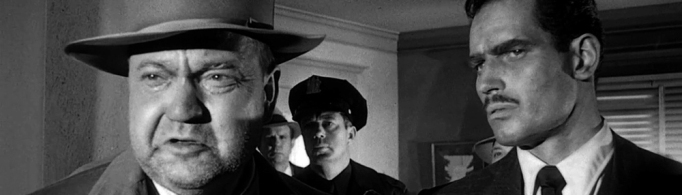
Touch of Evil most resembles a house of mirrors. In some parts you may feel you have gone backstage in some kind of carnival or circus. The direction is very Welles-ian, very masterful and very distinct. In the first minutes, we see a bomb placed in the boot of a car, and then the camera follows the car in one shot for a full 3 minutes and 20 seconds. We see shop-fronts, a souvenir seller moving his cart, some livestock and even two of our protagonists, who are walking the same route as the car. The bomb explodes, as it has to, and our story begins.
I’ve heard it said that the majority of neo-nazis and other members of extreme right-wing associations contemplate suicide at least once in their lives because subconsciously, they sense that their world-view is wrong. In Guy Nattiv’s Skin, Bryon Widner (Jamie Bell) is at this point. He is a member of the Vinlanders Social Club, not a social club at all, led by Fred ‘Hammer’ Krager (an unrecognizable Bill Camp), a stern father figure who is married to Shareen (Vera Farmiga), who actively tells everyone that they can call her Mum. It’s a bunch of people who have nowhere else to go, socially as well as economically, and they are just happy that there is someone who takes care of them and gives them things to do, no matter how vile or poisonous their chores are. The VSC is a family for people who never had a proper family. It would be a huge mistake to think that Fred and Shareen are in any way dumb or ridiculous. They provide food and shelter for strays and manipulate them into becoming white supremacists. They are not above murder, so be warned. The more they clash with their preceived enemies, the more they come alive, and the more dangerous they are. Continue reading →
Each Friday we travel back in time, one year at a time, for a look at some of the cultural goodies that may appear closer than they really are in The Rear-View Mirror. Join us on our weekly journey into the past!
Imagine you could create any movie. Any movie at all. A drama perhaps. It might star the inimitable James Stewart, it might have music by the masterful, the truly incredible Duke Ellington. That, to me, is Anatomy of a Murder. It happens to be a courtroom drama in the truest sense of the word. What we learn about the case (a murder and a rape), we learn through the court procedure only.
It’s possible to have great fun in a predictable formula movie. My daughter and me went to see Yesterday, about a luckless singer who has a road accident and wakes up in a world without the Beatles songbook. It slowly dawns on poor Jack that he is the only one who remembers the Fab Four. Screenplay by Richard Curtis, directed by Danny Boyle. That’s a pretty snazzy premise, innit? We went during a sweltering hot day, the movie theater was cool, and it was the tiniest viewing room in our city. “It’s just like a movie theater people would have at home,” she exclaimed. We were the only ones sitting there, and so we sang along to all the tunes. Great fun. Continue reading →





 I’ve heard it said that the majority of neo-nazis and other members of extreme right-wing associations contemplate suicide at least once in their lives because subconsciously, they sense that their world-view is wrong. In Guy Nattiv’s Skin, Bryon Widner (Jamie Bell) is at this point. He is a member of the Vinlanders Social Club, not a social club at all, led by Fred ‘Hammer’ Krager (an unrecognizable Bill Camp), a stern father figure who is married to Shareen (Vera Farmiga), who actively tells everyone that they can call her Mum. It’s a bunch of people who have nowhere else to go, socially as well as economically, and they are just happy that there is someone who takes care of them and gives them things to do, no matter how vile or poisonous their chores are. The VSC is a family for people who never had a proper family. It would be a huge mistake to think that Fred and Shareen are in any way dumb or ridiculous. They provide food and shelter for strays and manipulate them into becoming white supremacists. They are not above murder, so be warned. The more they clash with their preceived enemies, the more they come alive, and the more dangerous they are.
 It’s possible to have great fun in a predictable formula movie. My daughter and me went to see Yesterday, about a luckless singer who has a road accident and wakes up in a world without the Beatles songbook. It slowly dawns on poor Jack that he is the only one who remembers the Fab Four. Screenplay by Richard Curtis, directed by Danny Boyle. That’s a pretty snazzy premise, innit? We went during a sweltering hot day, the movie theater was cool, and it was the tiniest viewing room in our city. “It’s just like a movie theater people would have at home,” she exclaimed. We were the only ones sitting there, and so we sang along to all the tunes. Great fun.
  A Damn Fine Cup of Culture