How’s that for coincidence? I ended my write-up of Saraband with a reference to everyone’s favourite dysfunctional married couple, George and Martha (sad, sad, sad) from Edward Albee’s Who’s Afraid of Virginia Woolf? Fast forward to the next film on our Swedish odyssey, the 1980 From the Life of Marionettes (Aus dem Leben der Marionetten), which Bergman made for German state TV while in tax exile – and there is more than a touch of the seething resentment and marital cruelty of Albee’s classic on display.
Join us every week for a trip into the weird and wonderful world of trailers. Whether it’s the first teaser for the latest installment in your favourite franchise, an obscure preview for a strange indie darling, whether it’s good, bad, ugly or just plain weird – your favourite pop culture baristas are there to tell you what they think.
Each Friday we travel back in time, one year at a time, for a look at some of the cultural goodies that may appear closer than they really are in The Rear-View Mirror. Join us on our weekly journey into the past!
Everyone knows Charlie Chaplin. To a lesser extent perhaps, Buster Keaton too. But the third giant in this comedy trifecta, Harold Lloyd, is not as well known nowadays, although he made more films than the two of them combined. This may be because of distribution issues (Lloyd, in his later days, would only allow screenings of his films on special occasions). But perhaps even more so because the need-to-succeed everyman of his ’20s films was felt to be old-fashioned.
What better way to while away a pandemic-caused lockdown than by watching something really, really long? Isn’t that exactly what makes Netflix, Hulu, Amazon Prime, Disney+ and their like such an attractive proposition these days? Most of us have to stay home more or less all the time, so having things to keep us busy – books, films, TV series – is a lifesaver. The longer, the better, right? We don’t want to be done barely a week after we’ve started!
So a fourteen-hour film should be just what the doctor ordered, wouldn’t you say?
Join us every week for a trip into the weird and wonderful world of trailers. Whether it’s the first teaser for the latest installment in your favourite franchise, an obscure preview for a strange indie darling, whether it’s good, bad, ugly or just plain weird – your favourite pop culture baristas are there to tell you what they think.
Each Friday we travel back in time, one year at a time, for a look at some of the cultural goodies that may appear closer than they really are in The Rear-View Mirror. Join us on our weekly journey into the past!
1924 was a good year in culture. James Baldwin was born, author of the novel Go Tell It on the Mountain (1953), the collection of essays Notes of a Native Son and If Beale Street Could Talk, which Barry Jenkins adapted into a beautiful movie in 2018, and much, much more. So was Marcello Mastroianni, the archetype of the disaffected Italian playboy, and Hollywood icon Lauren Bacall. The composer Gabriel Fauré died (you’ve certainly heard the sublime “In Paradisum” from his Requiem), as did Franz Kafka – and indeed Vladimir Ilyich Ulyanov, better known as Lenin. Thomas Mann’s novel Der Zauberberg (The Magic Mountain) was published, as well as E.M. Forster’s A Passage to India.
In other words, there would be a lot to write about with respect to 1924, so honestly, there is little excuse for… this.
Warning: There may be spoilers for the video game Red Dead Redemption 2 in the final paragraph.
Dear Diary, it’s Matt again. How have you been? Going out, having a cappuccino, a glass of wine, going to the cinema? What, me? No, I’ve been a total homebody. Barely left the house, except for the occasional brief stroll. Though that’s not entirely true: I did leave the house – just virtually.
We like to think of Emily Dickinson as a shy recluse, communicating with the good people of Amherst and the world at large only by stringing her poems into small parcels and lowering them out of her first-storey window in a basket on a rope. There is, however, a branch of research into America’s beloved poet that brings the focus away from the cliché of an unravished bride of quietness, and tries to peek behind the scenes. The most conservative scholars, who might see themselves as keepers of the holy grail that is Emily D., might just foam at the mouth. A bit of irreverence never hurt anyone, especially if it’s not unfounded.
Because there seems to have been ravishing. Wild Nights with Emily (2018), a film directed by Madeleine Olnek, based on her own stage play, takes Emily’s relationship with her brother’s wife Susan as the center and goes from there, stating that, yes, Emily lived in Amherst almost all of her life, but only to be near the woman she loved – near in the sense that their houses stood only a few meters apart. Susan, according to this movie, seems to have married Emily’s brother Edward just to be close to Emily, who had a lot of time on her hands and could write love poetry all day because she could catch glimpses of Susan just by peeking out the window.
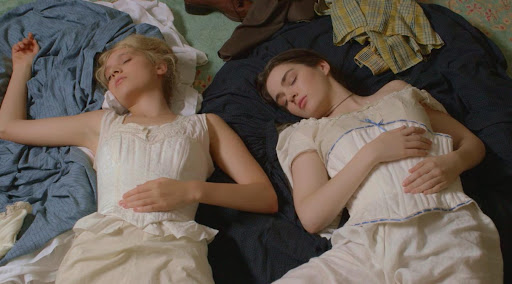
The movie shies away from portraying Emily as cruel and selfish, but there is a moment in the movie where Emily seems to roll in her bed with another lady just to make Susan jealous. She certainly was no womanizer, but that scene destroys the cliché of the virginal poet, because carnal knowledge entered Emily’s and Susan’s relationship in their teenage years, and both women, however spuriously, met other people.
And there is also Mabel, who is hired to play the piano for Emily, but never gets to see her: she is seated on the ground floor while Emily hears the tunes while sitting in her upstairs room, listening on her own. Mabel will go on to seduce Emily’s brother, maybe because she likes him, maybe she wants to get at the poems. The movie pretends that it was her who, after Emily’s death, erases Susan’s name from all of the poetry and suggests that there was a man involved. Mabel also goes on tour, telling the life story of the famous poet whom she has never met in person.
There is also Higginson, editor of the Atlantic Monthly, answering Emily’s letter in person. He says that her poems are not fit for publication. Emily seems disappointed at first, but the movie takes that rejection as the motivation to write even more. Wild Nights with Emily is tamer than the title suggests, but it is a kind of alternative riff on the life and times of Emily D. The tone of the movie is all over the place: it’s part biopic, part Drunk History and part filmed stage-play. Those puzzle pieces do not wholly fit into each other, but the cast saves a lot of scenes that would go nowhere. Molly Shannon plays her Emily as a very determined, lonely, slightly desperate and sometimes bitterly funny woman. In some scenes, I had to think of her as Fleabag before her time. Susan Ziegler plays Susan with the exasperation of a woman who wants to keep her lesbian love a secret but finds Emily’s love letters in places they should not be found. Amy Seimetz has the thankless role of portraying Mabel who seduces Emily’s brother, tells the falsified story of Emily and later forges all the letters, erasing Susan’s name.
Maybe the movie’s strongest argument is this: give Emily a bit of room to breathe. The harder you cling on to the myth of the lonely hermit poet, the more you insist on the argument that Emily’s poems were directed towards an unknown male rather than a well-known female.
Join us every week for a trip into the weird and wonderful world of trailers. Whether it’s the first teaser for the latest installment in your favourite franchise, an obscure preview for a strange indie darling, whether it’s good, bad, ugly or just plain weird – your favourite pop culture baristas are there to tell you what they think.
Each Friday we travel back in time, one year at a time, for a look at some of the cultural goodies that may appear closer than they really are in The Rear-View Mirror. Join us on our weekly journey into the past!
Ah yes, modernist literature. It’s suspicious, isn’t it? No other literary epoch is so well-known by its titles and authors, and yet so un-read. Go to your bookshelves. Find Ulysses. It might just be the most bought and least read book of all times. Go to the chapter that’s set in the maternity ward. See? Have you read it? Have you? Almost no-one has, at least not the one in the novel. And if you want to read it right now, chances are you will need linguistic help. Just as with the whole of Finnegans Wake. Here, just gave you the whole novel. Something tells me you have more time than usual on your hands, but you probably won’t read it.