On serendipitous finds

So there was the book, on top of my “to read” pile. An uninviting purplish-pink (dare I say ‘magenta’?), with some turquois waves, looking a bit as if it had been designed on an old CGA screen. The title was a bit more intriguing: Unaccustomed Earth, by Jhumpa Lahiri. I’d read some Lahiri years ago when preparing for an exam, or at least I thought so, but I couldn’t remember the first thing about it. For all I knew, I’d put the book on my reading list and then forgot all about it. Just as I’d forgotten why I had this book. Did I buy it, and if so, why? Had it been given to me as a present? (… perhaps by someone reading this blog, in which case I will be duly embarrassed?)

I picked it up and started to read it, more due to a vague sense of obligation than anything else. My bleeding heart pinko liberal Spidey senses were telling me that it’d be good for me to read this, as it’s good for me to eat spinach and the like.
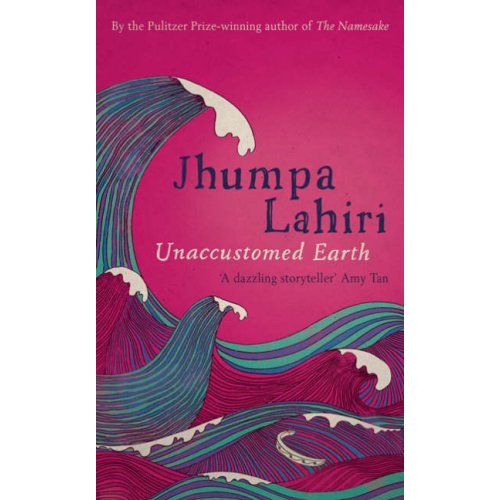
Unaccustomed Earth, I’m confident to say after having read it, is one of the best books I have read in the last ten years. Lahiri’s use of language is economical but never stingy, precise but not fussily so. Her characters feel real, but not because of the accumulated weight of details that you get with other writers; she deftly sketches their personalities with an elegance that is humbling. And her plots, while deceivingly simple, often carry a sting that is quite devastating.

I have an ambivalent relationship with short story collections. They’re often moreish, like a pack of Toffifee – one is so short and light that you’re sure another one won’t hurt… and then another, and another. And then you’ve had too much and feel faintly sick. There was no such moment with Lahiri’s stories – also because, unlike some other collections, it doesn’t feel like she’s belabouring a theme. There are motifs that are touched upon in all the stories, mainly because the majority of characters are the children of Indian migrants, but the book is definitely not dully monothematic.

Most of her stories are sad. They’re not grand tragedies (except, perhaps, for “Hema and Kaushik”, the final three-part story that almost qualifies as a novella), but loss runs through all of them, and more than once did I find my breath taken away by the feelings Lahiri evoked.

If you haven’t read any Jhumpa Lahiri, or if – like me – you’ve read her before but simply can’t remember whether you like her or not, give yourself a gift. Buy Unaccustomed Earth. Put it somewhere on your “to read” pile, preferably towards the bottom. Forget that you ever got the book and come upon it as if by accident. Give it a chance. I’m willing to bet you won’t regret it.

P.S.: If I did get this book as a present from someone reading this blog: thank you, thank you, thank you!

P.P.S.: After this one, I will definitely have to revisit The Interpreter of Maladies, if only to find out whether I did indeed read it. If so and I found it forgettable, the pre-exam pressure of “Gotta read x books by the weekend! No time to enjoy!” may have been to blame.
The discreet charm of the post-apocalypse

Is The Road a depressing movie? Do cannibalistic chickens have lips? Good question, actually – does a beak count as lips? Anyway, I’m ambivalent on the matter… not of poultry and their facial appendages, but of The Road‘s overall outlook on life. It is a powerful piece of cinema, though – perhaps almost too powerful. I wouldn’t be too surprised if a number of audience members found the grim, sad plot and atmosphere of the film so overbearing they resisted its effects and perhaps even resented its relentlessness.

And relentless the film is, which probably doesn’t come as a surprise to those who have read Cormac McCarthy’s novel – yet it’s not the relentlessness of so many post-apocalyptic films. There are moments that in other films might be thrilling, scenes where the film’s wandering father and son are pursued by cannibalistic survivors (no chickens, though), but in the end it’s not these fleeting moments of jeopardy that are the greatest threat to survival in the world of The Road. It’s finding the strength each morning to go on. The father played by an increasingly Giacomettian Viggo Mortensen has his son to keep him going, but most of the survivors we see don’t even have that. They seem to be alive simply because they haven’t died yet.

Nevertheless, The Road is about survival, not only physical survival but that of the soul, of the part that makes us more than glorified animals. As the son puts it in his childish words, “Are we still the good guys?” You’d think that good and bad would become relative in a world where you avoid other survivors because it’s more than likely that they only survived by preying on others, and the father’s reluctance to show compassion for others makes perfect sense. The son’s insistence on doing the right thing is naive and borders on the suicidal – yet survival, to the son and eventually the father, should not simply be about delaying the inevitable. And it is in this insistence that there is more to living than simply not having died yet, even in a world that seems to be all about death, that The Road, for all its horrors and sadness, is an idealistic story.

This may be the point where The Road loses some: it is difficult to accept the hopeful notes scattered throughout for the sheer weight of all the horrors we’re presented with. Does a single surviving beetle, a dog that’s alive against all hope (and hasn’t been eaten by its famished keepers) constitute a convincing ray of sunshine against the billions dead, the destroyed wildlife and decaying forests (by the way: this is the first film where I had to switch off the subwoofer – because the trees crashing to the ground were simply more than we wanted to inflict on our neighbours!). I bought both the despair and the glimmer of hope, but the former may overpower the latter for many.

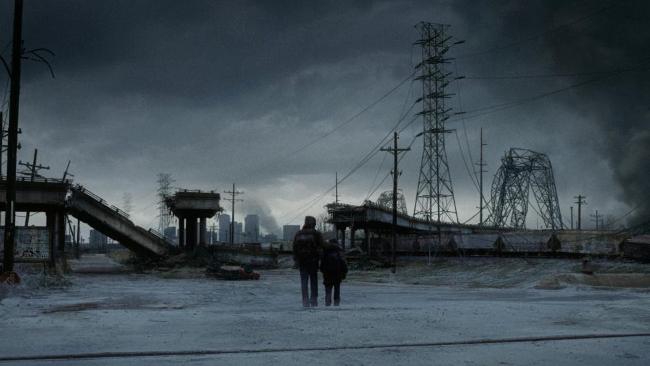
Through it all, though, the one thing that’s stuck most in my mind is the desolate, grim beauty of the world Hillcoat depicts in his adaptation. There’s dark poetry in McCarthy’s prose, and the visuals of the film capture this poetry impressively well.

O O O O that Kermodian rag!

I have found a new addiction. It’s called Mark Kermode. And the last couple of days I’ve been bingeing on his reviews (either on the BBC website or on YouTube).

What makes a good reviewer? I think that most people, me included, tend to respond first to those critics who agree with them. I also respond to critics who take a film on its own terms, something that Roger Ebert ten years ago (less so now, as far as I’m concerned) used to be brilliant at. A good critic should be able to acknowledge that in terms of what it achieves a brilliantly made genre piece (say, Raiders of the Lost Ark) is up there with the best of cinema, even if it may not be about ‘important’ things.

The best critics are the ones whose reviews you may disagree with completely, but that a) show you that the critic cares about the medium they’re writing about, b) make you think (and about something other than, “What’s this guy going on about?!”) and c) know how to write. Kermode hits all three of these, and trust me, there are a couple of reviews where my take on the film is practically 180° in the other direction. Fair warning, though: he can be smug and he is at times somewhat in love with his jokes – but he also seems self-aware enough to laugh about himself.

Anyway, enough from me. Here are two recent(ish) reviews by Mr Kermode that I liked a lot – enjoy!

War… War never changes.

It’s fascinating, and not a little unsettling, how little certain things about warfare seem to have changed. In the almost 100 years since the First World War, you’d think that soldiery has become something entirely different – that stealth bombers, ‘smart guns’ and UAVs would be worlds away from the gruelling trench warfare, mustard gas attacks and biplanes of the early 20th century.

There obviously are big differences between the wartime experience of a soldier in the trenches trenches near the Somne and that of a Marine deployed in Afghanistan in recent years. The wars can barely be compared. And yet, after watching Restrepo (by Tim Hetherington and Sebastian Junger) two things seem to be very much the same: the powerlessness while you’re under fire, and the tedium in between fights. In spite of PSPs and other distractions, the lulls between one engagement and the next seem to be as much of an enemy as the guys on the other side armed with AK-74s. It’s the moments when you become painfully aware of the situation, of the guy who was shot in the neck the other day, who used to be a friend and now is a body. It’s those moments when the overpowered gun you’ve got that’s so good at tearing apart the bad guys is of no use whatsoever.

Watching Restrepo it’s difficult not to think of Generation Kill although the soldiers in the HBO miniseries keep saying how Afghanistan, now, that was a good deployment. None of that Iraqi quagmire shit. However, for all its realistic look and feel, its journalistic credentials, Generation Kill is storytelling in a way that Restrepo isn’t. The former is structured in a way that makes it more immediately watchable and relatable. You care about Sgt. Colbert and Cpl. Person, about Lt. Fick and Doc Bryan, in ways that you don’t immediately about the Platoon depicted in the documentary. Hetherington and Junger didn’t over-narrativise their subjects, which is frustrating for the audience: there are times when Restrepo feels unstructured, and the tedium that the solders experience does creep in. It’s exactly this, though, that gives the scenes when an operation goes wrong and US soldiers get killed all the more chilling. When you watch one of the men realise that one of his friends has died and break out in loud wails unexpected from a guy who before had been much closer to the cliché of an all-American grunt.

It’s rare to get a depiction of men at war as devoid of judgment as Hetherington and Junger’s. Whether factual, facts-based, fictionalised or outright fictional, most writers and film makers dealing with war have certain attitudes towards the soldiers they depict. I haven’t seen many films, though, that leave it up to the audience to make up its own mind as much as Restrepo. It’s irritating, but it’s also liberating; I don’t mind documentaries taking a clear stand, as long as the bias is always overt, but Restrepo does that rare thing: it reports. It doesn’t opine. Which doesn’t mean that the film is artless – the craft of the film is evident – but it doesn’t use its art to tell the audience how to feel towards what it’s showing. It’s a rare document that deserves to be watched and remembered… even if it didn’t get the Oscar. And much more so because it is one of the last works of one of its authors.

Diary, by Tim Hetherington

Tim Hetherington: 1970-2011

Taken from Vimeo: “‘Diary’ is a highly personal and experimental film that expresses the subjective experience of my work, and was made as an attempt to locate myself after ten years of reporting. It’s a kaleidoscope of images that link our western reality to the seemingly distant worlds we see in the media.

Camera + Directed by Tim Hetherington
Edit + Sound design by Magali Charrier
19′ 08 / 2010″

I likes them vague…

… or at least I thought so.

I lost my nouvelle vague virginity to Truffaut’s Jules et Jim, and boy, was it a fantastic first time. After seeing that film, I was excited for the medium of film. Never mind that the film was over 40 years old at that time, I’d seen something that in its cinematic language was radical and fresh and lightyears away from tropes as old as the mountains. Probably some of that was a cinematophile’s crush on a young Jeanne Moreau (and who better to have a crush on than her?), but a lot of it was Truffaut’s way of making the material become incandescent through making it new. Even now, just thinking about the film makes me want to rewatch it – and if I could go back to being a teenager, be assured that a Jules et Jim poster would adorn my bedroom wall.

In the meantime I’ve seen a couple of films that are attributed, more or less loosely, to the nouvelle vague, from precursors like Bob le Flambeur and Ascenseur pour l’échafaud, to Truffaut’s Les 400 coups and Tirez sur le pianiste. Yes, Truffaut’s a constant, mainly because I was hoping to find something that would leave me as amazed as his seminal love triangle. Bob didn’t do much for me (for a heist film it’s disappointingly tame and lacking in memorable scenes – or perhaps I’m just too much into Soderbergh and compare every heist flick to Ocean’s 11), and both Truffauts mentioned above were good enough though somewhat underwhelming. Ascenseur, Malle’s first feature, worked well enough, but that is due in no small part to Miles Davis’ soundtrack, bringing out the sadness beneath the cool, and to Jeanne Moreau walking Paris in the rain for what feels like an eternity.

While nothing had lived up to that first time, I thought I was ready to graduate to Jean-Luc Godard. The signs were in my favour: here’s a French director whose name recalls both my mother’s maiden name (don’t ask me why this would be a good sign, but I thought it was) and my favourite Starfleet captain. (Somehow I think that if Godard had founded a society, it would have had a big sign at the entrance: “No geeks!”) It had gorgeous black and white photography and a cute-in-that-French-way-although-she’s-American Jean Seberg.

Here’s an admission: if a film’s main character is a dick, I will have to work twice as hard to like it. If the protagonist is a sexist dick, it becomes three times as hard. And if he’s behaving like an adolescent ass, four times.

Jean-Paul Belmondo’s Michel in A bout de souffle is all of that. He’s full of himself, he’s a blowhard, he’s a revolutionary in his head but a reactionary in his gut. He’s a git with an inflated sense of entitlement. In effect, in all but physical age he’s a teenager. Which would be okay, but the film seems to buy into him completely. The film seems to think that Michel is cool, revolutionary, a breath of fresh air. Cocky arrogance, that’s okay, that I can deal with – but Godard’s film seems so infatuated with its central character it becomes difficult for me not to transfer my intense, immediate dislike for him to A bout de souffle.

Stylistically Godard’s movie is interesting, and there are individual scenes that work well for me. All in all, I think I would have loved it as a 10-minute short. As a 90-minute feature, though, it feels at least two hours too long. Thing is, you can find a number of parallels between Truffaut’s film and Godard’s, and between its central characters. Catherine and Michel are both amoral, they’re both self-centred, and they get what they want at the expense of others. They’re both willful and capricious and narcissistic. They’re both adolescents in their emotions and actions, and both films ask us – at least up to a point – to forgive their actions. With one big difference: for everything horrible she inflics on the two men in her life, I can forgive Catherine. Michel, on the other hand, I want to punch in the nose, repeatedly.

I guess it’s like Vincent Vega said: “My theory is that when it comes to important subjects, there’s only two ways a person can answer. For example, there’s two kinds of people in this world, Elvis people and Beatles people. Now Beatles people can like Elvis. And Elvis people can like the Beatles. But nobody likes them both equally. Somewhere you have to make a choice. And that choice tells me who you are.”

Get rich or die coding

The Social Network could be a great movie if it wasn’t for its trite plot. There is that computer geek at Harvard called Mark Zuckerberg who will never ever get a second date, and so takes his revenge by setting up a ranking system for the female students on the net. Him and some like-minded fellow students can smell the big bucks from where they’re coding, and so they bend over backwards to become very rich very fast. This is a movie about greed. It features that one-dimensional ambition from Wall Street, but makes Gordon Gekko look like a piece of antique furniture. As soon as these guys realize that there is not only big money in working alongside, but against each other, they sue each other for ludicrous amounts. None of these characters is even remotely sympathetic. They were never friends, not on Facebook, and not in real life. They just happened to live in the same dorm at the same time, bumping ideas off each other. Zuckerberg may have a brilliant mind for computer ideas, but his biography is still one from glorified hacker to billionaire (while still being a glorified hacker). It’s not a coincidence that even the screenplay starts and ends with the question if this guy is an a-hole.

Pop quiz: How many lawsuits does the movie show? I think they are all depositions, but it’s hard to tell who’s suing who at any given time. The movie is too slick and self-absorbed to slow down and let us know exactly where we’re at. There is not one shred of criticism about how these idiots behave, which is just as well, because otherwise the movie might self-destruct.
It takes a very good cast and crew to make a bad movie look so good. The screenplay is well-informed and smart and always one step ahead, although I have a suspicion that Aaron Sorkin has no idea about how computers work. Apparently, David Fincher is unable to make a visually boring flick. Almost every main cast member has made at least one movie that is noteworthy: Andrew Garfield has made that fabulous British flick called Boy A, Jesse Eisenberg was in the very funny Zombieland, and John Getz will forever be the remorseful cheater in Blood Simple. What’s more, I’ve yet to hear a better score than that by Trent Reznor and Atticus Ross. That bit with the Henley boat race is an atmospheric masterpiece, but deserves to be in a better movie. Here’s a thought: It could have been a great movie about rowing, with countless geeks watching a live-stream from their laptops, simultaneously writing in their blogs about how they really wish they could have made it into the rowing team.

Now that’s what I call modelling!

Nothing to do with films, TV series, video games or books… but as a geek I have to say I love this recent XKCD comic:

Reminds me of one of my favourite bits in Michael Ende’s Momo… and I always thought that Google Earth would be a thousand times as cool as it already is if you could zoom in to where you are and see a little version of yourself looking at Google Earth, zooming in on himself.

P.S.: Don’t worry – actual original thought (well, sort of) coming again on Eagles on Pogo Sticks very soon!

The Wire Unplugged (or should that be “wireless”?)

Sometimes the only reasonable thing I can do is post a link and an image and just leave you to enjoy the genius of others…

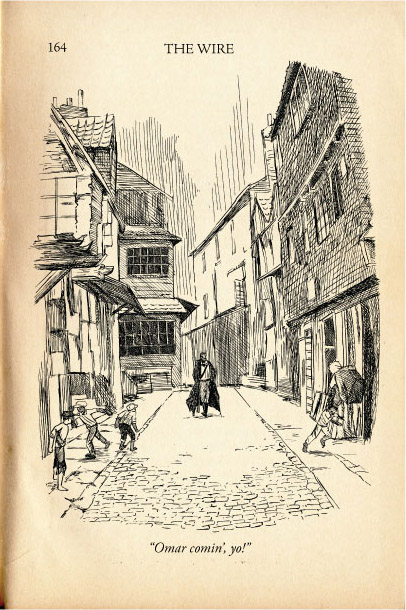
“When It’s Not Your Turn”: The Quintessentially Victorian Vision of Ogden’s “The Wire”

P.S.: If you have no idea what this is about, then do yourself a favour: get The Wire. Watch all of it. And then complain to me because you got your heart broken by Bubbles, Wallace, D’Angelo, Randy, Dukie, Bodie etc.