He say you Brade Runner!

When I was a teenager, I loved Blade Runner. I loved the atmosphere, the plot, the characters, the lines.

I am still very fond of the film, but after watching the Final Cut (which came out recently) yesterday, I am sorry to say that the original magic isn’t there any more. The film still looks absolutely gorgeous, even more so on the new DVD release, which almost makes you wonder what all the fuss about BluRay or HD-DVD is about if DVDs can look this stunning. The atmosphere is still there. But somehow I can no longer get into the faux-noirish plot and characters. Deckard is a dick, but not a very complex one; Rachael is, well, Sean Young, not the most exciting of actresses at the best of times; and most of the characters, including the replicants, remain one-dimensional. Much of what I originally found intriguing and evocative now strikes me as a tad too facile: “Ooh, we’re being vague here!”

Sushi, that’s what my wife used to call me. Cold fish.

This probably sounds worse than it ought to, because as I said, I used to love the film, so it came as a bit of a shock to find that my feelings had changed. Nevertheless – the film still looks amazing. Judging from the DVD quality, chances are it never looked better. And somehow the coherence of the visual design even makes the ’80s booboos work: Pris’ and Rachael’s hair, the shoulder pads, the neon. Although, after first seeing the film in the late ’80s or early ’90s, the intro sequence with its caption “Los Angeles, 2019” made me think that we’re probably still not much closer to flying cars than we were back then. Well, we’ll see in twelve years or so…

What was fun, though: spotting the actors from series I’ve been watching since. I’d never realised that I’d first seen Brenda’s mom wearing some artificial snake scales, a transparent raincoat and very little else. (Helloooo, Mrs. Chenowith!) And for some odd reason, I’ve only seen William Sanderson in parts where his first name consisted of double initials: E.B. Farnum, J.F. Sebastian. (Perhaps he should next try his hand at P.T. Barnum.) Finally, even though I know that Gaff is played by Edward James Olmos, but apart from the pock marks I simply don’t see it – Gaff looks and sounds so much creepier than Admiral Adama. If President Roslin ever gets hold of a Blade Runner video (probably with the corners cut off), she’ll get quite a shock…

And now… a political broadcast

Those of you who are Swiss or live in Switzerland already know what I’m going to say. Those of you who aren’t, or don’t, won’t get it. But it has to be said anyway.

Hooray!

Christoph Blocher is no longer in the Federal Council. Who is Christoph Blocher? He’s one of the big names of the SVP, the Swiss People’s Party. They’re part of the political system, but their right-wingedness has turned more and more into out-and-out racism, misogyny and political bullying. Their ads imply that foreigners, more often than not, are parasites, as are those receiving a pension for invalidity. Their implication has been that they are Switzerland and that they alone give voice to the Swiss people, cows, cheese’n’all. (No cuckoo clocks – that’s an invention of Harry Lime.)

Ding dong, the Christoph’s gone!

So, what happened? The Swiss parliament voted on the seven Federal Councillors, which Blocher was one of for the last four years. Since the SVP is successful with voters, they’ve been accorded two seats. But, oh no! The parliament voted two SVP members into the Council, but neither of them is CB. Instead – listen to this! – they voted for… a woman!

Putting it somewhat bluntly, the SVP is the sort of party that thinks proper women should be mothers and should be at home, looking after the kids, because otherwise you get broken families, youth violence, high school shootings and the like. And now an SVP woman is voted to one of the seven highest positions in the country. What a slap in the face for the old, white buggers… (Note for linguistically interested non-German speakers: her name is Widmer-Schlumpf, “Schlumpf” being the German word for “Smurf”.)

No Smurf she!

Irony of ironies, the demonstrators on the federal square in Bern, 99% of them on the political left, cheered when Widmer-Schlumpf, an SVP politician, accepted the election.

Now, what did the old fuddy-duddies do? They chucked both W-S and her other SVP colleague on the Federal Council from the party, so now there’s no one from the SVP on the Council. And then they went on to announce that “this was a black day for Swiss democracy” and that they’d been forced to go into opposition, because after all the rest of the kids didn’t want to play with them.

Okay, realistically speaking I don’t expect anything much to change. But still, it’s oh so satisfying to see the xenophobic old fogeys from the SVP end up with egg on their faces and stomping out of the sandpit because they think the others are being mean…

Lookin’ good… but does it add up to anything?

For me, Michael Winterbottom is rather hit-and-miss. I usually like the atmosphere of his films, but at the same time they tend to leave me somewhat cold. Intellectually and aesthetically I appreciate them, but I rarely care.

Tim Robbins in search of a script that makes more sense

Code 46, his foray into near-future SF (sci-fi, that is, not San Francisco), had exactly the same effect on me. It’s beautifully shot, its digital imagery more evocative than any version of the future I’ve seen since Blade Runner – more so because the futuristic effect is subtle. Winterbottom’s future is our present, just more so.

But this is a film that struggles to be a mood piece, or perhaps video art. I enjoyed looking at it, but I didn’t particularly enjoy watching it. Certainly my difficulty following the plot largely stemmed from the bad mix that left half the lines unintelligible, which wasn’t helped by the fact that in the near future, apparently everyone speaks English mixed with Spanish and other languages. But if the plot is as simple as I think it is (and the reviews I’ve read since watching the film seem to support that theory), then it doesn’t hold up very well, really. Tim Robbins’ investigator falls hard for the once more waif-like Samantha Morton who is suspected of stealing genetic passports that allow people to travel to places that would otherwise be off-limit to them. It turns out that she’s cloned from his mother’s genetic material, so their relationship is a criminal offense. Wacky hijinks ensue.

Trés artistique, enh?

I usually like elliptic films – I like not being led by the hand, whether by movies or by books. But sometimes ellipticness seems to be a cheap excuse for vague writing, directing and acting. The film intrigues intermittently, but it rarely follows up on the intriguing bits: for instance, William Geld, Robbins’ character, has his memory of  Maria Gonzalez (Samantha Morton) erased at the end so he won’t resume the genetically dangerous relationship. He goes home to his child and his wife who knows of the affair but cannot ever tell. There’s an interesting story in that. Unfortunately, the film focuses on William and Maria but never makes their attraction credible. We know that they have feelings for one another because of how they act, yet we never feel the emotions. Their love or passion or horniness or whatever it is, it remains an idea.

And frankly, I am getting somewhat annoyed with Samantha Morton’s acting, or perhaps rather with the characters she’s offered. She has this patented wild-child thing going that makes her come across as slightly funny in the head, or as someone who doesn’t do social conventions at all. But the longer the more it feels like an affectation, like a neo-punk letting us know very clearly how different she is. I could imagine that this is what attracts a number of indie directors to her, but it’s becoming tiring.

Then again, I shouldn’t forget that she was also in this:

P.S.: Code 46 was written by Frank Cottrell Boyce, who also wrote Millions. I guess I may prefer his children’s books to his adult movie writing. The Claim, which he also did with Winterbottom, shares this film’s vagueness and coldness.

The wedding of the century (19th century, that is)

Sorry, Magenta. This is another one of those pesky Deadwood entries that may just risk giving something away to you. Don’t worry, though – we’ve now finished season 2, so you can get started on that one whenever you wish.

For everyone else: Deadwood season finales are strange beasts. They’re a fascinating combination of carnage and sentimentality. Quite probably there are more deaths in this episode called “Boy the Earth Talks to” than in any other episode of the series so far. People hang themselves or get stabbed in the middle of the thoroughfare. Throats get cut. Juxtaposed with this, there’s Alma Garrett’s wedding to Ellsworth (whose first name, by the way, is Whitney – who’d have thunk?) looking eminently uncomfortable wearing lavender gloves.

All the rigour in New York, apparently…

What else? George Hearst has finally made it to Deadwood, after having been spoken about in hushed, ominous tones for an entire season (so far he looks non-threatening enough, but my gut tells me that will change); the cards dealer reborn as preacher gets his own back at Cy Tolliver (and I’m slowly getting away from seeing Zach Grenier only as Ed Norton’s poor boss in Fight Club); and Garrett Dillahunt makes us wonder who he’ll turn up as in season 3.

Meanwhile, in other series news: Greg House gets all sentimental after a 21-week old fetus grabs his thumb (things that make you undecided whether you should go “Awww…” or “Ewww…”); Lost continues its employment programme for Deadwood actors (it’s Joanie Stubbs’ turn again – now we just need Alma Garrett and perhaps Jewel); and Sawyer’s looking eminently silly with his ponytail, but there’s something sweet about seeing him conned by Hurley. Bless.

The Blue Bird of Sheer Fucking Misery

It’s Nate’s party, and he’ll scream if he wants to – and kill blue birds if they fly into his kitchen and threaten to poop all over the armatures. Symbolic? Especially considering that it follows this exchange between Maggie and Nate:

– I know that if you think life’s a vending machine where you put in virtue and you get out happiness, then you’re probably going to be disappointed.
– Is that what I sound like?
– A little.

 It’s just a bird, silly!

For those of you who are well and truly confused now, I’m talking about the episode of Six Feet Under we just watched over breakfast. (Stilton and Züpfe – the breakfast of champions!) We’re four episodes into season 5 now, and all is not well… well, almost anywhere. Nate’s afraid he can’t love Brenda or, indeed, anyone except himself, and he goes about proving that pretty convincingly at times. Billy’s pretty much batshit, having gone off his meds, so that even self-absorbed Claire notices. Ruth and George aren’t getting anywhere fast, either, in spite of more ECT treatments. At least Rico got his rocks off (second episode in a row! must be his lucky month…) and nothing went too drastically wrong with Keith and David, the latter narrowly avoiding some quick, unplanned sex with a hairdresser.

And reading through the previous paragraph, this sounds like absolute soap opera. But it isn’t, not really – because you buy the characters. They feel real, and so does their pain. But this episode was nasty in how it almost made me believe that it’s hopeful, with the Death of the Week being a 96-year old woman, and her equally ancient friend doing her convincing “It’s okay, she’s lived a long, full life” speech. But trust me, that was as hopeful as it got today.

And there is something very ominous about how the episode didn’t fade to white, as all the others do, but to black.

The death of Cranes

Today’s blog entry is about Japanese poetry.

 Not.

The Man Who Wasn’t There isn’t usually one of the films by the Coen brothers that people mention first. You’ve got Fargo people and you’ve got The Big Lebowski people, and sometimes you get an elitist or purist who swears by Blood Simple. Then you’ve got the ‘bad’ Coen films that most people agree to be substandard: Intolerable Cruelty, The Hudsucker Proxy (which I’ve never seen), Ladykillers. For some reason, TMWWT falls under most people’s Coen radar.

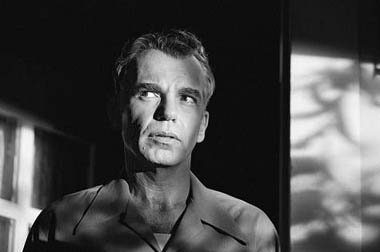
There he is! (Or is he…?)

Which I don’t get. I saw the film yesterday evening, perhaps for the fifth or sixth time, and it gets to me every time. In terms of sheer craft, it’s up there with the Coens’ best: the black and white cinematography is gorgeous to look at, as rich and evocative as the best film noir. The music – half Beethoven, half Carter Burwell (the Coens’ regular composer) – is simple and subtle, yet spot on. The script deftly intertwines film noir elements with the absurdity that many of the brothers’ films have, so that the references to ’40s and ’50s sci-fi do not feel out of place (unless you’re a stickler for Generic Purity(tm) – in which case the Coens are probably not to your taste anyway).

More than every other film by the Coens, I find that TMWWT mixes the comic and the tragic beautifully. The sort of postmodern game that they tend to play in their movies is tricky: the films foreground their parodic elements, they revel in their artifice. This film isn’t different: consider, for instance, the scene after the wedding, where Ed puts the drunk, sleepy Doris to bed, and the voice-over starts the story of how they met and got together. This is interrupted by the phonecall that leads to Ed killing Big Dave (James Gandolfini, with more than a touch of Tony Soprano), but afterwards Ed comes back home, sits down on the bed again and continues the Ed & Doris story as if nothing had happened.

No man there, definitely…

Perhaps more than the other films by the Coen brothers, TMWWT doesn’t shy away from pathos, even if there’s always the element of humour. One of the scenes with the Cranes’ arrogant, egomaniac lawyer Freddy Riefenschneider has Ed basically confessing to the killing in front of Riefenschneider but, more importantly, in front of his wife – and she realises what has happened and that Ed knew about her affair. Frances McDormand’s acting, without a single line, is masterful in conveying her heartbreak.

The film’s handling of tones and styles culminates in its final scene – a scene that only the Coens could have pulled off. If you haven’t seen the film, don’t watch the following video. If you have seen the film, watch the scene and then go and watch the film again. You’ll find gems that you may not remember.

Burial blues

I’ve had the DVD of The Three Burials of Melquiades Estrada for over a year now, but we finally got around to watching it yesterday evening only. What a weird film! I think you can clearly see the ways in which it’s related to Guillermo Arriaga’s other scripts Amores Perros, 21 Grams and Babel, directed by Alejandro González Iñárritu. There’s the playing with chronology; there’s the themes of migration and alienation; there’s the transnational cast of characters.

Melquiades Estrada, three burials earlier

In terms of tone, though, there’s a difference. Iñárritu’s films may be highly constructed and symbolic, but in terms of the acting they are firmly grounded in naturalism. Tommy Lee Jones’ first cinematic film, on the other hand, isn’t. I’m not quite sure what it is grounded in – theatricality, perhaps? Brechtian V-effect? Some of the acting feels more like the actors are wearing an emblematic mask: I am sad and distraught, I am bored, I am frustrated. The first half hour of the film, Tommy Lee Jones’ character looks like he’s about to burst into tears – and it doesn’t change.

The weird, unsettling thing is, though, that once you’ve eased into the film’s style, it’s oddly compelling. We’re so used to naturalism and, even more, Hollywood’s mock-naturalism that we expect filmic reality to have a certain style. When we get a film that visually seems to be realistic but the acting is stylised, it’s disorienting. My first thought was: the acting in this film is really, really bad. My third or fourth thought was: there’s something to it. And by the end of the film I’d fully accepted the style.

It’s also a beautiful film to look at, and an intricately written one. There are elements that are too broad, perhaps, such as all the Mexican characters being portrayed as proto-Communists willing to share any- and everything. (“Mi caballo es su caballo”, that sort of thing.) Some of the satire is heavy-handed. But then there are scenes that develop in strange, unexpected ways: the old blind man who asks the protagonists, quite reasonably, to shoot him (see the video clip above). The Mexican cowboys sitting out in the wilderness, watching American soaps. The ways in which Jones’ character deals with Melquiades’ increasing putrefaction. And the ending, which stops just at the right moment.

But, man, what a weird film!

All this, and smiles too

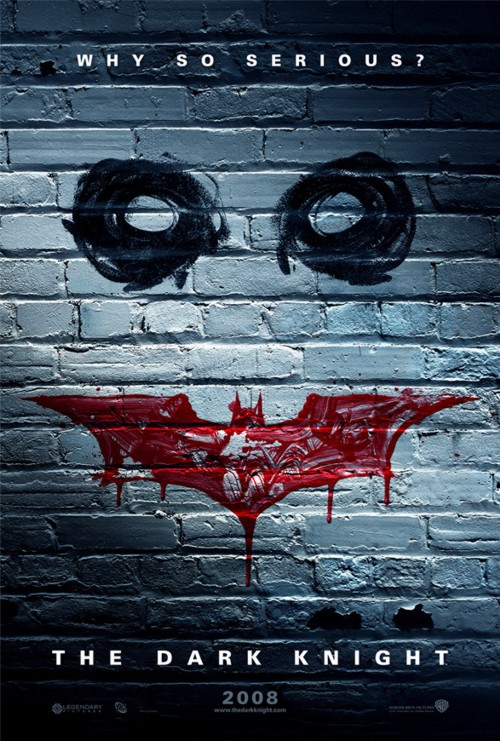
This’ll be a short one – it’s for the film buffs reading this who don’t frequent Ain’t It Cool News. I think it’s one of the coolest teaser posters in a long, long time.

Ha, ha, hee, hee, ha, ha!

There’s also a description of the first five minutes of the movie online, available here. I can admit that the Chris Nolan geek in me gets all excited at this.

Two deaths and three funerals… followed by two more deaths

Yesterday’s TV evening was marked by a high number of funerals. The deaths I sort of expected – after all, we did watch Deadwood – but I could have done without the ominous onslaught of funerals. House, M.D. managed to do without a death, as it pulled off its last-minute Eureka! moment, House saving the hard-done by Marc Blucas at the last moment. (As if his breakup with Buffy hadn’t already done enough damage…) Then we zapped into some series with Craig T. Nelson (I don’t know what he’s doing on telly anyway – shouldn’t Poltergeist have taught him to stay away from the flickertube?) and an epic African-American funeral, complete with gospel choir. This was followed by the quite heart-rending Deadwood episode “Let the whores come” (and only Al Swearengen can pull off asking the whore who’s giving him his daily blowjob whether she’s dyed her hair and almost seem considerate).

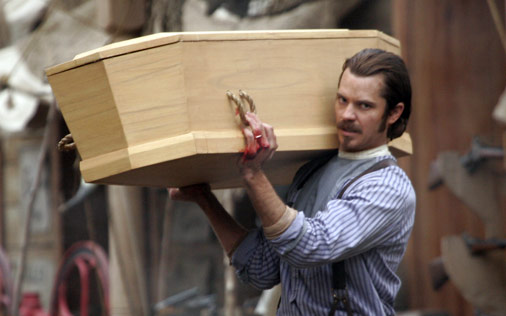
ep23_seth_coffin.jpg

But the whole thing was topped by the double-funeral, followed by double-death (très E.A. Poe) of Nikki and Paulo, Lost‘s most hated characters since… well, depending on who you ask, since Kate or Ana Lucia or Jack or Charlie or Boone or Shannon or practically anyone. Except Hurley. No one seems to hate Hurley. (Okay, not true. There are people who hate him – but there’s only one TV Hurley that everyone can agree to hate.)

Hurley by name…

What women don’t need…

… well, there’s lots of answers to that (dare I say “More shoes”?), but yesterday’s episode of Six Feet Under (“Take my hand”) gave us one clear answer: mentally unstable boyfriends/husbands. Okay, Claire obviously is oblivious to Billy’s manic behaviour, seeing how she’s lost on Planet Claire and likely to remain there for a while. Ruth, however, couldn’t be more aware of George’s mental and emotional problems if she tried.

I’m finding the George storyline in season 5 quite heartbreaking. After his brief sojourn in hospital, complete with ECT treatment, he’s been trying so hard – but it’s obviously an uphill battle. And while Ruth seems intent on being passive-aggressive (something that all of the Fishers are surprisingly good at), it’s understandable that she’s feeling trapped and depressed. I don’t think I could handle rotting food squirrelled in my partner’s clothes any better.

Happy TV family watching happy TV movies

David and Keith seem to be doing best of all of the series’ relationships. In their case, I’m more worried about the surrogate mother they’ve just had an interview with: that woman sounds like she’s likely to saw off her husband’s head and then make cookies, all the while talking to decapitated hubby. There’s something very, very creepy about her cheerfulness. But then, we’ve already had spousocide in Six Feet Under (frying pan to the head – season 2, perchance?) – and in any case, if anyone’s likely to off their beloved partner, it might just be Billy “Let me carve my name on your ass” Chenowith.

And he’s still a dozen times more likeable than Mother Chenowith. Even Grendel would give her a wide berth, I’d wager.