Welcome to Six Damn Fine Degrees. These instalments will be inspired by the idea of six degrees of separation in the loosest sense. The only rule: it connects – in some way – to the previous instalment. So come join us on our weekly foray into interconnectedness!

At a time when Matt would geek out with his fellow uni pals over ’90s TV series on a regular basis, I was still stuck in a positively rural Swiss middle school just getting into taping films and shows and sharing them with people in my class. It was actually my very tech-savvy grandfather who was the innovator in our family and had not only bought the first computer (a Commodore Amiga) but more recently a double-decker video cassette recorder. Which meant that we were finally getting his hand-me-down, our first family VHS player/recorder! So at the tender age of twelve, I finally got my hands on anything from Star Wars, Star Trek, Alfred Hitchcock and, of course, James Bond. Many of these recordings were missing bits at the beginning or at the end, were shown in questionably censored pan-and-scan versions and were of course dubbed in German. Nonetheless, the good ones got through to us and – unequipped with cell phones or social media – the schoolyard became the arena in which we would review, pan or marvel at the latest tapes making the rounds.
Nothing prepared us for the summer of 1993, however, when Stephen King’s IT first aired on German TV! Originally released for Halloween in 1990 on ABC and making its way to video the following year, we had of course heard stories of its impact on others and had shuddered at the descriptions of a killer clown wreaking havoc on a small town community. The image of Tim Curry in costume had been printed on fanzines and book covers and we couldn’t wait to finally see how this would play out. Stephen King was a very popular name for any kid growing up in the ’80s, even in rural Switzerland, and my sister, who was variably into death metal, satanism and tarot cards, had of course devoured many of King’s novels and held a particular disdain for the more problematic sides of IT, released in 1986. I had tried my hands at reading it but had been deterred by its almost 1,200 pages. This was about to change dramatically with the video tape of IT making its way into our home!
I’m not quite sure what struck me more: the first appearance of the clown itself or the fact that this was affecting me this much as a teenager. What I had expected to be a series of exciting suspense and horror scenarios first and foremost was a troubling tale of former outcasts remembering their initially sad childhoods in Derry, Maine in the 1950s. At the heart of the friend group that develops over the first 90-minute half of the miniseries is Jonathan Brandis’ Bill, the stuttering brother of little Georgie who becomes one of the very first victims of IT. Brandis had already been a hero of mine since his appearances in The Neverending Story II (1990) and would soon star in Sea Quest DSV (1993-1996). It’s this traumatic first death scene and Bill’s devastation over it that was the first true gut punch for me. The image of Georgie leaving the family home in his yellow raincoat and the soothing voice emanating from the gutter before we see Pennywise for the first time never quite left me after.
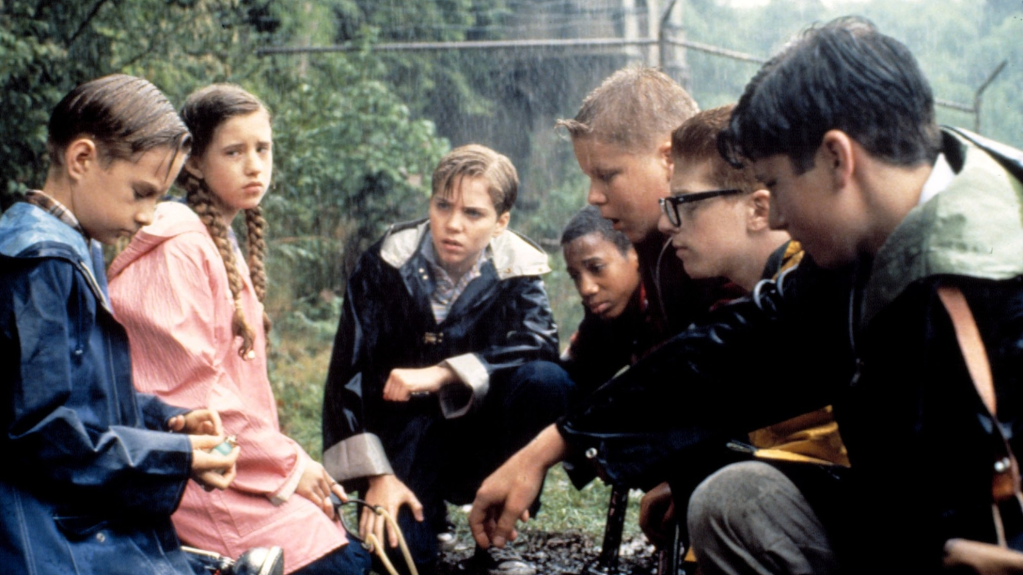
It’s the power of one of King’s favourite themes that works so well in this adaptation: the strong bond of friendship and love that develop in the face of such horror. Bill is joined one after the other by Eddie, Ben, Stanley, Richie, Mike and Beverly, the self-proclaimed ‘Losers’ Club’, who all have had encounters with Pennywise and who are fighting the worst kind of school bullies, abusive or overbearing parents and dismissive town folks one can imagine. The young cast works so well here (among them is also Seth Green) that I was completely mesmerized by the courage and tenacity they developed and the determination by which they decided to descend into the Derry sewers to get rid of the clown menace once and for all. As it turns out, the threat had been returning every 27 years and historical images of its appearance haunt parts of the story.
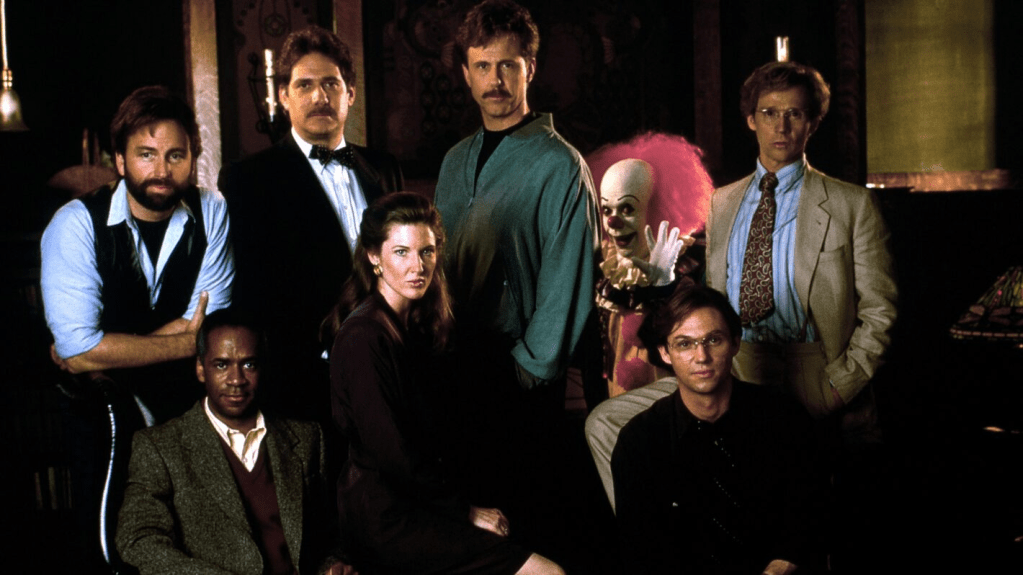
It goes without saying that Tim Curry is a towering reason for IT to work so well, and even if he has found as much iconic fame in The Rocky Horror Picture Show (1975) and has such delicious presence in Clue (1985), Home Alone 2 (1992) and The Three Musketeers (1993), this to me is beyond comparison. The way his Pennywise seemlessly shifts from kooky amusement to frightening menace is masterful. Of course, gory effects, costumes and make-up do the rest, but this was the stuff of all our teenage nightmares and an only thinly veiled harking back to other killer clowns in (movie) history.
I remember being less impressed with the second half airing some time after. Even though the true stars of the show at the time were the actors playing the grown-up versions of the ‘Losers’ Club’ (among them John Ritter from Three’s Company, The Walton’s Richard Thomas and Smallville‘s Annette O’Toole), the chemistry of their reunion paled in comparison to their teenage counterparts. By the time they returned to the sewer to once again defeat IT once and for all, the shoddy monster effects ruined the final confrontation, and Tim Curry’s absence certainly did not help.
His presence, however, could be felt in our years to come: clowns could no longer be trusted, gullies and sewers were duly avoided, and balloons on any occasion caused real fear. I remember one night in the late ’90s in particular: I used to cycle across the hills to the neighbouring village to join a fellow movie geek friend for a couple of nightly horror sessions. One night, I stopped my bike at a crossing and there was a bunch of balloons attached to a lamp post, swaying in the wind. I couldn’t have pedalled away any faster!
Later in life, I got my hands on the limited release of IT‘s soundtrack by composer Richard Bellis (a former child star himself) and I understood another source of IT’s dread, this eerie and elegiac underscore that immediately brought back the sadness of Georgie’s death, the hopefulness of ill-fated friendship and the permanent threat of terror and death. His Daytime Emmy for Outstanding Achievement in Music Composition for a Miniseries was well deserved, and it became even clearer to me how much I responded to instances of an ideal combination of images and music even at the outset of my movie fandom.
IT stands tall at the beginning of this great love of cinema, even as a two-part television event, and many tapes, discs, files and reels later, it is still one of my fondest memories of the fear movies can cause that reverberate across the decades. Even if I have admittedly enjoyed the recent two-part adaptations of the novel for the cinema (2017 and 2019), this is an instance where I believe the claustrophobic 4:3 format and graininess of the screen, as well as the soupy sound quality, make the impact even bigger. It’s some of the best early ’90s TV had to offer, and I’m grateful I was at just the right age to experience IT!


