To be honest, I’m not completely up-to-date on what will be coming to cinemas near you (and me) in 2008. Right now, I can only think of a handful of films that I know of, and even fewer that I’m actively looking forward to. Two of these I’ve already mentioned, namely The Dark Knight and No Country for Old Men.
However, the film that I may just be looking forward to most is the latest movie by Paul Anderson. Nope, not the guy who did Event Horizon or Aliens vs. Predator. The man who directed Boogie Nights (the best Scorsese film by someone other than Scorsese), Magnolia (the best Altman movie not by Altman) and Punch Drunk Love (the best- sorry, I have no idea what to compare this film to… the best Adam Sandler film, perhaps?).
People have called Magnolia especially a self-indulgent piece of something or other, but to them I say, “Bosh! Flimshaw!” If art isn’t inherently self-indulgent, I don’t know what is. Punch Drunk Love mainly left me non-plussed, but the cast and trailer of There Will Be Blood (as well as the title, which is reminiscent of the Deadwood season 3 premiere, “Tell Your God to Ready for Blood”) definitely have me intrigued and excited.
Elephant man! Elephant man! Does whatever an elephant can! Look out – here comes the elephant man!
Okay, I admit it… that was rather bad. Personally, I blame it on the effect of post-New Year’s Eve lack of sleep and a general tendency towards silliness when I’ve just got up. (Those who know me might say that this tendency generally lasts until I go back to bed…)
Elephant Man, together with The Straight Story, is one of the films by David Lynch that even people who don’t know Lynch and wouldn’t sit through five minutes of Lost Highway or Blue Velvet will have heard about. Regardless of this, though, the film is very much a product of Lynch’s aesthetic sensitivities. The many long takes of smoke and textured surfaces that aren’t immediately recognisable, the underlying mechanical sound effects (as if a large engine was powering the film and its world), especially the beginning and the ending. There are moments that recall his earlier works but also his later films. In this respect, Elephant Man feels more obviously like Lynch (if you know his films a bit) than The Straight Story, in which the Lynchian element is a lot more covert.
On a different note: why is it that half the hits to this website come about because people are looking for Miami Vice? Yes, I’ve posted two entries on the movie remake, but I’m surprised that a) people would find Eagles on Pogo Sticks and b) Miami Vice would be such a popular search term. (Well, I definitely prefer folks getting here googling “miami vice” to those who find the blog googling “panty sniffing”. The latter are also more likely to be disappointed by the actual content of the blog, I think/hope…)
Here’s a lovely countdown for the film nerds among you – it’s a bit like Peter Greenaway without the artsy showing off… In other words, it’s not at all like Peter Greenaway.
Apparently, Sophia Coppola’s Marie Antoinette was booed in Cannes. Now that I’ve seen it, I am tempted to say that French film critics are pretentious shrinking violets with an utterly neurotic attitude to their own past. It’s not a great film, and I would rank it lower than both The Virgin Suicides and Lost in Translation (both of which I liked a lot), but it’s a well made film with some good performances, and it’s definitely beautifully shot and edited. Frankly, I don’t know what les critiques Françaises are on about.
However, Marie Antoinette has one big problem: the beginning is by far the strongest, most subtle illustration of the film’s main motif – a young woman taken into a world that is foreign to her and that regards her as an alien intrusion into their rules and conventions – and almost everything that comes after is much more obvious, much less elegant. Coppola’s use of anachronisms, especially in her choice of music (but also in one semi-witty image of a Converse sneaker among the hundreds of Baroque shoes the young queen tries on), works well enough, but once you’ve seen one scene indicating that “she’s really just a lost, rich, poor teenager… and in the end, aren’t we all?”, you’ve seen them all.
In addition, the film does suffer from being under-plotted. This may be strange coming from someone who loves Lost in Translation, hardly the most plotty of movies, but because Marie Antoinette sticks pretty much to history, there’s little of the smooth flow that a well-told story has. There’s a sense that you could walk out for five minutes, to get yourself a drink or have a bathroom break, and come back without having missed much. I don’t think that films have to be plotted tightly, and in fact many of my favourite movies aren’t, but if you know from the beginning where the story will end – off with her head, and all that jazz – then the film can’t really afford to meander.
On related news, I’m going to keep myself short on Deadwood and Six Feet Under. Just know that there are things more frightening in Deadwood than Al Swearengen on a good or bad day, Francis Wolcott, or even E.B. Farnum talking dirty to a leather bag…
P.S.: Brian Cox should be a fun addition to the citizenry of Deadwood… I wonder whether he’ll ever get that theatre built – I’d love to see auditions for amateur night!
Well, for once I won’t write about last night’s episode of Lost (titled “Catch-22”). Why? Because it wasn’t very interesting – but neither was it so horrible that I have to share my eye-gouging terror with the world (and the Keira Knightley fans who may want to eviscerate me after yesterday’s entry… Just kidding!).
So, instead let me regale you with my current PC gaming choices: Colin McRae DIRT (which I’ve mentioned here before) and Thief: Deadly Shadows. The latter is a game that I originally played when it came out, but now, two computers and three videocards later, it runs much, much smoother than it ever did. However, the game bears sad witness to who I really am: someone who gets a kick out of skulking in the shadows, waiting for people to pass, and then hit them over the head with a blackjack and rob them blind.
Yup, that’s me. I prefer crouching in the darkness and waiting, and then knocking out my enemies. With almost any shooter game, if I have the option to put my opponents to sleep, that’s what I’ll do. There are few things as satisfying in a game as a totally non-lethal headshot with a tranquiliser dart and then dragging the motionless body behind a wall or some rocks… and then waiting for the guy’s buddy to turn up, looking for his mate – and do it all over again.
Now, as far as DIRT is concerned… I’m not bad at it. Not totally bad, at least. But sometimes… well, sometimes my driving looks pretty much like this – and (moving) pictures say a lot more than words in this case:
Well, at least when it comes to her latest hit… We went to see Atonement yesterday. I think the book’s one of the best novels to come out of England in the last few years; it’s intellectually stimulating as well as moving, with some grandiose setpieces and a lot of subtlety in its characterisation. (The only Ian McEwan novel I didn’t like so far was Amsterdam, the one he won his Booker Prize for.)
It’s a hell of a book to adapt to the screen, though. So much of it – its narration, its style, its themes and motifs – is, at its heart, literary. It’s a novel about writing and about fiction, and some of this is likely to be spelled out or left out in an adaptation. Nevertheless, it’s disappointing to see how often the movie chooses to be bluntly explicit when a more implicit approach would have made things more interesting. Like the trailer embedded below, the film version at times seems to be written in large capitals telling its audience what is going on: Imagination! Accusation! Betrayal! And a hard-boiled egg! (Okay, I made that last bit up.)
Also, I honestly don’t see why people keep praising Keira Knightley’s performance in this film so much. I liked her Lizzie in Pride and Prejudice, but there’s nothing much in her Cecelia Tallis that we haven’t seen before. There’s stuck-up Keira, passionate Keira, angry Keira and languishing Keira, and that’s about it. Frankly, I thought her performance was fairly similar to Elizabeth Swann in the Pirates of the Caribbean films – not one of the Top 10 performances in movie history, in my opinion.
All in all, much of the first third of the film didn’t work that well for me. It takes a special skill in an actor to pull off “upper class” without falling into a caricature of the “upper class twit” worthy of school theatre and Monty Python. Many of those ageing RSC actors can do it, but in Atonement my main thought was, “If that’s what the British upper class is like, then the masses would have chopped off their heads hundreds of years ago… or otherwise they deserve them!” Every actor seems intent on showing the audience, “Class snobbery is wrong! These people are hateful, hateful idiots!” Which, frankly, I don’t need spelled out in ten-foot letters underlined three times.
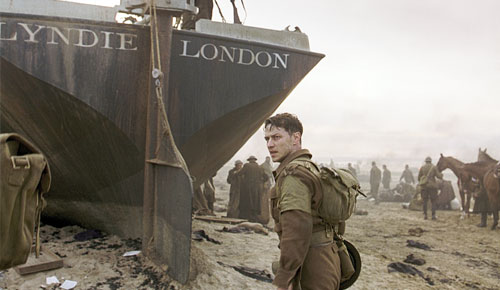
However, the film gets a number of things very right. Many of the wartime scenes, especially the already famous long tracking shot along the beach, are quite stunning. There’s a dreamlike quality to some of these scenes that is miles removed from the literal-mindedness of the beginning and ending. The same goes for the scenes in hospital which do not flinch away from the horrible wounds of the soldiers coming home from France. While the cinematography is beautiful, it still gets across the ugliness of war in a few very effective shots.
Still, while there were things to admire, I have to wonder in the end: is such an Easy Reader version of Ian McEwan’s intricate, beautiful novel really necessary? And is it enough to be able to say, “Well, they didn’t screw it up too badly… They did quite okay”? And why, oh why, are so many reviewers infatuated with Keira Knightley?
P.S.: If my suspicion is correct, merely mentioning Keira Knightley in this blog entry should get me lots of hits.
I’m back from my Christmas break, with lots of new DVDs to watch and not enough time… Sad, sad, sad.
In any case, we continued with Battlestar Galactica season 3 yesterday, watching “Exodus”, a double episode that ends life under Cylon occupation for the poor denizens of New Caprica. (Who’d have thunk, with a title like that?) The episode was exciting, with some fairly tough scenes in between – but the way they continued from “Precipice” was a disappointing cop-out.
Last thing we’d seen was Callie, running away after Jammer cut her restraints and told her to get out of there, and then we heard the sound of gunfire… Of course it was unlikely that the guns firing were actually the Cylon executioners cutting down, among others, Tom Zarek and Laura Roslin. It was unlikely that they’d kill both of them off in one fell swoop lifted more or less directly from The Great Escape. But they completely cheated with continuity and editing – when “Exodus” part 1 finally arrives at the scene, it’s plain to see that a) Callie isn’t running next to bushes or trees and b) by the time the guns start firing, she’s already been thrown to the ground by Chief Tyrol. There’s only one thing to say to such blatant cheating:
“HE DIDN’T GET OUT OF THE COCKADOODIE CAR!”
Anyway… While the episode fumbled on that one, it was very strong on characterisation. Especially Starbuck and Tigh get fantastic scenes. I never really liked Ellen Tigh as a character, finding her annoying more than anything else, but her last scene with Saul was quite heartbreaking; as was the expression on Kara’s face when she arrives on the Galactica with kiddo Kacey, whom she’s been made to believe is her daughter – and then Kacey’s real mother turns up, sees her child and takes it from Starbuck, crying and thanking her. You can almost see something inside Starbuck breaking.
It’ll be very interesting to see how (or indeed whether) the people who’ve escaped from New Caprica will re-integrate into life aboard the starship. Chances are there are fairly deep psychological scars, and it’s doubtful they’ll heal from one episode to the next.
P.S.: You gotta love Gaeta’s bitter quip to the quivering Baltar: “He believed in the dream of Gaius Baltar. The good life. Booze, pills, hot and cold running interns…”
Well… the blog is almost three months old now. And Christmas, the most unrelenting of holidays is upon us. Run! Or, alternatively, grab some eggnog, lean back, and enjoy some festive YouTube clips, courtesy of… well, YouTube.
Okay, I haven’t seen Rome yet, or The Wire (which is next on my list of “DVD sets I should bloody well get”), but in the HBO series I’ve been watching marriage pretty much seems to be a recipe for unhappiness of one sort or another. Nate and Brenda (although they did get along better than last week, and for a change Nate had a point under all his aggression), George and Ruth Fisher, Rico and Vanessa… The marriages in Deadwood are somewhat less unhappy and antagonistic, but the happiest couples are the ones that aren’t married: Trixie and Sol (and golly, aren’t they a lovely couple – the whore and the banker?), David and Keith (well, it took them long enough to get their act together!), Dan Dority and Johnny… Okay, that last one doesn’t really count – because we all know that Dan only has eyes for Al.
Today’s episode of Deadwood, “I Am Not the Fine Man You Take Me For”, made it clear that the town has been changed by the arrival of Hearst. People seem to be talking in more hushed tones and walking around on tiptoes. Even the sex and violence is no longer as carefree as in the good old days, when the guy shot dead in the saloon wasn’t part of an elaborate power game but just a symptom of Dan Dority having a headache. However, the episode had more humour in it than the season premiere, although some of it was of the “Did E.B. really just say that?!” kind. It’s amazing that the guy’s small intestine hasn’t jumped up his neck yet to choke his brain’s blood supply, to the service of all mankind.
We’re steadily getting closer to the end of Six Feet Under, and while I’m already sad about where the season will take us, I’m quite looking forward to getting started on a new series. We’ve got a couple to choose from: Rome season 1, Heroes, Carnivale (I’ve got both seasons), The West Wing, Dexter (you’ve seen him be neurotic and gay for five seasons – now see Michael C. Hall as a cop and a serial killer!). So many series, so little time…
Lost has this habit of introducing characters that I care little about (in some cases, I actively dislike them). Then, within one or two episodes, the series builds them up… and suddenly they’re fascinating!
That’s when I know they’re doomed, and in the next episode they’ll be blown up or eviscerated or shot.
If there is something to my theory, chances are that Juliet is for the chop. We recently watched “One of Us”, the episode where Jack introduces her to the rest of the beach bunnies and says, “Play nicely, kids!” Never mind that the Others abducted Claire, tried to shoot Sawyer, almost killed Charlie. (Okay, that last one may be understandable enough. Ahem.) Is it just me, or is Jack one of the most consistently naive people on that, or indeed any, island? Or is it just when it comes to women smiling at him?
Especially in this episode, Juliet’s really grown on me. She’s almost as fascinating as Benjamin “Henry Gale (hope you haven’t read Wizard of Oz!)” Linus was in season 2. Her backstory’s intriguing, and her motivations murky in a good, wanna-know-more way. Elizabeth Mitchell’s acting, especially in the scenes with Ben (see the YouTube video below, if you’re interested), has also become considerably more complex and interesting.
However, I think what I enjoyed most about this episode was how it started to tie up plot strands from the previous two seasons. While there are still dozens of big, red, blinking question marks when it comes to what watchers of Lost laughingly refer to as “the plot”, there are hints now that the writers do know what they’re doing. If the rest of season 3 can manage to do that while keeping things interesting for the last two seasons, then bring it on, I say. (Just don’t kill Juliet next episode, please!)