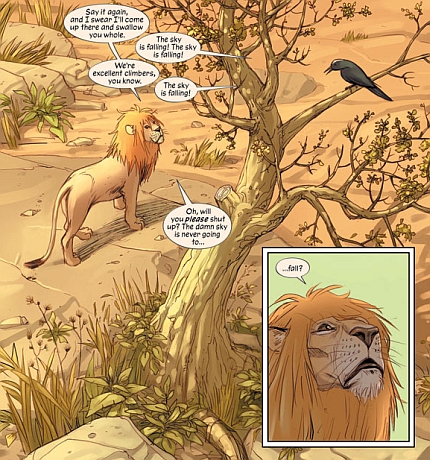
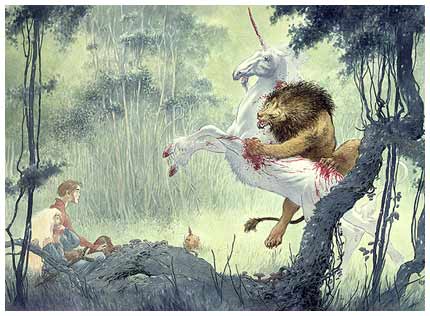
Shame I’ve already used “A Death in the Family”…

Anyway, it’s really two deaths I’ll be writing about. And the whole notion of family… well, let’s put it this way. It’s complicated.

I’m currently rewatching The Sopranos and I just finished season 3 (“… In which an old friend’s son is shot in the back of the head and Meadow interrupts a sentimental song with thrown chunks of bread and a rendition of a Britney Spears classic”). While the series dealt in ambiguities from the very beginning, season 3 is perhaps the first one where the audience’s complicity is brought to the fore. We root for Tony Soprano, paterfamilias to two families, but for all his charm and for all our sympathy for him (when he’s not being an asshole to the people around him) he is evil – if he is defined by who he is and what he does, he’s evil. Less so than the outright psychos in his entourage (I’m mainly looking at you, Paulie and Ralphie) and more self-aware, but he enables them and depends on them and their actions for his own success.

Up to the end of season 3, we’ve never seen him quite this manipulative and hypocritical, and now it’s seeping into his children more and more. Knowing quite well on one level that her idiot ex was killed because of the system her father upholds, she now defends it – to the face of idiot ex’s sister and with a degree of self-righteousness that is nauseating.

He's behind you!

The problem I have with rewatching The Sopranos, though, is that differently from, say, Deadwood, Six Feet Under or (most of all) The Wire the episodes and seasons are pretty much exchangeable. There’s very little character development – which may be the point, but if you could watch the episodes in pretty much any order and the only thing you can determine by whether it’s season 1, 3 or 6 is how old the kids are and whether Pussy Bompensiero is around? In my books that diminishes the lasting appeal and success of the series.

Talking of deaths in series: since Switzerland is a couple of months behind the States with respect to TV, we only got to see the House season 4 finale now… and what a downer that one was. Even though season 4 was the shortest season of the series ever, most of the episodes after House had chosen his new team felt like retreads (or, in fact, re-re-retreads), but the two finale episodes, “House’s Head” and “Wilson’s Heart”, were among the best and definitely the emotionally strongest episodes. I remember pretty much hating Robert Sean Leonard in Much Ado About Nothing, but together with Hugh Laurie he carries the series even in its most generic episodes. Give him material such as this and he absolutely shines. (And I don’t know what it is, but give me a well-acted man crying his eyes out in a series and I get a big lump in my throad…)

I still don’t think that Kate Beckinsale is talented or particularly beautiful, though, so there.

Give me Emma and Kenneth any time. Please.

WAAAAAAAAAALLLLLLLTTTTT!

Heh. Okay, I lied, if only by implication. This update is not about Lost – it’s about Evil Uncle Disney. Cracked has a fun (though somewhat crude) look at the most violent deaths in recent(ish) Disney films. While I like some of these films, the hypocrisy is quite striking: in most of these cases the good guy is allowed to defeat but not kill the bad guy because, after all, he’s good – but the villain still has to be punished horribly, ideally by dying. Mercy’s all fine and dandy, as long as the baddie gets the horrible, painful death he deserves! Kill! Kill!

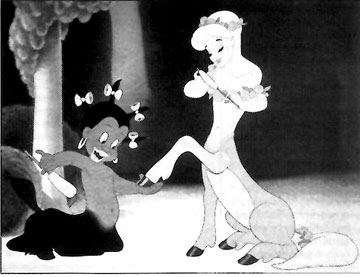
Click here to be reminded of just how gruesome your childhood favourites were. Somewhere the Brothers Grimm are shaking their skulls in envy. (And check out some of the other features – such as the best instances of racism in Walt Disney’s oeuvre. It’s almost as if Cracked has it in for the Waltster!)

Putting them darkie centaurs in their place, one hoof at a time

SoCal, baby! (Shoot me now…)

In case you were wondering: I haven’t abandoned you or the internet or my “way too late to be of any relevance whatsoever” blog. I’ve just been away, and still am. For the first time in my life, I’m not just witnessing the sheer bigness (biggitude?) of the United States of Thingamy through the TV screen – I’m in San Diego, enjoying the sun, the zoo, the predominantly Democrat people, the 24-hour shop at the gas station that sells juices made up of broccoli, spinach and garlic that nevertheless taste pretty damn good.

I’ve also made it to the fabled American movie theatre, and the first and most important thing to report is this: they show about 2 1/2 times as many trailers as they do back home! (That’s it, I’m moving here…) Okay, the number of trailers may not quite make up for the film that followed them in this instance…

As I may or may not have mentioned earlier, I’m not a Western fan as such… but some films and series that I like a lot happen to be Westerns. I like what you can do with a well established genre – such as showing up the genre’s limitations and giving alternate readings of its archetypes. I love Deadwood and The Assassination of is anyone still reading this title or have you already jumped to the end of the italics? is one of my favourite films of the last couple of years.

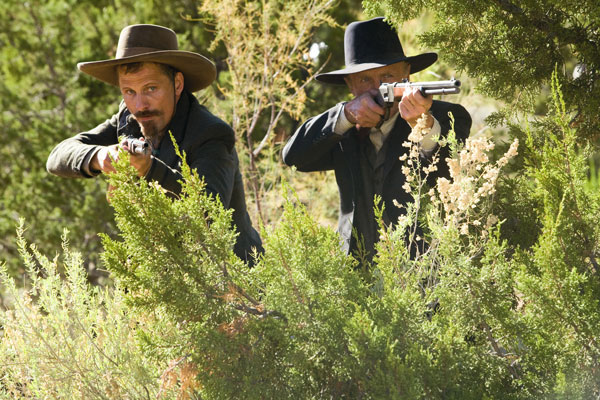
Appaloosa, Ed Harris’ second film as a director, could have been made 60 years ago, with little changes. It’s old fashioned. That in itself isn’t bad. What is a shame is that the film becomes way too comfortable with itself, to the point where, even when bad things happen, there is no urgency to the story at all. There’s too much there that is utterly predictable. And most of the characters have the emotional maturity of sitcom characters.

As a result, I sat there thinking, “Nice acting, but I don’t really care.” I didn’t care whether Harris’ character and Renée Zellweger’s golddigger would end up with each other and be happy. I didn’t much care whether any of the protagonists would die before the end. The few bits that made me look up with interest – the quasi-domestic relationship between Harris and Mortensen before it’s broken up by, gosh darn!, a woman is quite nice, and the film’s nicely aware of Harris’ character being rather thick at the best of times – were nice enough, but the overriding thought on my mind as I left the cinema was: “I wonder how many episodes of Deadwood season 4 this could have financed…”

On a slightly different note: Watched the premiere of the US Life on Mars. Was left with a deeply felt confusion as to why to do this remake and a mixture of pity for Harvey Keitel (he looked like he wanted to be somewhere else) and annoyance with him (if he doesn’t want to be there, why is he taking up the space?). I have no problem with remakes on principle – but if they’re as pointless, and joyless, as this one I have to wonder: “How many episodes of Deadwood…?”

Hamsterdam and the gooey kablooie

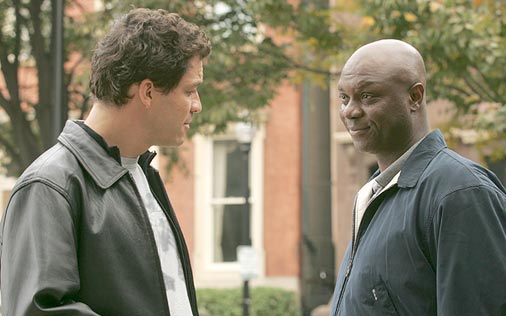
You have to admire Stringer Bell’s attempts to de-thuggify the Baltimore drug trade. His endeavours to get his business away from the drive-by shootings and everyday violence is one thing; his sweet, endearing (not words easily used when it comes to The Wire, except for everyone’s favourite addict Bubbles) meeting rules are something else altogether. It wouldn’t feel more strange to have these dealers and “soldiers” in the drug war speaking in Jane Austenese.

Season 3 of The Wire once more is among the best TV there is. It’s smart, impeccably crafted and unexpectedly funny. (A shout-out has to go to “My dawg…”.) I’m also finding it less affecting than the second season, though. Is it that the stevedores represented by Frank Sobotka had more pathos? Frank’s final episode nearly had me in tears. Or is it that I, in spite of my impeccable bleeding heart credentials, can relate better to pudgy, corrupt white guys with receding hairlines than to black hoppers slinging red tops and getting hot and bothered about semi-automatics.

There’s more than enough here to get to the viewer, though: Cutty’s attempts to get back into the game after 17 years in prison, or Bunny Colvin’s subversive social experiment born out of a frustration with the shambles and hypocrisy of the war on drugs and a wish to do something, however radical, that might actually break the stalemate and help.

And on that happy note I’d like to thank Amazon for its special offers. (No, I don’t get paid for this. I should, though!) Thanks to them, seasons 4 and 5 of The Wire are on the way and I don’t even feel too guilty about spending the money. I’m slowly running out of interesting HBO series, though… so in one, two years’ time I’ll either be reduced to Sex and the City – or it’s back to Six Feet Under. In which case I might as well rename this blog “Fisher & Sons”.

Always running… from something!

Avid readers of this blog may have noticed that I’m fairly keen on Messrs. Vaughn and Whedon’s work in comics… so when Joss Whedon was set to write the next series of Runaways, I was excited. Both writers have similar strengths; their writing is witty, they create ensemble casts of characters that gel extremely well, and they tell a good story while providing more than enough ambiguity to keep things interesting beyond the plot.

I recently re-read Vaughn’s original three Runaways volumes and apart from a couple of minor issues (such as the slightly inconsistent quality of the artwork – there’s some gorgeous work there, but some panels and some of the inking feel rushed) I greatly enjoyed it. Coming away from Whedon’s run with the kids, however, has left me somewhat disappointed. When he’s at his best, Whedon is a fantastic storyteller, getting you involved way more than I would have expected from stories about teen vampire slayers or space cowboys. He’s not infallible, though; his first Serenity comic, while not abysmal, was in no way as memorable as the TV series, for instance.

And now, Dead End Kids: my first and main thought throughout was, “I wonder what Brian K. Vaughn would have made out of the material.” Again, Whedon’s writing isn’t bad, but there’s little of the sense of surprise or freshness that Vaughn’s stories had. The kids feel ever so slightly less real and more like comic book teens. (And don’t think you can worm your way into my heart by introducing a new regular character that comes from where I live, insiduous comic!) The art is absolutely fine, but it lacks the quirk of Alphona’s best panels. And the time travel gimmick, while fun, also comes across as a tad overused. In that respect, the story feels a bit as if Joss Whedon had written an episode of Star Trek.

Nevertheless, there are moments when Whedon’s talent shows. Even if the time travel plot is a tad overdone, its denouement is more poignant than I would have expected. There are some interesting hints at the direction in which especially one character might develop, with a daringly cruel punishment for two of the story’s villains. And there’s a couple of pages ending in the death of a minor (or should I say “small”?) character that had me giggle and go “Yewwww!” at the same time.

Was it worth getting the comic? Yes. Was it as good as the other volumes? That’s a definite no. In any case, I’m very much looking forward to Vaughn’s use of Whedon’s characters now. If I’m lucky, the first two volumes of Buffy: Season Eight (the comic-book continuation of a certain barely known TV series that Whedon supposedly had a hand in) should arrive this week, and if memory serves Vaughn has penned a Faith storyline. Should be fun to see how that one’s turned out.

On a very different note: we completed The Wire season 2. ***Warning: some spoilers to follow.*** Apparently there are people that didn’t like the second season too much, mainly because they wanted more Avon Barksdale, Stringer Bell and everyone’s favourite junkie Bubbles and fewer paunchy white guys with bald spots and union shenanigans. Okay, I could have done with more Bubbles too (who couldn’t?), but season 1, while tighter, didn’t have the tragedy of Frank Sobotka. The ending of episode 11, “Bad Dreams”, builds up to one of the saddest fade-outs I can remember. In a way, the reveal at the beginning of the twelfth and final episode of the season isn’t half as sad as seeing Frank walk towards his fate. Even Ziggy, one of the major fuckheads of television history, becomes a tragic character when you see the larger context of what is going on. Yet for all the sadness that permeates the season ending, the series never loses the anger and sense of humour that make it bearable. At least in the first two seasons – I may very well be setting myself up for a broken heart in any of the three remaining seasons.

Damaged goods

Damages sounded so good. It’d had great reviews in the States. It had an interesting cast. It had won all these nominations and awards.

And it was one of the most disappointing series I’ve seen in a long time.

What confuses me is that so many critics and viewers seem to bend over backwards to praise this series. “Riveting”? “Simply extraordinary”? Sure, these are just soundbites, but the longer reviews and especially the nominations (Emmys: Best Dramatic Series)… I just don’t get them.

To begin with, there simply isn’t enough material for a full season. Had this been a six-episode miniseries, it may have been riveting, but as it was in progressed in fits and starts in between long periods of not going anywhere. I wouldn’t mind if the downtime had been used to develop the characters, but with most of them what you know at the end of episode 1 is pretty much what you know by the end of the season. The only difference is one of degree: we’re quickly aware that Patty Hewes (played competently by Glenn Close) is willing to have animals killed to get what she wants, so there simply isn’t that much of a surprise in learning that she’s willing to have people killed. The only characters that truly seem to develop are Ellie (although with her it takes until the last two to three episodes) and the defense attorney Ray Fiske, both of whom have actual character arcs.

The other thing, which is closely related is this: if a series over-relies on twists and turns they pretty much lose all their effectiveness. This happens fairly quickly in Damages; every so often, you’re asked to re-examine a character or a scene and ask yourself, “So, did this really happen as I believe it did?” Which is all fine and dandy, but the problem is that we quickly learn not to trust anything, and at that point I stop being involved. I don’t invest in the characters or in what I’ve seen because chances are things’ll be different one or two episodes down the line. And at that point, nothing that happens in the series matters. Why be surprised at a character turning out to be evil when you knew that you’d be naive to believe that character to be good? If everything twists and turns, everything becomes arbitrary.

Last but definitely not least: very few of the characters were interesting to begin with. Even a static character can be fun to watch, but almost everyone in the series felt generic. There simply wasn’t enough to Glenn Close’s Lady Macbeth-a-like Patty Hewes to make her different from similar manipulative characters. Same goes for Ted Danson’s Arthur Frobisher, one of the main bad guys in the series (although I found his uncanny, involuntary Christopher Walken impersonation at the beginning quite fascinating for an hour or so).

While I’m usually a fan of unconventional chronology in stories, it didn’t help or change much in Damages: it had the effect of making audiences wonder, “Okay, how do we get from point A to point B?” But sadly, the answer to that always seemed to be the same: Patty does something manipulative and underhand. Frobisher’s people do something manipulative and underhand. Ellie falls for it. Rinse and repeat.

So, since I don’t want to go on much longer about why I didn’t like (or didn’t get) Damages, I’ll just ask: is there anyone reading this who can tell me why I missed the point and that the series is actually clever/subversive/exciting in ways that I’ve failed to see? Because I do find it somewhat disconcerting that my opinion on Damages is shared by very few people out there, it seems.

Fruit flies like a banana

It’s been… way too long. Ages. What’s my excuse? Work. Too much of it.

Yes, I know – it’s a feeble excuse, but it’s the only one I’ve got. Sorry.

However, you’ve all been on my mind… or rather, the blog has. Every one or two days I’d think, “Hmm… I should write about this.” And then nothing would come of it. Okay, admittedly, it’s not as if I was at work 24/7 – but the combination of lots of things to organise (after all, I had to bring five young climate activists to the inaugural meeting of Kofi Annan’s new organisation – no pressure!) with lack of sleep doesn’t exactly make for diligent blogging. In any case, I am deeply sorry about being so silent for the longest time.

So, what sort of things did I feel like blogging about?

  • The EURO 08 and the woes of having high-definition digital television and the only things on are football and tennis. (You can count the grains of sand!)
  • The latest Hellboy collection, which I enjoyed quite a bit. And the Hellboy 2 trailers – Guilhermy goodness!
  • House of Leaves – postmodern horror or horrifically postmodern?
  • I, Robot – there are some films that aren’t even worthwhile when you can watch them for free…
  • Team Fortress 2 – but then, everyone’s already blogged about TF2, so I’d only out myself as perennially late.

In any case, I’ll leave you with an impression of the latter. Great fun if you need to blow off some steam. (For gamer nerds: no, that pun wasn’t intended.) Never before has carnage been such family-friendly fun!

My HDTV runneth over

Today I finally became the proud owner of a digital TV set-top box. I haven’t really checked it out that much yet, but it finally allowed me to see the Future of TV. More pixels. Full HD. And lots of other terms that basically boil down to “Let’s let the boys play a bit, shall we?”

So far I’ve checked out three of the HD offerings: HD Suisse, BBC HD and lastminute.tv. The latter was basically a glorified travel ad for last-minute trips, BBC was showing some nature documentary and HD Suisse was broadcasting a classical concert. Not exactly the most exciting programming imaginable. But I was sitting there going, “Wow, look at that image, you can read every semiquaver on that violinist’s sheet music, and even his notes, and check out that Capuchin monkey. see how every single hair on its head is visible? And that cheap, computer-generated price tag for the hotel, you can hardly make out any aliasing on it! This is what TV is all about!” (Okay, that last one is even more wildly exaggerated than the other examples.)


If they actually showed Lost or Battlestar Galactica in Full HD, chances are my brain would implode and I’d end up a drooling imbecile. Right now I don’t drool yet.

And my girlfriend’s reaction? “Cool, they’re showing Doctors on BBC!”

Talking about the future of this and pixelly goodness that, the latest entry in the AV Club‘s “My Year of Flops Case File” is a highly enjoyable panning of Speed Racer, latest proof that the Wachowski siblings’ worst movie may not have been a Matrix sequel. Share and enjoy!

Whys and wherefores: hot monkey love for Brian K. Vaughan

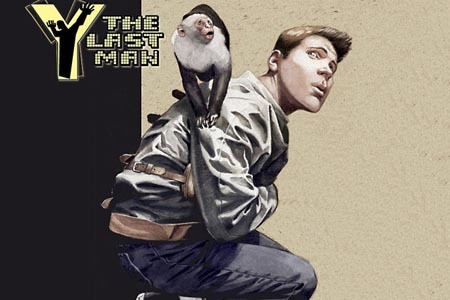
I’ve been re-reading Brian K. Vaughan’s Y: The Last Man over the last week or two, in preparation for the last volume to come out. (It shouldn’t be much longer than another month or so.) In the last few years, Vaughan has become one of my favourite comic writers. He’s no Alan Moore and he’s no Neil Gaiman (then again, these days Gaiman himself is no Neil Gaiman, it would seem), but his appeal is entirely different from those. In style, and in quality, he’s much closer to Joss Whedon – Vaughan knows how to tell a good story with wit and people it with characters you care about.

Like most of the Vaughan comics I’ve read, Y: The Last Man is a great example of high concept: the story’s premise is that every male mammal on Earth dies under mysterious circumstances, except for one Yorick Brown, ex-literature major and hobby escape artist, and his monkey Ampersand. However, it isn’t the premise that makes this a fun, exciting, witty ride. The world of Y takes a sketchy starting point and fills it with credible detail. (Well, mostly – I’m still not sure I buy the S/M intervention staged for Yorick in volume 4…) And, just like Whedon at his best, it’s just great fun to listen to his characters. This is one of the comics where much of the action is in the talking – but when there is action, it means something more than the nth installment of Super Guy vs. Evil Dude.

There\'s a monkey on your back, dude...

There’s perhaps one thing that I dislike a bit about Y, and it’s no coincidence perhaps that Vaughan also writes for the TV series Lost: at times the narrative meanders, goes zig zag. Most detours are fun enough to follow, but like Lost this is a series that at least pretends to have a plan, and just like Lost this pretense isn’t always very convincing. Without a plan, it feels like the story is arbitrary, which weakens the central mysteries and unanswered questions, such as, “What killed all the dudes?”, arguably a bigger question than “What exactly is that Smoke Monster?”. At times, if it wasn’t for the writing and characters, you’d be tempted to say, “So? Where exactly is this going?” I don’t mind some element of making it up as you go along, but arbitrariness is poison for a plot-heavy narrative.

And this might out me as the biggest closet case in history (which would come as a surprise to myself, really), but… Why is it that 90% of the women in Y are hot, slim, curvy babes? For once, we can’t blame the comic artist – Pia Guerra, the series’ co-creator and lead penciller, is very much a woman. So, for once, don’t blame us XY types!

P.S.: Other Brian K. Vaughan comics that come with the Goofy Beast Seal of Approval: Runaways, Ex Machina and the one-shot Pride of Baghdad.

Pride of Baghdad

His name is Snot Boogie?!

This film nerd here is a complex beast. On the one hand, I get as much childlike joy out of well-executed genre films that follow the formula to a T. I enjoy the climactic showdown between Hero and Villain. On the other hand, I cackle gleefully when a film (or a book, for that matter) frustrates my expectations. No Country for Old Men is a good case in point, where the supposed hero dies off-stage and isn’t even killed by the bad guy of the piece. Even Raiders of the Lost Ark, a genre movie if there ever was one, doesn’t end with the hero triumphing: it ends with the hero tied to a stake as the ultima deus ex machina comes and melts the faces off a bunch of undeserving unbelievers.

I just finished re-reading Neil Gaiman’s Stardust. I’d last read it in the summer of 2001, just after graduating. I have fond memories of sitting in a French café in Edinburgh during festival time, drinking good coffee, eating croissants and not looking up from my book until I’d finished half of it in one sitting. What I remembered much less was the plot, at least beyond the broad strokes. What I definitely didn’t remember was how differently it told its story from how Hollywood would (and, from what I’ve heard, did) do it. Here too, we don’t get a showdown with the villainess – instead, we get a melancholy coda and a bittersweet ending that made me realise how rarely Hollywood does “bittersweet”. I know that most Gaiman fans prefer American Gods, but I must say that even without Charles Vess’ pictures (I have the non-pic edition), this is a beautiful, wonderfully light, exquisitely crafted fairytale. In comparison, I feel that American Gods collapses under its own ambition, because its dozens of ideas never really come together in a fully satisfactory way.

Narnia it ain\'t...

Oh, and in case you’re wondering about the title of this entry? Well, we’ve just started watching The Wire season 1. Very different fare from Buffy, if you would believe it… But intriguing, with carefully drawn characters and lots of shades of grey. Definitely looking forward to seeing more of it – and telling you all about it, in epic detail. Shudder and despair.