The Rear-View Mirror: Hayao Miyazaki (1941)

Each Friday we travel back in time, one year at a time, for a look at some of the cultural goodies that may appear closer than they really are in The Rear-View Mirror. Join us on our weekly journey into the past!

I have the writer Neil Gaiman to thank for my first experience with director Hayao Miyazaki and his fantastic worlds: at the time, Gaiman wrote the script for Princess Mononoke‘s English dub, which was probably the first dub of a Miyazaki movie that didn’t cast actors primarily known for their voice work in the main parts. Instead, we got names such as Claire Danes, Billy Bob Thornton and Gillian Anderson – and we also got a wider release than anime features (as opposed to, say, the latest Disney princess movie) usually got in my neck of the woods.

Continue reading →

Of Horses, Women, Men and Children: Three Icelandic Films

This I can already conclude: films from Iceland are obviously like buses. You wait for an Icelandic film to watch for years, and then within a week you end up seeing three. (Okay, I cheated somewhat for the sake of the joke – I have seen an Icelandic short film about an old man who declares war on seagulls, but I must be misremembering the details, as I can’t find it on Google.) Another thing I can conclude: I like what I’ve seen of Icelandic cinema.

Continue reading →

The Compleat Ingmar #9: A Lesson in Love (1954)

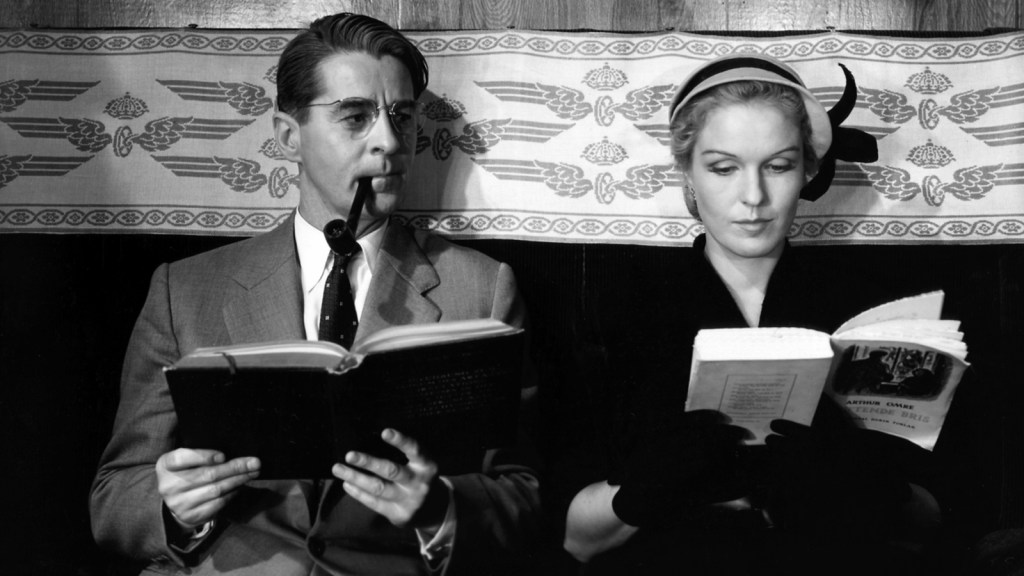
A Lesson in Love doesn’t exactly start very well, at least from a contemporary perspective: after an arch voiceover telling us to prepare ourselves for a comedy for grownups, we first meet a comely but angry young woman, Susanne (played by Yvonne Lombard), listing the failings of her older lover, the gynaecologist David Erneman (Bergman regular Gunnar Björnstrand). The lines are sharp, even witty, but it still seems that we’re watching what is essentially a male fantasy: obviously the young, attractive patients of a middle-aged, jaded gynaecologist would fall over themselves to undress for him in private as well as in his practice. It’s not that Bergman spares his protagonist, but whatever criticism is leveled at David, in the end it doesn’t matter. Young women seem magically attracted to him, and even as Susanne berates him for his cynicism, she still can’t help begging him to continue being her lover.

Continue reading →

A Damn Fine Cup of Culture Podcast #29: There Will Be Blood

d1ad56da-abce-4afe-9f45-79294aede9e3Prepare to have your milkshake drunk right across the internet: your cultural baristas once again return to the Paul Thomas Anderson well, this time to talk about his grim, disorienting epic There Will Be Blood that still confounds after multiple viewings. We also briefly touch upon family horror story Hereditary (which Mege talked about in this post), the surreal comic treat Legion (which we discussed in podcast #9) and and the celluloid nightmare that is The Lighthouse.

Continue reading →

d1ad56da-abce-4afe-9f45-79294aede9e3Prepare to have your milkshake drunk right across the internet: your cultural baristas once again return to the Paul Thomas Anderson well, this time to talk about his grim, disorienting epic There Will Be Blood that still confounds after multiple viewings. We also briefly touch upon family horror story Hereditary (which Mege talked about in this post), the surreal comic treat Legion (which we discussed in podcast #9) and and the celluloid nightmare that is The Lighthouse.

Continue reading →

The Rear-View Mirror: Cat People (1942)

Each Friday we travel back in time, one year at a time, for a look at some of the cultural goodies that may appear closer than they really are in The Rear-View Mirror. Join us on our weekly journey into the past!

cat-people2

In the early 1940s, RKO was in trouble. The costs of Orson Welles’ Citizen Kane and the financial disaster that was The Magnificent Ambersons (now tragically partly lost) had left the studio in dire straits. In order to get back in the black, they looked to Universal, which made a steady income from low budget by-the-numbers horror movies.

Continue reading →

The Rear-View Mirror: The Life and Death of Colonel Blimp (1943)

Each Friday we travel back in time, one year at a time, for a look at some of the cultural goodies that may appear closer than they really are in The Rear-View Mirror. Join us on our weekly journey into the past!

My mother was an emigrant from England. Since both my parents were from countries other than the one where I was born and where I’ve always lived, I always felt to some extent that wherever I was from, it was elsewhere – and if pressed on the matter, I would have said that I felt a connection to England and to the UK that I didn’t feel to the place my father came from. However, over the last few years I’ve very much had both an opportunity and a reason to re-examine my feelings towards the UK. Probably it started before then, but ever since the summer of 2016 it’s been impossible to avoid the escalating conversation/shouting match/toxic circle-jerk that, at its core, seems to be about identity: what does it mean to be British? What does the UK want to be? What does it want to represent in the world? Does it want to look forward or backward, outward or inward?

Continue reading →

The Rear-View Mirror: The Excursion of the Dead Girls (1944)

Each Friday we travel back in time, one year at a time, for a look at some of the cultural goodies that may appear closer than they really are in The Rear-View Mirror. Join us on our weekly journey into the past!

Anna Seghers’ short story The Excursion of the Dead Girls starts with the heroine Netty walking through the Mexican desert as a middle-aged woman, but quickly spirals into past memories, fairy tales and metaphor, all connected to that school trip in Germany many years ago. It’s semi-autobiographical – Seghers, after going through two worlds wars, had to escape Europe, and it was Mexico that seemed to offer a way out, as told in her novel Transit. Plus Seghers calls her protagonist Netty, a name she got called in her youth. Continue reading →

Toxic Digitality

I am writing this on a laptop with internet connection. I’ve got another laptop without internet that I use for writing because if I have to research something, it might lead to unbridled surfing. You know how it is. I have owned four or five laptops before, and maybe seven or eight cellphones until now. Then there is all that hardware at work that got upgraded regularly. That must be thirty to fourty units of hardware just because of me. I am a moderate user because the digital superhighway is not my preferred means of communication, but not using laptops or cellphones makes you a hermit without wanting to be one. Even my daughter gets her homework online. So yes, I have my hardware needs, and so have you. But where do our machines go after we dispose of them? Continue reading →
The Rear-View Mirror: Brief Encounter (1945)

Each Friday we travel back in time, one year at a time, for a look at some of the cultural goodies that may appear closer than they really are in The Rear-View Mirror. Join us on our weekly journey into the past!

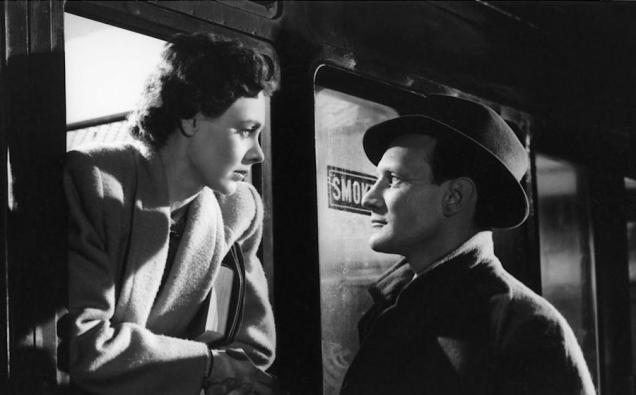
David Lean is best known for movies that were anything but lean. Lawrence of Arabia, his longest feature, clocks in at 3 hours and 48 minutes, and Doctor Zhivago, Ryan’s Daughter and A Passage to India are significantly longer than your two-hour standard feature. These movies, however, are from the second half of his career; from 1940 until 1955, he was perfectly able to keep it brief, bringing in two Dickens novels (Great Expectations in 1946 and Oliver Twist in 1948) in well under two hours. He was an editor on much more movies than he was a director, so he knew how long a story had to be in order to be told well. Continue reading →

The Rear-View Mirror: It’s a Wonderful Life (1946)

Each Friday we travel back in time, one year at a time, for a look at some of the cultural goodies that may appear closer than they really are in The Rear-View Mirror. Join us on our weekly journey into the past!

Bear with me, even though it’s still a few weeks before Christmas, but there’s no way we can’t talk about Frank Capra’s eternal holiday classic now that the Rear-View Mirror is reflecting the year 1946 back at us. When Frank Capra is mentioned, it’s easy to think of a certain kind of corny sentimentality, doubly so when the film in question is It’s a Wonderful Life. The fairy-tale ending, the song about lassoing the moon, the twee story about how an angel gets his wings whenever a bell rings, and Zuzu’s damn petals: it’s easy to be dismissive of the film. Easy and wrong.

Continue reading →