They create worlds: Journey

One of the things that video games can do magnificently is create worlds. From the satirical real-world analogues of Rockstar’s Grand Theft Auto series to the historical simulacra of Assassin’s Creed infused with secret meaning, from Super Mario‘s candy-coloured vistas to the stark alien worlds of Metroid: in games we can experience spaces that are uncanny twins of real places or that are thrillingly new. This isn’t exactly a series of posts or a new feature as an occasional exploration of games that I love because of where they take me.

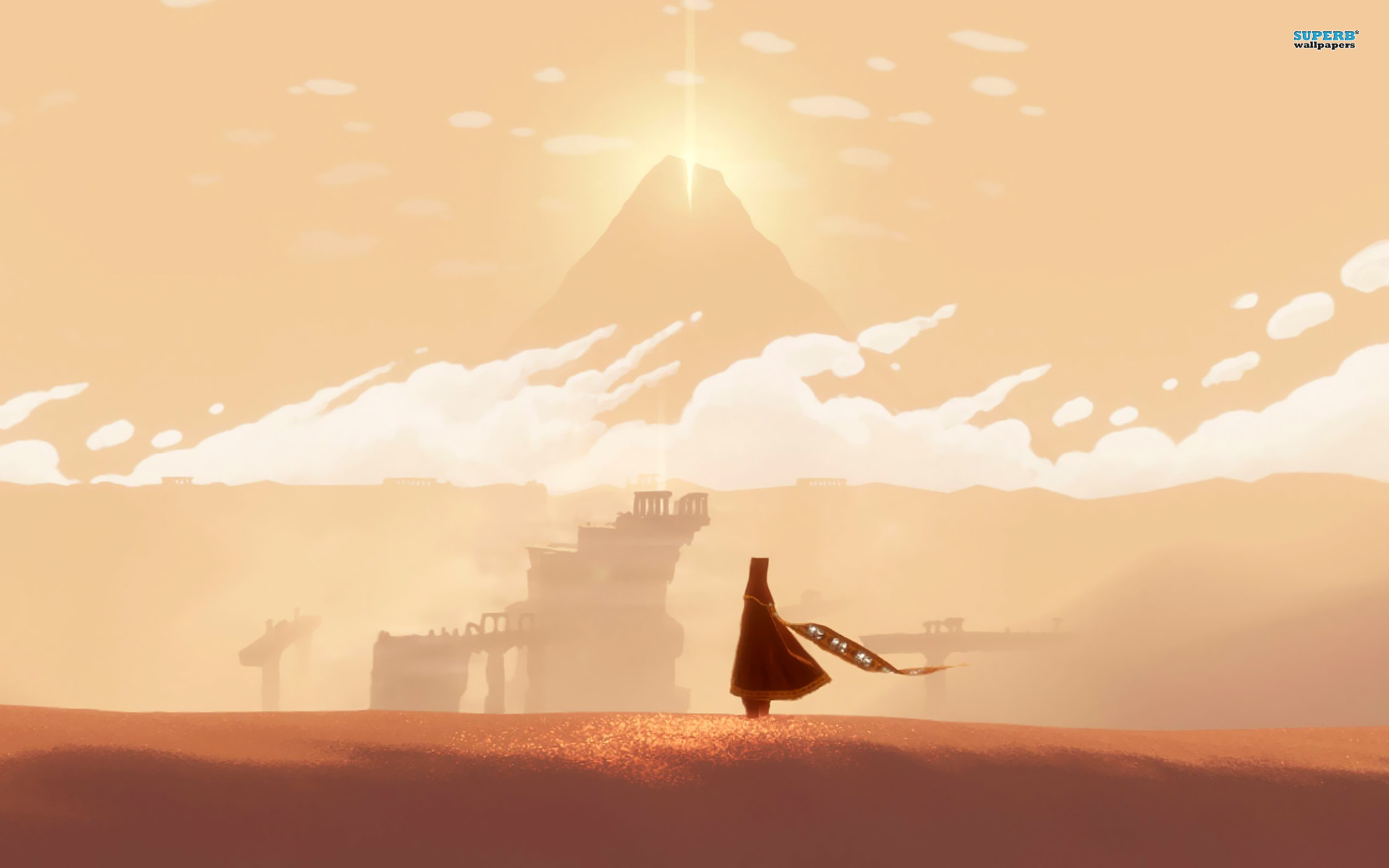
One of these games is Journey, originally developed by Thatgamecompany for the PS3 and now available for the PS4. In terms of its gameplay, it’s a simple game, almost entirely devoid of challenge; it has also been called an ‘art game’ and I’m sure there are some who would even deny it’s a game to begin with, for some reason or another. It wonderfully evokes a sense of place, though: in Journey you’re a lone traveller, perhaps a pilgrim, marching onwards towards the distant mountain through deserts, among abandoned ruins, across the bottom of the ocean and up snowy slopes towards the goal that keeps getting closer even as it remains tantalisingly out of reach.
Journey

While the actual virtual locations are fairly small and can be traversed in a few minutes, they come alive through a wonderful blend of the real and the imaginary. Visually, Journey has a minimalist but beautiful style, using strong colour contrast and simple shapes to evoke less real places than our dreams of such places. There’s a sparsely surreal quality to the deserts you travel through early in the game, as if Lawrence of Arabia‘s vistas had been reimagined by Giorgio de Chirico. At the same time, the place is tangible: you leave behind lines in the glittering sand as you move through it, sliding down dunes. There’s a tactility to these environments and your place in them; late in Journey, as you travel up the mountain towards your destination, the cold wind holds you back, slowly freezing you in place. Journey‘s spaces feel both alien and real – these are worlds you could otherwise only explore while asleep, but you feel the sand between your toes, the snow on your face.

Journey offers fairly little in the way of interaction to its players, its chief method of interaction being movement, and the game gets that very right. The player avatar becomes a part of the world, where in a lesser game that avatar feels superimposed on it. Other than walking around, the player can also fly, though this power is very much limited and feels less like the kind of power fantasy common to gaming than like a moment of freedom – again, very much like in dreams. There is one more thing the player can do, though, and that’s where the world gains a dimension: he or she can sing… and if others are around, they will hear that song. Journey is a multiplayer game, but it’s a most unusual one: on your pilgrimage to the mountain, you encounter other pilgrims, looking exactly like you. They walk, fly, and they sing; where one pilgrim may chirp in short, playful sounds, another may hold a note, almost as if inviting you to join voices.

It’s strange how other people can make a virtual space in a game feel more real, but that’s definitely how I experienced Journey. It’s maybe a bit like Marianne Moore’s “Poetry”, which talks about “imaginary gardens with real toads in them”: if you inhabit a world of the imagination with someone who may be incomprehensible to you but who is real, reacting to your movement, your flight and song, then that world becomes more real as well. Some of the pilgrims I encountered in Journey went exploring with me, others were kind guides pointing out an interesting ruin or a forlorn statue for me to find, and yet others seemed to sing at me in an increasingly frustrated voice, unable to make me understand their song. And then there were some that ignored me entirely. Yet most accompanied me, for a short while or for longer stretches, on my pilgrimage towards that mountain. For a few moments, they were friends, the only friends I found in that strange world. And when I dream of the desert and the bottom of the sea and that mountain, I also dream of their song. It’s those disembodied voices that we’ve left behind, floating over the dunes.


But does it work as advertised?

How long is long enough to shake the unfairly high expectations created by everyone loving a new series? I never watched Mad Men back when it first aired, but now that the series has come to an end I finally decided to dust off my Season 1 box set and acquaint myself with Don Draper and company. The result: I don’t dislike it, I find it intriguing, it’s beautifully made, and yes, Don is an attractive figure – but I have to admit that I don’t find myself caring all that much.

Mad Men

Continue reading →

Why did the chicken go down into the basement?

Men & Chicken is a bit of a letdown. It has good things in it, but on the whole, it’s not as good as Adam’s Apples, the 2005 film by the same Danish director Anders Thomas Jensen. I had high hopes for this one: it is the fourth collaboration between Jensen and Mads Mikkelsen. Jensen also has written the brilliant After the Wedding, Wilbur Wants to Kill Himself (both movies also starring Mikkelsen, but not directed by Jensen), and Red Road.  Continue reading →

Jus Sauli

Saul Goodman is one of TV’s greatest supporting characters. He’s definitely one of the funniest, with Breaking Bad‘s writing and Bob Odenkirk’s acting working together to create comedy magic. At the same time, the humour is never at the expense of the character, which is a rare thing – each wisecrack, each lopsided bit of legal advice adds to the character, an amoral cynic with the surprising occasional flash of a moral compass underneath all the quips and jadedness. However, supporting characters do not necessarily make good leads. Is Saul a Walter White – or, better, is he a character entirely of his own that can support his own series?

Better Call Saul Continue reading →

Making love out of thin air

Love Island wants to entertain in the best way it knows how. It’s at times clumsy and hackneyed, with a very short attention span, but it is sweet, goofy and sensuous, and it is hard to dislike it. Reader, I was entertained. It consists of standard scenes making up a flimsy summer comedy about a love triangle in a holiday resort under the Croatian sun called… well, Love Island. It’s a movie like filo pastry: you like it, sometimes you crave it, but it’s not anybody’s favorite food. There’s Liliane (Ariane Labed), beautiful and pregnant, and her husband Grebo (Ermin Bravo), a lovable dork. Liliane and Grebo seem to look forward to being parents. But there is Flora (Ada Condeescu), who works at the resort as a diving instructor and animator, and she and Liliane were a couple once. Continue reading →

Strong Woman vs. Gruff Man

For more than an hour, The Homesman is one of the best-told films I can remember. It is directed by, and starring, Tommy Lee Jones, based on a screenplay co-written by him. The secret prime mover, however, is a woman named Mary Bee Cuddy, played to perfection by Hilary Swank. Miss Cuddy, unmarried, devout and outspoken, lives on her own farm on the Nebraska Territory. The year is 1837, and this is the frontier. If you go West, you will find disease, hunger, isolation and hostile Indians. There is nothing but flat grassland as far as the eye can see. No villages, just huddled groups of little colorful houses crouching under an overwhelming sky.

homesman3 Continue reading →

Best Before

Das Ewige Leben (German for eternal life), the latest instalment in the Simon Brenner movies from Austria, starts with the usual slight comedic misunderstanding. Brenner, forever unshaved and in his shabby green jacket, wants to get social security, but has no job, no fixed address, no money, and no ID on him. “You’re homeless,” the woman behind the counter tells him. Maybe that has not occurred to Brenner.

das-ewige-leben-10 Continue reading →

Mad to the Max

I am either the ideal or the wrong person to review Mad Max: Fury Road. I like my movies simple but suspenseful, on the realistic side, with weight and witty dialogue, with rounded, believable characters. Mad Max doesn’t have any of this. Instead, it’s a loud, shrill, monomaniacal high-speed romp through a barren, deadly post-apocalyptic landscape. Reader, I loved it. Movies like this elicit one of two likely responses: you either want to get off that hellride, or you cry for more. I cried for more. What doesn’t truck with me is complaining about the action and violence; that would be like jumping into a pool and complaining about the wetness. You’ve been warned.

maxresdefault Continue reading →

Kurt Cobain will have his revenge on all of us

It’s the darnedest thing with Kurt Cobain: Montage of Heck. I can see that it’s a good documentary, but I have no idea what it wants to do or where it wants to go. It latches on to the biographical details as a red thread, and everything in it – the music, the drawings, the puppets and statues – is by, or at least featuring, Kurt Cobain. A bio-pic would feature a lot more interviews. Ok, so maybe it’s all about Kurt Cobain as an artist. Hardcore Nirvana fans will appreciate that, but all others must be warned: Cobain’s artwork is as uncompromising as his music. Since the movie is 130 minutes long, that means a lot of monsters. I grew slightly tired of exploding entrails and erected penises.

montageofheck Continue reading →

Love and war – same thing

Les combattants is essentially a love story, but the movie is at its best when it forgets that. There’s Arnaud, a carpenter who helps his older brother build pergolas in other people’s gardens. He looks on as the daughter of their latest customers fills a backpack with roof tiles and jumps into the family pool. He fears she might drown. “It’s combative swimming,” she replies, as if she did that every day. She does. Later, he will give her a ferret as a pet.

still3

She also puts a whole fish in a blender and drinks it all. “I have to prepare for the end,” she says, although she doesn’t know exactly what that end might look like. Madeleine is not a gun-toting tomboy, nor a pessimist, but a young woman who thinks it’s her best choice to enrol in the French territorial army. She can be outgoing, but chooses to stay silent because she is not too good with people. She seems constantly on the brink of exhaustion, what with all that survival training. When Arnaud sees her, he is not love-struck at first, but curious enough about her to enrol alongside her. Madeleine has not much of a clue that he might like her. She takes his tagging along with a shrug.

ZUT_WEB_LesCombattants

Almost none of the scenes play out the way you think. There is a very tender moment where they paint each other’s face with camouflage colors. Another scene shows raindrops on her naked skin. Arnaud is fascinated, but all Madeleine wants is for him to punch her. Madeleine realises that the military is actually not hard-core enough for her, so she and Arnaud desert into the woods. There is a surreal scene at a gas station where they seem to grow apart, but actually find something out about each other. Arnaud doesn’t have much interest in joining the army, Madeleine wants it far too much.

4ac06-affiche-les-combattants2

The film avoids almost all of the clichés of boy meets girl or of the army. By the end of the movie, the two of them have grown closer together – in what way is for you to decide. Les combattants shows you fresh faces and an unusual story, told in an unusual way. Arnaud is played by Kévin Azaïs, slightly dorky and clueless about who he wants to be; Madeleine is played by Adèle Haenel, and I have a hunch that she might go on making good to great movies.