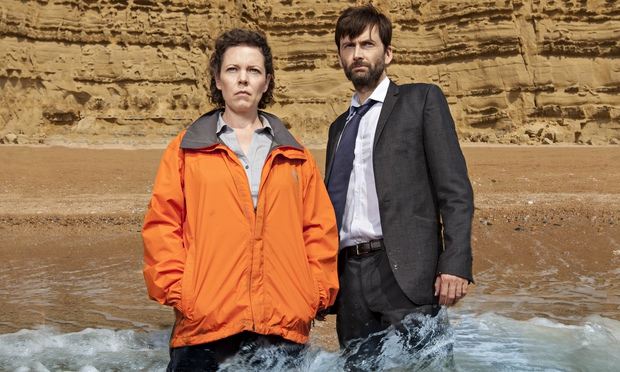
How does one continue a show like Broadchurch? One of the things I appreciated most about the recent, deservedly acclaimed BBC crime drama was that it ended: as all stories that aim to reflect the real world to some extent, there was a degree of openendedness to Broadchurch‘s conclusion, but there was nothing that called for a sequel, a second series. Except, of course, Broadchurch‘s success with critics and audiences, so as soon as the series had ended there was talk about continuing it. In the absence of a clear need for continuation, a second series faced an uphill struggle to begin with. What storyline could justify bringing back the characters?
The solution that the Broadchurch writers came up with is both ingenious and risky: at least judging from the first episode, the second series changes gear by changing genre. The first series of Broadchurch was a character drama through the lens of a crime story, and it’s the crime story that provided a clear structure: suspects come into focus, doubts are raised, secrets are revealed, and the murderer is uncovered. The series deftly balanced this structure against the drama of a little town where everyone knew everyone else, or at least thought so, and where you can scratch any surface and find some hidden or forgotten (but rarely forgiven,) guilt. It seems that guilt will also be one of the central motivators for the second series, as the first episode suggests its central hook will be the trial of the murderer uncovered at the end of the previous series. Legal drama can be as strong a structuring device as the tropes of crime stories.
There is a risk that audiences who previously enjoyed Broadchurch as a crime story first and foremost will reject the change, although there are hints that the second series will have a parallel plot strand to the trial, focusing on the botched murder investigation that was central to David Tennant’s character and his motivations. There is another risk, namely that of retconning: the writers may be tempted to revisit and reexamine the events of the first series. Did what we were told happened really happen? If handled well, this can be intriguing, forcing us to reinterpret what we thought we knew. This is extremely difficult, though, and the more likely result of a retcon is a loss of trust in the story: if what we were previously told with relative certainty turns out to be inaccurate, why should we believe what we’re told with similar certainty going forward? There are degrees of this effect: it can already be problematic to fill in blanks in the earlier story, since this changes how the different elements of the story fit together.
So far I trust the creative team of Broadchurch – and a large part of the success of the first series was due to the actors as much as the writers. Or, perhaps more accurately, I don’t distrust them. However, they will have to prove that there were good reasons to continue this particular story beyond its success.
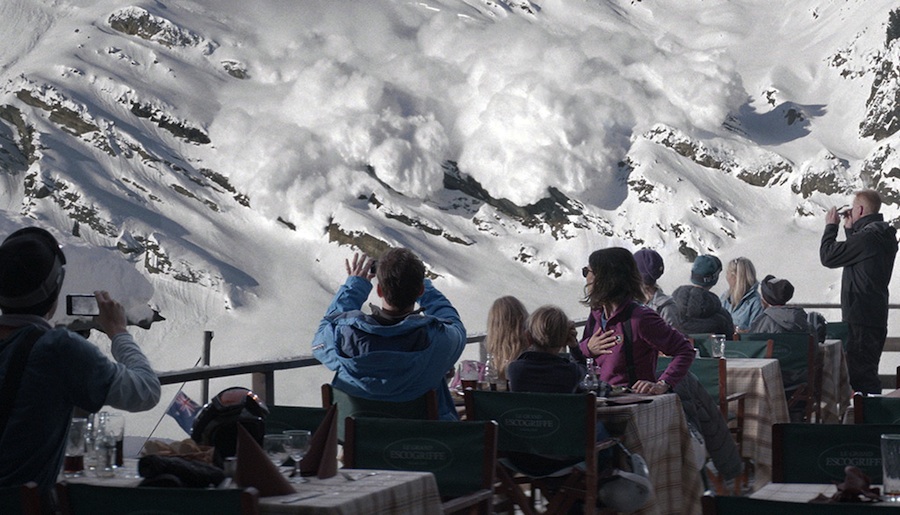
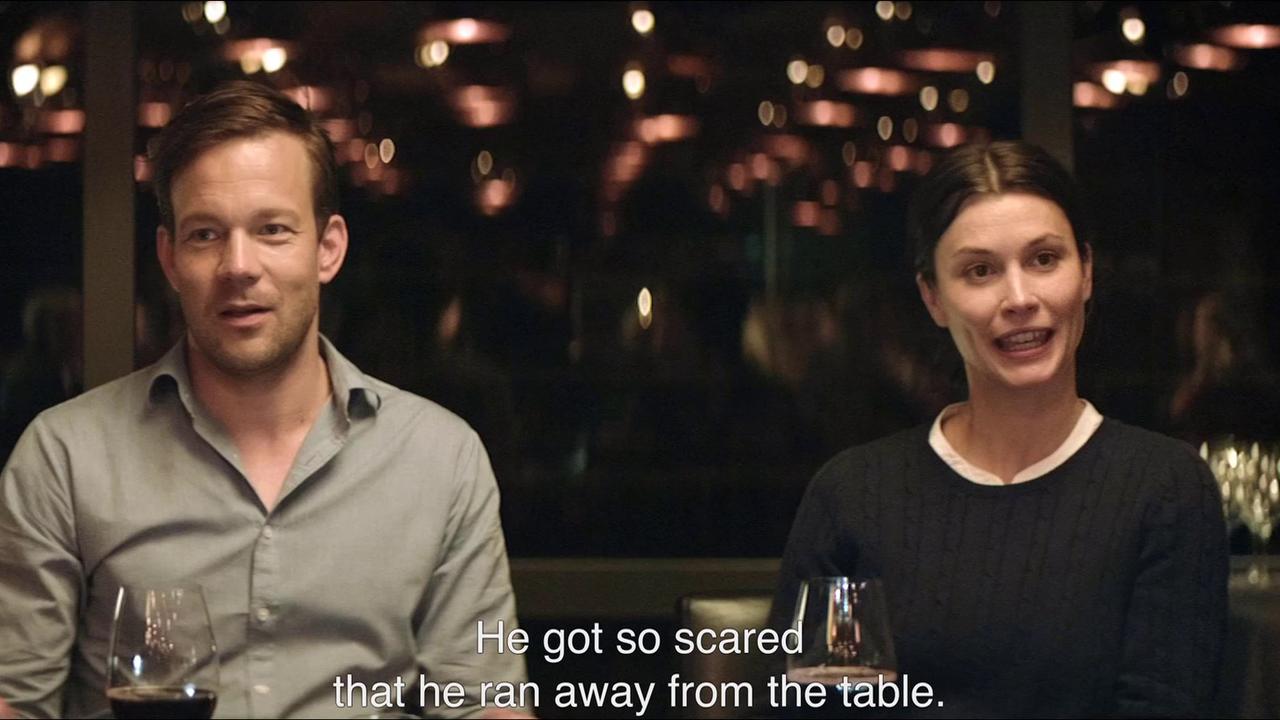
The Swedish movie Force Majeure, or Turist, as it is called here in Switzerland, is a mediocre affair, but you can almost see the very good movie it has entrapped in itself. A Swedish family is on a skiing holiday in a French resort when they are sprinkled over by the fallout clouds of a controlled avalanche. While Ebba, the mother, instinctively stays to protect the two kids, Tomas, the father, runs away.
Ebba is devastated that her husband would abandon his family in a dangerous situation, while Tomas claims he did not flee the scene. Their marriage has its first cracks, and the two kids are afraid their parents might be getting a divorce. Ebba and Tomas only very eventually broach the subject because, well, sometimes the ones closest to you cannot tell you the truth because a) they don’t want to hurt you, and b) they will have to live with the consequences their telling might bring.
This is all very well handled, but there are scenes that are only loosely connected to that main story. There is a bit where Ebba is talking to a woman who is married while she and her hubby keep seeing other people. That scene is there because Ebba now knows that her husband is much less reliable than she would have guessed, and she is trying to find out if other people have to deal with such weakness, too. But instead of talking to that woman with her strong sense of self, Ebba could have talked to the woman’s boyfriend who is there with her at the hotel. What is it like to be the boyfriend of a married, strong-willed woman? Do you consider yourself a weak man beside a strong woman, or do you have to be just as strong to keep up? We get much less from Ebba in that scene than we should – we merely learn that she could not live in an open relationship. But we already guessed that.
There are good things in Turist, too. You might remember Kristofer Hivju from Game of Thrones because of his flaming red hair and beard and intense eyes; here, he plays Mats, the soft-spoken friend who has brought his 20-year-old girlfriend to the resort and feels he has to negotiate between Ebba and Tomas because, being divorced, he is an expert on marriage and relationships. The scenes between him and his girlfriend are very funny without breaking the ominous atmosphere of the movie’s main story. Ebba and Tomas always start their fights in the corridor where everybody can hear them, instead of fighting in their apartment in front of the kids. Another good thing are the expository scenes with the avalanche cannons and snowplows. And it is a very bold choice to play Vivaldi’s Summer over scenes of dense snow.
The movie ends twice. Ebba goes missing in dense fog, and Tomas finds her, his masculinity half-way restored. Then the bus on the way home almost crashes on the serpentine mountain road, and they continue their journey on foot. Both scenes would have been good endings. To leave them both in there is to add unnecessary running time. Drop the ending in the fog, and drop the conversation between Ebba and the other woman, and you have a better movie.
I don’t get Medea. I am sure that is the point of the play. Some theatre productions give her a motive for killing her children: revenge, bloodlust. Love. Loyalty. These are all different interpretations; in the end, we just don’t know.
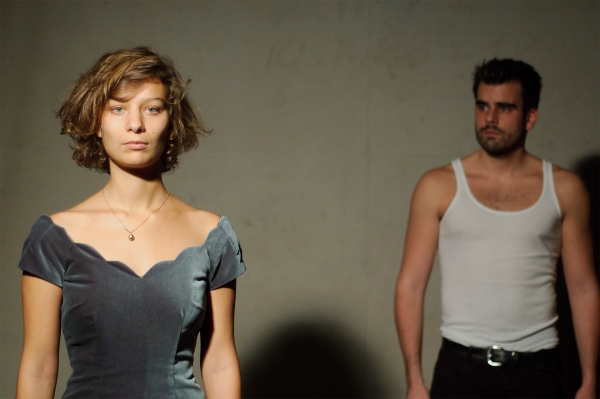
What the inspired people from Bern-based theatre company Faust Gottes have done with the material makes for a fascinating 90 minutes. They are working together with vocal ensemble Suppléments Musicaux, musicians from Campo Fiorente, and the BeST student theatre. There’s a Greek choir at the entrance you have to walk past. Then there’s the eerie, jarring soundtrack. The play itself uses all kinds of conceits: I think I’ve identified elements as diverse as the Trololo Man, a casting show, a party rally, a pompous speech, and slight allusions to Peter Greenaway and Julie Taymor’s Titus Andronicus. Mundart. Internet trolling. Literary history. Musical numbers. Slow-motion party revels. Mindless fame-worshippers babbling nonsense. High pathos is followed by bleak realism. Most theatrical productions with so many twists and double-backs turn into something like a muddy pick-n-mix. Not this one. It’s on of the best plays I’ve seen in quite a while.
Among the performances, two stand out. Kudos to the actress playing Medea because it is such a difficult role to pull off. Medea, the character, is overwhelmed, and overwhelming. And there is an irresistibly camp Kreon who behaves like Liberace was given an island to rule over.
While the party in Corinth must go on because her husband Iason is marrying Kreon’s daughter, Medea is on her downward spiral. She gets derided, scorned, molested, cast out and is generally ignored, while keeping her thoughts more and more to herself. There is a scene towards the end where she takes her time to put on make-up. You know what’s coming. The longer the scene goes on, the more hopeless I felt. There is a chill in those moments that made me fidget in my seat.
Any yet, throughout the play, Medea does not let her shoulders slump. She doesn’t flinch. It’s the darnedest thing: She is not free of guilt, but I still somewhat empathise with her. What she does is horrific, but what happens to her is just as horrific. You want to look away, but Medea keeps staring at you.
“Medea” is on every night this week at the Tojo Theatre, Reithalle Bern, Switzerland, until Sunday, January 11.
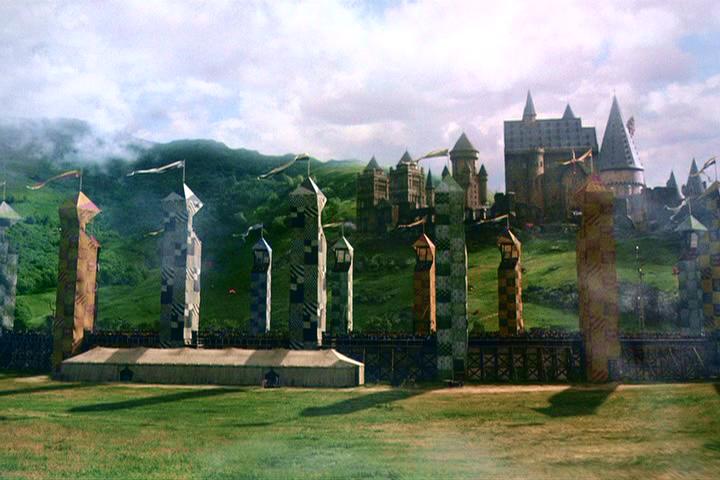
Over the last few years we’ve been watching the Harry Potter movies with a friend who lives abroad; every time she’s been over, we watched another one or two of the films, and over the holidays we saw the two parts of Deathly Hallows, in my case for the third or fourth time. As far as I’m aware, the first part fared less well with critics and audiences than the second one, and it’s clear why: it’s definitely the less crowd-pleasing film of the two. Its plot meanders, what big setpieces there are don’t feel as cathartic as the showdown against Voldemort, and a lot of the movie seems to be dedicated to Harry, Hermione and, with some interruptions, Ron hiking, camping and generally looking wet, cold and miserable.
Nonetheless, rewatching the two films, I found myself clearly preferring the first one. Deathly Hallows Part 2 largely works because it’s the end of a journey, but it feels (and felt even when I first watched it) perfunctory to some extent. We need to resolve the different plot strands, we need to bring closure to Snape’s story, we need to dispose of the remaining horcruxes and of Voldemort himself – but little of this feels like it tells us anything about the characters. We know that Harry is brave, Hermione is smart and Ron is, well, Ron, and we also know that the visual effects wizards are great at doing what they do, as are the designers, artists and everyone else responsible for the way the film looks and sounds. After a while, though, setpieces become interchangeable, and while the escape from a fiery Room of Requirement is exciting in the moment, it’s also strangely bland. It’s a Harry Potter movie, of course there would be some chase or fight involving pixel magic, derring do and last-minute escapes. It’s fan service to some extent, but fan service isn’t automatically bad.
However, there are moments in Deathly Hallows Part 1 that are decidedly different, that are quiet and unexpected, that have nothing to do with crowd-pleasing 3D whooshery. The film already starts with some of these scenes, filled with foreboding and sadness, as Hermione for instance wipes herself from her parents’ memories so they’d be safe. It’s a largely wordless scene, not of teary farewells but of loss and poignant resolve. Another scene I found surprising and delighting was the animated Tale of the Three Brothers; and later, as Ron is temporarily off and Harry and Hermione are alone, Nick Cave’s “O Children” plays on the radio, and Harry engages his friend of many years in a clumsy, sweet dance. It doesn’t further the plot, and it doesn’t get the pulse racing with excitement and danger – but it surprised and enchanted this muggle here more than all of the final part of the final part of Harry Potter.
Obviously the Potteriad wouldn’t have worked, or at least been as successful, if all it consisted of were these quiet, unexpected, intimate moments (though it would be intriguing to see someone try their hand at creating the Before Sunrise of the wizarding world) – but for me it highlights both the shortcomings and the potential of big franchises. Many of the fans love the Harry Potter films for the magic and the world, the quidditch matches and firebreathing dragons and wizards’ duels, so obviously these are things by which later instalments are judged. We want what we know, what is comfortable, because that’s how we came to love the franchise. These expectations are reasonable, but they’re also a trap, keeping a franchise frozen like an insect in amber. It’s similar with something like the Marvel Cinematic Universe, where we get some variation between the different strands – Iron Man isn’t the same as Captain America, whose pulpy WW2 first instalment and more sombre second film differ from Thor‘s sci-fi/mythology mashup – but we know what we’ll get, namely some good action setpieces, some snarky humour and a band of heroic characters that need to put their rivalries and disagreement aside and come together as a family to defeat some colourful yet dull villain – or, if you’re lucky, Tom Hiddleston.
Franchises are the storytelling equivalent of comfort food: when you want a plate of spaghetti, you don’t want it to surprise you with chopped coriander or shiitake mushrooms or a honey-aceto balsamico reduction with shavings of shock-frosted lamb’s kidney. The line between comfort food and tinned spaghetti is thin, though, and there’s always a risk of that exciting quidditch match or that bit where the Hulk goes smash getting stale, to the extent where you hardly know which particular instalment you’re watching at the time. Franchises thrive on constancy, on giving fans what they want, but they can’t be that and that only if they want to be alive and vibrant. They need scenes like Harry and Hermione’s awkward dance to Nick Cave, just like they need Trevor “I am (not) the Mandarin” Slattery. They need to be willing to withhold the simple, immediate gratification of More Of The Same” at times if they want to be good and not just safe. And there’s potential in exactly this: fans know what to expect, so you can surprise them by playing with the format. The most memorable episodes in TV series (which tend to be prone to becoming formulaic) are often the ones that, once the format has been established, play with the formula: Buffy the Vampire Slayer‘s “The Body”or “Once More With Feeling”, House M.D.‘s “Three Stories”, M*A*S*H‘s “The Interview”. It’s because people know the formula that they see how it’s played with, and if it works, it can create some of the most memorable moments a franchise can afford.
Doing that with an entire film is risky: people who go and watch a Harry Potter movie want to see an adventure for the whole family, with magic and special effects setpieces. Iron Man fans want an action comedy with explosions, flying metal suits and Robert Downey Jr. doing what he does so well. But the safety net of the franchise shouldn’t become a prison. By all means, establish a formula, make us fall in love with the flying brooms, the comic-book villainy, the TIE Fighters and Star Destroyers and light sabres. But use those things as a starting point. Don’t just give us what we already know we want: surprise us and win our hearts again by whisking us into a clumsy, earnest dance to the strains of “O Children”. Because being a franchise doesn’t mean we want to watch the same movie over and over again, forever stuck on repeat.
My partner-in-blog has written about his year in pictures, so I’ll end 2014 with three videos: two about the main thing that keeps us going here at Château Goofybeast, i.e. film, and one bonus one that barely qualifies as a video, but damn, if the music ain’t pretty. Here’s wishing each and every one of you a great 2015, with lots more films, books, comics, games and whatever your eyes, ears and hearts may desire!
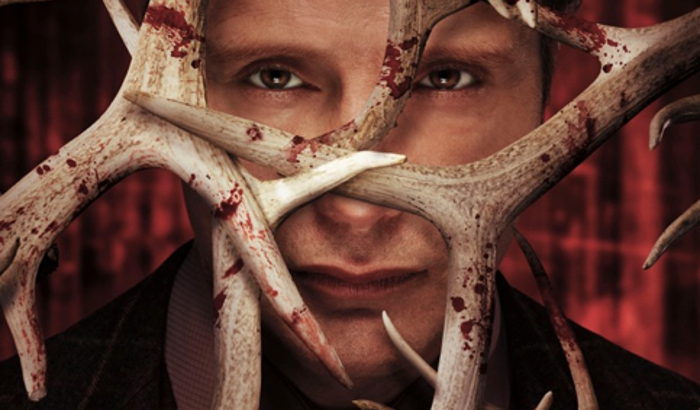
It’s been a year of good series. The palatable horror of two seasons of Hannibal, which is much, much more than a retreading of the Thomas Harris books. The creepiness of Les Revenants, an elaborate French ghost story. The film-noir style and jarring relationship between the two cops in True Detective. The first season of The Fall with its head-to-head between a cop and a serial murderer. The first season of Utopia in which five comic-book fans try to decipher their favourite graphic novel. (The Fall and Utopia clearly turn for the worse in their second seasons.) Happy Valley. I also found good things in Broadchurch, The Leftovers, and Top of the Lake.
Movie-wise, it was a year of diminished returns, but I would like to point out The SaltoftheEarth, Nightcrawler, EverydayRebellion, and Blue Ruin. I’ve written elsewhere about Ida and Locke, but the annual movie cake must go to the excellence of Under the Skin. I’ve praised Jonathan Glazer’s movies elsewhere, but I’ve seen this one first drunk, then sober, and it works both ways. Some scenes are so strong that they have become part of my movie-going DNA.
In some respects, Under the Skin is a horror movie, but there is really only one moment where you might jump out of your seat. At its core, it’s a story about… well, an alien visiting Earth, for whatever reason or to whatever end. She (she?) is very busy trying to get to know the human race in a lonely, isolated Scotland. She lures males into a pool of black quicksand, and since she looks like Scarlett Johansson, there are several willing victims. She’s not evil, but seems to imitate what she thinks is female human behavior. To her surprise, she discovers in herself a kind of empathy, until she no longer has the upper hand.
Since this is the point where one chapter ends, I would like to thank Matt K. for Les Revenants, and Patrick M. for Southland. Another chapter will begin soon: I am looking forward to Inherent Vice and Birdman. Countless surprises await in the rectangular dark. We’ll see.
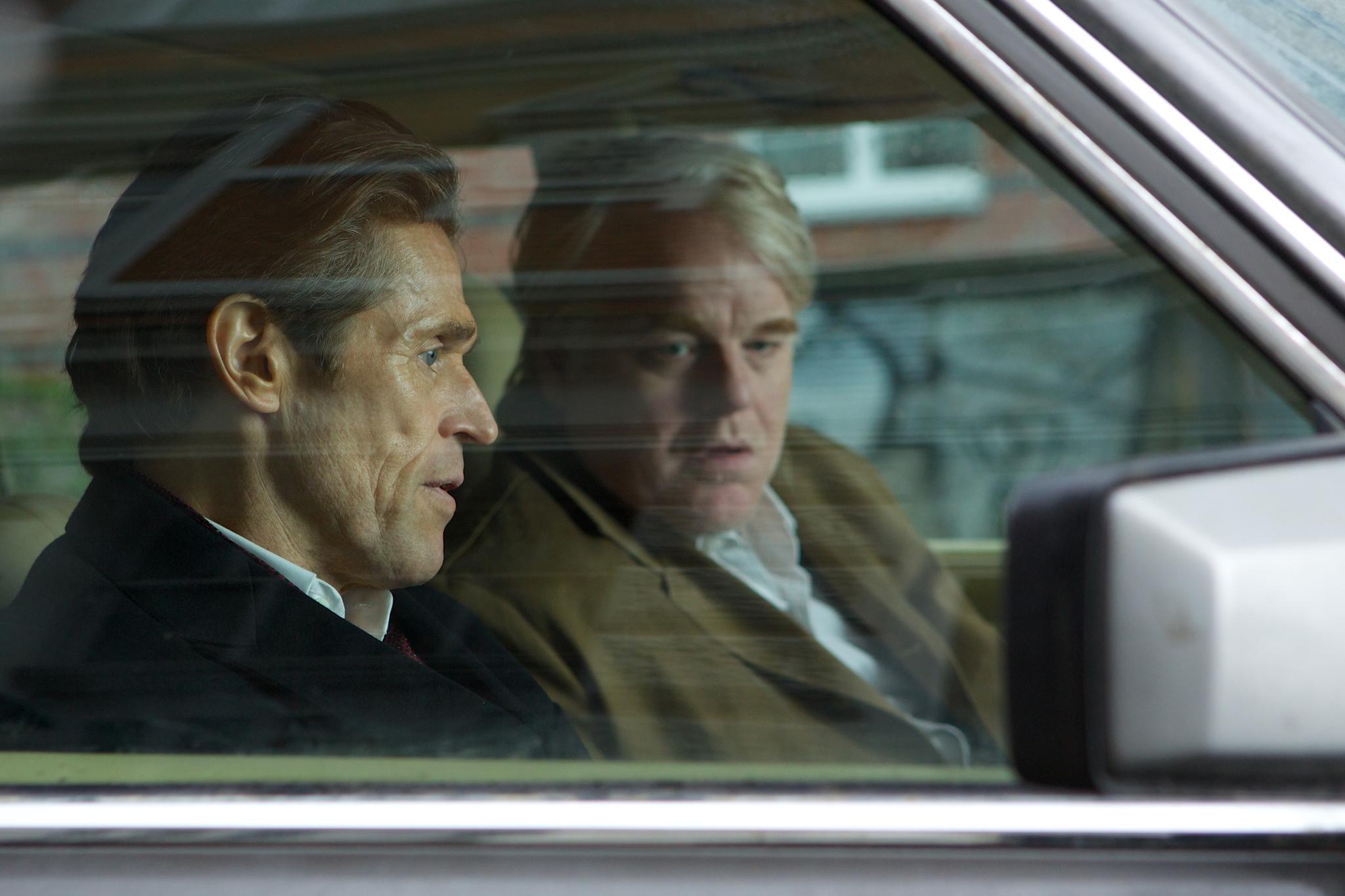
I found it practically impossible to watch A Most Wanted Man without constantly being aware that the man I was watching on the screen was dead and this was his last film. Philip Seymour Hoffman was one of Hollywood’s most unlikely stars and often one of the best things about the films he was in; this swansong, based on a John Le Carré novel, may not be one of the ones Hoffman will be most remembered for, but it is definitely a worthy final addition to his filmography.
As with many of the films based on Le Carré’s works, A Most Wanted Man is not so much a spy thriller as a drama, with a distinct tendency towards tragedy. Hoffman plays a jaded German espionage operative keeping an eye on the Muslim community in Hamburg, and when a former Chechen radical enters his hunting grounds illegally he hopes to use him as an asset in his investigation of a Muslim philanthropist with possible ties to Al Qaeda. While the film doesn’t present us with as much of a quagmire of connections, motives and plots as a successful other recent Le Carré adaptation did – and Hoffman’s operative is a descendant in spirit of George Smiley – it is about similar themes. Years ago the Swiss magazine Du published an issue on John Le Carré titled “All Sorts of Betrayal”, and apparently this is still what the author keeps returning to. All of these betrayals, whether of friends, lovers, or of organisations and countries, are finally private at heart, and A Most Wanted Man sees its main character trying to weigh betrayals, to tempt, bully and cajole others to violate trust to prevent a bigger, more final betrayal.
Except, of course, in Le Carré’s world there is no such thing as a lesser evil, and most definitely not one that can be trusted to end up being lesser. Even more, Hoffman’s body language, the way he looks at people and practices a studied cynicism, all these make it clear that A Most Wanted Man will not end happily for anyone. And this fatalism is in part why this is a good but not a great film: only in rare moments is there the urgency that comes from hoping, and even believing, that this may not end in tears. There is a grain of… faith in something other than jaded pragmatism, perhaps? Belief that even in espionage people, organisations and countries can still hold on to vestiges of a soul? And this belief keeps the main character going, but the tone of the film is as hangdog as Hoffman himself, though without his occasional sparks of hope and of righteous anger. As an audience, though, it’s difficult not to know better: this will end badly, so why commit emotionally? If anything, the film prompts us to be even more jaded than its protagonist, and this works against A Most Wanted Man.
As may the real-life circumstances: Hoffman’s death hanging over the film may make it more poignant, but this poignancy is not in sync with the film. I was prompted to sadness, though not by Le Carré’s story so much as by knowing that this is the last time we’re seeing a lead performance by an actor gone too soon. A Most Wanted Man is a good film, it’s crafted beautifully, its performances are consistently strong, but its greatest tragedy may be that it serves most as a reminder of a different tragedy that has nothing to do with the film itself. Perhaps it will be easier to see it for itself in five to ten years, when it no longer feels quite as much like a obituary.
Serial is the most successful podcast around these days. At its core, it’s about the 1999 death of a Baltimore County high school student called Hae Min Lee, about her ex-boyfriend Adnan Syed, who is serving life in prison, and about Jay, the guy who testified in court that it was Adnan who killed Hae.
All this is told in weekly instalments by journalist Sarah Koenig. The material she presents is intriguing, but I think Koenig herself is the key to Serial‘s success: she asks the right questions, provides smart answers, and is unafraid to confront many of the people involved. After twelve months of researching Adnan’s case, she does not claim to know the truth – she still isn’t sure if he is guilty or not. Her point is: the trial was too weak for Adnan to be convicted. I agree. There are too many unanswered questions, too many incongruous details.
And she avoids the greatest of pitfalls: she doesn’t sensationalize. She’s simply curious about what has happened, and we are allowed to come along. She has the right kind of voice for this – at times, she is annoyed, surprised and suspicious just as her audience must be.
I don’t have a particular problem with a real-life murder case being used for entertainment – if it comes along smart and knowledgeable like this series here. Koenig and her team could not have foreseen the success that Serial has now. And if it leads to pressure for a re-trial or to a case review, why not? I only have a problem with those amateur sleuths who gain access to trial documents and then publish the names and details of persons who are connected to this case whose names Koenig withheld intentionally. Adnan’s family also gets pestered by people who want to know if they think that Adnan is a psychopath.
Dramatically, Serial is a risk. This is about real life, and it won’t bow to conventional storytelling. Koenig has gotten so many donations that there will be a second season – maybe about another crime with its open questions and incongruities. Meanwhile, Adnan Syed’s case has been taken on by a group of lawyers connected to the innocence project, so whereas Serial will definitely come to its end next week, the case might go on. So be it – this might well turn into a podcast that has an impact on the US legal system. Imagine that.
Interstellar pushed many of the right buttons for me, primarily the big one labelled “Sense of cosmic wonder”. I was the kid who had a poster of the solar system on his bedroom wall for an embarrassingly long time; I loved anything to do with space, but I reserved a special love for space exploration, especially of the supposedly authentic kind. Sure, I wanted to fly an X-Wing, but that thought never felt as wondrous as that of NASA journeys, of the Apollo missions or the Space Shuttle. Wormholes and black holes? Accretion disks? Count me in.
That sense of wonder was definitely there when I watched Interstellar, and the film captures it well. What it captures less well, though, is human emotion – which is a problem, since for all its space age imagery the film is essentially about sentiment much more than it is about physics. It’s not the emotions themselves that are the problem; thematically, Interstellar uses its premise and setting to tell a very human story. The problem is that the Nolans are much better at telling a different kind of story – one that is conceptual, that tends to be about puzzles. At their best, the Nolan-directed and -penned films are interested in the feelings of their characters, but they don’t focus on them head on. Their protagonists are often emotionally repressed, in denial or simply unable to access or express their feelings, and the stories tend to derive poignancy from this inability. Interstellar, though, wears its heart on its sleeve. Its characters talk about their emotions, they cry quickly and freely – and while the actors are more than capable, they can’t overcome that the words they’ve been given are often clumsy, overly explicit, explaining things too much. The worst scene in this respect has a teary-eyed Anne Hathaway trying to impress on her fellow astronauts that love is a force transcending space and time. Done differently, written better and allowing for some ambiguity, this could work, but in the film it feels like a NASA-themed Hallmark card. Those moments very much suggest that when it comes to the Nolans’ dialogue, quite literally, the less said, the better.
It is this tendency to overexplain, to make things too literal, that hobbles some of Interstellar‘s central scenes as much as its clumsy handling of emotion. Late in the film, the story bends causality back on itself in a classically sci-fi way, but where Christopher Nolan often finds striking images for settings and situations, here they turn faintly ludicrous, and they fire rockets full throttle into silliness the more the protagonists explain what is happening. All fiction, including speculative fiction, engages in some narrative handwaving, leaving gaps with respect to what is happening or how precisely it is happening, because the exact mechanics are irrelevant to what the story is about. Interstellar, however, tangles itself up in knots by trying to fill in the blanks, when it should well have left alone. Trying to elaborate on what is happening, the expository dialogue is hamfistedly literal, drawing attention to what is arguably least important, and raising questions about its feasibility that shouldn’t come up in the first place. (One can only imagine a Nolan-penned 2001: A Space Odyssey, giving the Monolith a -logue to explain to Dave Bowman what the last 20 minutes meant.)
When I first saw the Interstellar trailer, I was intrigued, but I was equally worried that this would be Nolan’s Contact, an intriguing sci-fi tale that takes a turn for the sentimental: daddy issues in space. It isn’t quite that bad, and there’s a lot to like about the film. It is ambitious, it is often beautiful, and Matthew McConaughey has vastly improved as an actor since the giddy days of 1997. Interstellar is a compelling illustration of both the strengths and the limitations of Nolan’s filmmaking, though, and it is frustrating in how it could have been a better, more subtle and more convincing film. This isn’t a complaint along the lines of “Waiter, there’s some sentiment in my sci-fi soup!” I don’t think that hard sci-fi, or any sci-fi, needs to lose the human element. What it does need, though, is a human element that’s done with the same skill as the visual effects. Interstellar excels at showing us the surfaces of alien worlds, but its telescope is flawed when pointed at the human heart.
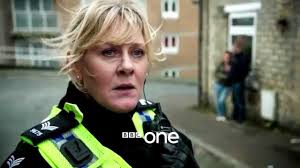
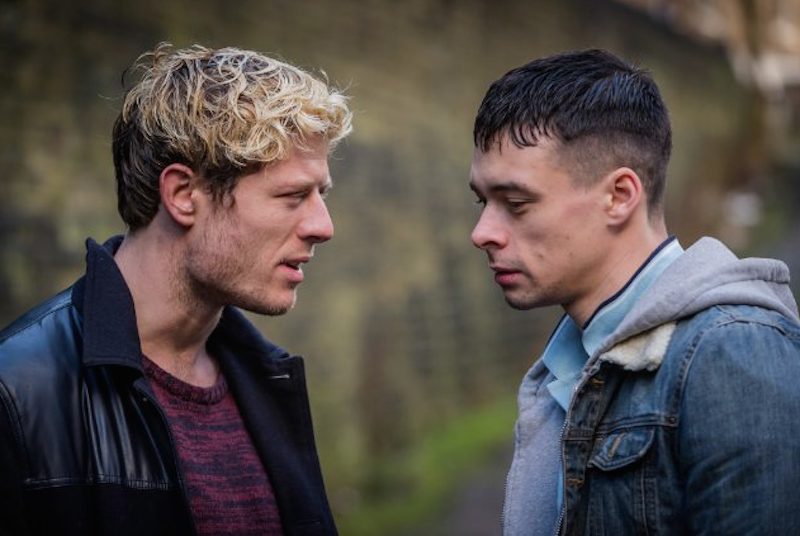
Poor Catherine Cawood. She is police sergeant of a small Yorkshire village. She sleeps with her ex-husband. She looks after her sister, a recovering heroin addict. She takes care of her grandson because his mother, her daughter, has committed suicide after being raped. The man responsible has returned to the valley, and Catherine is very, very alert, up to the point of breaking a few police rules. Happy Valley might just be the misnomer of the year.
The reason I want to admire this six-part series is the main performance by Sarah Lancashire. She plays her scenes matter-of-factly, but without being hardened or cynical. She is so good that the scenes she is not in feel slightly off. It will be hard to watch her in anything else and not think of this series. On the whole, Happy Valley might not be as even or as suspenseful as Broadchurch, but Sarah Lancashire is more memorable than most of the coppers on TV lately.
Unlike Broadchurch, Happy Valley is not a whodunit. The audience has to wait for the police to latch on to the fact that someone has been abducted. It’s also bleaker and gorier than Broadchurch, but nowhere near The Fall. I like Gillian Anderson as much as Olivia Colman, but it’s Lancashire’s performance that stands out. There is a drunk guy who wants to set fire to himself. Sergeant Cawood arms herself with a fire extinguisher and a pair of sunglasses and goes to talk to the man. Just in case.
Episode 5 is a slight disappointment because there are too many moments of soul-searching and too many family resentments coming to light. Episode 6 is slightly too neat and, at the same time, too undecided about how it wants to end. Never mind – Catherine Cawood is as interesting as was Jane Tennison in her time.