A season too far…

We watched another two episodes of the second season of Life on Mars yesterday, and while they were more enjoyable than a couple of the ones earlier this season, they still felt like variations on a theme – and minor variations at that. The impression I got was that they had material for a total of eight or nine episodes, at most. Instead they decided to stretch it to two seasons and 14 episodes altogether, and as a result much of the impact was lost. This could have been a little gem of a series, and instead it turned out to be an okay execution of a clever premise, extended past its sell-by date.

You doity rat (redux)

Quite a few series are milked, the episodes becoming tired, stale rehashes of earlier material. Even fans say that The Simpsons have been going on for too long (although they also argue that the last season has been a marked improvement). Same seems to go for Spooks (another BBC series by Kudos, the producers of Life on Mars), Buffy (I’ve seen few defenses of season 7), The X-Files or most of the Star Trek series.

And then you get series that are killed untimely. Firefly and Deadwood come to mind, but I’m sure there are other examples as well. (Futurama, perhaps, ending with one of the best episodes of the entire series, but it’s being revived right now, so I’ll wait and see.) Series that, quite simply put, had much more to say. Series that quite often also expected something from the viewer, that made demands – for instance, that you tuned in every week. You can’t really tell a good, sustained story if viewers may look in once a month, at best.

Death by trampoline?

To be honest, I can only think of a handful of series that managed to end when they should have. Six Feet Under is a candidate. M*A*S*H, perhaps, although the jury’s out on whether the series maintained its quality, got better, or simply got smug and self-righteous. Most people loved “Goodbye, Farewell and Amen”, but there are some who hated it with a vengeance for being Alan Alda’s soapbox.

I guess that, given the choice, most fans would prefer more material of their favourite series even at the price of diminishing quality. But it is frustrating to see them putting out yet another cop series or medical soap but at the same time not allowing more complex, more ambitious – and, admittedly, less audience-friendly – material the breathing space it needs.
Deadwood is other people

There’s many things you can say about Deadwood – many very complimentary things – but “endearing” may not be the first thing that comes to mind. Seeing Al Swearengen all dressed up and trying his best to be polite (and do without his usual colourful idiom) in his first face-to-face meeting with Alma Garrett was exactly that, though: endearing. Even when he asks Alma to tell her ward, young squeaky-voiced Sophia that there are “no hard feelings”. No hard feelings, that is, about his plan to have her killed back in season 1, since she could have put a spanner in his works. I’m still amazed at the tonal range this wonderful series has (or rather, had – more on that below), and at the complexity of the characters.

In general, these characters play eminently well with, and off, each other. You don’t even need much plot to enjoy what happens when you put Al and Alma together in a room. Or E.B. Farnum and Calamity Jane (although if they were in a room together, chances are only one person would come out). Personally, I wouldn’t mind putting Cy Tolliver in a room with Dan Dority, just to see Dan’s famous impulse control do its thing with the boss of the Bella Union.

Sadly, it’s looking less and less likely that the post-season 3 TV movies will ever be made. With so much garbage and generic rehashes of rehashes on TV, it’s sad that an intelligent, tough, beautifully crafted series such as Deadwood is shelved. But what can you do?

Perhaps David Milch should create a series about a team of forensic crime-scene investigators in the Old West. That should sell like handguns…

The cake is a lie… or is it?

“The Enrichment Center is committed to the well-being of all participants. Cake and Grief Counseling will be available at the conclusion of the test. Thank you for helping us help you help us all.”

“Did you know you can donate one or all of your vital organs to the Aperture
Science Self Esteem Fund for Girls? It’s true!” 

Portal is probably this year’s most written about game, even more so than Halo 3. And for good reason. It’s the first game I’ve every played (and I’ve been doing this since 1982, roughly) that I would call perfect. This weirdly wonderful offshoot of the Half-Life franchise, feeling like the movie Cube, if it had been written by Charlie Kaufman, doesn’t take a single wrong step. The brilliant idea that forms the premise of the game gets the usual Valve polish, but it’s the script that turns this into something special.

 Which is also why I’d rather show than tell. So, here goes, courtesy of YouTube:

P.S.: Portal‘s AI GLaDOS, who gives good old SHODAN a run for her money, is brilliantly written. The funnier she gets, the more disturbing she gets. And the song at the end makes me want to cuddle and cuddle and cuddle this game.

It’s never lupus

Yesterday’s TV series evening was fun. First “Finding Judas” on House, M.D., then Lost‘s “Flashes Before Your Eyes”.

Slap the parents and House both, please…!

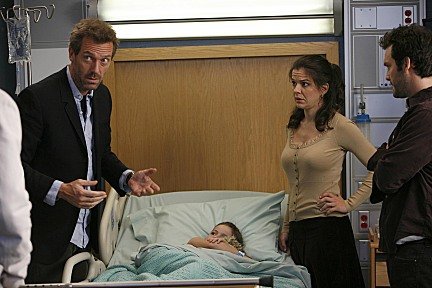
Actually, I tell a lie. The “Judas” episode wasn’t fun, though it was eminently watchable. For the first time, House really seemed to lose it completely, becoming a strung-out bastard who used his incisive mind not to help his patient but to hurt those who are on his side. If Tritter wasn’t so clearly a bastard himself, he would have proven that he has a point in much of what he says. House’s words to Cuddy, for instance, were cruel and his general behaviour shitty. His suffering from withdrawal explains it, but it doesn’t excuse it.

Obviously the episode was manipulative (even more so than most of House), but effectively so. I knew they wouldn’t amputate the little girl’s arm and leg, but part of me sat there thinking “Ohshitohshitohshit…” nevertheless. I’m curious to see where they’ll take the Tritter plot and Wilson’s friendship with House, as that storyline seems to be coming to a head. And I wonder whether it’ll ever be lupus…

“Flashes Before Your Eyes” was an intriguing episode of Lost, and a heavy focus on Desmond is always welcome. For all its meandering and self-indulgence, the series has been fairly good at introducing new and interesting characters: Ben, Mr Eko, Desmond. The episode also had some interesting twists, such as the Precog Scot trying to save Charlie (and not Claire, as it appears at first), and the clever use of the flashback convention.

It’s oh-so-British, innit?

I could have done without the fake Englishness of some of it, though. The series’ England feels as if its makers only know the country from bad movies and TV. Especially Fionnula Flanagan’s character felt fake, when she should have been eerie. Still, though, it looks like Charlie – possibly the character who annoys me most – is heading for a rendezvous with the Grim Reaper. Can’t say I’m going to be too sad. Then again, they made me kinda like Shannon and Boone just before killing them off. The Lost writers are obviously bastards.

Pretty as a picture

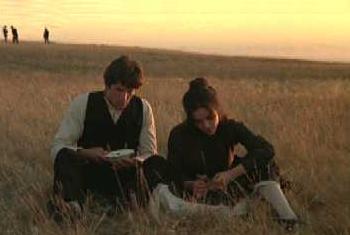
Actually, that’s not really accurate. Terence Malick’s Days of Heaven isn’t pretty – it’s beautiful. The cinematography has a grandeur that is breathtaking at times. There are films that you’d want to frame and hang on the wall, and all of Malick’s works have that quality.

Happy couple doing couply things

What about the rest of the film, though? Does it just look good but is a waste of time otherwise? Apparently, Days of Heaven was criticised for its muted emotions. Indeed, we don’t get the extremes of passion that the love-triangle plot would suggest. No shouting and screaming, and even during the film’s scenes of violence there’s a certain distanced quality of defeat and resignation. Which I liked a lot, thuogh. So much emotion in films is melodrama, going to 11, but a) this isn’t necessarily true to life and b) I wouldn’t want this sort of emotional forte fortissimo in every film. Not every tragedy of jealousy should be Othello.

The protagonists in Days of Heaven seem so know from the first that real happiness is likely to be out of their reach, that the best they can hope for is a momentary reprieve from the dull despair, of poverty, of illness, of loneliness. Melodramatic passion is an indulgence none of them believe in. Their emotions, or at least their expression of their feelings,  have been dulled by various kinds of deprivation.

This dullness is encapsulated neatly in the narration by the teenage character Linda. She’s a kindred spirit to Sissy Spacek’s Holly in Badlands, although without that character’s naive romantic imagination. As with Holly, nothing would seem to be quite real to Linda. Bad things happen, people die, that’s the way it is. No use crying about it. Fair or unfair doesn’t come into it.

Day of the Locust

I’m not sure I get the film’s ending, though. Although the narration’s focus lies with the lovers, we get a curious continuation of Linda’s story that ends abruptly. I’m certain there are film buffs who could explain the purpose of this not-really-epilogue to me. I could come up with a number of interpretations, but I’m not sure any of them would ring true. Perhaps I should just watch the film again, though, and become caught up in the sheer depth and width of the images all over.

Newsflash: Death cheats at chess!

From Lowell Bergman to Ingmar Bergman. (Classy, huh?) Yesterday we watched Bergman’s The Seventh Seal. Call me odd, but I find his movies entertaining. They get a bad rap for being a film nerd’s wet dream (but actually somewhat boring), but I think that many of the parodies of his style are unfair.

At least in the two Bergman movies I’ve seen so far – Wild Strawberries in addition to The Seventh Seal – there’s always been a gentle sense of humour that puts the more lofty philosophical and metaphysical passages into perspective. For every scene with the knight Antonius Block contemplating life, death and the existence (or lack thereof) of God, there’s a scene with his more cynical, down-to-earth squire Jöns, puncturing the musings of his more pompous master. And beyond all this, there’s nothing boring, overly intellectual or pretentiously existential in the very real dread of the scenes with the flagellants or the distrurbed girl about to be burnt at the stake.

And there’s something refreshingly sly about both Block and Death cheating at the chess game they’re playing, even if they cheat for different reasons.

But, fair or not, without Bergman we wouldn’t have scenes like this (wait for a bit to get to the Seventh Seal bit):

P.S.: By the way, I don’t think it’s too much of a spoiler to give away that they both win in the end.

It’s a Mann’s world

Yesterday we watched The Insider, Michael Mann’s 1999 film about whistleblower Jeffrey Wigand, 60 Minutes and the evil machinations of big US tobbaco. I like Mann’s cool jazz style, the calm rhythm of his movies. Watching The Insider for the fourth or fifth time, though, I was struck at how much the director’s cinematic world is a male one.

Insiders inside a car (duh…)

Like in several of Mann’s movies, it’s not so much that there isn’t any sympathy for the women (in this case especially Wigand’s wife Liane, played by Diane Venora), but that the film’s focus always remains with the man, and as a result the women are seen in terms of whether they remain loyal to their men or not. It’s really weird – if I write it like that, it makes Mann sound like the worst misogynist ever. However, I don’t think that’s quite fair. Venora’s character in Heat (this time she’s together with the Pacino character) also decides to walk out on her man because his job is more important than his family. It’s not that he doesn’t love her, but he’s obsessed with what he does. Perhaps that’s why the films aren’t straightforward exercises in sexism – Mann’s men are obsessive-compulsive, they choose their duties like lonesome cowboys. There’s something glamorous and admirable to the male protagonists, but at the same time they’re stuck in adolescence and in the belief that they don’t need anyone else, except the other boys they play their lethal games with.

By comparison, the women live in the real world much more than the men. Things aren’t as clear cut for them. Venora’s Justine Hanna in Heat realises that she will always come second to her husband. Her Liane Wigand knows that Jeffrey (fantastically acted by Russell Crowe, by the way) will not give up his quixotic quest against big tobacco, not even for the sake of his family. She comes off worse, perhaps, than other women in Mann, because Jeffrey Wigand is so clearly doing the right thing. But there is understanding in the film for her plight.

In the hands of a lesser director and actress, Liane and Justine would simply be shrews who screw over their good-guy husbands. It’s difficult to completely shake the feeling that they are disloyal and selfish. But they have a strength and a dignity that makes us look and think twice.

But it doesn’t change that, at its heart, Michael Mann’s world is a man’s world indeed.

Tom and Jamie,/Sitting in a Car…

Sniffle…

Since I feel like I’ve come down with something, I’m going to take it easy today. No long speeches, no pretentious analyses of videogame narratives.

Just a trailer for one of the films I’ve been looking forward to most.

Oh, and it’s got that coward Jack McCall and Francis Wolcott in it. Playing the same character.

One planet, one vote!

I did it.

I finally finished Augusten Burroughs’ Running With Scissors. And boy, am I glad.

By the time I got to the last chapter, I no longer hated it. I simply didn’t have the stamina for that. I simply found it boring and annoying – and boringly, annoyingly unfunny. There’s little structure in the novel, so the single episodes could all be jumbled up and re-ordered with little to no effect on the book. There’s barely any character development. I’m sure you can write enjoyable novels without character development or structure, but you have to be a hell of a lot better than Burroughs and your story has to be a hell of a lot more interesting. Up to the very end, I felt I was reading the self-indulgent, self-dramatising journal of a drama queen – admittedly one whose childhood and adolescence (as told) were quite horrible, but suffering in itself does not a good novel make.

Anyway, it’s over, and I’ve now started on Haruki Murakami’s short story collection Blind Willow, Sleeping Woman. I recently read his Kafka on the Shore, which was okay but faltered a lot towards the end, and it suffered a lot from having come after The Wind-Up Bird Chronicle, which I think is what the Germans surreally call “ein grosser Wurf”. (Roughly translateable as “a great success”; literally, it means “a great throw”, which might make sense if the Germans played baseball.) I enjoyed a lot of Murakami’s earlier short fiction, perhaps mainly because his excursions from the main plot are always fascinating… and in a short story there’s less of a risk that he runs out of steam and the novel peters out. Murakami is a great writer, but endings aren’t his forte.

What else? I’ve played on in Anachronox, and it’s as delightfully inventive as I remember. I’ve just left Democratus, one of the great inventions of the game: a planet that makes Switzerland’s political system look positively efficient. On Democratus, every decision requires a vote. Every decision. And every decision has to be discussed in great detail, so that the planet’s High Council even fails to come to a decision about the 64 lethal missiles aimed its way by an aggressive insect race. But watch for yourselves:

Since few of you are likely to still find the game and play it, I’ll go ahead and spoil some of the further plot for you: after you save Democratus, the Council decides to reward you by having the planet shrunk and joining your party. As Wikipedia puts it, “the most annoying civilization in the universe shrinks their planet to five feet in diameter and begins following the team around.” And there’s little as boggling as the sight of that man-sized planet happily floating after you, squabbling about your every decision.

It happened at the movies… (3)

(… although technically that should be (4), since my entry on The Departed was also part of this tightly plotted, carefully laid out series. Ah well.)

I wish I could remember the title of this movie…

Christopher Nolan made an impression on me with his second film, Memento, which I thought clever, affecting and fascinating. Insomnia, his follow-up, didn’t do much for me, well crafted and acted tough as it was. It didn’t have the conviction of the Norwegian original, sitting uncomfortably between Hollywood thriller and harsh morality play.

The Prestige is probably Nolan’s best film since Memento. His reboot of the Batman franchise was good and intelligent, but its plot was predictable. The Prestige, a film about 2+ rival magicians at the turn of the century is at least as cleverly conceived and told as his amnesia thriller. Judging from the plot of the original novel (as given on Wikipedia), the film adaptation has been changed quite a bit, so it’s all the more surprising and impressive to find such an intricately structured, yet elegantly executed plot in the movie.

What struck me most was Nolan’s witty use of repeated motifs that, in a second viewing, might look like obvious hints at the twists in the movie. Every element is carefully laid out, and the film plays fair, yet when the viewer thinks he’s figured it out and smugly leans back, chances are he’ll realise half an hour later that he’s underestimated Nolan’s Chinese box.

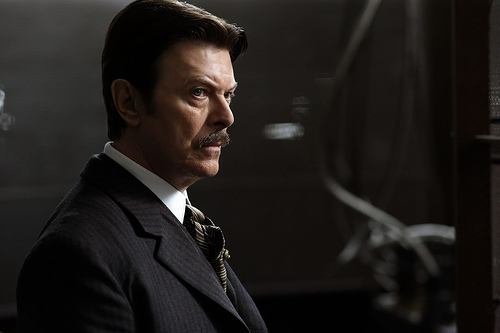
And apart from The Prestige‘s cleverness (which has a slightly arch quality to it, just as some of the voiceovers), there’s something admirably goofy about casting David Bowie as an aging Nicholas Tesla, perhaps the truest magician of the piece yet the least mysterious, least self-dramatising character in the film.

Is there life after Mars?