Six Damn Fine Degrees #20: Dubbed and snubbed – the secret voices of Hollywood

Welcome to Six Damn Fine Degrees. These instalments will be inspired by the idea of six degrees of separation in the loosest sense. The only rule: it connects – in some way – to the previous instalment. So come join us on our weekly foray into interconnectedness.

Question: Do you think this is actually Audrey Hepburn singing the wonderful “Moon River” from Breakfast at Tiffany‘s (discussed in last week’s post by Alan)?

Continue reading →

I’ll be in my trailer… watching trailers: Taking the Mickey – right out of the trailer

Join us every week for a trip into the weird and wonderful world of trailers. Whether it’s the first teaser for the latest instalment in your favourite franchise, an obscure preview for a strange indie darling, whether it’s good, bad, ugly or just plain weird – your favourite pop culture baristas are there to tell you what they think.

This was a remarkably busy week at A Damn Fine Cup of Culture, starting with three journeys – into pre-history, a Jules Verne-style alternate past, to the moon, and beyond! Matt wrote about his encounters with Karel Zeman’s oeuvre in the beautiful Criterion edition of three of his key films. (We would say that you should Czech this out, but obviously we’re above such cheesy puns.)

Continue reading →

A Damn Fine Cup of Culture Podcast #42: The Complicated Women of Pre-Code Cinema

… or how the Code Ruined Everything. Welcome listeners! For our March episode we will look into the cinema of the 1930s, before the Motion Picture Production Code was enforced in 1934. Just after the roaring ’20s and through the Great Depression, there was a space for stories and characters which would ultimately be lost to Hollywood. A space where there was an opportunity for a different kind of part – especially for women. Where rather than just virgin or vixen, there was room for something in between: something more interesting, more human, and so much more fun! Tune in as Alan and Julie explore what makes pre-code films, and the characters who inhabit them, so special!

Continue reading →

Six Damn Fine Degrees #19: Mr Yunioshi

Welcome to Six Damn Fine Degrees. These instalments will be inspired by the idea of six degrees of separation in the loosest sense. The only rule: it connects – in some way – to the previous instalment. So come join us on our weekly foray into interconnectedness.

Watching classic cinema for the first time on the big screen can be a fabulous experience. Firstly, you’re getting to see how the makers intended you to see it. Secondly, the audience in the type of cinemas that play old movies tend to be incredibly well-behaved. No loud phone calls mid-movie or bored kids kicking the back of your chair.

Continue reading →

A Journey through Worlds of Wonders: Three Films by Karel Zeman

At the very least since I first watched Star Wars recorded off ITV onto a Betamax video tape, I’ve had a keen interest in special effects, and in films that use special effects to create unique and different worlds and beings. In this respect, though, the last twenty years or so have been something of a disillusionment: while CGI visual effects have become more and more realistic and indistinguishable from reality, they only rarely recapture one of the things I enjoyed most as a kid. See, the kind of special effects I’ve enjoyed most were never about verisimilitude, at least not first and foremost. A fantastic world is made believable and engaging by the imagination going into it more than by the number of pixels and shaders. And sure, I prefer a well-made green screen effect providing the illusion that those kids on broomsticks can really fly to a bad green screen effect aiming for the same thing and failing, but the special effects that stick most in my mind are the ones that transport me to a different, more interesting world – and that can be achieved by miniature spaceships suspended on threads you can make out if you look closely.

Continue reading →

I’ll be in my trailer… watching trailers: In Cold Blood, in more ways than one

Join us every week for a trip into the weird and wonderful world of trailers. Whether it’s the first teaser for the latest instalment in your favourite franchise, an obscure preview for a strange indie darling, whether it’s good, bad, ugly or just plain weird – your favourite pop culture baristas are there to tell you what they think.

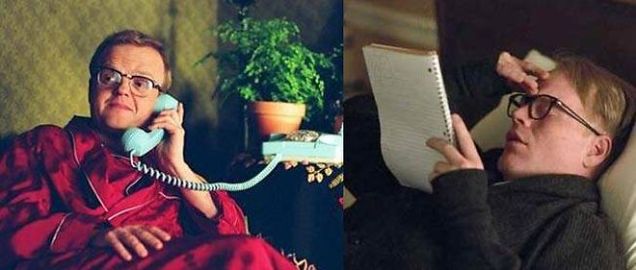
This has been a relatively quiet week at A Damn Fine Cup of Culture, but we did have a tribute to the wonderful Toby Jones in Friday’s instalment of Six Damn Fine Degrees. Jones lost the Battle of the Capotes in the mid-Noughties, and his Infamous was pretty much overshadowed by Capote, which came out the year before, but that’s all the more reason to give Jones his due here.

Continue reading →

Six Damn Fine Degrees #18: Toby Jones

Welcome to Six Damn Fine Degrees. These instalments will be inspired by the idea of six degrees of separation in the loosest sense. The only rule: it connects – in some way – to the previous instalment. So come join us on our weekly foray into interconnectedness.

You know how sometimes there are these strange cases of cinema serendipity, where within a year you’d get not just one but two big films about, say, asteroids heading for Earth and teams of astronauts sent on a mission to destroy them. Or CGI comedies about ants. Or biopics about legendary Scottish freedom fighters.

Perhaps the strangest of those pairs of ‘twin films’, as the phenomenon is called on Wikipedia, is the 2005 film Capote and 2006’s Infamous, both of which told the story of Truman Capote’s writing of his 1966 book In Cold Blood. Capote received wide acclaim and won its lead actor Philip Seymour Hoffman an Academy Award. Infamous, though, was barely noticed – beyond the comparisons to the film released earlier. And this extended to the actor who played Infamous‘ version of Truman Capote: Toby Jones.

The Two Capotes
Continue reading →

I’ll be in my trailer… watching trailers: Say it with me – “It’s not TV. It’s…”

Join us every week for a trip into the weird and wonderful world of trailers. Whether it’s the first teaser for the latest instalment in your favourite franchise, an obscure preview for a strange indie darling, whether it’s good, bad, ugly or just plain weird – your favourite pop culture baristas are there to tell you what they think.

Remember when every year seemed to see the release of half a dozen adaptations of YA novels, with bonus points if you were 1) starting a trilogy, 2) the final film of that trilogy was to be split into two films and 3) there were still people interested enough to watch the final instalment? For last Friday’s Six Damn Fine Degrees post, Mege took a look back at the YA franchise that probably fared best, apart from the media behemoth that was Harry Potter, and that in no small way because of a cast to die – or kill – for: The Hunger Games.

Continue reading →

The Loneliness of the Long-Distance Pilgrim: revisiting Journey

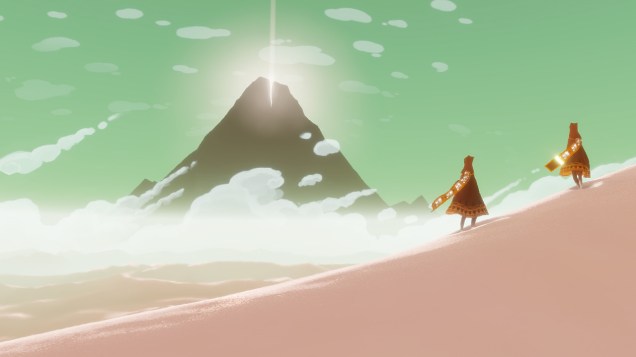
In 2012, a game called Journey was published on the PlayStation 3. It was pretty much the consummate indie art game: there were no puzzles, no boss encounters. Heck, you couldn’t even shoot anyone. What you could do is control your avatar, a figure in a red robe, to walk around the desert dunes. You could jump and even fly, in very limited ways. And you could sing. And as you crossed the desert, you could bump into other robed figures and communicate with them – by moving around, jumping, flying and singing. Whoever you were, and whatever you were hoping to achieve in this desolate yet beautiful landscape: you were not alone.

Continue reading →

Six Damn Fine Degrees #17: The Hunger Games (2012)

Welcome to Six Damn Fine Degrees. These instalments will be inspired by the idea of six degrees of separation in the loosest sense. The only rule: it connects – in some way – to the previous instalment. So come join us on our weekly foray into interconnectedness.

You can dismiss it as juvenile dross, and you would not be entirely wrong, but The Hunger Games (2012) gets one thing admirably right: it is very able to balance its theme of mass media voyeurism showcasing a random group of soon-to-die game show contestants with the fact that we, the audience, are watching their imminent demise alongside the anonymous masses in the film. We are made to be voyeurs, too, not entirely against our will, and yet we are asked to side with the contestants – or victims, let’s call them, for that is what they are. And since we are not heartless, we empathize with them.

Continue reading →