 I’ve heard it said that the majority of neo-nazis and other members of extreme right-wing associations contemplate suicide at least once in their lives because subconsciously, they sense that their world-view is wrong. In Guy Nattiv’s Skin, Bryon Widner (Jamie Bell) is at this point. He is a member of the Vinlanders Social Club, not a social club at all, led by Fred ‘Hammer’ Krager (an unrecognizable Bill Camp), a stern father figure who is married to Shareen (Vera Farmiga), who actively tells everyone that they can call her Mum. It’s a bunch of people who have nowhere else to go, socially as well as economically, and they are just happy that there is someone who takes care of them and gives them things to do, no matter how vile or poisonous their chores are. The VSC is a family for people who never had a proper family. It would be a huge mistake to think that Fred and Shareen are in any way dumb or ridiculous. They provide food and shelter for strays and manipulate them into becoming white supremacists. They are not above murder, so be warned. The more they clash with their preceived enemies, the more they come alive, and the more dangerous they are. Continue reading
Author: Mege
Other People’s Music
 It’s possible to have great fun in a predictable formula movie. My daughter and me went to see Yesterday, about a luckless singer who has a road accident and wakes up in a world without the Beatles songbook. It slowly dawns on poor Jack that he is the only one who remembers the Fab Four. Screenplay by Richard Curtis, directed by Danny Boyle. That’s a pretty snazzy premise, innit? We went during a sweltering hot day, the movie theater was cool, and it was the tiniest viewing room in our city. “It’s just like a movie theater people would have at home,” she exclaimed. We were the only ones sitting there, and so we sang along to all the tunes. Great fun. Continue reading
Burying the Lead
 Karyn Kusama’s Destroyer fails for me (and maybe for me only) on a mere technicality. Consider Nicole Kidman’s character, a police detective by the name of Erin Bell. She walks as if she is in constant pain, or medicated, or both. There are flashbacks with her partner and later boyfriend Chris, where she looks younger and healthy. It’s just that it is implied that she has to take drugs and/or alcohol in order to infiltrate the bank heist crew run by Silas (Toby Kebbell). There are only very few scenes, and very late in the movie, that really let us know what it cost Erin to stay in Silas’ crew. What drungs did she have to take in order to keep her disguise? And what about Chris? And her lower jaw seems wired or dislocated – is that from the car crash she produced herself long ago? We just don’t know. And it’s Erin Bell’s face that the whole movie rotates around. On the whole, Destroyer raises far more questions that it answers. Continue reading
Slow Deaths in the Sun

The situation for movie theaters in my hometown is dire. The inner city places are closing up one after the other because the rent is said to be too expensive for the two chains, Kitag and Quinnie. The Capitol, where I saw Return of the King, is boarded up. So is the Gotthard, where I once took a girl who was way out of my league on a date. The Jura triplex is closed, the City triplex is a provisory pub, the Royal has reopened as a vegan burger restaurant. The Splendid, the only inner city theater still showing undubbed blockbusters in 2D, is said to close soon. Instead, soulless multiplexes have sprung up at the edge of town where it is cumbersome to get to by public transport. Their viewing rooms are bigger, so the small number of viewers seems even more lost. They are run by companies that have profit as their priority, not fine movie-making programmed along a common theme or name for an appreciative or even regular audience. Granted, Pathé is a movie production and distribution company, but their multiplex is just as anonymous as that by Swisscom, the national number one telecommunications company. I only go to either of them when I have to, for instance when I want to see Jordan Peele’s Us in its original language.
Continue readingThe Rear-View Mirror: Asterix (1961)
Each Friday we travel back in time, one year at a time, for a look at some of the cultural goodies that may appear closer than they really are in The Rear-View Mirror. Join us on our weekly journey into the past!

I didn’t come to Asterix on my own – someone at my school must have introduced me to the series when it was already 15 years old and several volumes long. Of course, I got hooked on it immediately: a period of history that wasn’t too hard to learn, and now it was even fun, with battles, quests, betrayals, and a great many fistfights and chases that almost always ended well for the little Gaul with the large moustache and his friends.
Continue readingBridging the Gaps
 Maybe I am not the ideal audience for Martin Witz’ Gateways to New York. On the one hand, it’s a documentary about some of the bridges of New York. Since I have absolutely no spatial orientation, I was at a loss as to where these bridges are and which two areas they connect. Here’s an easy question: what does the George-Washington Bridge connect? I only faintly remembered that the answer is New York and New Jersey, maybe because of The Sopranos. And what does the Verrazzano-Narrows Bridge connect? Aha, see? I have no clue, and if you are not from the Eastern Seaboard, or an acolyte of architecture, you might be as lost as me. There are maps in Witz’ documentary, but they are gone before you can really grasp which bridge we are talking about now. Continue reading
All the Roads Lead Elsewhere
 Road movies are, in a way, like interconnected short story collections, no? You learn of a reason to take to the road – first story. You get to another place because it’s the way to get to your destination – second story. And another place, and another, a seemingly random sequence of loci, until you reach your destination, which makes for your last short story. Yeah, I know, my analogy holds up only roughly, but my point is: there should be an arc from the first to the last story, otherwise you get accused of fillers. And no-one, no filmmaker, no author, wants to get accused of producing fillers. Continue reading
The Rear-View Mirror: Woman in the Dunes (1964)

Each Friday we travel back in time, one year at a time, for a look at some of the cultural goodies that may appear closer than they really are in The Rear-View Mirror. Join us on our weekly journey into the past!

There is that insect collector on holiday who misses his last bus home and so is stuck on that sandy beach, and then he climbs down into that pit where the young widow’s house stands and asks her if he can stay the night while the other locals pull up the ladder so the collector has to stay down there. He thinks he is going home the next day. The widow knows different. She has to shovel sand every night or her house will be filled with it.
Continue readingThe Rear-View Mirror: The Good the Bad and the Ugly (1966)

Each Friday we travel back in time, one year at a time, for a look at some of the cultural goodies that may appear closer than they really are in The Rear-View Mirror. Join us on our weekly journey into the past!
Please don’t think less of me, but my introduction to Westerns was Sergio Leone’s The Good, the Bad and the Ugly. Not only was the peak of the western genre, if not over by 1966, then at least in decline, but this one here also got not made anywhere near the New World, but mainly in Spain, and by an Italian. In a way, it’s a western twice removed, but it uses some set pieces and arrays them into a three-hour spectacle that seems to know exactly how much it can stretch any kind of suspense without actually reaching breaking point.
Continue readingEl Royale, Come Down in the World
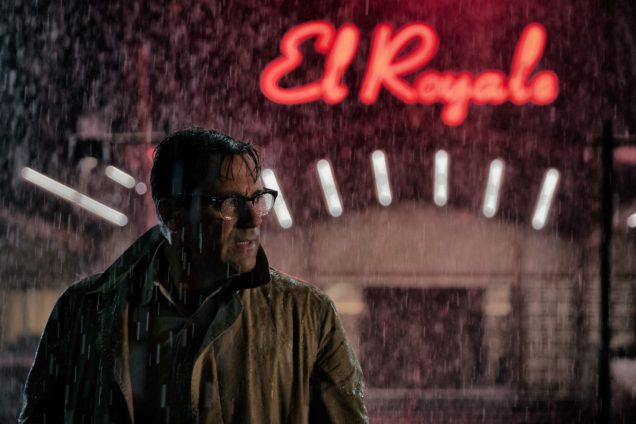 I recently read an interview with a game designer. Among other things, she talked about how, in many computer games, your avatar is often in mortal peril, and how such a situation is not only an option, but the very point of many computer games. You might die, so your main goal is to survive. She called that the stress of dying. I am very much a non-gamer, but I know what she means. Although the drama of life vs. death, whether it be your avatar’s or any other character’s in a game, is higher in a potentially fatal scenario, it might take your attention away from the intriguing story, the elaborate graphics or the well-written characters themselves. Sometimes it’s about exploring and going places, about living in a new universe, not just surviving it. Or about admiring the craft. Continue reading
 A Damn Fine Cup of Culture