One of the things Ingmar Bergman is famous for is the great parts for women in his films, and consequently his work with great actresses. So many of the films feature complex roles for women, and while Bergman must often have been a terror to the women in his life, both in private and in his professional capacity, many of his leading ladies have said again and again that it was a gift to be in a Bergman film and to portray those characters. As much as Bergman can be criticised, and rightly so, for his behaviour towards women, we have several actresses who nonetheless were eager to work with him repeatedly – sometimes even after they had been in a relationship with him that had ended badly.
There are films that are a joy to watch because they’re so well crafted. The director knows what they’re doing, the cinematography is stunning, the editing is masterful, the acting and writing, the score – everything is spot on.
Then there are films that are deeply unpleasant because of the world and characters they depict. You don’t want to spend time in this place, with these people, and once you’ve been there for two hours, you just want to go and have a shower and clear your brain from the memory of them.
And sometimes, there’s a film that fits both of these descriptions. For me, Martin Scorsese’s Raging Bull is one of those films.
One of the things that video games can do magnificently is create worlds. These posts are an occasional exploration of games that I love because of where they take me.
A lot of gaming is about power fantasies. Okay, perhaps most of us don’t fantasise about being a mustachioed plumber jumping on the backs of turtles or about manoeuvring oddly-shaped blocks in order to form lines, but the clichés are still true a lot of the time: you play in order to become a fantasy hero with a big sword or a soldier with a big rifle or a space warrior with a big raygun. These games can be tremendous fun (and not all power fantasies are as Freudian in nature), but the longer I’ve played games, the less they’re the ones that pull me in most. There are other fantasies (no, not that kind – at least not in this post!): games that let me exist in places where I could never be in real life. For me, it’s one of the main draws of the Assassin’s Creed games: not that they let me become a super stealth assassin with some cool threads and hidden blades, but that they let me explore revolutionary Paris or Victorian London or Ptolemaic Egypt.
And sometimes the fantasies are much more mundane – but fulfilling them is no less fascinating. I mean, how many of us have had the opportunity to become a fire lookout in a North American national park?
Welcome to Six Damn Fine Degrees. These instalments will be inspired by the idea of six degrees of separation in the loosest sense. The only rule: it connects – in some way – to the previous instalment. So come join us on our weekly foray into interconnectedness!
Will the Coen Brothers ever make another film together? Or will Netflix’ The Ballad of Buster Scruggs remain their last collaboration? Obviously it’s rather ungrateful to look at a filmography that includes greats such as Fargo, Barton Fink and No Country for Old Men and whine that there won’t be any more – but at the same time, is there anyone else who makes films that compare with their genre-busting and their often oddball tone? (The closest I’ve come to considering anything Coenesque is probably the British true crime black comedy-drama – which is what Wikipedia calls it, and anything shorter couldn’t begin to do it justice – Landscapers, which we talked about in one of our podcasts.)
Then again, besides their most recognised films, there are a number of movies by the Coen Brothers that didn’t receive the same praise. Some of them were downright disliked when they came out, sometimes more justifiably so (The Ladykillers), sometimes less (The HudsuckerProxy). One Coen film that I’ve always felt deserved more attention than it got is The Man Who Wasn’t There, a film noir pastiche starring Billy Bob Thornton and Frances McDormand that in many ways exemplifies the particular tone that the Coens excel at: somewhere between parody and homage, with a sprinkle of something decidedly stranger. I mean, which film noir classic ever included a subplot that concerns dry cleaning, or a scene featuring a UFO?
There have been times over the course of Criterion’s Bergman collection where I couldn’t really say why they went from this film to that one, but those instances have very much been an exception. Obviously a chronological sequence would’ve been very easy for them to do, but it’s clear that they had ideas about how these films fit together: relationships on the rocks, theatre and actors, God’s silence. Having such a curated collection may be somewhat leading, suggesting certain approaches to interpretation over others, but this gives the collection a shape that mere chronology does not (leaving aside that chronology isn’t a neutral approach either). At the same time, the sequence chosen by Criterion’s curators can work against a film – watching the fourth or fifth variation on one of Bergman’s insufferable husbands vacillating between expressing smug superiority and neurotic inferiority towards the women in their lives, the Bergman tropes can become a bit tiresome, especially if the strongest film featuring this particular trope has already come up. After Scenes from a Marriage, many a Bergman male seems yet more tiresome because they cannot have the nuance that Bergman and his actor Erland Josephson brought to Scenes‘ male lead, Johan, in five hours of material.
Being a self-confessed Criterion junkie, I have once or twice bought a Criterion release by mistake. I managed to order Personatwice (which, to be fair, makes perfect sense, considering the film). I once bought a DVD version of Le Samouraï from some Amazon reseller that turned out to be a Korean bootleg – and it didn’t even work. And I ordered They Live By Night (1948) after attending a lecture on Ida Lupino, where the lecturer showed a scene of the film that made it look intriguing and thrilling.
Turns out that film with Ida Lupino was They Drive by Night, of which there isn’t a Criterion release. As that great American philosopher said so memorably: D’oh. On the plus side, the Ida Lupino lecture was by Johannes Binotto, who joined us for our recent podcast on Lupino.
And while we’re talking about the pluses of me ordering the wrong film: They Live by Night is very good.
Welcome to Six Damn Fine Degrees. These instalments will be inspired by the idea of six degrees of separation in the loosest sense. The only rule: it connects – in some way – to the previous instalment. So come join us on our weekly foray into interconnectedness!
This should come with a lot of caveats, but the Fantastic Beasts films have given me a new, albeit partial appreciation of the Harry Potterfilms. Remember those? Orphan discovers he’s a wizard, goes to a wizarding school, makes friends with some kids, is bullied by others, and all the while this noseless evil wizard threatens the world. For some reason the whole thing, starting with the books and definitely not ending with the films, was a huge success – so You Know Who started a massive media franchise and shared fictional universe, and they roped in the likes of Eddie Redmayne, Katherine Waterston, Jude Law and Colin Farrell – no, Johnny Depp – no, actually it’s Mads Mikkelsen – to make more of these films and make more money. Sadly, while I found the first of the Fantastic Beasts messy but surprisingly charming, the sequels that have since come out have made it blatantly obvious that whatever magic they lucked on with the original novels and their movie adaptations, this new series would need a lot more wizardry, dark or light, to be successful. Both The Crimes of Grindelwald and The Secrets of Dumbledore suffered massively from plots that were both overly complicated and utterly irrelevant. Momentous things happen, only to turn out that, really, they didn’t matter at all.
Petrov isn’t doing well. It’s nighttime, he’s on a bus at night, and he’s got a fever. He sees, and takes part in, things that probably, hopefully, aren’t actually happening: violence, murder, weird, weird shit. The people around him may not have come down with the flu, but the snippets of conversations he hears are just as weird and ominous: the people are highly unpleasant, they’re selfish and paranoid and judgmental, happy to throw each other to the wolves. If Petrov wasn’t ill, he might even almost be relieved when the FSB stops the bus, drags him off and throws him into a van – but it turns out that while this episode really does seem to happen, it’s not the FSB but a bunch of mates of Petrov’s. Oh, and a coffin with a dead person inside. It’s one of those nights, and it’ll only get stranger.
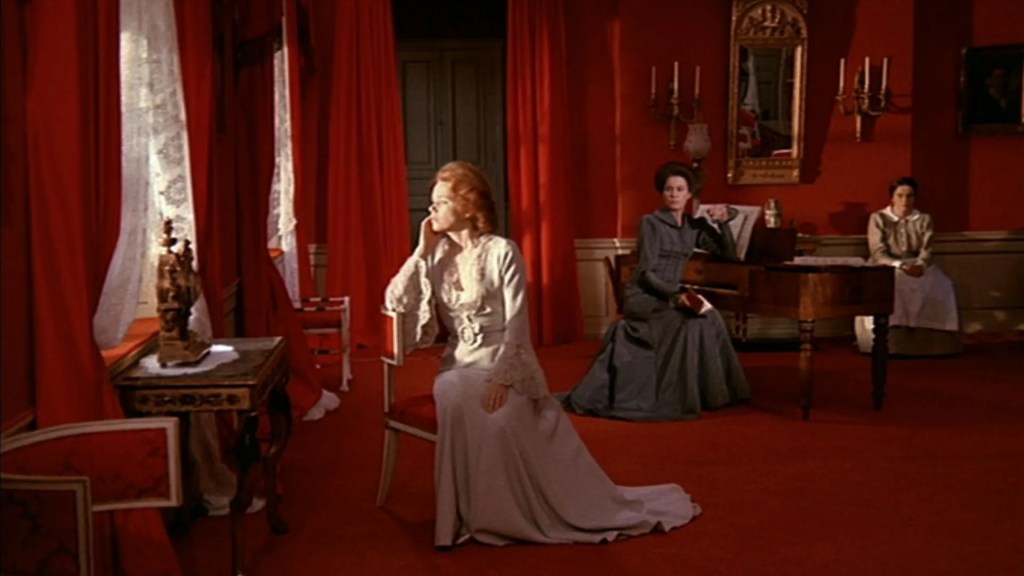
While the supposed heaviness of Bergman’s filmography is frequently exaggerated (or am I the only one who finds The Seventh Seal with its snarky Death entertaining, even if the film undoubtedly isn’t a laugh riot beginning to end?), it is certainly true that many of his films deal with heavy themes. Mortality in the abstract is a frequent motif, but so is death in the very concrete. And death in Bergman’s films may never have been as harrowing as in his 1972 film Cries and Whispers, the first half of which depicts the suffering and agony of Agnes, one of its four main characters.
One of the things that video games can do magnificently is create worlds. These posts are an occasional exploration of games that I love because of where they take me.
There are certain experiences that would only be possible in video games – or perhaps in some medium that doesn’t even exist yet. In view of my woeful ignorance of this unknown future medium, I will come out and say that Return of the Obra Dinn could only exist as a game, in more respects than just one. And in the process, it is a wonderful example of how video games can be entirely unique and different.
And that’s before we even get to the – ah, but that would be a spoiler.






 A Damn Fine Cup of Culture