Earlier this year, we saw Summer of Soul, Questlove’s documentary/concert film hybrid about the 1969 Harlem Cultural Festival. In its last third, the film juxtaposes the festival, an event by and for the African America community that at the time (and not just then) was sorely disadvantaged and underserved, and the first moon landing, where NASA put Whitey on the Moon. Why are millions spent on space exploration when the planet we live on is severely lacking in so many respects?
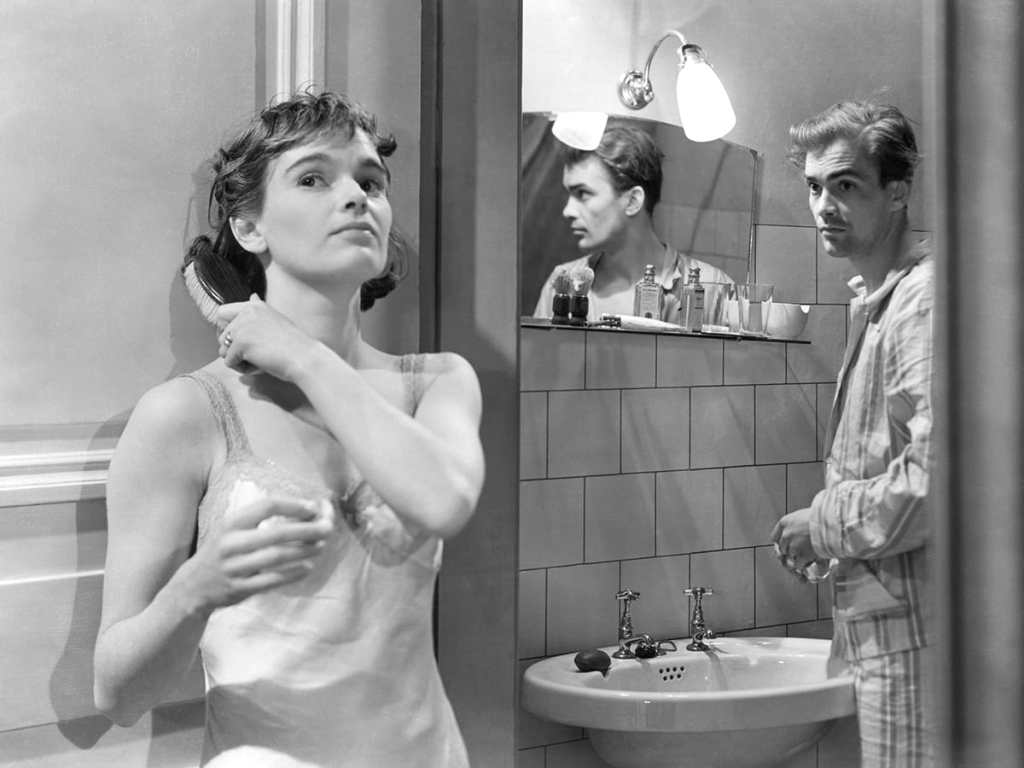
Port of Call doesn’t make a great first impression. In the context of Bergman’s complete oeuvre (if movie watching had a progress bar, we’d be somewhere between 80% and 90% through his filmography), its first fifteen, twenty minutes or so is more striking in its images than its storytelling, as the latter seems oddly impersonal, almost generic. Once past the initial hurdle of a decidedly middling beginning, however, there’s more to like about Port of Call than is immediately apparent.
Welcome to Six Damn Fine Degrees. These instalments will be inspired by the idea of six degrees of separation in the loosest sense. The only rule: it connects – in some way – to the previous instalment. So come join us on our weekly foray into interconnectedness!
I made my first kill before the age of 10. By the time I was a teenager, I must have killed hundreds. By the time I reached the age of 20, I expect the number was somewhere in the five-digit range, at least. And I suspect that the same is true for so many people these days, at least in the west – because murder is just a click away.
In 2021, we did a podcast episode titled “Second Chances” (which we’re hoping to turn into something of an annual thing). In it, we discussed films that, for one reason or another, didn’t work for us but that we’d been wanting to revisit because we thought it might’ve been a case of “It’s not you, it’s me”: that we watched these films with the wrong kind of expectation, or that we lacked the right lens through which to watch it.
Sometimes, though, there can be films (or books, plays, poems, TV series, albums, games etc. etc.) that simply work on a wavelength that we’re not receptive to. This doesn’t mean that they’re bad or that we’re wrong or stupid for not liking them. I’ve long believed that most art that is interesting won’t be for everyone. Ideally I can still get something out of culture that isn’t for me, but generally this is a matter more of appreciation than of enjoyment. Often these are works that I prefer to discuss or read or watch a good video essay about rather than to watch.
But these works still tend to leave me with lingering doubts, especially the ones that have elements or aspects that I genuinely do enjoy: a scene, a performance, or perhaps a shot that sticks in my mind. And the same can be true for certain directors: I don’t generally like their work, but there’s something about it that makes it difficult for me to just conclude that they’re not for me.
It’s a difficult act to follow Persona, and Criterion probably made the right choice when it decided to follow Bergman’s monolithic masterpiece with a number of his earlier, smaller films, in which he was trying to find his voice as a director. Thirst is one of those films. It’s by no means bad – in fact, some of the later films that are more clearly Bergman’s work are probably worse films (and yes, All These Women, I’m looking at you). However, it is a film that in the context of Bergman’s filmography feels like he was trying his hand at themes and techniques that he’d later use to better effect.
In 1984, my dad took me and my sister to see Amadeus at the cinema. We would go to see a movie, usually something from the Disney catalogue of animated features, as a family once a year, but this wasn’t part of the annual ritual. My dad was an avid hobby musician and he loved Mozart’s music, so he wanted to see the film with his children. I was nine at the time, and I’m sure my dad didn’t expect the mature themes or the scatology. I don’t really remember seeing any other films just with my dad when I was a kid, rather than with my mum or both my parents, but Amadeus stayed with me. As a pretentious little nine-year-old, I loved it – less so for Mozart’s impish, infantile irreverence than for the drama and the dark humour. Or perhaps that’s me projecting into my younger self, 38 years after the fact.
I first saw The Piano at the cinema in 1993, when it originally came out. The film felt intense and erotic and physical. It felt adult – though, looking back, I’m surprised by how many films I’d seen as a child and teenager that I’d consider adult. Not because of nudity or sex, although they definitely featured those – I’m thinking of the likes of Milos Forman’s Amadeus or Bernardo Bertolucci’s The Last Emperor -, but because of the characters and themes, and because they were more than happy to leave things unsaid. They were ambiguous. Certainly, I also spent the ’90s watching things like Aliens and Die Hard and Jurassic Park, and I enjoyed those (though I never loved Jurassic Park, which always felt like a more family-friendly Jaws to me, and Jaws should never be family-friendly) – but where these now feel familiar, like cinematic comfort food, The Piano still has that strange intimacy that is both thrilling and discomforting.
It’s not easy being the son of a king: first your papa gets killed by his nefarious brother, then the wrongdoer steals your mother and makes her his wife. Soon enough, witches and ghosts whisper words of revenge in your attentive ear. What’s a kid to do, other than to, all together now! … avenge Father – save Mother – kill Fjölnir?
One of the things that video games can do magnificently is create worlds. These posts are an occasional exploration of games that I love because of where they take me.
There are video games that strive to recreate the real world in one way or another: the Grand Theft Auto series, for instance, which satirises modern America in many respects, but in others it has been pushing for a more and more intricate, realistic representation of the urban everyday of New York or Los Angeles; or Everybody’s Gone to the Rapture, where a Shropshire village in the 1980s constitutes the naturalistic setting for a cosy apocalypse that wouldn’t be out of place in a John Wyndham novel; or Dirt Rally 2.0 and its rally courses that have struck fear into the heart of this gamer without ever leaving the realm of the real.
Then there are games that create realities distinctly different from our own everyday reality. The likes of Paper Beast, which puts the player inside a virtual world with its own rules and its own forms of life coming to an end, or Device 6, which thrives on the kind of worldbuilding that is possible only with the written word, or Fez, combining the two- and the three-dimensional in ways that wouldn’t be possible outside the virtual spaces inside a computer’s memory.
Tunic is firmly in the latter camp, but that doesn’t make the world it evokes any less impressive.
Welcome to Six Damn Fine Degrees. These instalments will be inspired by the idea of six degrees of separation in the loosest sense. The only rule: it connects – in some way – to the previous instalment. So come join us on our weekly foray into interconnectedness!
I remember that as a kid I found the Biblical dramas of the 1950s fascinating. I didn’t watch all that many of them, but I remember movies that drew me in with gladiatorial combat but kept me engaged with Technicolor melodrama and righteous men and women sacrificing their lives for some greater good – which in those films always meant God in the end, and more specifically, a bearded, male, white God with just the right blend of being stern and being kind, someone inbetween Charlton Heston and Gregory Peck. I was raised Catholic in a place where Catholicism wasn’t particularly strong or particularly strict, so while we did go to church once or twice a year and while I did receive First Communion when I was 8 or 9, I didn’t get much of a sense of the metaphysical from Sunday School. My religious education at the time derived from old movies – oh, and from Jesus Christ Superstar and from Oh, God! Book II. My sense of the eternal was hippies singing and dancing to showtunes in the desert, George Burns’ ironic smile, and Richard Burton and Jean Simmons looking heavenwards while celestial choirs sing and the credits roll, moments before they are eaten alive by lions.






 A Damn Fine Cup of Culture