Where’s a will, there’s a pill

Ron Woodroof, the protagonist of „Dallas Buyers Club,“ isn’t easy to like. He is a racist, a homophobe, a drug addict, a drunk and a thief. His one redeeming quality is that he does not give in when he learns that he has caught HIV, but tries to fight it – and he does not just fight the virus, he also fights a harmful anti-HIV drug called AZT, the FDA, the DEA and the DA.

Image

Woodroof is played by the ubiquitous Matthew McConaughey, and he takes on a lot of acronyms with the same down-to-earth earnestness and a stubborn logic. He travels to Mexico, Japan and elsewhere and brings back protein-based and/or natural drugs that will help him and many other AIDS patients to live a little longer and with less pain. He has moral standards: Every drug he distributes, he has tested on himself first. Since selling those drugs is illegal, he accepts paying members to his Dallas Buyers Club and then gives away the drugs they need. To him, it’s a ponzi scheme where no-one loses; to his customers, it’s like swinging yourself form one last straw to the next with a death sentence hanging over you. It’s 1985.

So there you have it: the protagonist is a bastard with some heart. He is gaunt, emaciated and sometimes collapses where he stands. Most of the time, he doesn’t even have enough strength for his escapades anymore. If you can bring yourself to like him, the movie works for you. There is a magnetic scene where Woodroof takes a leak on the Mexican side of the border, but is so weak that he has to clamp the IV drip with his teeth, while humming to himself and racking his brain how to bring a trunk full of medicine to the other side. Thirty years ago, the US had nothing up its sleeve to go to war against a virus.

Image

The movie has a lot of scenes and a lot of cuts; there are only a few takes that are over a minute, and yet it never feels in a hurry. It’s not a tear-jerker, but has a lot of humanity for its characters. If Woodroof is the point of entry into the movie, a transsexual called Rayon is its emotional center. Played by Jared Leto with exactly the right amount of courage, confidence and sensitivity, it’s a performance that’s a match for McConaughey’s. Rayon sees something in Woodroof he himself does not. There are no cheap solutions: Woodroof does not become a philanthrope or even Rayon’s lover. Neither does he fall for a doctor, played by Jennifer Garner, who helps him with his cause. Their fates lie elsewhere. It’s not an easy film, but it is surprisingly upbeat, considering.

Building worlds

Although I enjoyed Captain America: The Winter Soldier quite a bit, quite possibly more so than any Marvel film other than (predictably) The Avengers and (surprisingly) Iron Man 3, I won’t be writing a straight review of it. Enough has already been written about how it shakes up the fictional universe begun with the first Iron Man film and about its overtones of ’70s political thrillers, which don’t actually hold up all that well except on the most superficial level.

Suffice it to say, I liked the film – but mostly I like what it does, and what the Marvel  movies have been doing, which as far as I know is pretty unique to cinema. Worldbuilding is something that so far has been done best in long-form formats: Tolkien, for one, did a magnificent job of it in The Lord of the Rings, but he has hundreds and hundreds of pages to do so as well as several other books to contribute to the creation of Middle-earth. Series in various media also have a lot of potential when it comes to worldbuilding, whether we’re talking about comic books or TV series. Some films have done the same, but it’s probably not the format’s main strength: you have examples such as the Star Wars series, but on the whole creating interesting worlds that live and breathe takes time, and the genres that lend themselves to worldbuilding (e.g. fantasy or sci-fi) also tend to produce plot-heavy – and setpiece-heavy – films that simply don’t have the breathing space that makes for the successful evocation of fictional universes.

In the Marvel films, the makers have succeeded at this by creating a network of characters and events that relate to each other yet still result in individual stories. You can watch Captain America 2 without knowing what happened in the Iron Man films, The Avengers or even the first Captain America movie, but having an idea of what happens outside the confines of this one film adds a sense of scope that the usual SFX of Mass Destruction don’t have. As I was watching the movie, I wasn’t thinking of sequels, prequels and franchises: I was thinking that here was a world that’s alive beyond any individual entry. What is going on in Captain America 2 resonates beyond Cap’s story. Even if the stories being told are still pretty basic, predictable tales of superheroics – and no, Robert Redford does not make this film Three Days of the Condor – there’s something exciting to the way the Marvel films have come to suggest that there’s plenty of space to be coloured in beyond the lines of Captain America 2 or Iron Man 3 or The Avengers. To me, it feels there’s a world out there, and it exists whether we’re presently looking at it or not – and that may be one of the best things that can happen to a fictional world.

Marvel Cinematic Universe

It also presents a storytelling challenge, because I’d argue that in the long run it gets boring if every single story told within this universe is about averting some world-shattering calamity. That’s one of the strengths of serial formats: they give the storyteller space to tell the smaller stories too. Not every Marvel comic is about some super villain’s latest plot to destroy New York, the Earth or the universe. Look at something like Joss Whedon’s Buffy and Angel: yes, there are Big Bads and plot arcs, but there are similarly more intimate stories. Does Hollywood have something similar to offer? Can there be Marvel movies that aren’t about defeating this bad guy or stopping some major evil plot? Or will we get to the point where each and every one of these films is essentially the same story given a slightly different coat of paint based on which superhero has the lead part? If this happens, all the world-building will fall flat, because at this point the universe no longer feels like one and begins to feel like a Setpiece Generator. There have already been hints of this, for instance in Thor: The Dark World‘s “Let’s destroy London!” climax. Here’s hoping that Marvel can continue to build on what’s most intriguing about this project and that they avoid having created a world that lives and breathes only to bore the hell out of us.

An Alaskan nightmare

He picks them up in the streets of Anchorage, Alaska, some of them in broad daylight. He starts with local middle-class girls and women, then changes to hopeless drifters and whores because nobody is going to miss them. He rapes and tortures them for weeks in his flat. The less satisfying ones he shoots right there in his living-room where all the animal trophies with their dead eyes look upon the unspeakable acts he commits. The better ones he loads in his Piper plane, flies them to his lonely, wintry hunting grounds, where he sets them free and watches them stumble away through the crosshairs of his rifle. He lets them run until they think that there is the faintest sliver of an escape. Then he shoots them and watches the light die in their eyes.

You shouldn’t have to be told that “The Frozen Ground” is based on a true story. It’s a movie about the twelve-year killing spree of Robert Hansen, a well-liked baker in whose shop cops gather for coffee and doughnuts. He is played by John Cusack, and I’ve just realized that I don’t remember what his voice sounds like. It’s Cusack’s performance that stands out in an otherwise generic exercise. The Hansen in the movie is guarded, watchful, generally friendly. He is boring and can blend in. He is married and has two kids with his second wife. Some say he has a stammer, but how do you know if he says so little?

There is a cop who hunts him, called Halcombe, played by Nicholas Cage, an amalgamation of several real-life cops who were on the case. It’s a decent enough performance, but it’s one that Cage seems to have played at least three times before, and he does nothing with his role to elevate it to Cusack’s level.

There is one girl who gets away while Hansen prepares the Piper for take-off. This is Cindy Paulson. Halcombe must win her trust so she will testify; if she doesn’t, there is no way they can charge Hansen with anything. She is played by Vanessa Hudgens, who could be dismissed as some teenage bimbo from half-assed teenage movies. Not after this movie, she won’t. She plays Cindy as a damaged kid who is almost glad that, after Anchorage, there is nowhere left to run to. Hudgens doesn’t go for manipulative emotions, but for guarded mistrust and self-reliance. There are pieces missing with Cindy Paulson, and Hudgens manages to make us care about her, and so we tend to identify with Cindy, a teenage hooker who lies about her age. She is the entry-point for the movie. Halcombe is the motor for the plot, Hansen is the boogeyman.

The movie is flawed. Halcombe’s family is perfunctory and only there to remind him that they will move to brighter pastures in two weeks, while he cannot let go of the missing girls. Halcombe’s wife is played by Radha Mitchell, an actress who can improve any movie she is in. Not here: the screenplay makes her and Cage play out stuff from the stock cop plot shop. There are supporting roles that don’t lead anywhere, which is a shame when they’re played by actors such as Dean Norris. There is also a confusing scam between two pimps who quarrel about who owns the rights to Cindy. I also minded the prolonged scene where we get to see Vanessa Hudgens pole-dancing. I don’t much care if Hudgens is shapely and pretty; I get that she had to dance for money during in a brief scene; there is no need to film her body from all angles.

The ending is a shame. The Halcombe family, not moving after all, see Cindy off at the airport. That scene is just too fucking cute, Cindy leaving like that over a sickly-sweet soundtrack. I would like to have heard what she had to say to Halcombe.

His last scene with Hansen is weird, too: Halcombe gets a confession out of him by opening the door and letting Cindy take a look at him. That’s too easy and too fast, and a whole scene seems to be missing here. The movie is in a hurry to clean up.

Hansen was caught in 1983, and only after presented with overwhelming evidence did he admit to killing 17 women, but might be responsible for as many as 30. He got convicted for murdering four of them and for the rape and abduction of Cindy Paulson. In Hansen’s home, Halcombe found a map of an uninhabited area full of red crosses. The police went to those spots and dug. Some bodies could not be identified, some were already eaten by animals. Others have not been found, and they might still be lying there, freezing and thawing with the change of seasons, lying there for more years than they had living years on earth.

He’s not the Antichrist, he’s a very naughty boy!

Note (to self as much as to anyone else): This should’ve gone up a while ago, but it seems it’s been stuck in draft limbo. If anyone feels they’ve already read this one, let me know, because that would be a sign that my mind – or at least my memory – is pretty much going.

I’d been avoiding Lars von Trier’s Antichrist for a while, mainly because I dislike provocation for provocation’s sake, and that’s what Lars von Trier’s public persona largely seems to be about. Having finally seen the film, I have to admit that it didn’t strike me as adolescently provocative as the man himself – and credit where credit’s due, von Trier makes highly unique films* that are fascinating examples of the craft. Antichrist is a striking film, although for each effective scene there’s another one that overuses a certain technique, causing a bit of von Trier fatigue. Nevertheless, it is only fair to say that the director is eminently skilled.

Antichrist

Having said that, I do think Antichrist goes off the rails and after a strong beginning becomes too random. Stylistically it remains fascinating, but it doesn’t so much bring up motifs and raise themes as throw them against the wall like so much psychosexual spaghetti. Grief! Despair! Pain! Clash of genders! Misogyny! Men are logical, and logic is evil! Women are emotional, and emotion is evil! Nature is evil! Woman is nature! Men can’t cope with women and so burn them! Antichrist flirts with all of these but doesn’t end up doing all that much with any of them. None of it seems to add up to anything much, feeling like window dressing for what is in effect an arthouse slasher movie. For all of the scenes of extreme violence, cruelty and self-harm, I rarely felt particularly involved – nor even all that shocked. When you feel non-plussed rather than anything else at fairly explicit scenes of genital mutilation, you have to wonder what exactly Lars was trying to do.

I imagine that courses on film, gender, violence and Lars von Trier will have a field day with Antichrist, and in fact I might enjoy a discussion about it more than I enjoyed the film itself. In the end, though, I have to wonder whether von Trier, always a consummate trickster, didn’t primarily enjoy the idea of doing a genre film and chose the various thematic overtones more as a game, a puzzle without a solution for the audience to try and solve in vain. It would be interesting to check out the Criterion edition of the film, which seems to be choc-a-bloc with excatly these kinds of discussions by scholars – but while I usually have to be physically kept from ordering yet another Criterion disk, I don’t think I have an urgent need to see Antichrist again, commentary track or not.

I am, however, slightly more curious about Nymphomaniac than I was before, so as an expensive, extended advert for Lars von Trier’s work the film seems to have done its trick. I’m sure his body doubles will appreciate this.

*When I say “unique”, though, I have to relativise that statement – especially at the beginning I did feel I was watching a mashup of David Lynch and Ingmar Bergman’s work, although with more graphic sex than you’d find in either of those.

Paradise: Hope

The last movie in Ulrich Seidl’s Paradise trilogy, Paradise: Hope, has, at its centre, the relationship of a teenage girl with a doctor. She is about 17, he must be at the far end of forty. The girl is Melanie, and she is the daughter of Teresa from the first movie. Melanie is curious about her effect on boys; her bunkmate’s tales about blowjobs and shaved vaginas not only educate her, but seem to make her eager to go out and explore on her own.

Melanie is pretty. She is also overweight. The movie takes place at a camp for overweight teenagers. One of the saddest scenes I’ve seen lately is the one where the teenagers stand in line in the courtyard and have to sing: “If you’re happy and you know it, clap your fat.”

Melanie is aware of the camp’s doctor. He is a bit of a joker, not bad-looking, but far too chummy with Melanie. She fakes mysterious stomach aches in order to see him. There might also be moments where he engineers their encounters in the camp’s changing rooms. That guy is trouble of the creepy kind.

The camp is full of teenagers trapped in a loveless environment, dumped there by their parents. They sneak food, fags and booze into the camp. They get caught, and Melanie is mortified because the doctor tells her off like an unruly child.

There is an away day at a lakeshore. Melanie wanders off into the nearby woods, maybe hoping for the doctor to follow her. He does so. It’s a very uncomfortable scene, because Melanie is looking after company, a kind word, a connection, some appreciation. The doctor might hope for more. He follows her to a clearing, and she approaches him. Then she hugs him, which seems to come as a surprise to him. After some hesitation, he hugs her back. That must be enough. This time.

Later, he sneaks into her room and goes through her things. He lies in her bed, then leaves before she comes back. The same evening, she waits by his car until he appears. He tells her off – not because they are off limits to each other, but because he could be seen talking to her.

Melanie and her bunkmate escape to a local bar where they get picked up by two horny teenage boys. They slip something in her drink, and her friend takes off because Melanie gets all the attention. They feel her up while she tries to dance under the effect of the drug. Then she collapses and is saved by the barkeeper. This time.

The barkeeper calls the doctor to pick up the unconscious girl; he must have seen this kind of thing before. The doctor appears, and one danger of abuse is replaced by another. He drives into the woods and stays there with an unconscious Melanie until morning. He lays her down gently in a mossy clearing, lies down beside her and starts sniffing her. This time.

He brings her back to the camp and tells her that they cannot have any more contact. High time for that, but get this: He severs ties not because she is infatuated with him, but because he is afraid that he cannot handle her infatuation much longer.

I struggled a bit with the movie, because there seemed to be little hope: Does Melanie really still hope for good friends and acceptable partners? Maybe, but that would be against the odds. On the other hand, it must be an excellent kind of hope, with such a long shot.

One thing that still bugs me: In all three films, the women are somehow exploited by men, and they barely recover. Maybe it’s one of the formal points Seidl makes; maybe it’s also his way of finding out how his characters fare under pressure. But the coincidence haunts me, and it is only partly solved by the fact that he made all three protagonists women. There seemed to be so little joy in any of their lives. Teresa is still in Kenia at the end of the movie. Anna is whipping her savior, and Melanie is still at fat camp, having no clue how close she was to being raped. Neither of the three women has escaped their trap, but did anyone really think they would?

Or maybe Melanie is hard-wired like her mother and her aunt. They do what they must, and joy or relief doesn’t really have anything to do with it. Like Teresa, who will go on looking for love in dubious places. Maybe the paradise of the title is the one time where you really find what you are looking for. Like Anna, who might come to some kind of truce with her religion, which demands everything of her, whether she gives gladly or no. For Melanie, hope is the one red line going through her life. At least that. Living without it must be hell. There is no sure way to reach paradise, and most of us won’t reach it, but the movies seem to suggest that we must at least try, or we will fail miserably. It could be possible that some kind of truce is the best we get. Maybe hell isn’t other people; maybe hell is you, but it’s not your fault. It’s just the way you are.

Great Expectations

I’ve seen both of the main winners at this year’s Academy Awards, Gravity and 12 Years A Slave – and I came away from both of them feeling just a bit underwhelmed. Don’t worry, this isn’t going to be one of those “Why the Oscars suck!” posts, not least because I don’t really feel particularly invested in them to begin with. What I want to talk about instead is this: expectations.

With 12 Years A Slave, I went in expecting to be as much bowled over as I was with Hunger and Shame. I was stunned when I caught Hunger on TV a couple of years ago; his visual language and his storytelling, combined with Fassbender’s amazing performance (is the guy ever any less than very good?), struck me as something I’d never seen. Shame built on this, engaging me both emotionally and intellectually in a way that’s rare in films. 12 Years A Slave is by no means a bad film, in fact it’s very good, a beautiful example of moviemaking craft on all fronts – but it didn’t stun me. It felt less unique than McQueen’s previous films.

Gravity

Gravity, too, is an exquisitely crafted film. It’s been criticised for being (allegedly) thematically shallow, all spectacle and no substance – which I don’t agree with. No, my beef with Gravity is this: I watched the trailer on a large screen in HD, and it pulled me in, evoking a real dread of floating in outer space, untethered, with nothing there but stars that are trillions of miles away. It’s not that the film itself didn’t summon this dread, but it didn’t build on it: basically the thing I liked best about the film was already there in the trailer. More so, actually, because it was distilled into two minutes. It doesn’t help that I’m not a big Sandra Bullock fan, finding her bland rather than relatable, but mainly my disappointment was similar to what I felt after 12 Years A Slave. I was disappointed, not because the films were bad, but because they didn’t, and perhaps couldn’t, meet my expectations.

In some ways I think those expectations weren’t entirely fair, if fairness indeed comes into the matter. If I hadn’t seen and been so receptive for that particular Gravity trailer, the actual film might have wowed me more thoroughly. If I hadn’t been stunned by Hunger and Shame, I might not have expected 12 Years A Slave to be stunning in that particular way, and this in turn might have allowed me to appreciate it more for what it was rather than being disappointed at what it wasn’t. Then again, without the trailer I might not have gone to see Gravity to begin with; I might not have gone to see 12 Years A Slave at the cinema just because of Chiwetel Ejiofor (no doubt a great actor, but I don’t go to the cinema just because of a particular actor).

12 Years A Slave

How many films could I have appreciated more if it hadn’t been for very specific expectations? And how do you manage your expectations anyway? I’m not sure I could, or would want to, watch a trailer and go, “Yeah, fantastic trailer, but I’m sure the film won’t live up to it. I’ll go and see it, but ho hum…” I want to be enthusiastic about things, I want to have that feeling of anticipation – and when such expectations aren’t just met but surpassed, it feels amazing. If anything, the problem may not be how much I expect but how specific my expectations are.

Anyway: sometimes when I rewatch films that underwhelmed me the first time, I enjoy them all the more the second time around. I’m sure that in a couple of years’ time Film Four will show 12 Years a Slave and Gravity, just in time for Cuaron and McQueen’s latest works – and if I go to see them expecting to be just a bit disappointed and underwhelmed, perhaps I’ll come away enjoying them all the more.

Back to the Roots

I have a confession to make: I was underwhelmed by 12 Years A Slave.

Don’t get me wrong, the film is extremely well made. It’s beautifully shot, the acting is impeccable, and I would go as far as to say that Steve McQueen’s latest may just be the best, most accomplished slave narrative on film. My problem with it is that I was entirely bowled over by his earlier two works, Hunger and Shame. Especially the former of these took me completely by surprise, its style amplifying its story to an almost unbearable extent, and Shame, while perhaps not being quite as immediately striking (no shit mandalas in this one, for one), was similarly effective. 12 Years A Slave deals with what I’d consider a historically more major issue, but the film didn’t surprise me. In fact, it felt weirdly predictable.

12 Years A Slave

Not every film has to be surprising, and I can’t think of anything that 12 Years A Slave does wrong, but I came out of the film thinking that I’d basically seen a more cinematic, nearly perfectly executed version of the early episodes of Roots. There’s absolutely room for such a film, but McQueen being the director made me expect something, well, more, or perhaps rather something different. I expected something more unique – and I want to stress that this is my problem more than the film’s. However, I came away thinking that McQueen could have done more with what’s unique about the story he’s working with.

The big difference to other slave narratives is that the film’s protagonist, Solomon Northup, was born free in the USA and abducted into slavery. This is touched on in 12 Years A Slave: Northup, as played by Chiwetel Ejiofor, holds himself differently from his fellow slaves, he sees himself as separate from them for a long time. His situation, from his perspective, is immediately wrong to him in ways that the other slaves’ situation might not be in his eyes. This is alluded to occasionally throughout the film – but it is of much less interest to the film McQueen has made than the shared reality of what being a slave must have been like. There is clearly a purpose in depicting this universal reality, but I couldn’t help wanting more of what made Northup’s story different as much as what made it universal.

Does 12 Years A Slave deserve the accolades it gets? Absolutely. It is, as I have mentioned, a beautifully made, engaging film. It just isn’t the surprising, unique work that I expected from McQueen.

Paradise: Faith

I’ve been in love a few times, and I imagine I’ve been loved a few times as well. Sometimes the feeling wasn’t mutual. That’s the way it is sometimes. With belief, it’s a different story: I am not really a religious person. The things I believe don’t believe back in me. This is a suspicion, not a complaint: Belief seems to be such a one-sided affair.

This explains already why I had more difficulty in understanding Ulrich Seidl’s Paradise: Faith, the middle film of his Paradise trilogy. There are other problems with this installment, but we’ll come to that eventually.

05

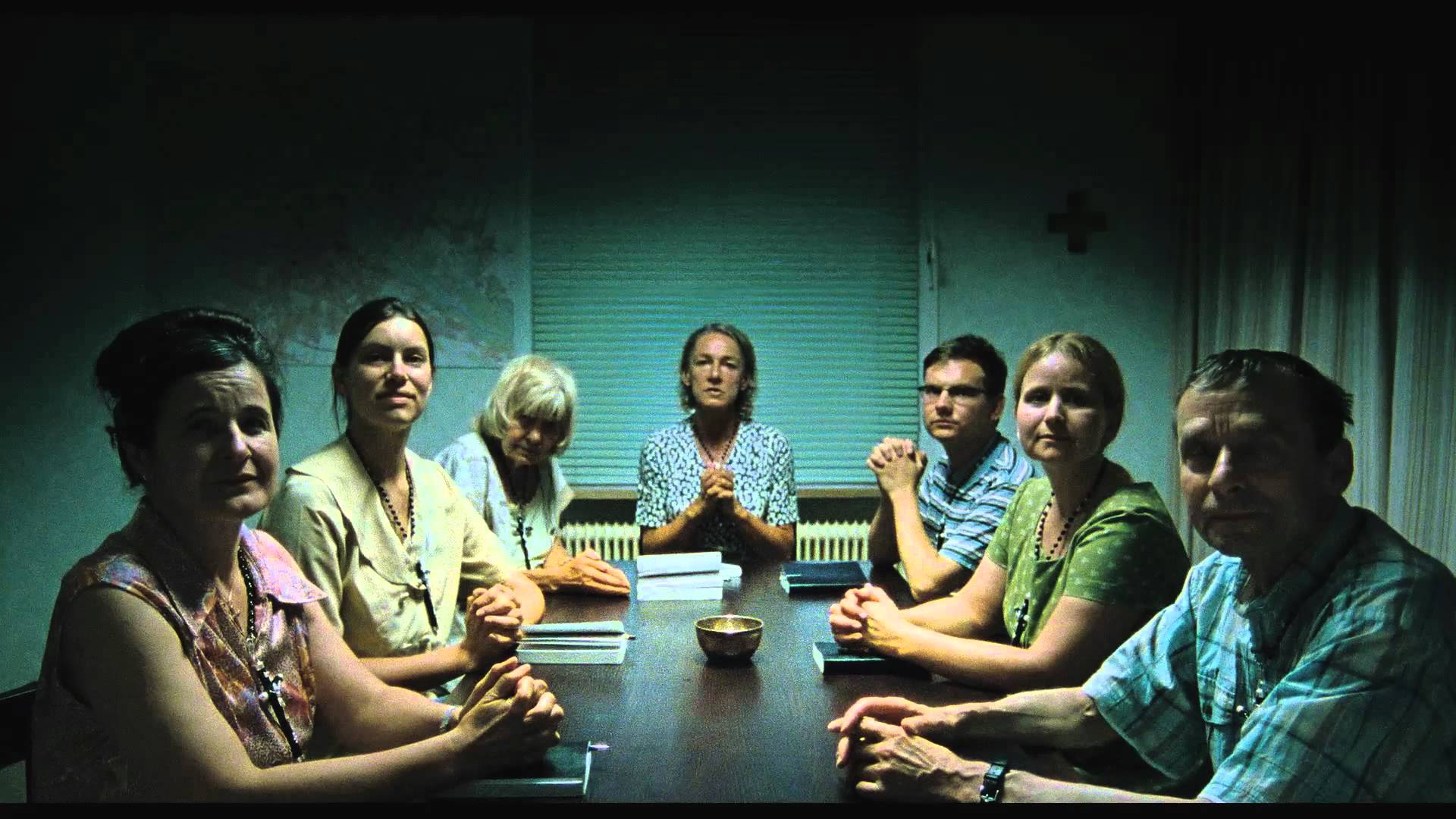
This film’s protagonist is Anna, Teresa’s sister. She is devoutly Catholic, and it is her and her bible group’s sworn objective to make Austria wholly Catholic again. Anna herself is convinced that the world is full of sex-obsessed people, and she asks that they be forgiven by whipping her own naked upper body with a whip while kneeling in front of her crucifix in a cheerless room in her house. Then she thanks her savior for the chastisement. Sometimes she goes as far as to tie a belt with iron thorns around her waist and make rounds through her flat on her knees while praying, and the kitchen timer telling her when to stop. She works as a radiologist’s assistant, but during her holiday, she goes from door to door in run-down apartment complexes and tries to convert people. She doesn’t stop at anything – there is a family of foreigners, non-Christians, of which only the eldest daughter speaks German. The whole family kneels in front of the Mother Mary statue. Anna can be very convincing.

One evening she comes home, and a Muslim is sitting on her living-room sofa. This is Nabil. They seem to know each other. It will later transpire that this is Anna’s husband. To Anna’s mind, this not at all a contradiction to her Catholic zeal – it is simply a test of her faith. She is happy to be married to her pet project, and she thinks it’s an excellent thing that two years ago, her husband had an accident and is now in a wheelchair – if only Nabil could see that true faith has entered her life that way.

Nabil, of course, is less delighted about his situation. He can no longer have sex with her, which is what Anna considers the right path: no sex, but a test of faith instead. Nabil thinks that a wife must serve her husband in all walks of life, and Anna agrees – except that Nabil asks for intimacy and a little more of her time. He is her project and is not supposed to develop human needs, and particularly not such disgusting ones like sex. Nabil’s every attempt is thwarted by Anna; although she can brush him off easily, she must bear his presence because her faith tells her to. Turn the other cheek. She politely refuses him at first, but when he insists, they trade blows. He wants sex he probably cannot have, she has a country to convert. This relationship will end badly.

maxresdefault

One night, again on her way home from trying to convert people, Anna’s greatest conviction seems to become real in her own neighbourhood. She walks past a public park and sees a dozen people involved in a gangbang. She knows she must interfere, but she cannot, and while not really consciously aroused, she must become aware of her own suppressed sexuality. Nabil asking her to sleep in the same bed and those gangbangers entail the same horror to Anna: the world is really only after one thing. It is here that Seidl’s strictly geometrical, static camera lets go and adopts Anna’s point of view. There is a possibility that Anna might only imagine the orgy. There is very subtle irony here: Anna is the one person who cannot tell whether she imagines the whole thing or not because for her, this was bound to happen. She staggers back home, utterly shocked, but proven right.

Anna’s zeal remained impenetrable to me. This movie must play like a horror flick to some Catholic audiences. To me, a former Protestant, Anna is very far from my own walk of life. That’s not to say that I don’t know about being passionate about something, way more passionate than is good for me. I understand obsession. I utterly empathize with trying to fulfill that passion, but I also empathize with the despair of not getting any rest about being passionate all of the time. I seem to be able to stop before I damage myself or others; for Anna, it’s all or nothing. She has subscribed to her faith, and if that involves more than she can take, so be it. It’s God’s will. She is so far out there that I can hardly see her. The actress playing her, Maria Hofstätter, disappears completely in her role. She is Austrian, friendly, with a quick smile. There is nothing in Anna of her.

Back at home, there is undeclared war. Nabil takes down her crucifixes, asks to watch TV, listens to Islamic prayer tapes and even puts a framed photograph of their wedding on her nightstand. He insults her faith and asks her, not to convert to Islam, but simply to find a better religion. He has a point, of course, although if you look past the object of her obsession, religion is not Anna’s problem. She enters a similar situation as her sister Teresa: She might still love Jesus, but there are moments when she despises her faith, but she cannot not believe. She is hard-wired that way, and there is no escape. The movie ends with Anna not whipping herself for a change, but whipping the crucifix on the wall.

Philip Seymour Hoffman 1967-2014

Well, fuck. I remember a few years ago, just around this time, hearing about Heath Ledger’s death and believing it to be some internet-era hoax at first. Yesterday was very similar: I quickly go to check Facebook and see a handful of posts that Philip Seymour Hoffman had been found dead in his apartment, and my first instinct is not to believe it. He can’t be dead. He’s too good. This is some sad internet joker’s idea of a good joke.

If it’s a joke, it’s definitely one of the worst I’ve heard in a long time – or the Great Big Casting Agency In The Sky decided to up its game considerably, because Hoffman was one of the strongest, most unique and least vain actors to come out of Hollywood. Here’s hoping he’s sitting next to Maximilian Schell right now, going through his lines with that half-amused, half-exasperated half-smile of his.

In Memoriam Philip Seymour Hoffman 1967-2014

Like so many people, I first noticed Hoffman on my radar when I saw Magnolia. He’d been in earlier films and had a poignant part in Paul Thomas Anderson’s Boogie Nights that was indicative of the work to come, but Anderson’s Magnolia put him in one of the leading parts, and rightly so. There was something seriously weird about the performance, but not in the quirky indie style that we’ve become accustomed to; there was no trace of that cutesy self-centredness in him. Magnolia: now there’s a film that was almost impossible to act and act well, for all involved. In the wrong hands, its lines would be overblown melodrama. Its too-decent-to-be-true character Phil Parma, among many others, would fall flat. Not so in Hoffman’s hands.

By the time The Talented Mr Ripley came around, it felt like Hoffman had always been there. Even though it was only shortly after Magnolia, I remember looking forward to the film because, damn, Philip Seymour Hoffman, one of my favourite actors! The part was smaller, but it’s one of the most memorable performances in a film packed with unusually strong performances. And again, that weirdness: Hoffman could turn on the most disturbing brand of camp that shouldn’t ever work, but he made it work – more than that, he made it essential to the character and so right it hurt.

It would be difficult not to go through the man’s filmography and pick scenes from practically every single movie he’d been in; personally I’m partial to his shlubby teacher in 25th Hour, an underrated film and a beautifully judged performance, and he was fantastic in Almost Famous or providing one of the main voices in Mary & Max, but also in uneven and mediocre films like Red Dragon or Mission: Impossible 3. Charlie Kaufman’s Synecdoche, New York is a film that works better on paper than on the screen, but when it works it’s because Hoffman made its central character inject an almost unbearing humanity into a story that constantly risks being tripped up by the meta Chinese Boxes it leaves lying all over the place.

For me it started with Paul Thomas Anderson, so it’s only right it ends with him. I’m sure Hoffman’s performances after The Master were as watchable as everything he’d done, but his Lancaster Dodd is all the proof that’s needed that American cinema has lost one of its most unique, generous and powerful voices – and while we have many indelible performances to choose from, it’s difficult not to be greedy and wish we could have had many more.

Rest in peace, Philip Seymour Hoffman.

Paradise: Love

Ulrich Seidl’s Paradise trilogy takes three basic needs – the need to love, the need to believe in some higher power, and the need for company -, and then shows how we fail most of the time. That doesn’t make Seidl a pessimist – maybe he is just very curious to the point of intrusion. I am not so sure why he chose two women and a girl as his main characters, and I am not sure what the paradise of the title means, but these are three movies that ask the right questions and wisely avoid giving any clear answers.

This trilogy may not be easy to watch. Seidl’s gaze doesn’t flinch, his camera rarely moves or zooms. There is a rigid geometry to his frames: many shots feature some sort of symmetry or at least horizontal or vertical lines of reference – the horizon, train tracks, the roof of a house, a window. His characters are often shown to inhabit the centre of the screen, within clear sight of the audience.

This clarity and order is at odds with some emotional or moral dilemma of one of its protagonists. Sometimes it looks like the edge of the screen is some sort of protection, but more often than not, these three women, and other characters, desperately try to break out of it. The two first main characters are played by renowned Austrian actresses; everybody else seems like they were picked up in the street and put on set. Some of them are.

Paradise: Love

The three main characters are introduced at the beginning of Paradise: Love. Teresa and Anna are sisters, while Melanie is Teresa’s teenage daughter. Teresa takes care of a group of people with special needs; there is, for the whole trilogy, a fitting first scene with bumper cars, not moving at first, then jolting to life and trying to find their route without any clear destination. Everyone has special needs – not because everyone thinks they’re special, but because we are all individuals, looking for something.

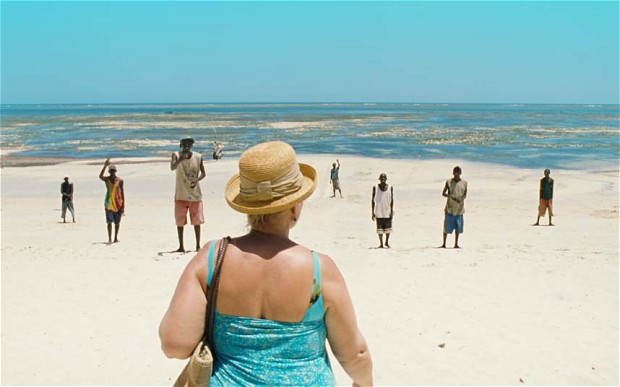
Teresa goes to spend her holiday in Kenia. She is egged on by a group of friends to get herself a toy-boy, who will make love to her for money. Both parties are in on the deal. You pretend to like me, and I will pay you and pretend to like you, too. This offer is subject to mood and need and can be cancelled anytime without prior notice. Seidl uses a chilling shot to establish that situation: there is a line along the beach along which men in uniform are patrolling. On the land side, there are rows of deckchairs, where the female tourists lie. On the other side stand the local vendors. They are not allowed to cross the line, and none of them do. The watchmen must exercise a very strict rule over that line, although we never see them at it.

Teresa is shy at first, almost reluctant, and an initial encounter makes her feel used, and she dumps the guy before he gets into bed with her. There are the salesmen on the beach with their beads and keyrings and souvenirs who are crowding her, and when her refusal to listen to them doesn’t work, there is Munga, unmistakable with his dreadlocks, who sends those overeager guys away. She suspects that this is his spiel. He does not ask her for anything, but is happy to watch over her while she wades in the water, and later show her his village, his flat, his bag of weed and his bed. They have sex. Teresa falls for him because Munga treats her as a human being. He seems inexperienced when it comes to touching a woman, and she teaches him how to. There is a sort of grim comedy to those scenes. A guy that inexperienced, he must be… different.

Let me digress here for a moment. There is a fair amount of nudity in this movie. Teresa is overweight, but she is also attractive. In some scenes, when she is on her way to Munga, she glows with the anticipation of meeting him. Other movies rely on younger and slimmer actresses to get naked. My point is this: most women’s bodies don’t look like models’, and most men are not muscle-bound athletes. Teresa looks… normal. Despite Seidl’s visual compositions, there is a realism to his environment that asks for normal people. If the physical appearance of some of his characters is a problem for you – well, what do you and the people around you look like?

To Teresa’s mind, Munga and her embark on a relationship. He introduces Teresa to his sister, who has a baby in her arms. Munga mentions another child who is in hospital and needs an urgent procedure, but Munga and his family don’t have the money. Teresa is happy to help out, and she gives him some cash. They visit a school, and Munga again asks her for money for school funds. When Teresa hands over only a small amount, the teacher gets cross and sends her away. Munga tells her off later, too, and it’s finally clear that this was his spiel. Well, she should have known that all along, but seemed to forget for a moment. He is just more patient than the vendors on the beach, and slightly cleverer as well.

Well, what did Teresa expect? Sometimes, we convince ourselves that we have found the real thing – fame, money, love – that we walk towards the snakepit with eyes and arms wide open. We need to love, and to be loved – it’s one of the most powerful drives in us humans. We can’t not love. And the promise of that makes us far too trustworthy. Some people are hard-wired that way.

The same goes for Munga. I don’t think he is indifferent to Teresa, but when you can get money out of the woman who comes and makes love to you, why not? She must have loads of it. And he must be grateful to have learnt how to touch a woman. Here’s a cruel thought: Maybe his inexperience is part of his act. Maybe his ‘sister’ is his wife, and the kid is his. And the kid in the hospital doesn’t exist. Who knows? Munga is gone, and Teresa has no clue where to put her love.

Of course Teresa is deeply hurt and disillusioned, but she meets another guy. She can’t not try. There must be some truth in her friend’s smirk when she talks about her black boyfriend. Of course Teresa knew that she wouldn’t find lasting love in Kenia, and that bitter disappointment, in herself as well as in Munga, together with her feelings of revenge, lead to the scene with the male stripper for her birthday and the sad hopeless scene where she tries to seduce the barkeeper. This was never about seduction, but about business. Teresa returns home hurt, disillusioned and with some new, shiny prejudices. She is sadder than before her holiday, and her sadness is deepened by her knowledge that she didn’t have a real choice.