”[Madonna’s character] is a beautiful woman. But when the trial is over you will see her no differently than a gun or a knife. Or any other instrument used as a weapon. She is a killer and the worst kind—a killer who disguised herself as a loving partner,” Mantegna thunders to the jury. Now, far be it from me to challenge the veracity of anything said by a character played by Joe Mantegna, but I would argue that the worst kind of killer is one who wears a necklace made out of puppy skulls and a rain poncho made out of the stitched-together torsos of murdered kittens. That, to me, is worse than a killer disguising herself as a loving partner.
I’ve never been much of a James Bond fan. As a kid, I watched some of the Sean Connery ones and enjoyed them, but never enough to think “Hey, there’s a Bond movie on tonight! Let’s watch it.” Roger Moore always struck me as eminently kickable, and in my books Pierce Brosnan is the better, more interesting Bond in John Boorman’s The Tailor of Panama than in any of his actual Bond movies. Especially in the last couple of Bond flicks, the writing devolved to the level of a bad Christmas panto, with puns so atrocious you have to be pissed on eggnog to appreciate.
Yesterday, I watched Casino Royale for the second time. More so than at the cinema, I was struck less by how different it was from the earlier Bond movies than by how similar it is in many respects. When it came out, critics kept saying how the franchise had taken some pointers from the Bourne movies, and that’s definitely true – but it’s still as glossy and slick as its predecessors. Bond’s world is still that of the rich and famous, not the more faceless, banal world that Bourne tries to survive in.
Nevertheless, I found the film just as intriguing on the second viewing as when I saw it at the cinema, and that’s mainly down to the much tighter writing and to the two leads. David Craig has an effortless arrogance that complements his rough-hewn exterior perfectly. Craig makes Bond an interesting character much of whose charisma comes from his brutal ruthlessness. You actually believe that he is capable of what he does, whereas I could never buy Brosnan’s derring-do adventures.
More so, however, Eva Green is a brilliant asset to the film. Not only is she breathtakingly beautiful, she too is a much more rounded character than any other Bond girl I can remember. Neither Green nor Craig seem to have thought, “I don’t really have to act, it’s only Bond.” They approached their roles as if they were actual rounded characters, and that makes watching them so much more interesting than watching the action figures you got in most of the franchise’s movies in the last ten, twenty years.
Seeing how two franchises – Bond and Batman – were rescued from their worst moments (Die Another Day, Batman & Robin), I’m definitely looking forward to where they’ll go next. It would be a shame for them to flicker and burn briefly only to fizzle out yet again.
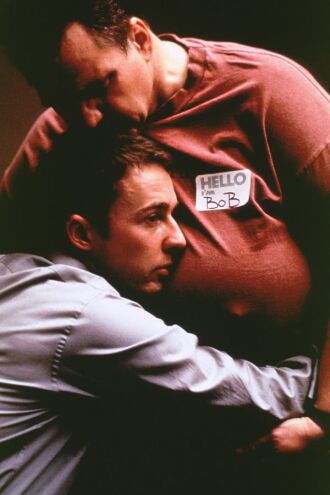
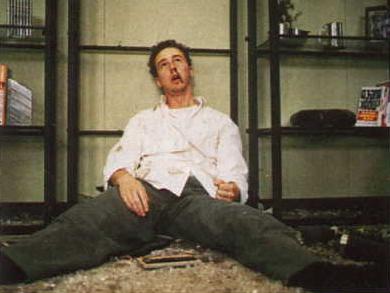
So, I’ve been rewatching Fight Club. (Best way to listen to commentary tracks? Work out while you’re listening to them. You’ll feel like a fit couch potato.) I still think it’s a very funny, very clever and extremely well made movie. But one thing about it tends to annoy me… and that’s many of its male fans.
So many guys I know who like the film buy into Tyler Durden’s fashionable nihilism and reactionary chic. They see the film as a critique of a society that brings forth the silly, ridiculous “Let’s all grouphug and cry into each other’s t-shirts!” self-help groups and subscribe to the “You are not beautiful, unique snowflakes” existentialism that Tyler preaches.
But, essentially, is there much of a difference between the fight clubs and the self-help groups? Aren’t both basically places where people come together, feel sorry for themselves and their lot in life (perhaps even with justification) and then make each other feel better by either hugging each other or beating each other? Aren’t both simply schemes to make you think “Yeah, there’s others out there who feel like me?” The guys who join Tyler’s clubs are losers, and they think that beating each other up and being about as nihilist as a Nine Inch Nails t-shirt turns them into men.
“We’re still men.”
“Yes. Men is what we are.”
The only real difference (apart from the blood and snot vs. tears and snot, depending which brand of self-help group you prefer), it would seem to me, lies in the ideological veneer that covers either. But those guys who think, “Yeah, that Tyler is cool, we’re not beautiful and unique snowflakes, consumerism sucks, and I’d quite like to beat someone’s face into a pulp, because that’ll make me a man” – I’d say that a lot of Tyler Durden’s joke is on them. If you have to beat someone up, or be beaten up, to feel like a man, if you have to demolish coffee shops in order to feel you’ve got a sizeable penis, then good luck finding new teeth.
Today’s episode – the first one in season 5 – feels like it continues straight from the end of season 4, emotionally, even if enough time must have passed for George to have undergone ECT treatment and Rico to have started dating again. (He doesn’t seem to be very good at it…) There’s the same mix of tentative hope and deep sadness, the former perhaps most in David and Keith’s decision to try for surrogacy, the latter especially in the aftermath of George’s illness and Ruth’s fears of what her life will be like, tied to a sick person. Her hold on her life has always been precarious, but now she seems to lose against her fears.
What else is there? Billy’s rapidly becoming much more likeable than bitchy Claire (although she didn’t necessarily deserve the hard slap her mother gave her for something very minor). The Death of the Week(tm) was one of the uglier ones in the series, uglier even than the Elevator of Doom at the end of season 4. (Definitely the kind of thing that could put anyone off psychotherapy…) And Rachel Griffiths once again shows what a great actress she is.
On a slightly different note: we watched Sergio Leone’s The Good, the Bad and the Ugly yesterday. Can’t say I like it as much as Once Upon a Time in the West. It’s a much lighter, fluffier piece, and it forgoes the pathos of the later movie. But, like Once Upon a Time…, it’s got a great final showdown – and the music, like many of Morricone’s works, is iconic. It even survives being played by a ukulele orchestra. Don’t believe me? See for yourselves:
Last evening’s session on film analysis went well, and the students enjoyed it too. It made me want to do an entire course on the subject. It also made me want to watch all three movies again.
Of the three, Memento is the one that startled me most when I first saw it. It’s intricately structured and plotted, but beyond this it’s beautifully presented, with a sparse melancholy and occasional absurd humour that strengthen it into something more than a well made puzzle.
It’s also got a fantastic, disorienting first scene that acted as the perfect hook for me. I got the impression that it also did so for the students yesterday; they seemed quite frustrated at me stopping the film after roughly seven and a half minutes. Well, guys, it’s in the department DVD library, I think – and if it isn’t, just pester one of the staff members ’till they get it. After all, someone also got the original Texas Chainsaw Massacre for the department, which justifies many an additional purchase, I think (Perhaps they could get Crossroads, that Britney Spears movie, scripted by Shonda Rhimes of Grey’s Anatomy fame.)
I liked the effects of reverse chronology in storytelling, if done well. Memento definitely makes good use of having two narrative strands, one in normal chronological sequence, the other one reversed, putting us in Leonard’s shoes: we never know what went before, just like he can’t remember. It’s a structural strategy that’s also highly effective, and moving, in Eternal Sunshine of the Spotless Mind and in Harold Pinter’s play Betrayal. (I’ve just read that there’s a Seinfeld episode, “The Betrayal”, that has the same structure and makes multiple references to Pinter – gotta see that one!) The focus is shifted from “What happens next?” to “Why did this happen?” I wouldn’t necessarily want my Die Hard or Aliens told in reverse chronology, of course, but every so often I get tired of “What happens next?” – mainly because what happens next isn’t all that exciting.
P.S.: It’ll be interesting to see what sort of visitors the tag list will bring in. Welcome, one and all! Even Britney Spears fans! And aliens, I guess.
I’m about to be off and teach a two-hour colloquium on film studies. I’ve never studied the subject, but somehow the person who asked me to teach the session thought that a) having a PhD in English and American Literature, b) being a film nut (and having 400+ DVDs to prove it) and c) having an opinion on everything qualifies me for this.
Hurm, as a certain psycho superhero might say.
Anyway, since I have to make a few last notes, I’m going to have to make this short. I’ll be analysing extracts from three films with them: The Talented Mr Ripley, Fight Club and Memento. Having re-watched the beginning of those three films, I was reminded again why I liked them so much in the first place. Ripley got a bad rap with some critics, but I still find it one of Anthony Minghella’s, Matt Damon’s and Jude Law’s finest movies. And for those who think the film lacks tension, I thought I could put a highly spoilerish excerpt in the blog. Those who haven’t seen the film yet, don’t click on the clip lest you do so at your own peril!
However, I don’t want to leave you with murder and mayhem (or soap – sorry, wrong movie…!), so here’s another, more peaceful clip from the same film. Dunno what it is about the song, but I always get an urge to snap my fingers and tap my feet when I hear it. Enjoy!
The title should already give it away: The Assassination of Jesse James by the Coward Robert Ford is not the kind of movie you watch in order to find out what happens at the end. If that’s why you go to the movies, don’t see this film. If you tend to use the words “pretentious” and “artsy” fairly often when talking about films you didn’t like, don’t see this film. If slow equals boring when it comes to movies as far as you’re concerned, don’t see this film. If you’re hoping for gunslinging action, don’t see this film.
However, do see this film if you want to see a beautifully written and shot, psychologically fascinating, immensely atmospheric and deeply sad movie, and especially if you’re interested in good acting. Down to the last part, The Assassination has an impressively talented cast; for instance, even the few scenes that focus on Garrett Dillahunt’s Ed Miller (I’ve been a fan of his ever since watching Deadwood) tell volumes in themselves. But the film stands and falls with the two title characters, and they both carry their share of the load with distinction. I’d only seen Casey Affleck in the Ocean’s Double-Digit films, where it’s difficult to judge his acting, but his Robert Ford is a complex, riveting creation: in turn wheedling, puffed up, disturbing, pathetic, deluded, but finally truly tragic, he’s a relative of Matt Damon’s Tom Ripley. At one point James asks him: “Do you want to be like me? Or do you want to be me?” Their relationship recalls that of Tom Ripley and Dickie Greenleaf (Jude Law) in Anthony Minghella’s movie, but it goes further than that. And Ford’s longing, loathing looks at Jesse James carry so much.
I must admit that I am also becoming quite the Brad Pitt fan. I used to think that he was a star, but not much of an actor – and there are films where you need stars. It was only in Babel that I recognised he could play a part that was in no way that of a movie star. In that film I forgot for the first time that he’s a pretty boy, and I saw him as the character. The star quality is back in The Assassination, but it needs to be – Jesse James is a myth, so Pitt has to portray that facet of the character – and it’s made deeper and richer by Pitt’s performance. This quasi-mythic outlaw is also a paranoid, superstitious and at times cruel and petty bastard, and he’s got a deep streak of self-loathing. When he turns his back on Ford for the last time to wipe the dust of a picture, we’re basically seeing a suicide at least as much as a murder. While James is no Christ figure, Ford is as necessary as Judas to complete the narrative – and to some extent this is because James lacks the courage himself to end it all, nor to live on. It’s by no means clear whether Robert Ford is really the coward that the title suggests.
I don’t want to go on too much, because otherwise this blog entry will rival the film in length. If you don’t mind slow, long films, if you don’t mind portentousness, if you think that the western genre can do tragedy successfully; if you don’t mind hearing the same three pieces of music repeated frequently (and they fit very well), if you don’t mind artsy choices in the photography, editing and writing. Or simply if you want to see Nick Cave hamming it up with a guitar in a Brad Pitt movie. If any of these apply, go and see the film.
Okay, I have to warn you. This is not one of those “I like game/movie/book XYZ enough to bore you with the details” posts. It’s an opinion piece. And it’s about one of those boring topics that the media keep coming back to, usually in the most facile, over-the-top way possible. Especially in the German media, you often get the equation: video gamer = potential murderer and sadist.
Which ticks me off. But what ticks me off just as much are gamers who aren’t able to look at the issue with some critical distance. You can’t have a decent discussion with the likes of Jack Thompson, people who believe that games train you to kill and maim (the word “murder simulator” pops up in their rhetoric), but it’s just as impossible to have a decent discussion with people who don’t have any second thoughts about a game where you’re rewarded for stealthy behaviour with extra-gory executions, and that’s part of the fun. (Warning: the video, showing Manhunt, is quite explicit.)
The people who think that any depictions of violence in games are fair game usually bring up three arguments: 1) “Movies such as Saw or Hostel are just as violent, they’re more realistic than pixellated polygon carnage, and adults can watch them, so it’s hypocritical to want to censor games!” 2) “It’s just a game, and personally I can tell the difference between a game and reality. If you can’t, that says more about you…” 3) “Censorship is a restriction of free speech! And that’s un-American! Why don’t you go back to Russia, commie?”
1) “Many movies are just as violent, but you don’t see them being banned, do you?”
It’s definitely true that films such as Saw or Hostel are at least as violent. They’re also more realistic, because while games have advanced quite amazingly in terms of visual representation, you still wouldn’t mistake a game’s version of reality for the Real Thing(tm). (One point that’s often raised together with this one is that games aren’t kiddies stuff per se. I agree with that – just like not all animation is Disney fare but may be aimed at an adult audience, not every game is Super Mario World.) However, it’s silly to ignore the fact that games are interactive, whereas films aren’t. Quite often, game violence is inflicted by the player’s avatar, controlled by the player. It’s too simplistic to say that you, the gamer, are committing the violent acts, but there’s obviously a causal link between your actions and the on-screen violence.
I’m not saying that this automatically programs gamers to become murderers, or simply to become more violent and aggressive. Most of the studies I’ve seen that suggest such a correlation are questionable in terms of methodology – for instance, they measure an increase in aggressivity in ways that would apply to football or any other competitive sports as well. On the other hand, though, there aren’t that many good studies that show the violence in games to have no effect whatsoever. Until there’s more, and especially better, unbiased research, the argument simply doesn’t hold. And just because individual gamer X who’s been playing violent games since he was 12 hasn’t taken a knife to his parents yet (you gotta love anecdotal evidence!), that doesn’t mean that there might not be other, more subtle effects.
Does this mean we should prohibit all violence in video games? No – but it does suggest that we, critics as well as defenders, should keep a more open mind.
2) “It’s just a game, man! Ever heard of fiction? It’s this thing that isn’t reality!”
When Goethe published his novel The Sorrows of Young Werther which ends with the protagonist’s suicide (yeah, I’ve just spoiled the novel’s ending for you! deal with it!), there was a rash of copycat suicides. People cheer when bad guys get killed in movies. They cry when their favourite characters in a series die. Yes, the emotional reaction is safe to some extent because it’s based on fiction – but it is nevertheless an emotional reaction.
And while the relationship between fictional representations and the reality they represent is highly complex, would anyone really, honestly deny that there is a relationship? Horror movies scare – why else would people watch them? Romantic comedies make you all warm and fuzzy. How many people sit in their seats thinking “Yeah, right, but it’s not real, is it? That’s just an actor, that’s ketchup, and those are digital effects.” Much of the time we watch fiction in order to get lost in it. Fiction can have a real effect on us, so saying that when you put a virtual knife in some poor virtual henchman’s virtual eyesocket it’s just fiction strikes me as naive at best, and disingenuous at worst.
Again, this doesn’t mean that violence in games should be made illegal outright. It just means that the argument is becoming increasingly facile.
3) “Freedom of speech, yadda yadda yadda…!”
Okay, I’m going to out myself here. I don’t necessarily believe that absolute freedom of speech is such a great thing. In the best of all possible worlds it is. In a world filled with responsible, mature people who can look at themselves and their own actions with a minimum of critical distance, free speech would be one of the greatest goods.
In a world where people think that just because you’re allowed to say something it’s right to say it, and where people don’t think that every now and then it’s better not to say something… well, in such a world, I must say that I can live with restrictions to free speech. There is no such thing as absolutely free speech anyway – there are always limits imposed by others. Sometimes these limits are institutionalised (for instance when the government issues laws against hate speech), sometimes they’re internalised. (“You don’t say XYZ because…”.)
I often find that you can’t really talk to people who act on pure principles – because principles, if applied as purely as they’re usually argued, ignore context. And that’s what is woefully missing from this entire debate: people fight over examples of videogame violence, but they don’t really look at the individual contexts. Do I think it’s right that the BBFC denied Manhunt 2a certificate, in effect banning it in the UK? I don’t think it’s wrong, although I think this sort of thing should be applied only after a lot of consideration, and it should be open to appeal. I think it’s important to discuss whether “freedom of speech” means such games should be made and sold. I think it’s important that the in-game context of violence should be looked at critically. Who is the player character, what does the violence consist of? How is it integrated into a plot? Who is it committed against? Does the game reward violence, does it punish it, or does it simply show it? All of these are interesting, important questions that are so often ignored by both sides of the debate. The same act of violence may mean something vastly different depending on context.
If anything should go in games, because they’re fictional and because artistic freedom should be absolute (i.e. it should include such things as gamers being able to chainsaw their opponents in the throat and then dismember the corpses – it’s art, innit?), then there’s nothing wrong with rape games or concentration camp simulators. These games exist (they’re amateur productions), and they won’t stop existing if there’s legislation. But unless the defenders of videogame violence are willing to have an mature, differentiated debate about the issue, acknowledging its complexity, I can live with limits to what is acceptable in games.
Until a game is banned that I really like, and that’s when I’ll probably be shouting the loudest.
(Note: That last sentence is there to acknowledge the contradiction in me advertising GTA: San Andreas one day and ranting against violence in games the next. Hey, I’m a contrary bastard! Also, I’d rather continue the discussion in the Comments, if anyone’s interested. This issue should be debated, and not just in black/white terms.)
I finished (re)watching the Miami Vice movie yesterday, and I can confirm my impression that it improves on repeat viewings, at least for me. It’s still one of Mann’s weaker films, mainly because the characters are more sketchy, but it makes for a nice change from all of those ’80s and ’90s cop buddy movies. The main reason for this is the characters’ professionalism. You get the impression that these guys are good at their job, and so are the criminals.
In so many other films, neither the good guys nor the bad guys are very professional. Usually, the cop characters seem to be (bad) stand-up comedians first and policemen second. Similarly, the villains of such pieces fail because they’re so easily manipulated. How often in these action movies do you have to suspend your disbelief so much that it’s almost at sea level because the characters act in such stupid ways?
Yes, the professionalism of Mann’s Miami Vice also means that it packs less of an emotional punch. To some extent, the conflict between the guys wearing white hats and the ones in the black hats is so cerebral that I was fascinated, but I didn’t necessarily care. Ricardo’s relationship feels a bit more real, because there’s a sense of history; Sonny’s affair with the high-class gangster moll doesn’t seem like the sort of relationship that has a future, but the erotic charge between Colin Farrell’s Sonny Crockett and Gong Li’s Isabella is nevertheless quite effective.
It’s unlikely that anyone who completely hated the film the first time or who doesn’t like Mann’s work would like Miami Vice on a second viewing. If you don’t fall into either one of these camps, you may want to check it out again in the slightly extended version.
P.S.: And to make up for yesterday’s puerile homoerotic joke, here’s a different ’80s joke. Enjoy! (Note to self: Mwahahahahaha. Erm.)
Yesterday I started watching Miami Vice, Michael Mann’s recent film update of the quintessential ’80s neon series. I’d seen it at the cinema, and while I’d enjoyed the gorgeous visuals, I’d been rather underwhelmed on the whole. Now that I’m seeing it on DVD (in a slightly longer version), I like it a lot more. Some of that is probably down to the lack of expectations on my part. (I’ve talked about my Mann-love here before), some of it may be due to the Michael Mann atmosphere: his films tend to have a strong streak of loneliness going through them, which may not work as well in a packed cinema.
It’s rare that my appreciation of a film changes from “meh…” to something better on repeat viewings. The opposite happens a bit more frequently, but it’s still fairly unlikely. But sometimes I see a movie at the cinema and something about it stays with me. SOmehow my brain knows it needs to give this film a second chance. And sometimes it’s those films that I end up liking most.
Just for the record: 12 Monkeys was a film that I needed to see two or three times to like.
And now, for your appreciation, some more Mann love: