Would you kindly…?

My apologies for the posting delay – I was laid low the last two days with a stomach bug. I’m still home from work, but now I have no more excuse to dawdle… So here, without much further ado, the latest entry. I promise not to throw up while writing it.

I’ve been re-reading The Sandman from beginning to end. About a month ago I got the last of the Absolute Sandman volumes – gorgeous hardback large-format reprints of the original comics, with tons of extras such as additional stories in the Endless universe or scripts of some of the most important issues.

Yes, I know, I'm a book fetishist.

This is probably the fourth or fifth time time I’m reading the series in its entirety, and I still have the same favourites: A Game of You (vol. 5), Worlds’ End (vol. 8) and The Kindly Ones (vol. 9 – more on that later). However, Brief Lives (vol. 7) has grown on me, especially the last few chapters. I’m still not all that hot on its art, but the storytelling is fantastic – Gaiman at his finest – and it’s pretty much the volume when Delirium comes into her own.

I’m currently halfway through The Kindly Ones, and even at a fifth re-read, it still packs quite a punch. I love the art (which some found too cartoony – but I definitely prefer it to the more generic comic-book art of some of the other volumes, even though they all have their inspired moments), but even more, I love how Gaiman manages to bring together dozens of threads from the previous volumes in clever but not ostentatious ways. He makes it all feel natural and, as in all the best tragedies, inevitable.
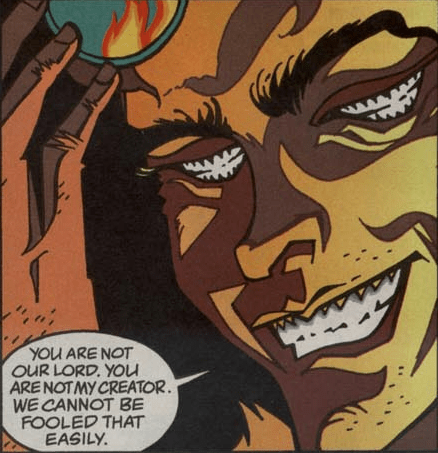
Imagine him brushing his teeth (and flossing) and he'll get a lot less creepy...

There are a number of things that in the hands of a lesser writer would feel like fan service, especially the return of the Corinthian, or indeed the extended scenes with Mervin Pumpkinhead. But what Gaiman pulls off is something that few series (in any medium) have managed so far: reading The Kindly Ones, you get the impression that he’s always known where he was going. And you want to follow him, even though you know it’ll all end in tears.

I haven’t been all that hot about most of Gaiman’s work since The Sandman. His recent short stories, and indeed his novels, have seemed too twee, too enamoured with their cleverness. There are always great bits, but in between those bits I feel I’m reading some Gaiman imitator who does an okay job but simply isn’t the same. Fragile Things was a shadow of Smoke and Mirrors (which contains some of my favourite short stories). Anansi Boys was fun but pretty forgettable. I liked Coraline a lot, though – perhaps Gaiman tries too hard to be clever and Gaimanesque when writing for adults, and when he writes for children he simply focuses on telling a good story. Which, in Coraline, he very much does.

Talking of Gaiman: this animated short reminded me of him – most of all because Nick Cave’s narration sounds exactly like some of Gaiman’s readings:

youtube=http://www.youtube.com/watch?v=Uj4RBmU-PIo]
More series business

How many different series can a person watch and still keep them all apart? Right now we’re watching Angel, House  M.D., Carnivale and Heroes and Grey’s Anatomy, I’m rewatching Six Feet Under, Battlestar Galactica and Life on Mars, we’ve just finished Fringe and we’re waiting to continue The Sopranos and Buffy. Well, at least no one can accuse me of being a total elitist snob when it comes to telly series…

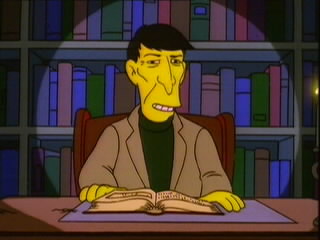
I enjoyed Fringe because it fulfilled my post-X-Files FBI-investigating-weird-shit cravings. Is it a good series? Not particularly – it’s repetitive, some of the acting is dubious and with half the episodes I think that I’ve seen them before, only Mulder and Scully did them better. It’s great turn-off-your-brain TV fast-food, though, and I’m looking forward to more Leonard Nimoy in season 2. “It’s all lies. But they’re entertaining lies. And in the end, isn’t that the real truth?” (Damn you, YouTube, for not having a clip of that scene!)

The answer is, "No."

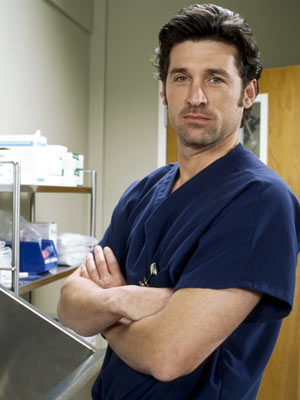
Grey’s Anatomy has been something of a guilty pleasure of mine, and throughout much of season 4 it wasn’t all that much of a pleasure, to be honest. The series’ problem – well, main problem – is that they’ve got a number of very good actors and even the middling actors know their parts by now, but the writing (especially with respect to character development) covers the whole range from maudlin to obvious to plain bad, with the occasional strong scene. If the series could decide to be a comedy, it wouldn’t matter that most of the characters are written to be highly unprofessional so much of the time (typical example: some patient is dying and needs urgent care, and doctor X decides that this is the right moment to ask doctor Y why they didn’t have sex the previous night – remind me not to get ill in TV Seattle…). It takes very good writing to make the constant jumps from quirky comedy to serious (melo)drama work if the characters aren’t to come across as nincompoops at the mercy of the script. Season 5 had many of those weaknesses, but it had enough strong moments to keep me watching. Still, there are some developments and storylines that just annoy the hell out of me: a resident at a big Seattle hospital going more or less bankrupt from one day to the next because Daddy cuts her trust fund? Swapping one interesting lesbian character for cute but eternally bland blondie because you want eye candy rather than an actual character? Derek Shepard yet again going all pompously self-righteous, and still no one takes one of those circular saws to his perfectly coiffed head?

If we all gang up and stab him with scalpels, it shouldn't take too long...

In the meantime, I’m rather enjoying where Angel season 3 is taking us. Yes, there were a couple of false steps – Gunn and Wesley going all mooney over Fred wasn’t cute, it was just annoying, and having it go on for several episodes made me want to go Angelus on them all – but it’s fascinating to see how Angel, Cordelia and especially Wesley develop during the season. Just 2-3 more episodes to go until season 4 – and I’m ignoring all those people who say that it’s one of the worst seasons ever in the Whedonverse, because it’s something we have to get through before season 5 and “Smile Time” and the (wait for it) bitter-sweet finale. (Yes, Lucy, I put that there just for you…)

Oh, before I forget: gotta love this recent article in The Onion: Next Tarantino Movie An Homage To Beloved Tarantino Movies Of Director’s Youth.

Fight, fight, fight, fight, fight, fight, fight. How many fights is that? A lot.

And finally: I’ll be writing a weekly entry at The Best Shows You’re Not Watching, alternating between Six Feet Under and Life on Mars. You can find the first one here. Let me know what you think!

Hanging on to the chick habit

I’m okay with people disliking Quentin Tarantino’s movies. I have no problem with those who find him annoying as a person. His films aren’t for everyone.

But those who call him talentless? These I have a major issue with.

It may be tempting to say that all Tarantino does is cut and paste old films into fan-wankery collages – he is in effect a collage artist, and you can watch almost any scene in any of his films and point to an original he’s ripping off – most likely some forgotten ’70s B movie of dubious taste. But like all the most compelling postmodernists, Tarantino knows that there is nothing new under the sun… except in the recombination of old things. Kill Bill, for instance, is a collection of hommages, clichés, parodies, pastiches, but Tarantino pulls all these disparate bits together in a way that invigorates them. I came out of both volumes of his worship at the feet of Uma Thurman feeling energised in ways that few other films have managed.

Is Tarantino self-indulgent? Definitely. But more than almost any director who can be accused of this, he’s also usually in great control of his material. The films are more tightly constructed than is usually acknowledged, in ways that make it easy for audiences to underestimate their sheer formal accomplishment. Yet, in spite of this, the films breathe freely.

Chick, chick, chick, chick, chick, chick, chick.

Death Proof was much maligned when it came out, and it’s perhaps Tarantino’s most self-indulgent film. Its first half is misogynist, its characters unlikeable, its humour sadistic and misanthropic. But it’s almost a textbook case of postmodern pastiche vs. parody. Again, I fully respect people who dislike or even hate what Tarantino does, but he does it oh so well: the second part of Death Proof desconstructs the male sex-and-death fantasy of the first half. Stuntman Mike’s wet dream of fucking over sexy but annoying chicks with his car (and yes, sometimes a dick extension on wheels is not just a cigar) is turned on its head when the girls of the second half fight back. And god, is it exhilarating to watch as they turn the tables on Kurt Russell’s leathery prick of a man.

And then the ending comes. And it feels like Tarantino ran out of ideas and the script just read: “And then they beat the shit out of him.”

That they do, indeed. But, as so often in Tarantino, the rewarding bits aren’t the bursts of violence – his reputation of wall-to-wall, bloody violence is undeserved, but he likes to punctuate his films with bursts of it -, it’s the conversations leading up to the violence. People who say they liked such-and-such film of his, “if only there wasn’t quite so much talking”? You might as well say, “I like Michael Bay’s films, if only it wasn’t for the explosions. And the stupidity.”

Spiraling down towards madness

I don’t really know much manga. Yes, I’ve read Akira, and I quite enjoyed Osamu Tezuka’s Buddha, but other than that I simply haven’t read much. In addition, other than the original Dark Water I’m pretty ignorant about Japanese horror (other than having read reviews, and reviews of the American remakes – I don’t know anything, basically, I just meta-know!).

When I read about Junji Ito, though, I was intrigued. I don’t know what it was – the chills that his works evoked among the people who had read him, the single panel someone had posted? Perhaps it was just that I had time on my hands.

So I checked out Uzumaki. And I’m glad I did. But yes, some of it will haunt me.

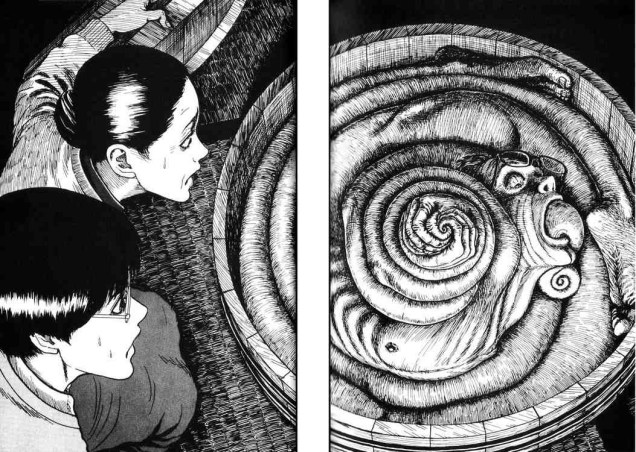
Differently from the Western horror I’ve watched or read, Uzumaki doesn’t go for full-on naturalism that is then invaded by some uncanny creature of the beyond. From the first, there’s something weird and uncanny about his stories. Is it that the people who become obsessed with spirals in the story are going mad, or is there something more to it? There is something obsessive in the storytelling itself, as each chapter takes us further down the spiral.

There are bits that are gruesome and gory (in moderation), but those aren’t really what had most of an effect on me. It’s the surreal that somehow becomes frighteningly compelling as it invades every aspect of the manga – there are overtones of Kafka, as people turn into giant snails, but there’s also something creepily funny about some of the chapters. It’s unsettling, to say the least.

So, if you’ve got time on your hands, you may want to check out Uzumaki. Beware, though – it is addictive, it is unsettling, and it may just burrow into your mind and leave little, spirally holes, as if someone had taken a corkscrew to your frontal lobes.

I made that last bit up...

Or did I?

Psychotic dentists, mutated lungfish and a turtle named Mr. Pokeylope

You may already have gathered this, but in case you haven’t I have a confession to make. It’s one of my dirty little secrets.

I re-read books. And not only that: I also re-watch films. And, horror of horrors, I re-play games. Old games that have fewer pixels than Dick Cheney has had ethical thoughts. Games that require an hour or two of fiddling with Windows, downloading fan patches and editing game code in order to work on a 21st century operating system.

Of course I don’t replay any and every game I’ve ever played. Your run-of-the-mill first-person shooter is unlikely to get much of a repeat performance with me, unless it’s got that certain je ne sais quoi and is called Half-Life 2, I guess. (Or No One Lives Forever, or Call of Duty 2. For some reason, though, I didn’t even properly finish Doom 3 once.) Just like the films and books I enjoy more than once, some games are so good at telling a story and pulling you into their world, whether this is because of the gameplay or the writing, that I can’t resist revisiting them.

Psychonauts is definitely one of those games. It’s one of the most inventive, best written video games I know, and funny to boot. It’s also one of those rare cases where the gameplay itself is fun but not all that special – but once you combine it with everything else, the game becomes that oldest of chestnuts: more than the sum of its parts.

It’s the sheer exuberant imagination of the minds the game visualises: the paranoid delusions of the Milkman Conspiracy (and its wonderfully off-the-wall G-Men), the monster-movie inspired Lungfishopolis, the many other minds that form the basis for the game’s level. And the often inspired voice work is still among the most perfect in the videogame industry.

Differently from many of the other classic games I replay (or hope to, if I ever find the time), Psychonauts is still available (there’s no need to get it for lots of dough on eBay), namely on Steam. I don’t often do such blatant plugs on my blog, but this game is worth it.

Et In Blogosphere Ego

Yup, I’m back. You may not have known that I was gone… but I was. Two weeks of holidays, baby, and sorely needed ones as well.

What’s happened in the meantime? Well… I saw and enjoyed a play by Beckett. In spite of a major in English Literature, I always felt that Beckett’s plays were too long by half – and I still think so. Yes, the length (and resulting tedium) are part of the point, but I’ve always prefered his short plays to Endgame, or Waiting for Godot for that matter. What can make the latter much more enjoyable, though? Good actors, or to be more precise, Magneto and Professor X. Or Jean-Luc Picard and Gandalf. Those two godfathers of the English stage made the play more than worthwhile.

Still, though, too long by 'alf!

Less enjoyable, though, was the current London production of Tom Stoppard’s Arcadia. Yes, I compound my iconoclasm as a Beckett-disliking EngLit major by prefering the derivative Stoppard to the originator. Take that, SDH! Arcadia is one of my favourite plays, a wonderful blend of wit, intellect and heart. I fell in love with the play when I saw a fantastic amateur production done by a German student drama group.

So, with a play like this and a professional cast and crew, what could go wrong?

Well, mainly one thing: whether it’s the director’s fault or the actors’, they got the one central relationship of the play – between Thomasina, precocious 19th century teenage genious and Septimus, her tutor – wrong with a spectacularly wrong-headed interpretation of Thomasina (and a very mediocre Septimus). As a result, the production didn’t even begin to have the heart it needs to balance its cerebral qualities. If there is no ongoing flirtation and attraction between the two, one that Septimus is hardly aware of, then the final scene between them falls flat.

And fall flat it did. Having taught the play, I was constantly aware of what it could be and what the production failed to make of it. It had some strengths, mainly in the present-day comedy of academia and in a fairly strong Bernard Nightingale. (Oh, I wish though that I’d been around for the play’s original production, with actors such as Felicity Kendall, Bill Nighy and Rufus Sewell.) But without the heart, Arcadia is rendered flat and unengaging, rayless and pathless.

Okay, that’s enough for now. One thing, though, before I’m off: thanks to Rock Paper Shotgun, a computer game blog, I stumbled upon this story which has nothing to do with computer games and everything with sweetness and sadness and John Hughes. Well worth reading, unless anything even approaching sentimentality makes you come out in a rash.

You know what they say about no news… (Sometimes they’re wrong.)

I’m afraid I don’t have a proper update for this week, for a couple of reasons. To make sure that you didn’t come here for nothing, though, here’s the trailer for Michael Scorsese’s new film, Shutter Island, based on a novel by Dennis Lehane (of Mystic River and Gone Baby Gone fame). Looks like Scorsese’s love affair with Leo DiCaprio is still ongoing.

I likes me some scary asylum flick.

Sugar, ah, honey honey

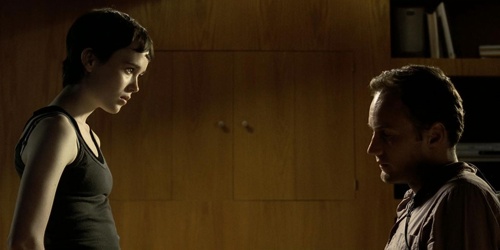
Hard Candy is one of the most uncomfortable films I’ve seen lately. Is it a good film? I don’t know. It’s an interesting film, and it’s definitely well acted. It’s a courageous film for the most part because it doesn’t go for an easy judgment of its characters, but neither does it go for an equally easy moral relativism. And then, in the last twenty minutes or so, it commits a couple of serious blunders that take away from its ability to disturb.

Like some of the most disappointing films, its first quarter of an hour is probably the strongest part of the film. The way it establishes the relationship between its two main characters – photographer Jeff and precocious 14-year old Hayley – and then turns this relationship upside down is very well done. Jeff isn’t an out-and-out creep, yet he is way too keen to play along with the teenage girl’s flirtation. He deserves it when she turns the tables on him… at first, but does he deserve the emotional and physical torture she puts him through? How far does his guilt go, and what puts her in a place where she can take it upon herself to be judge, jury and quite possibly executioner?

Hard Candy

Jeff is too much interested in teenage girls, and he lets his interest go too far. He is guilty – but so far his desires are only different in degree from those who check out porn that advertises itself with “Hot Teen Sluts” or “Barely Legal”. You don’t have to go to the pornographic industry to see how teenage female sexuality is used to sell, well, just about anything, and how the line that delineates legal desires from illegal ones is blurred. Does this lessen Jeff’s guilt? No, but it puts it in context, and it makes it less easy to draw a line between him and they guy you work with who has the hots for the Olsen Twins or early Britney Spears or any number of nymph used by the marketing industry. If Jeff deserves castration, what do guys deserve who count down the days until some teen starlet becomes legal, or who fantasise about the high school cheerleader dressed up to be a sexual fantasy?

All of this only works so far, though. Throughout Hard Candy the question of a teenage girl who’s disappeared comes up, and Hayley insinuates that Jeff was somehow involved in this disappearance. A (chaste) photo of the vanished girl serves as incriminating evidence. Unfortunately the film comes out at the end and says that Jeff was either there when the girl was killed (by another pedophile) or that he killed her himself. Does it matter which of the two is true? Not really. He is culpable in either case, and his culpability is different in kind from the many, many men who have a hard-on for teenage girls. At this point we can easily draw the line, and Jeff is on the other side of the line. He’s a murderer or an accessory to murder. And at that point it becomes much easier to watch Hayley drive him to commit suicide. Most of the ambiguity of the film falls away, and with it the discomfort. And the movie’s previous courage to let its ambiguity stand gives way to a much more conventional moral simplicity, leaving us with just the window dressing of ambiguity.

I like strong women

Just when my frustration at Firefly‘s premature cancellation was starting to abate:

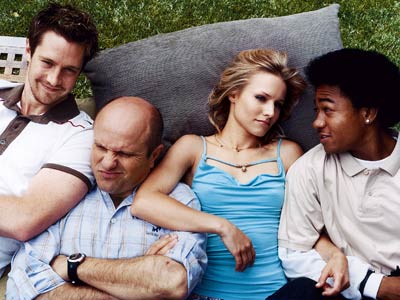
Yesterday evening we watched the last episode of Veronica Mars. The series definitely went out on a very strong episode – but why did it have to go out to begin with? Okay, the answer is simple: not enough people were watching it. Don’t ask me what they were watching instead; probably some reality TV crap with barely one percent of the wit of Veronica Mars, not to mention the wonderful acting by the lead and the great supporting characters. I’ve said it before (somewhere) and I’ll say it again: the relationship between Veronica and Keith Mars is the best father-daughter relationship I’ve ever seen on TV.

Yes, there were weaker episodes, one of the banes of series that require 20+ episodes per season. Yes, season 2 was a muddled mess in terms of its overarching plot. And yes, Duncan Kane was largely a boring waste of space. But the main character was one of the funniest, strongest female characters this side of Joss Whedon’s work. And I don’t see anyone much having replaced her.

Veronica & Co.

Talking of strong women: one of the games I’ve been playing lately, Mirror’s Edge, is one of the few A-list titles whose protagonist Faith is a woman – and, more unusually, the game is played from first-person perspective, so the mostly male players aren’t even invited to ogle Faith’s assets. (No Lara Croft, her.) The game takes the trendy sport Parkour as its main inspiration, but it’s much more than a gimmick – in fact, it’s perhaps the most exhilarating first-person game I’ve played. Mirror’s Edge is flawed, mainly in its humdrum plot and storytelling, but when it works, it works amazingly well. I’ll let the visuals speak for the game: