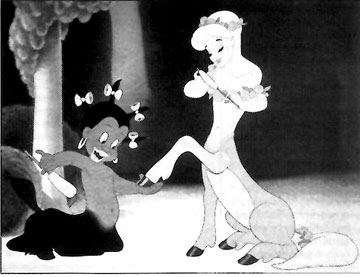
Heh. Okay, I lied, if only by implication. This update is not about Lost – it’s about Evil Uncle Disney. Cracked has a fun (though somewhat crude) look at the most violent deaths in recent(ish) Disney films. While I like some of these films, the hypocrisy is quite striking: in most of these cases the good guy is allowed to defeat but not kill the bad guy because, after all, he’s good – but the villain still has to be punished horribly, ideally by dying. Mercy’s all fine and dandy, as long as the baddie gets the horrible, painful death he deserves! Kill! Kill!
Click here to be reminded of just how gruesome your childhood favourites were. Somewhere the Brothers Grimm are shaking their skulls in envy. (And check out some of the other features – such as the best instances of racism in Walt Disney’s oeuvre. It’s almost as if Cracked has it in for the Waltster!)
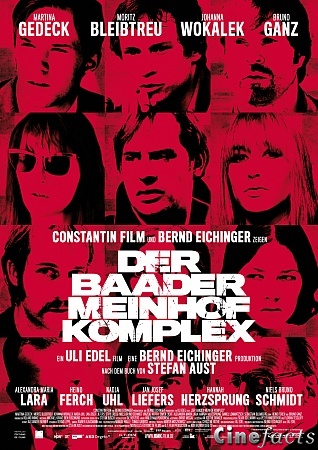
Uli Edel’s film Der Baader Meinhof Komplex is both fascinating and frustrating. It has some of the best actors Germany has to offer at the moment acting their hearts out; at the same time, it has a script that often feels like a badly edited Wikipedia article. I can imagine that the film becomes much more frustrating for those who’ve read the book it’s based on – I was in the lucky position to have known relatively litte about the RAF (Red Army Fraction, not Royal Air Force!) before watching it.
What the script would have needed, more than anything else, is an editor: it is packed with too many incidents, as if the author felt, “This has happened so it would be wrong to leave it out!” That may be true for history books – it is less true for films, obviously. Too many scenes feel like they’re a repetition of what was shown earlier, repeating the same points over and over again. “Yes, we know that Andreas Baader was an immature, self-righteous, misogynist asshole,” we want to say, “We know that Gudrun Ensslin was too much in love with herself! Get on with it!” As a result this 2 1/2 hour film feels strangely short-winded. There is little in the way of a Spannungsbogen, as we get what amounts to “This happened, and then this, and then this…”.
At the same time, there are moments when the film (almost despite itself) settles into a storyline, and that’s when the actors take over. Especially the scenes in prison where the incarcerated heads of the RAF turn on each other and on themselves are, at their best, riveting drama. Especially Martina Gedeck, at least as strong a presence as she was in The Lives of Others, creates a fascinating potrait of Ulrike Meinhof slowly falling apart in prison.
It’s in those scenes that I wished the film knew what it wanted to do. Mere chronology may be sufficient (at best) for documentaries, but it doesn’t make for very good drama. With the same actors but with a sense of focus, it could be so much better. As it is now, it ticks all the boxes but fails to bring them together into something satisfyingly coherent and whole.
What it did achieve, though, and quite strongly at that: I now want to find out more about the RAF and the people and events involved. And I definitely want to check out what else Martina Gedeck has done.
(I was going to write lots more here, on the inherent risk of presenting terrorism as sexy if you’ve got young sexy actors playing terrorists, and on the apparent development from the first generation of the RAF into a copy of a copy of a copy, reducing the sparse initial greys into stark black and white, but if I did that there’d be another week before an update. If you’re interested, let me know and I’ll write something about it next time.)
The Call of Duty games are prime examples of on-rail shooters done to perfection, with amazing production values. They’re not complex games, nor do they strive for realism: they’re the equivalent of a great 80’s action movie – Die Hard rather than some Van Damme or Seagal vehicle.
Call of Duty 4, subtitled Modern Warfare, was the first (and to date only) game in the series that didn’t take place in that most overused of scenarios, the Second World War. Instead, it tells a Tom Clancy-style story of Russian Ultra-Nationalists and, surprise, Middle Eastern terrorists. So far, so unoriginal.
What is fascinating, though, is this: in a genre that is usually about making the player feel like some super-hero with a gun and macho one-liners coming from his lips like so much testosterone-riddled drool much of the storytelling is about showing the player that he doesn’t actually have that much control over what is happening. In fact, two of the game’s most interesting scenes in a subtly subversive fashion give the player just enough control for him to realise that he’s powerless.
Consider the prologue, in which the president of a fictional Middle Eastern country is shoved into the back of a car, driven through his war-torn city, dragged in front of the apparent Big Meanie (who turns out to be a minor meanie, in fact) and shot in the head.
And you, the player, get to control the president. As far as he can be controlled: beaten and dragged by soldiers, he can barely move his head enough to glimpse scenes of loyalists being executed through the car’s windows. And whatever you do, the outcome is the same: gun pointed at your head, blam, black screen. It’s chilling and very, very effective. Clearly it’s also designed to make you hate the bad guys, but apart from this obvious aim it does throw in question the power-trip fantasy of first-person shooters.
The second scene is the one that every reviewer and most players remarked on. (If you’re planning to play the game without spoilers, DO STOP READING RIGHT NOW. In fact, STOP READING TWO PARAGRAPHS AGO! WHY ARE YOU STILL READING? IDIOT!) In it, you and your squad (platoon? team? posse? I’m afraid I don’t really know what the correct military term for “you and the guys with you” is…) have just rescued a downed pilot from the bad guys and you fly off in an army chopper – when a nuke goes off. You watch as the shockwave races towards you, crushing the helicopters behind you. There’s no way you can outrun it.
After you crash, the game gives you control of your character. He’s alive, just barely, having survived the crash. You stumble out of the wreck of the helicopter and look around at the devastation, your heart beating in your ears. In the distance you see the mushroom cloud. Obviously you don’t perceive the radiation, but you know it’s there. But you’re the player! You’re in a shooter! Surely there must be a way to make it out of there!
And then you die, perhaps of radiation, perhaps of your injuries. It doesn’t matter. You have a minute or two of stumbling around and then you die.
The game doesn’t have the ambition or the guts – or the stupidity – to end on your lack of control over the situation. Later on, as a different character, you do stop nuclear missiles from destroying half of the Eastern Seaboard (although you do that using a computer rather than an automatic weapon). And at the very end, you’re given the chance to kill the main bad guy who’s behind it all in a fairly heroic scene (although one with an interestingly bitter tinge).
Clearly Call of Duty 4 is a first-person shooter, not a treatiseon the powerlessness of the soldier. Clearly you want to give the player the feeling that he’s the hero. But it’s still interesting, in a game that is almost the perfect representative of its genre, that you get this subversive, and in this highly effective, streak… Sneaking it past the player that for all of his heroic fantasising, he’s not in control. Just don’t let him find out…
I’ve pretty much given up on the Academy Awards for years now, to the extent that I have no idea whatsoever which films have been winning since that hobbit movie. I did hear about that Irish indie romance Once, though, but I didn’t really follow it. On paper (or, more accurately, “computer screen”) it sounded rather twee.
Then a message board friend of mine mentioned seeing it. He didn’t write much about the film, but from what he’d written it was clear that I wanted to check out the film.
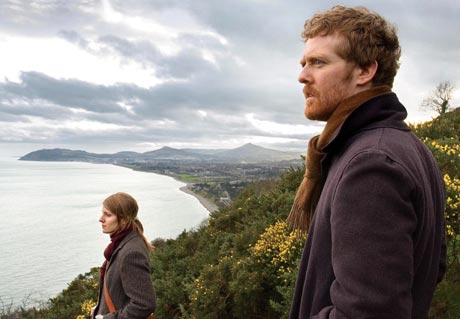
Now I’m in this silly situation: I loved the film and I’d go so far as to say that it’s one of the best, most beautifully told and acted love stories I’ve ever seen on film. I also fear that anything that I might write about it will make the film sound twee. Words such as “sweet” and “charming” come to mind, but they don’t really get at what makes the film work.
It’s funny (in a film nerd way, that is): we watched two films on two consecutive nights last week that were amazingly similar in some ways but couldn’t be more different in others: Michael Winterbottom’s Wonderland and, well, Once. Both were filmed simply, going for verisimilitude, especially in the acting and writing. Both were City movies, so to speak, very much rooted in London and Dublin respectively. Both were about people who have to struggle to make ends meet at times, and not the Guardian-reading upper middle class characters of, say, Anthony Minghella’s Breaking and Entering.
Yet Once has an artlessness that in its effectiveness is highly artistic, whereas Wonderland never lets you forget that you’re watching a film by a director who wants his directing to be visible on screen. In its digicam, improv way Winterbottom’s film is as much a director’s film as any movie by Scorsese. It is the sort of film that some people might call “pretentious” because it forms its material in unexpected ways and makes this very clear on every frame. Once, by comparison, wants to be a small film, is a small film and knows it.
But it’s by no means unambitious. Pulling off a simple, bittersweet love story – with songs, no less! – take courage, or stupidity, but whatever it was, they managed it. For lack of a better word, Once may just be the most honest love story I’ve ever seen. And in some ways I hope never to read the words, “From the makers of Once” because I’m afraid that there’s no way they could do anything other than disappoint. Poor buggers…
Anyway, enough words from someone who basically said, “Words won’t live up to the film so I’ll keep this short.” Both films, Wonderland and Once, are very much worthwhile. The former is probably more a matter of personal taste – Winterbottom’s films are not likeable as such, nor do they set out to be – but still a definite recommendation. And now I will leave you with trailery goodness and shut up.
Since we’ll be leaving the United States in just over 32 hours, we thought we’d check out another movie, if only for the experience of sitting in a movie theatre armed with a double espresso shot caramel macchiato and an apple fritter. I’ll never eat in this town again.
The film itself, Burn After Reading, was decidedly so-so. I think my main problem with several of the Coen Bros. comedies is that the characters are painfully flat and, as a result, I simply don’t care much. (The Big Lebowski gets around this by making its characters quite endearing and strangely poignant, which should be an impossibility with such a far out, potheaded plot.) Same here: apart from very few moments, all of the protagonists remain cartoons – added to which there simply isn’t much of a plot to hold everything together. While the individual situations are comical, there’s a “ooookay… what should happen next? dunno…” quality to this film.
So, since a lot has already been written about the film, let me talk about more interesting things: the trailers. Four of ’em, and all of them intriguing.
I’m not a big Meryll Streep fan, although I acknowledge that she’s a good actress. Much of the time she seems too much like “Meryll Streep acting her little cotton socks off”, just like Robert de Niro, even at his best, tends to make the strain of acting very visible. It works in some films, but I prefer acting that almost vanishes – or otherwise make it very overt acting that doesn’t even try to hide the fact that it’s an act. Having said all of that, this trailer made me look up. Added to which it’s got Philip Seymour Hoffman. Colour me intrigued.
Trailer no. 2. Okay… on the surface, this looks like it’s trying way too hard to win Oscars. Disability. Troubled musician. Based on a true story. Directed by the guy who brought you these middlebrow tearjerkers. And yet, and yet. Robert Downey Jr. can make most middling films interesting and Jamie Foxx definitely knows how to act. Also, based on the trailer the film looks beautifully shot, without going for the glossy, strings-swelling-triumphantly, one-step-away-from-Hallmark visual style.
I’ve only seen one film by Gus Van Sant: Finding Forrester. Yes, I like Anna Paquin, but that didn’t make it a very good film (although it was one of the weirdest, coolest, loveliest evenings and nights in my life that followed that film). Okay, I’ve also seen the vignette he directed in Paris Je T’Aime. I have no idea whether I like him as a director or not. Mostly I’ve read reviews of his films and thought, “Um… right.” (I am uncannily interested in Gerry, mind you.) Then there’s Sean Penn who, for me, is very hit-and-miss. When he’s good he’s very, very good; when he’s on a mission, he’s annoying as hell. But, I must admit, this trailer looks fascinating.
Finally, Frost/Nixon. So far I wasn’t interested at all. And if I’d remembered the director, my disinterest would have doubled, nay, trippled. Is there a more competently nothingy director than Ron Howard? But this may be just the right film for a bland director who nevertheless knows how to get good performances out of his actors. Added to which: Matthew Macfadyen. Yep – it’s Tom Quinn. It’s Henry IV. It’s one-eyed guy with bigass scar. (That last one was Enigma, in case you just went, “Huh?”) And the trailer doesn’t look like “Talky sort-of-historical film based on a play, with actors who wish they hadn’t played in those vampire movies” – it looks like a proper film.
So: main feature – meh. Trailers? Gimme more of that!
In case you were wondering: I haven’t abandoned you or the internet or my “way too late to be of any relevance whatsoever” blog. I’ve just been away, and still am. For the first time in my life, I’m not just witnessing the sheer bigness (biggitude?) of the United States of Thingamy through the TV screen – I’m in San Diego, enjoying the sun, the zoo, the predominantly Democrat people, the 24-hour shop at the gas station that sells juices made up of broccoli, spinach and garlic that nevertheless taste pretty damn good.
I’ve also made it to the fabled American movie theatre, and the first and most important thing to report is this: they show about 2 1/2 times as many trailers as they do back home! (That’s it, I’m moving here…) Okay, the number of trailers may not quite make up for the film that followed them in this instance…
As I may or may not have mentioned earlier, I’m not a Western fan as such… but some films and series that I like a lot happen to be Westerns. I like what you can do with a well established genre – such as showing up the genre’s limitations and giving alternate readings of its archetypes. I love Deadwood and The Assassination of is anyone still reading this title or have you already jumped to the end of the italics? is one of my favourite films of the last couple of years.
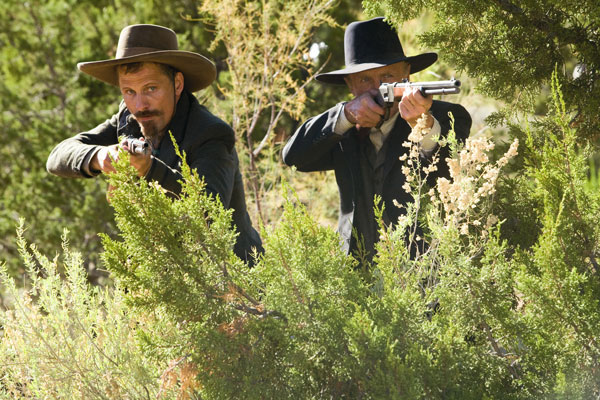
Appaloosa, Ed Harris’ second film as a director, could have been made 60 years ago, with little changes. It’s old fashioned. That in itself isn’t bad. What is a shame is that the film becomes way too comfortable with itself, to the point where, even when bad things happen, there is no urgency to the story at all. There’s too much there that is utterly predictable. And most of the characters have the emotional maturity of sitcom characters.
As a result, I sat there thinking, “Nice acting, but I don’t really care.” I didn’t care whether Harris’ character and Renée Zellweger’s golddigger would end up with each other and be happy. I didn’t much care whether any of the protagonists would die before the end. The few bits that made me look up with interest – the quasi-domestic relationship between Harris and Mortensen before it’s broken up by, gosh darn!, a woman is quite nice, and the film’s nicely aware of Harris’ character being rather thick at the best of times – were nice enough, but the overriding thought on my mind as I left the cinema was: “I wonder how many episodes of Deadwood season 4 this could have financed…”
On a slightly different note: Watched the premiere of the US Life on Mars. Was left with a deeply felt confusion as to why to do this remake and a mixture of pity for Harvey Keitel (he looked like he wanted to be somewhere else) and annoyance with him (if he doesn’t want to be there, why is he taking up the space?). I have no problem with remakes on principle – but if they’re as pointless, and joyless, as this one I have to wonder: “How many episodes of Deadwood…?”
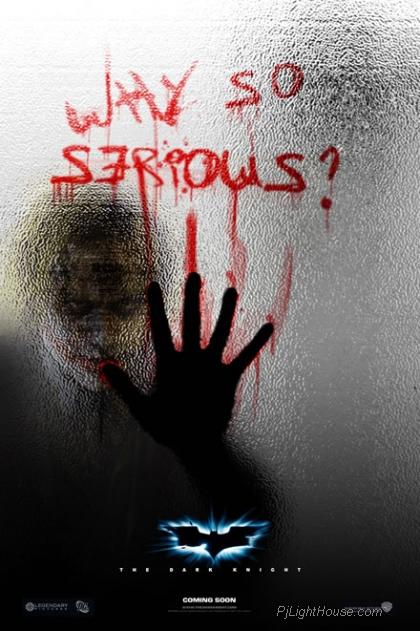
To once again prove that I’m pathetically behind on what’s going on in the world of pop culture: I’ve only now got around to seeing The Dark Knight. At this point, is anyone interested in yet one more glowing yet sad praise of Heath Ledger’s Joker? Yes, Ledger’s performance was hypnotic and is one of the main reasons why this film is rightly hailed as more than your run-of-the-mill comic book adaptation. But that’s all I’ll say on the issue, because you don’t come here to read an elaborate “Me too” blog entry.
The Dark Knight is a good film and better than Batman Begins – the latter was clearly an origins story and therefore somewhat stuck in its template (although doing very well in this respect), but its sequel definitely does much better in terms of providing an interesting, worthwhile antagonist. It does so well, in fact, that Batman/Bruce Wayne suffers by comparison: the film is just so much more interesting when the Joker is on screen. Still, you couldn’t have the one without the other, and the moral dilemmas that Gotham’s favourite anarcho-terrorist poses the Dark Flabberghast are fascinating to watch. The ferries scene, even though it resolves itself without Batman’s input is a vast improvement on the simplistic scenes in the Spiderman films where the general populace pulls together and proves to be heroic in their own right.
It’s not a perfect film, though, not even in it’s genre. There are some mistakes it should have avoided quite easily. For one thing, some of the editing is seriously disorienting and not in a good way – there are scenes that feel like a bad TV edit to get rid of scenes that are too violent, and as a result continuity suffers. Were they trying to keep the film in PG-13 country? (If so, the studio is eminently silly – even without explicit violence this is not a film that you should let your 13-year olds watch.) I don’t mind the disorienting editing of the fight scenes, but there the lack of clarity has a purpose. The continuity wobbles get especially bad in the batpod scene where I felt that they’d buggered up the sequence of scenes.
The film also tries to cram too much into its running time, and where it tries too hard to make us believe something. I’m not complaining about the two villains, because Harvey Dent’s fall from grace follows smoothly from the Joker plot. However, the scene where Bruce Wayne and Alfred get the fingerprint from the bullet? Overly complicated, to a point where it barely makes sense. Same goes for the bat sonar and the ethical quandary that comes with it: not only does it feel overly gimmicky in the film, it’s also much less interesting and complex than the Joker-induced “damned if you do, damned if you don’t”. It feels like a top-heavy retro-active explanation for how Batman manages to find the Joker later in the film, and surely it could have been done in a more elegant way.
These quibbles aside, though, the film is definitely worth watching. It’s worth it for the visuals, it’s worth it for the acting, and it’s worth it to see to which dark corners Nolan will take its hero. If there’s a third film, I’ll be happy to follow him there.
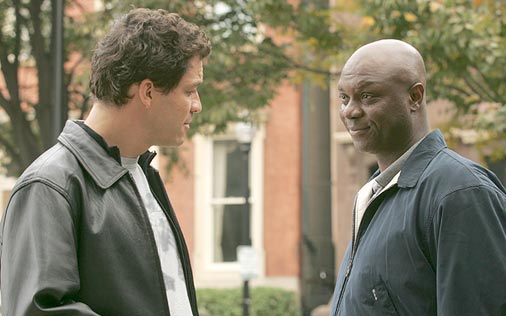
You have to admire Stringer Bell’s attempts to de-thuggify the Baltimore drug trade. His endeavours to get his business away from the drive-by shootings and everyday violence is one thing; his sweet, endearing (not words easily used when it comes to The Wire, except for everyone’s favourite addict Bubbles) meeting rules are something else altogether. It wouldn’t feel more strange to have these dealers and “soldiers” in the drug war speaking in Jane Austenese.
Season 3 of The Wire once more is among the best TV there is. It’s smart, impeccably crafted and unexpectedly funny. (A shout-out has to go to “My dawg…”.) I’m also finding it less affecting than the second season, though. Is it that the stevedores represented by Frank Sobotka had more pathos? Frank’s final episode nearly had me in tears. Or is it that I, in spite of my impeccable bleeding heart credentials, can relate better to pudgy, corrupt white guys with receding hairlines than to black hoppers slinging red tops and getting hot and bothered about semi-automatics.
There’s more than enough here to get to the viewer, though: Cutty’s attempts to get back into the game after 17 years in prison, or Bunny Colvin’s subversive social experiment born out of a frustration with the shambles and hypocrisy of the war on drugs and a wish to do something, however radical, that might actually break the stalemate and help.
And on that happy note I’d like to thank Amazon for its special offers. (No, I don’t get paid for this. I should, though!) Thanks to them, seasons 4 and 5 of The Wire are on the way and I don’t even feel too guilty about spending the money. I’m slowly running out of interesting HBO series, though… so in one, two years’ time I’ll either be reduced to Sex and the City – or it’s back to Six Feet Under. In which case I might as well rename this blog “Fisher & Sons”.
As usually, I was late to the party. Everyone ranted and raved about Children of Men when it came out, so I got the DVD almost immediately when it came out. And then it lay around for ages, was moved from one flat to another… and last Saturday we finally thought, “The value of a DVD lies in watching it, not having it,” as Confucius said. Or Yoda. I forget which.
Now, having seen the film, I’d say that the raves were warranted… if the reviewers left the cinema roughly two thirds into the film. The first hour or so of Children of Men is the most compelling, most chillingly credible cinematic dystopia I’ve ever seen. It is also one of the most breathtakingly well shot films – just how on earth did they shoot some of those long takes?
For a long time, Children of Men succeeds in making a horrific vision of the future all too credible by taking our present-day world and extrapolating. None of the over-the-top gadgetry of other near-future films. (While I’m embarrassingly fond of Strange Days, that millennial melodrama does look extremely dated. That film was right, however, in assuming that whatever entertainment technology will be the next best thing, it’ll largely be used do commodify violence and porn. Now let me go back to play GTA 4.)*
I also like that the film doesn’t provide lots of explanations and exposition. It throws its viewers into a world where the youngest child is 18 years old, where people have become almost indifferent to small-scale terrorist bombings but can’t stop crying over the killing of a Brazilian teen just because he happens to have been the last baby born. Where “Rah, rah, we are the best!” chauvinism has become the norm. And every one of these developments has its roots in our present day. Eighteen years of a slow, ongoing apocalypse will do that to you, I guess. But none of this is dwelled on. While watching the first hour of the film I never felt like the film was trying to tell me something in six-foot high, bolded letters.
But then the film becomes more heavy-handed. We get images that are clearly inspired by Abu Ghraib. We get grimy ethnic refugees in wartorn Bexhill. And to me at least, it all looks less like an extrapolation of our current world and more like editorial comments on current conflicts. Yes, the beginning of the film also commented on our present-day world, but it did so much more subtly, in the background. There’s a richness to the scene-setting that is more convincing and more complex than the in-your-face correspondences of the last 30, 40 minutes.
It doesn’t help that while the first hour of the film focuses on dialogues and characterisation, it ends on what is mostly running and shooting. At least the main character doesn’t become an action film hero (there’s a gorgeously funny escape roughly at the half-way point which plays refreshingly different from what you’d get in a Hollywood action film), but still, there are only so many variations on the theme of running away and being shot at .
Sadly I’d heard so much about the key scene where the guns fall silent at the sound of a baby crying, so when it came it didn’t strike me the way it struck many viewers. The Bexhill transition had taken me out of the film so much that the scenes of awe-struck ‘fugees staring in almost religious rapture at the first baby in 18 years, with the occasional poor sod in the background being shot while gawping, struck me as almost Monty Pythonesque – “Oh look, bab-eurgh!” “Look at its widdle fing-blam!” Or perhaps I just had a phase last Saturday of being a callous bastard… or perhaps it was that I didn’t quite buy the Uncanny Valley CGI Baby. Earlier scenes – the amazing sequence in the car, or Michael Caine’s final moments – got to me much more.
(Yes, I am evil.)
In some ways I think I’d reacted better to the film if I’d known less about it – but even then, I would have felt disappointed by the abrupt shift in tone. The moment that Peter Mullan’s cartoon character Syd turns up is the moment that the film sharply turns into something different, and much less compelling, than before. I came away feeling that I’d seen the beginning of a masterpiece and the end of an okay dystopia. I just wish I’d been able to finish watching that masterpiece before someone spliced a decidedly inferior film, though one strangely starring the same actors playing the same characters, into the reel.
*Actually, I haven’t got the equipment to play GTA 4, so I’m stuck with lower-tech virtual snuff. Poor widdle me.
Avid readers of this blog may have noticed that I’m fairly keen on Messrs. Vaughn and Whedon’s work in comics… so when Joss Whedon was set to write the next series of Runaways, I was excited. Both writers have similar strengths; their writing is witty, they create ensemble casts of characters that gel extremely well, and they tell a good story while providing more than enough ambiguity to keep things interesting beyond the plot.
I recently re-read Vaughn’s original three Runaways volumes and apart from a couple of minor issues (such as the slightly inconsistent quality of the artwork – there’s some gorgeous work there, but some panels and some of the inking feel rushed) I greatly enjoyed it. Coming away from Whedon’s run with the kids, however, has left me somewhat disappointed. When he’s at his best, Whedon is a fantastic storyteller, getting you involved way more than I would have expected from stories about teen vampire slayers or space cowboys. He’s not infallible, though; his first Serenity comic, while not abysmal, was in no way as memorable as the TVseries, for instance.
And now, Dead End Kids: my first and main thought throughout was, “I wonder what Brian K. Vaughn would have made out of the material.” Again, Whedon’s writing isn’t bad, but there’s little of the sense of surprise or freshness that Vaughn’s stories had. The kids feel ever so slightly less real and more like comic book teens. (And don’t think you can worm your way into my heart by introducing a new regular character that comes from where I live, insiduous comic!) The art is absolutely fine, but it lacks the quirk of Alphona’s best panels. And the time travel gimmick, while fun, also comes across as a tad overused. In that respect, the story feels a bit as if Joss Whedon had written an episode of Star Trek.
Nevertheless, there are moments when Whedon’s talent shows. Even if the time travel plot is a tad overdone, its denouement is more poignant than I would have expected. There are some interesting hints at the direction in which especially one character might develop, with a daringly cruel punishment for two of the story’s villains. And there’s a couple of pages ending in the death of a minor (or should I say “small”?) character that had me giggle and go “Yewwww!” at the same time.
Was it worth getting the comic? Yes. Was it as good as the other volumes? That’s a definite no. In any case, I’m very much looking forward to Vaughn’s use of Whedon’s characters now. If I’m lucky, the first two volumes of Buffy: Season Eight (the comic-book continuation of a certain barely known TV series that Whedon supposedly had a hand in) should arrive this week, and if memory serves Vaughn has penned a Faith storyline. Should be fun to see how that one’s turned out.
On a very different note: we completed The Wire season 2. ***Warning: some spoilers to follow.*** Apparently there are people that didn’t like the second season too much, mainly because they wanted more Avon Barksdale, Stringer Bell and everyone’s favourite junkie Bubbles and fewer paunchy white guys with bald spots and union shenanigans. Okay, I could have done with more Bubbles too (who couldn’t?), but season 1, while tighter, didn’t have the tragedy of Frank Sobotka. The ending of episode 11, “Bad Dreams”, builds up to one of the saddest fade-outs I can remember. In a way, the reveal at the beginning of the twelfth and final episode of the season isn’t half as sad as seeing Frank walk towards his fate. Even Ziggy, one of the major fuckheads of television history, becomes a tragic character when you see the larger context of what is going on. Yet for all the sadness that permeates the season ending, the series never loses the anger and sense of humour that make it bearable. At least in the first two seasons – I may very well be setting myself up for a broken heart in any of the three remaining seasons.