… do as the Belgians do

After I killed him, I dropped the gun in the Thames, washed the residue off me hands in the bathroom of a Burger King, and walked home to await instructions. Shortly thereafter the instructions came through – “Get the fuck out of London, you dumb fucks. Get to Bruges.” I didn’t even know where Bruges fucking was.

Pause.

It’s in Belgium.

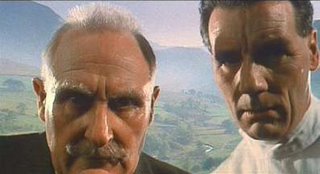
Martin McDonagh’s In Bruges is an effective, strangely affecting black comedy. It’s by no means a great movie, but what it does it does tremendously well. Many of the reviews compare it to Tarantino’s films and to the modern Brit gangster flicks such as Lock, Stock and Two Smoking Barrels, but both of these comparisons miss the persuasive streak of sadness that runs through the film.

Clearly there are elements of Tarantino’s Pulp Fiction, but these similarities only go skin deep. (Two humanised hitmen spouting funny, quotable lines.) A more apt comparison would be Harold Pinter’s The Dumb Waiter, both in its absurdity and in the way its characters are acutely aware of their guilt yet unable to verbalise their feelings. Both Pinter’s early play and McDonagh’s film work as comedy, yet it wouldn’t be fair to either to dismiss them as just that.
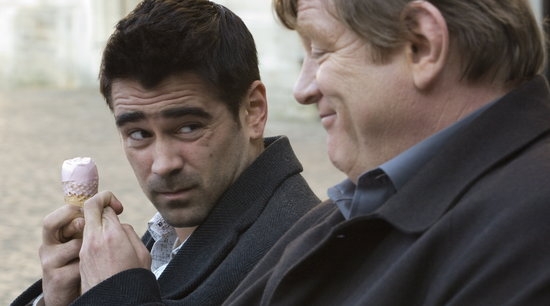
A lot of the sadness that permeates (yes, I’m using that pretentious word – deal with it) the film, clearly helped by the medieval morbidity of Bruges and Carter Burwell’s simple yet effective score, comes from Brendan Gleeson. However, while Gleeson’s performance is spot on, it isn’t that different from many of his earlier dubious yet loveable characters (his best to date, as far as I can tell at least, would probably be Martin Cahill in John Boorman’s The General). For me, the true standout performance, surprisingly, was Colin Farrell, both funnier and more touching than I’ve ever seen him. (Disconcertingly, Farrell’s second best performance was in a Joel Schumacher film, Tigerland. How’s that for scary?)

In Bruges falters towards the end, with a finale that ramps up the absurdity at the price of its earlier moodiness, but the film remains a small gem composed of moments of unexpected beauty. And how often do you get the chance to see Ralph Fiennes play the Ben Kingsley part from Sexy Beast?

Coming up next (hopefully sooner than this update): Is it possible that the Goofy Beast was slightly disappointed with a Joss Whedon-penned comic? (No, not Buffy.)

Damaged goods

Damages sounded so good. It’d had great reviews in the States. It had an interesting cast. It had won all these nominations and awards.

And it was one of the most disappointing series I’ve seen in a long time.

What confuses me is that so many critics and viewers seem to bend over backwards to praise this series. “Riveting”? “Simply extraordinary”? Sure, these are just soundbites, but the longer reviews and especially the nominations (Emmys: Best Dramatic Series)… I just don’t get them.

To begin with, there simply isn’t enough material for a full season. Had this been a six-episode miniseries, it may have been riveting, but as it was in progressed in fits and starts in between long periods of not going anywhere. I wouldn’t mind if the downtime had been used to develop the characters, but with most of them what you know at the end of episode 1 is pretty much what you know by the end of the season. The only difference is one of degree: we’re quickly aware that Patty Hewes (played competently by Glenn Close) is willing to have animals killed to get what she wants, so there simply isn’t that much of a surprise in learning that she’s willing to have people killed. The only characters that truly seem to develop are Ellie (although with her it takes until the last two to three episodes) and the defense attorney Ray Fiske, both of whom have actual character arcs.

The other thing, which is closely related is this: if a series over-relies on twists and turns they pretty much lose all their effectiveness. This happens fairly quickly in Damages; every so often, you’re asked to re-examine a character or a scene and ask yourself, “So, did this really happen as I believe it did?” Which is all fine and dandy, but the problem is that we quickly learn not to trust anything, and at that point I stop being involved. I don’t invest in the characters or in what I’ve seen because chances are things’ll be different one or two episodes down the line. And at that point, nothing that happens in the series matters. Why be surprised at a character turning out to be evil when you knew that you’d be naive to believe that character to be good? If everything twists and turns, everything becomes arbitrary.

Last but definitely not least: very few of the characters were interesting to begin with. Even a static character can be fun to watch, but almost everyone in the series felt generic. There simply wasn’t enough to Glenn Close’s Lady Macbeth-a-like Patty Hewes to make her different from similar manipulative characters. Same goes for Ted Danson’s Arthur Frobisher, one of the main bad guys in the series (although I found his uncanny, involuntary Christopher Walken impersonation at the beginning quite fascinating for an hour or so).

While I’m usually a fan of unconventional chronology in stories, it didn’t help or change much in Damages: it had the effect of making audiences wonder, “Okay, how do we get from point A to point B?” But sadly, the answer to that always seemed to be the same: Patty does something manipulative and underhand. Frobisher’s people do something manipulative and underhand. Ellie falls for it. Rinse and repeat.

So, since I don’t want to go on much longer about why I didn’t like (or didn’t get) Damages, I’ll just ask: is there anyone reading this who can tell me why I missed the point and that the series is actually clever/subversive/exciting in ways that I’ve failed to see? Because I do find it somewhat disconcerting that my opinion on Damages is shared by very few people out there, it seems.

Who watches the Watchmen? – We do, we do!

Okay, 95% of the people reading this will already know, and the other 5% are probably not interested – but for the remaining 0% (yes, that means you!), here’s the Watchmen trailer that came out recently:

Now, part of me looks at this trailer and thinks, “Wow… that is almost picture perfect!” Another part thinks that the last thing Watchmen is about are pretty pictures. This is a trailer, yes, which has one purpose: to get people excited and put asses in seats. But Zack Snyder strikes me as a director enamoured with glossy, stylised images – and that sort of thing tends to detract from the humanity of the characters. And one of the major points of Watchmen is that the superheroes in it (excepting Dr Manhattan, although that would make for a longer discussion) are utterly human. And the book is about ideas, not about wowing the audience with cool visuals.

Having said that, I like much of the casting. I like that Snyder didn’t go for the superstars (although I do think that Adrian Veidt could easily have been played by a good-looking star, since he is pretty much one of the biggest celebrities in the world he inhabits). I like the visual metaphor of the clockwork in the trailer. And I find the CGI representation of Doc Manhattan strangely affecting, especially in that shot where you’ve got three of them.

What worries me, though, is what I’ve heard about the ending. If it’s true… well, there’s one way of pretty much ruining Watchmen, and that’s by screwing with one or two elements of the ending. I just hope that they will be able to resist killing the ‘bad guy’.

Oh, and one last thing…

Heh...
Heh...

Hellboy is the new Miami Vice

Thanks to Hellboy II (or so I would imagine), I’ve been getting lots of hits in spite of a lack of regular updates. Messrs Mignola, Del Toro and Perlman, thank you very much! The film does look quite gorgeous, as do most of Del Toro’s films – obviously they give the Latin American version of Peter Jackson full reign, and his wild imagination thanked them accordingly.

But that’s not what I wanted to blog about. Instead, I’ve come to praise Yorick Brown, not to bury him.

Remember what I wrote a couple of days ago about Joss Whedon’s Astonishing X-Men? Well, Joss is not the only sadistic bastard out there writing comics. Enter Mr Brian K Vaughan, who recently finished his long tale of a man, his helper monkey and a world full of women.

While I enjoyed all ten volumes of Y: The Last Man (the final volume just came out), the series isn’t perfect. There are moments when Vaughan missteps. The plot could do with some tightening. And the hook and setup are so breathtakingly big that it’s almost impossible for the ending to satisfy fully.

Warning: Here be spoilers!

The story strand that perhaps worked least for me was Alter’s trajectory. She’s intriguing to begin with, but Vaughan didn’t seem to know where to take her. She ends up as someone who cannot cope and, as an alternative to suicide, tries to get someone else to pull the trigger by being an all-round homicidal bitch. We’ve had similar motifs with Hero, with 355 (although more subtly, perhaps) and even with Yorick. It doesn’t help that there are entire issues that seem to forget completely about her.

Regardless of that, though, issues 58-60 are heartbreaking. 355’s death (apart from a flashback to Yorick’s intervention in an earlier volume (Safeword) that didn’t work as well as it should have) is done beautifully and practically wordlessly, to devastating effect. Pia Guerra’s simple yet effective art is at its best in the facial expressions: 355’s final look at Yorick, his silent exchange with Alter, and his face as he looks up at Hero, unable even to begin to express what has happened.

Issue 60 is a tricky one: with its “60 years later” conceit, it could easily have fallen flat. And there is something alienating about seeing a world where most of the familiar characters are absent and Yorick appears to be an old, white-haired loon in a straightjacket. My first reaction to the final issue was one of feeling at a distance from the guy we’d just accompanied for several years through a post-gendercidal world, where before he’d always been the ideal screen for all us white, somewhat nerdy male Lit majors to project ourselves onto. But with every flashback filling in glimpses of what happens during the 60 years in between the last two issues, Vaughan hooked me more and more.

At first I would have said that the best, worst moment of the issue is Ampersand’s death, euthanised by an old Yorick wanting to spare his friend the pain. It’s a simple, touching farewell to a character who, with his Eeps and Cheeps has become as much of a person as any of the human characters. This was topped, though, by the silent, moving last three pages, as our escape artist Yorick gets out of his last fix. Vaughan and Guerra handle it perfectly, giving us and the characters just the right note to end on.

So, on that note: Thank you, Brian K Vaughan. Thank you, Pia Guerra. Thank you, Yorick, 355, Dr Mann, Beth, other Beth, Natalya and, of course, Ampersand. It’s been a terrific journey.

And if you break my heart again, Mr Vaughan, I will do real damage to you with the Absolute Sandman vol. 3.

Mais le chat, elle ne reviendra jamais…

I don’t particularly like superhero comics.

I treasure my copies of Batman: The Killing Joke, Watchmen, Top Ten, Promethea (notice something?), Arkham Asylum, Superman: Red Son.

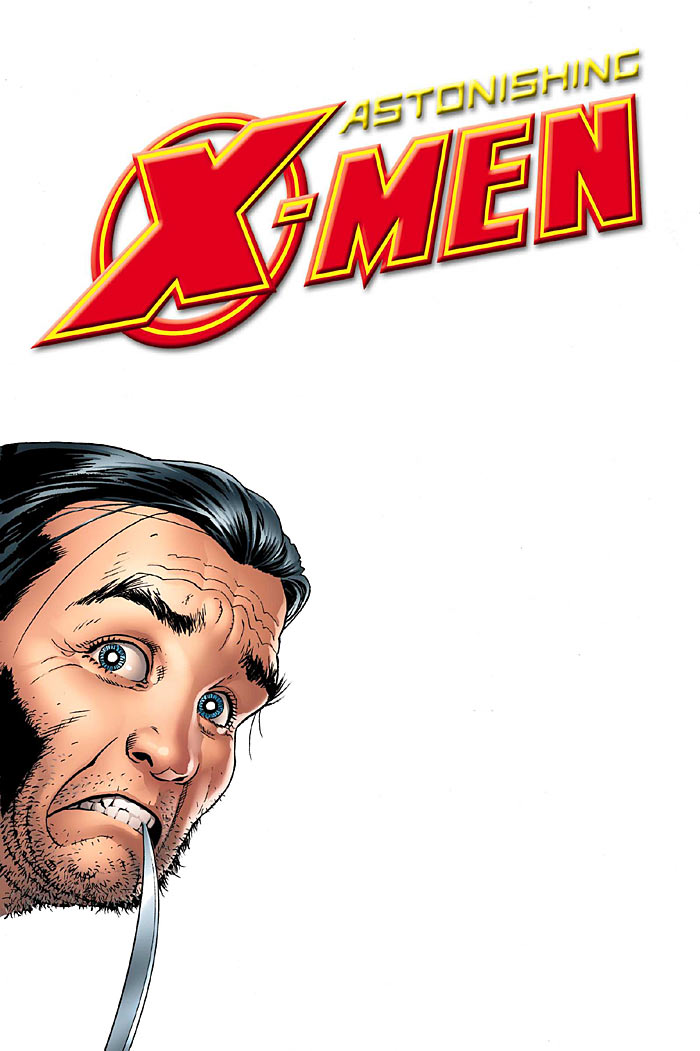
And now the complete Joss Whedon run of Astonishing X-Men.

Contradiction? No. What I like is that those books and those writers do something interesting, memorable, sometimes subversive and often just plain cool with the superhero template.

While I’ll always consider Watchmen one of the masterpieces of comics (and, if pressed on the matter, literature altogether), I’ve got a special soft spot for Whedon’s X-Men. Moore is a fantastic writer but he’s mainly an ideas man. Almost no one beats my man Whedon (check out this male white nerd and his command of embarrassing language!) at characters. Firefly and Buffy wouldn’t be a tenth as good if you didn’t want to spend time with the characters. Whedon is adept at making you fall in love with the characters…

… and then breaking your heart.

I’m over what he did to Wash. No, really, I am. I know why he did it and I appreciate it. I want fictional characters to generate feelings in me, and I’m the kind of morbid git who takes the death of a character as final proof of these feelings. Thing is, unless I can believe that a character may die, I will not develop any deep feelings towards that character because, well, they’re not real. In a way, what makes characters real for me (apart from good writing and acting, of course) is that they have a life, and that life may end. If I know that a character can’t and won’t die (because the writers, producers or fans won’t allow it), then they’re no more real to me than my avatar in a computer game, with an unlimited supply of credits.

The flipside of that is, of course, that it allows writers like Joss Whedon, again and again, to break my heart. And, morbid Whedon-bitch that I am, I like the way it hurts.

But if I ever meet him in real life, I’ll have to kick the man’s shin until it drops off.

P.S.: I don’t care whether you’re into superhero comics or not. If you’ve liked any of Joss Whedon’s writing, if you enjoyed Firefly (in spite of not being a sci-fi fan), if you got into Buffy (in spite of the bad make up and silly special effects and, worse, the whole high school vibe) – read Astonishing X-Men. For some silly reason, I started with vol. 2, definitely the weakest of the run, yet I was still hooked on his character writing.

P.P.S.: Another thing that Whedon does very well is sexual attraction. And there’s some of that in Astonishing X-Men, in the last place where you might expect it. Hee.

P.P.P.S.: Yes, today’s blog entry has a title à clef. I’m allowed to be pretentious every now and then.

Late to the game, as usual

So, I hear there’s this new Indiana Jones film on. What’s that? It’s been out for a month or so? Aw shucks…

I’m probably exactly the right age for the Indy movies. I saw Indiana Jones and the Last Crusade at the cinema when I was 14, and I got Raiders of the Lost Ark on video later that same year. As a teenager I enjoyed the hell out of these films – except for Temple of Doom, which I already didn’t particularly like at the time. It’s got fantastic set pieces but doesn’t hold together very well as a film. (And it’s the one Indiana Jones movie, in my opinion, where the stereotypical natives do become offensive and racist… but that’s not my beef here.)

My favourite one of the films was always Raiders. It had a magic, a rawness and an energy that the others don’t match. Last Crusade is the funnier film, but it comes dangerously close to self-parody – added to which, well, it’s pretty much a rip-off of Raiders. So many of the scenes made me think, “Yeah, cool, but haven’t I seen this one already?” You get the same type of intro sequence, followed by scenes at Barnett College, followed by the story proper. You’ve got rats instead of snakes. You’ve got the wrath of God visited on those undeserving. And all of it tries just a bit too hard to be funny.

Last Crusade fares worst when it comes to the side characters that were introduced in Raiders. Both Sallah and Marcus Brody are turned into jokes – and they aren’t particularly good jokes. If it wasn’t for the interplay between Indy and his father, Last Crusade wouldn’t be much better than, say, The Mummy or any other Indiana Jones rip-offs.

Now, finally, Spielberg, Lucas and Ford got their act together and made a fourth film. Lots of fans hated it. Correction: lots of fans hated it on the internet. There’s something about Web 2.0 that brings out the extremist in fanboys and nerds. Something can’t be pretty good or sort of bad – it’s all either perfect, worthy of geekgasms, or utter shite of the “George Lucas raped my childhood!” ilk.

Crystal Skull is neither. It’s the third best Indiana Jones film. It’s enjoyable but forgettable. And it makes a couple of very unfortunate mistakes:

  • There’s little to no motivation for Indy. He’s only reacting to what’s happening. For a hero, he’s pretty damn passive. Compare that with Raiders, where something is actually at stake for him. Here the baddies have ten times more of a motivation to do what they do. Indy’s just along for the ride, really.
  • What happened to the guy who got shot, who bled, who looked worse for wear after his big scenes? Indy’s always survived things that no real human being would survive – but he was never indestructible. Here, one of the first things we see the man do is survive an atomic blast. Yes, it’s funny. Yes, it’s one hell of a cool image. But if a hero isn’t touched by a nuclear explosion, well, are we supposed to be thrilled when he’s being chased by bumbling Russian soldiers?
  • David Koepp, the script writer, didn’t really know what to do with his characters. Many of them are utterly unnecessary for the plot and take time away from one another. Was Mac necessary? Not really. The Russians could have done what they did without him. Oxley? He was basically a talking version of Last Crusade‘s Grail diary. Even Marion, although she had some nice scenes, was basically wasted, as was Mutt. There was no urgent reason why any of these characters were in the film – and if you’re making what should be a rollercoaster ride of a film, superfluous characters slow you down.
  • I don’t have any problems with aliens instead of religious artefacts – if they’re intriguing. The Ark of the Covenant had mystery, it felt positively alive. (It was also helped by John Williams’ wonderful score, which I’ll talk about in the next bullet.) The Grail was already much less interesting, but Last Crusade didn’t focus on it: it focused on Indy and his father. The crystal skull? It’s a pretty uninteresting gizmo. It doesn’t have much character. And the ending pretty much lacked awe… which the Ark had in spades.
  • I don’t remember a single one of the new tunes Williams penned for Crystal Skull. All three former Indiana Jones movies had memorable tracks, and the Raiders March is one of the most iconic pieces of film music there is. I can’t remember the last time Williams wrote music that didn’t feel like B-sides. The man wrote some of the most memorable film scores – but from what he’s been producing in the last, say, ten years, he should finally retire.
  • The villains… Raiders had its iconic Nazis, and it had Belloq, to date still by far the best adversary Indy ever had – because he wasn’t actually that different from the man. Belloq had a great introduction, his interactions with Indy were well written and acted, and he actually had charisma. Cate Blanchett tries hard, but the script doesn’t know what to do with her. Is she evil? Driven? Obsessed? Is she actually a tragic figure? I don’t mind ambivalent characters, but I mind scripts that seem to have an attention span of five minutes. Koepp didn’t really seem to have much of a concept of any of the characters… which is probably why the film feels mostly like a string of episodes, none of which are really terribly compelling. And what’s Indy without a good adversary?
  • And what’s with the horrible over-exposed wedding at the end? It looked like Heaven in Always! Walk into the light, Indy…

Anyway, the film’s had enough of a critical pummeling. All in all, it was entertaining enough, but not much more so than a competent Indiana Jones knock-off. And somehow mediocrity is almost worse than an out-right bad Indy movie. I just hope that Lucas and Spielberg won’t try to keep flogging this almost-dead horse. At some point it becomes terribly, terribly undignified.

And talking of undignified: have fun with this! 

Fruit flies like a banana

It’s been… way too long. Ages. What’s my excuse? Work. Too much of it.

Yes, I know – it’s a feeble excuse, but it’s the only one I’ve got. Sorry.

However, you’ve all been on my mind… or rather, the blog has. Every one or two days I’d think, “Hmm… I should write about this.” And then nothing would come of it. Okay, admittedly, it’s not as if I was at work 24/7 – but the combination of lots of things to organise (after all, I had to bring five young climate activists to the inaugural meeting of Kofi Annan’s new organisation – no pressure!) with lack of sleep doesn’t exactly make for diligent blogging. In any case, I am deeply sorry about being so silent for the longest time.

So, what sort of things did I feel like blogging about?

  • The EURO 08 and the woes of having high-definition digital television and the only things on are football and tennis. (You can count the grains of sand!)
  • The latest Hellboy collection, which I enjoyed quite a bit. And the Hellboy 2 trailers – Guilhermy goodness!
  • House of Leaves – postmodern horror or horrifically postmodern?
  • I, Robot – there are some films that aren’t even worthwhile when you can watch them for free…
  • Team Fortress 2 – but then, everyone’s already blogged about TF2, so I’d only out myself as perennially late.

In any case, I’ll leave you with an impression of the latter. Great fun if you need to blow off some steam. (For gamer nerds: no, that pun wasn’t intended.) Never before has carnage been such family-friendly fun!

My HDTV runneth over

Today I finally became the proud owner of a digital TV set-top box. I haven’t really checked it out that much yet, but it finally allowed me to see the Future of TV. More pixels. Full HD. And lots of other terms that basically boil down to “Let’s let the boys play a bit, shall we?”

So far I’ve checked out three of the HD offerings: HD Suisse, BBC HD and lastminute.tv. The latter was basically a glorified travel ad for last-minute trips, BBC was showing some nature documentary and HD Suisse was broadcasting a classical concert. Not exactly the most exciting programming imaginable. But I was sitting there going, “Wow, look at that image, you can read every semiquaver on that violinist’s sheet music, and even his notes, and check out that Capuchin monkey. see how every single hair on its head is visible? And that cheap, computer-generated price tag for the hotel, you can hardly make out any aliasing on it! This is what TV is all about!” (Okay, that last one is even more wildly exaggerated than the other examples.)


If they actually showed Lost or Battlestar Galactica in Full HD, chances are my brain would implode and I’d end up a drooling imbecile. Right now I don’t drool yet.

And my girlfriend’s reaction? “Cool, they’re showing Doctors on BBC!”

Talking about the future of this and pixelly goodness that, the latest entry in the AV Club‘s “My Year of Flops Case File” is a highly enjoyable panning of Speed Racer, latest proof that the Wachowski siblings’ worst movie may not have been a Matrix sequel. Share and enjoy!

Where hearts were entertaining June

“I think we lost him.” That is still one of the most chilling final lines of any movie I’ve seen. (Another very effective last line, and one of my favourite, would be: “Ernest Hemingway once said, ‘The World is a fine place and worth fighting for.’ I agree with the second part.”) And whatever else you may think about the film, Terry Gilliam’s Brazil has one of the most effective endings in film history.

On the whole, I like films the way I like my sharks: single-minded. (Okay, that wasn’t exactly the most successful simile this side of Metaphysical Poetry.) Films that are trim, lean, effective. I also like the sprawling epos, but if a film is messy – if it’s jam-packed with ideas and images that in the end don’t really lead anywhere – I tend to lose patience.

Brazil is a big mess of a film. Terry Gilliam isn’t exactly a disciplined film-maker, and Brazil is one of his least disciplined movies. There are dozens of scenes, incidents and characters that seem to be in the film because it seemed a good idea at the time. It’s garish, cartoony and unfocused – very much like its central character, really. Nevertheless, for me it’s the best, most affecting dystopia on celluloid.

Part of this is Gilliam’s success at using a handful of characters and actors to anchor the film in some sort of emotional reality. Yes, so many of the characters remain flat cartoons that are there for a joke or to make a point (which usually kills a film’s credibility for me), but then you’ve got Mrs. Tuttle’s anguished “What have you done with his body?” or Michael Palin’s greatest creation, Jack Lint… or Sam Lowry, Jonathan Pryce’s funniest, saddest part ever. The forlornly happy look on his face at the very end, after he’s “escaped”, still breaks my heart. And the interrogation scenes are still both funny and frightening (although I could do without the “pinball prisoner” scene).

Would the film be better if it was more focused, if Gilliam had been less sprawling, running off in several different directions at once? It’s impossible to say – a streamlined, single-minded Brazil would be an entirely different movie. Sufficient to say, though, that Brazil remains my favourite Gilliam film, even after a dozen viewings. And its happy ending is the saddest ever filmed.

Just make sure not to watch the “Love Conquers All” edit, unless you have an unhealthy fascination with watching road accidents as they’re happening – or if you can dissociate yourself enough from what you’re watching to observe, clinically, how a different edit can change a film into a grotesque mockery of itself.

Oh, and while we’re at it: one of the most fascinating (Un-)Making Of documentaries must be Lost in La Mancha, which documents the disastrous production history of Gilliam’s take on Don Quixote. If you ever want to see a mad ex-Python as unwitting King Lear, or if you have any interest in how films come about, check it out.

Whys and wherefores: hot monkey love for Brian K. Vaughan

I’ve been re-reading Brian K. Vaughan’s Y: The Last Man over the last week or two, in preparation for the last volume to come out. (It shouldn’t be much longer than another month or so.) In the last few years, Vaughan has become one of my favourite comic writers. He’s no Alan Moore and he’s no Neil Gaiman (then again, these days Gaiman himself is no Neil Gaiman, it would seem), but his appeal is entirely different from those. In style, and in quality, he’s much closer to Joss Whedon – Vaughan knows how to tell a good story with wit and people it with characters you care about.

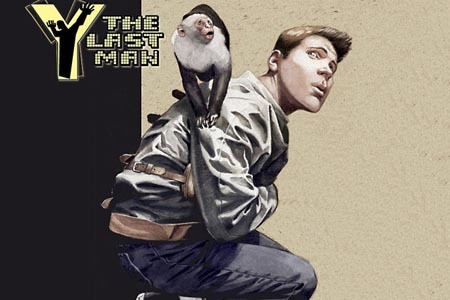
Like most of the Vaughan comics I’ve read, Y: The Last Man is a great example of high concept: the story’s premise is that every male mammal on Earth dies under mysterious circumstances, except for one Yorick Brown, ex-literature major and hobby escape artist, and his monkey Ampersand. However, it isn’t the premise that makes this a fun, exciting, witty ride. The world of Y takes a sketchy starting point and fills it with credible detail. (Well, mostly – I’m still not sure I buy the S/M intervention staged for Yorick in volume 4…) And, just like Whedon at his best, it’s just great fun to listen to his characters. This is one of the comics where much of the action is in the talking – but when there is action, it means something more than the nth installment of Super Guy vs. Evil Dude.

There\'s a monkey on your back, dude...

There’s perhaps one thing that I dislike a bit about Y, and it’s no coincidence perhaps that Vaughan also writes for the TV series Lost: at times the narrative meanders, goes zig zag. Most detours are fun enough to follow, but like Lost this is a series that at least pretends to have a plan, and just like Lost this pretense isn’t always very convincing. Without a plan, it feels like the story is arbitrary, which weakens the central mysteries and unanswered questions, such as, “What killed all the dudes?”, arguably a bigger question than “What exactly is that Smoke Monster?”. At times, if it wasn’t for the writing and characters, you’d be tempted to say, “So? Where exactly is this going?” I don’t mind some element of making it up as you go along, but arbitrariness is poison for a plot-heavy narrative.

And this might out me as the biggest closet case in history (which would come as a surprise to myself, really), but… Why is it that 90% of the women in Y are hot, slim, curvy babes? For once, we can’t blame the comic artist – Pia Guerra, the series’ co-creator and lead penciller, is very much a woman. So, for once, don’t blame us XY types!

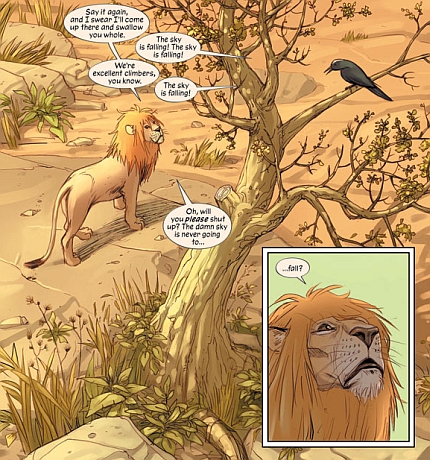
P.S.: Other Brian K. Vaughan comics that come with the Goofy Beast Seal of Approval: Runaways, Ex Machina and the one-shot Pride of Baghdad.

Pride of Baghdad