League of Extraordinary Literary Self-Indulgence, part II

While I think that From Hell and Watchmen (and, to a lesser extent, V for Vendetta – it’s rougher around the edges in terms of tone and style, and its inconsistencies can be a bit jarring) are amazing, rich and exciting works, I have a lot of fondness for some of the comics that are sometimes considered ‘minor Moore’. In many ways, the Moore titles that I’ve enjoyed most are Top 10 and League of Extraordinary Gentlemen.

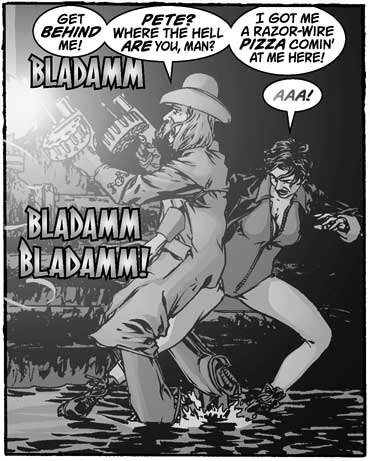
On paper, Top 10 especially didn’t sound like my cup of tea. I’m not that much into superheroes, so the idea of a whole city of superheroes didn’t exactly appeal to me. Except, of course, if everyone has superpowers, they’re no longer variations on the Nietzschean übermensch. There’s something very humane to the shlubs of Neopolis, where every Joe Shmoe wears a cape and blue-collar shapeshifters rub shoulders with telepaths heading for a boring day at the office.
Top 10

It’s the characters of Top 10, together with its Where’s Waldo? appeal (there’s riches of funny little allusions and throwaway gags on every single page, the little iMac-bot building a snowman being one of my favourites), that make the series come to life. And while much of it is ‘just good fun’ (as if that were in some way less important than deep, large volumes about serial killers and our fascination with evil), there are vignettes in there that are surprisingly touching, such as the aftermath of a teleporter accident in volume 2.

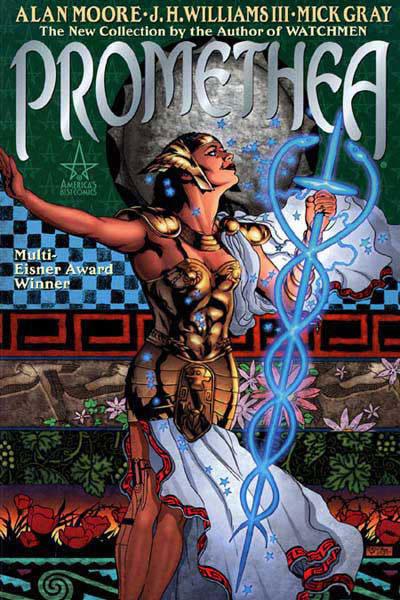
I also enjoyed Promethea, although less so. In it, Moore started to go off on his post-structuralist New Age tangent. And he started to become too infatuated with his cleverness and wealth of erudition, I sometimes feel. The effect is, at least to me, that some of Promethea reads less like a good story with fascinating themes and hidden depths (which it starts out as) and more like an educational comic on magic, tarot, religion and myth with a lot of input from Peter “Prospero’s Books” Greenaway.
Promethea

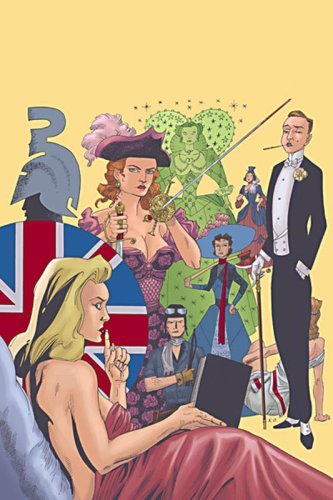
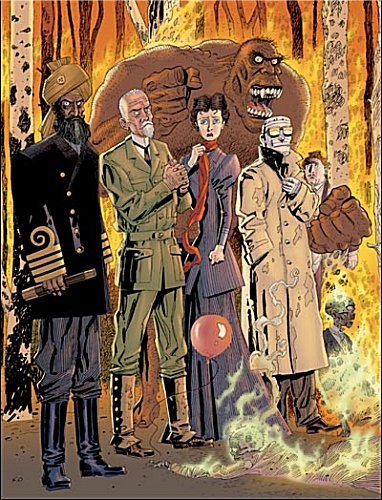
League of Extraordinary Gentlemen was more in the vein of Top 10, and accordingly I enjoyed it more than Promethea. Again, the characters made it into more than it seemed to be at first (which was a witty, exciting pastiche of Victorian ‘superheroes’ and monsters, deconstructing the cultural politics of the era) – especially the Invisible Man and Mr Hyde turned out to be quite disturbing and brilliantly ambivalent in their depiction.

More than that, though, Moore told a rollicking tale in his League books, perfectly complemented by Kevin O’Neill’s art: the mock-Victorian counterpart to the ’50s sci-fi world of Top 10. It’s ironic that the god-awful League of Extraordinary Gentlemen film is so much less cinematic and exciting than the book… In the first two volumes of the League’s adventures, Moore managed an almost perfect balance between cleverness and erudition on the one side and fun on the other.

Next: League of Extraordinary Gentlemen: Black Dossier.
’s all true!

Best thing since sliced throats

My first David Cronenberg was The Fly, and I was probably 15 or 16 when I watched it. Like so many adolescents, I was into horror movies, although I was never a big fan of gore. The Fly was probably the goriest film I’d seen at that point, and it’s still one of the movies I’ve seen that is most disturbing in its graphic depiction of horrible things happening to human (and simian) bodies.

Yet Cronenberg’s use of violence is very different from the wave of torture porn we’ve had lately, the films that try to top one another with even more grotesque displays of sadism. I wouldn’t say that his films contain gratuitous violence (a strange term, because violence that is supposed to titillate the audience is used for a very clear reason – it’s the only raison d’etre of those films), because there’s nothing cool about it. There is a meticulous fascination with the human body as physical material. There are few directors who show what damage is done to the body when it is shot, stabbed or cut to the same gut-wrenching effect.

Take the hobbit outside and shoot him in the head. Then cut off his fingers and bring me the ring.

There are 3 1/2 brutal scenes in Eastern Promises: two cut throats (one of them a pretty amateurish job, the mere thought of which makes me flinch), a fight between a naked, vulnerable Viggo and two armed Chechens that hurts to watch (and probably hurt to film – where do you hide padding if you’re stark naked?). Oh, and a corpse gets a couple of fingers cut off – but he’s dead, so that hardly counts as violence. Unless, that is, you can’t bear to watch the annual dissection of the turkey at Christmas.

Are all of these scenes necessary to get the point across? I guess that depends on what you think the point is. If Cronenberg is preaching about the brutalising effects of violence, then there’s something about the film that is paradox at best and hypocritical at worst. However, I don’t think that’s what he’s doing. For me at least, he revitalises the sheer physical horror of doing damage to a human body. Violence in films is so often anodyne or aestheticised to the point where you shrug it off. Especially gun violence seems simple: point, click, blam, dead (or maimed… or at the very least shit scared, if you miss). Take a knife to someone and try to take his life, and apart from anything else it’s bloody hard work. Or hard, bloody work. It’s not just a concept, an idea or a theory: it’s a physical, tangible reality.

And strangely, Cronenberg’s films more than those of most other directors remind me just how precious and fragile the human body can be. It’s no coincidence that one of the first images we see in the film is a newly born baby with almost translucent skin, still wet with her mother’s fluids. And later in the movie Viggo, naked and slick with his blood, is just as vulnerable and easily damaged. Forget notions of morals, of good guys and bad guys, of right and wrong: bodies weren’t built to take such punishment, and they shouldn’t. But they do. And Cronenberg – and some of his characters – are strangely, horribly fascinated with this tension.

But enough pseudo-academic blabbering. If the previous few paragraphs make little to no sense, put it down to the fact that I should be in bed. So, good night and see you tomorrow.

P.S.: Don’t worry, I’ll get back to Uncle Alan and his merry band of gentlemen and -women, extraordinary and otherwise, tomorrow.

League of Extraordinary Literary Self-Indulgence, part I

I came to comics fairly late. Of course I read the odd Asterix, Tintin and Disney comicbook when I was a kid, but I never really read those adolescent fantasies with guys in tights and big-breasted caped beauties fighting dastardly villains when not moping about their lovelives.

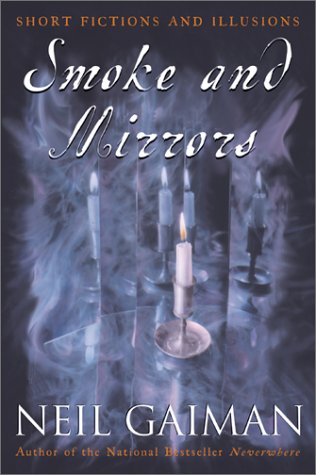
When I was 26, I went to Glasgow for a few months. Being a literature nerd, one of my favourite pastimes was to go to Waterstone’s (or, on my most nerdy days, Forbidden Planet), grab a book or five, sit down on one of the couches and read. That’s when I came across Neil Gaiman’s Sandman. I’d heard of it before, and I’d read Gaiman’s Smoke & Mirrors and Good Omens, the novel he’d written with Terry Pratchett. I’d always wanted to check out Sandman, but since I wasn’t into comics… I didn’t. Until Glasgow.

Smoke & Mirrors

And there, within the space of one or two days, I got hooked on Gaiman’s mythopoetic world. (Yes, I’ve always wanted to use the word “mythopoetic”. Now I have. Life suddenly feels empty.) And I started to think, “Hmm. Maybe there’s something about them there comics after all.”

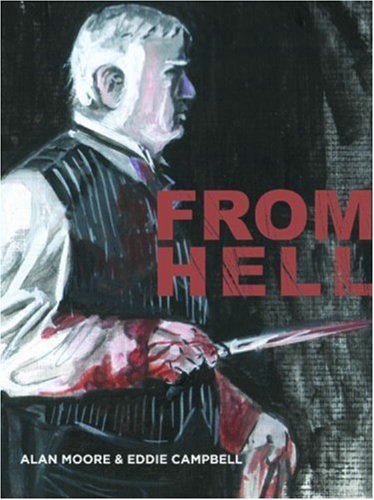
Shortly after I started looking for other comic book authors of similar renown as Gaiman. Names like Mike Mignola came up, or Daniel Clowes, or (of course) Will Eisner. But the name that came up most insistently was Alan Moore. And the titles that were mentioned were Swamp Thing, From Hell, V for Vendetta and Watchmen. So I got started on From Hell, not knowing what to expect – and got hooked. Yup, the book grabbed me pretty much like a sharp hook to my belly, pulling my insides out. But metaphorically. And in a good way.

Ahem. Anyway, after reading V for Vendetta and then Watchmen (rather unsettling, as I read it just after 9/11), I knew that Moore was my kind of writer.

From Hell

 Next: Top 10, Promethea… and the League.

P.S.: Here’s a little bonus, at no additional charge, for the Neil Gaiman fans among you:

Blue, extraordinary and oh so pulpy

Sorry, guys… Not enough sleep and no coffee make this guy uncreative. I could write something about today’s episode of Six Feet Under (“The Silence”), but then, something about its ending made me feel all blue.

Nate and Maggie

Or should I write about League of Extraordinary Gentlemen: The Black Dossier today? Well, considering that the annotations file on that one is more than 50’000 words long, I think that my review should wait until I’ve had more sleep.

The Black Dossier

So… should I write about Pulp Fiction, which I watched again yesterday, for the first time after years? Thing is, so much has already been written about Pulp Fiction, so I think I’ll just leave it at saying that the film is as fresh and as cool as it was back then (has Samuel L. Jackson ever been cooler?). And here’s a little something to keep you happy ’till the next blog entry:

If it ain’t broken…

… oh, but it is. It is. In subtle but essential ways.

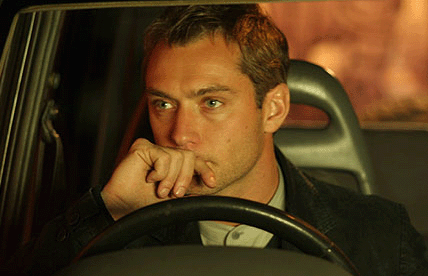
Okay, that’s probably way more cryptic than you would’ve hoped for – so let’s clarify things: Anthony Minghella’s latest, Breaking and Entering, a film that feels like it was made by Guardian readers for Guardian readers, gets some things very right. If you’re into urban decay, atmosphere, good acting, if you basically want to see a mood poem set in London, or indeed if you want to ogle Jude Law and enjoy his accent, this film is for you.

Abiding the Law

If you want a stringent story with credible character motivations and subtle writing… Meh. Not so much. It’s a shame, really, because the acting is there: I’m not usually a fan of Robin Wright Penn, but she makes her character’s pain credible, and the rest of the cast does a good, sometimes great job – but it doesn’t help that the film takes things that were already clear when they were only implied and makes them clumsily explicit. Also, one of the central two relationships seems to pop up out of nowhere in between scenes – and this, to me, almost crippled the film. (In fact, I felt like I’d fallen asleep for five minutes and had missed an important scene.)

What I really liked: the depiction of London; Martin Freeman’s character (oh so British!); Vera Farmiga’s character, miles away from her shrink in The Departed; Juliette Binoche (there are people, good friends of mine, who hate her – I’m sorry, guys, but I hope you forgive me for liking her acting a lot); the look and feel of the film. In some ways, I think I would have preferred Breaking and Entering if I’d seen it dubbed into some language I barely understand. If I could have watched the dialogues through some sound-proof window and taken in only the images and the soundtrack, I might have loved it.

P.S.: Minghella’s working on an anthology film called New York I Love You. Check out the list of directors, and give a good, hearty “What the…?”

Look at the size of those eyebrows!

It’s dangerous to go back to the things you enjoyed as a kid after decades, because chances are that you’ll want to tear out your eyes and lobotomise yourself rather than know that, boy, did you have crap taste when you were young!

Going back and watching the ’50s version of 20’000 Leagues Under the Sea isn’t nearly as bad as it could be. There’s still a lot in the film that works: many of the special effects, if not up to scratch nowadays, still have a certain realism, so that the film still looks pretty damn good. This is helped by the underwater scenes and the colour art direction which won an Academy Award. (Makes you wonder what other Academy Awards they gave back then – Best Racist Caricature in a Motion Picture? Best Gratuitous Use of a ‘Funny’ Seal Sidekick? Best Repeated Underwater Performance of Toccata & Fugue As Bach Never Wrote It?) The film’s atmosphere is still cool, and the kid in me still thinks it’d be fun to be on the Nautilus, at least if that Nemo guy stays off the organ playing for a few hours.

At the same time, I never noticed just how clunky the dialogues and much of the acting were. Not that I expect Dostoevsky from a Jules Vernes adventure movie, nor did I think, “This film could do with more Lee Strasberg-type performances…” But at times you wonder whether Richard Fleischer ever bothered  to direct his cast. I know that Peter Lorre can do better, as can Kirk Douglas… and James Mason mainly works due to his eyebrows and his snobbish British accent, which makes lines like “I am not what is called a civilized man, Professor.” quite funny – you expect him to follow this with, “Now let us have a snifter of brandy and read some Shakespeare, shall we?”

And the trained seal and that insufferable “Whale of a Tale” song are evil, I tells ya! Eeevil!

P.S.: Speaking of Captain Nemo, perhaps I should take a day or two to write a blog entry on Alan Moore’s League of Extraordinary Gentlemen: Black Dossier. Very little Nemo in that one, though… Shame.

The League, back when things were happy (in a dysfunctional way)

Coming attractions

To be honest, I’m not completely up-to-date on what will be coming to cinemas near you (and me) in 2008. Right now, I can only think of a handful of films that I know of, and even fewer that I’m actively looking forward to. Two of these I’ve already mentioned, namely The Dark Knight and No Country for Old Men.

However, the film that I may just be looking forward to most is the latest movie by Paul Anderson. Nope, not the guy who did Event Horizon or Aliens vs. Predator. The man who directed Boogie Nights (the best Scorsese film by someone other than Scorsese),  Magnolia (the best Altman movie not by Altman) and Punch Drunk Love (the best- sorry, I have no idea what to compare this film to… the best Adam Sandler film, perhaps?).

People have called Magnolia especially a self-indulgent piece of something or other, but to them I say, “Bosh! Flimshaw!” If art isn’t inherently self-indulgent, I don’t know what is. Punch Drunk Love mainly left me non-plussed, but the cast and trailer of There Will Be Blood (as well as the title, which is reminiscent of the Deadwood season 3 premiere, “Tell Your God to Ready for Blood”) definitely have me intrigued and excited.

Superheroes the world didn’t need

Elephant man! Elephant man! Does whatever an elephant can! Look out – here comes the elephant man!

Okay, I admit it… that was rather bad. Personally, I blame it on the effect of post-New Year’s Eve lack of sleep and a general tendency towards silliness when I’ve just got up. (Those who know me might say that this tendency generally lasts until I go back to bed…)

Elephant Man, together with The Straight Story, is one of the films by David Lynch that even people who don’t know Lynch and wouldn’t sit through five minutes of Lost Highway or Blue Velvet will have heard about. Regardless of this, though, the film is very much a product of Lynch’s aesthetic sensitivities. The many long takes of smoke and textured surfaces that aren’t immediately recognisable, the underlying mechanical sound effects (as if a large engine was powering the film and its world), especially the beginning and the ending. There are moments that recall his earlier works but also his later films. In this respect, Elephant Man feels more obviously like Lynch (if you know his films a bit) than The Straight Story, in which the Lynchian element is a lot more covert.

On a different note: why is it that half the hits to this website come about because people are looking for Miami Vice? Yes, I’ve posted two entries on the movie remake, but I’m surprised that a) people would find Eagles on Pogo Sticks and b)
Miami Vice would be such a popular search term. (Well, I definitely prefer folks getting here googling “miami vice” to those who find the blog googling “panty sniffing”. The latter are also more likely to be disappointed by the actual content of the blog, I think/hope…)

Marie Antoinette… She’s just zis girl, you know?

Apparently, Sophia Coppola’s Marie Antoinette was booed in Cannes. Now that I’ve seen it, I am tempted to say that French film critics are pretentious shrinking violets with an utterly neurotic attitude to their own past. It’s not a great film, and I would rank it lower than both The Virgin Suicides and Lost in Translation (both of which I liked a lot), but it’s a well made film with some good performances, and it’s definitely beautifully shot and edited. Frankly, I don’t know what les critiques Françaises are on about.

However, Marie Antoinette has one big problem: the beginning is by far the strongest, most subtle illustration of the film’s main motif – a young woman taken into a world that is foreign to her and that regards her as an alien intrusion into their rules and conventions – and almost everything that comes after is much more obvious, much less elegant. Coppola’s use of anachronisms, especially in her choice of music (but also in one semi-witty image of a Converse sneaker among the hundreds of Baroque shoes the young queen tries on), works well enough, but once you’ve seen one scene indicating that “she’s really just a lost, rich, poor teenager… and in the end, aren’t we all?”, you’ve seen them all.

In addition, the film does suffer from being under-plotted. This may be strange coming from someone who loves Lost in Translation, hardly the most plotty of movies, but because Marie Antoinette sticks pretty much to history, there’s little of the smooth flow that a well-told story has. There’s a sense that you could walk out for five minutes, to get yourself a drink or have a bathroom break, and come back without having missed much. I don’t think that films have to be plotted tightly, and in fact many of my favourite movies aren’t, but if you know from the beginning where the story will end – off with her head, and all that jazz – then the film can’t really afford to meander.

On related news, I’m going to keep myself short on Deadwood and Six Feet Under. Just know that there are things more frightening in Deadwood than Al Swearengen on a good or bad day, Francis Wolcott, or even E.B. Farnum talking dirty to a leather bag…

This man couldn’t be scary… could he? Could he?

P.S.: Brian Cox should be a fun addition to the citizenry of Deadwood… I wonder whether he’ll ever get that theatre built – I’d love to see auditions for amateur night!