Join us every week for a trip into the weird and wonderful world of trailers. Whether it’s the first teaser for the latest instalment in your favourite franchise, an obscure preview for a strange indie darling, whether it’s good, bad, ugly or just plain weird – your favourite pop culture baristas are there to tell you what they think.
Chantal Akerman’s Jeanne Dielman, 23 quai du Commerce, 1080 Bruxelles is not an easy watch – and for a long time it was especially difficult to find an opportunity to watch it, but thanks to its top slot in the Sight & Sound critics’ poll in 2022, it returned to a number of cinemas, giving some of us a chance to watch (or even rewatch) Akerman’s contribution to radical cinema. At 3 hours and 21 minutes, during which little happens that would make up the plot of conventional movies, Jeanne Dielman asks a lot of its audiences – but, as Julie and Alan argue, it gives a lot back. What did the two of them get out of Akerman’s film dedicated to three days in the life of a widowed bourgeois housewife and occasional sex worker? How does its running time and structure work? And will their suggestion to shorten the title to a potentially catchier JD stick? Tune in to find the answer to, well, most of these questions!
Welcome to Six Damn Fine Degrees. These instalments will be inspired by the idea of six degrees of separation in the loosest sense. The only rule: it connects – in some way – to the previous instalment. So come join us on our weekly foray into interconnectedness!
“After that, I didn’t care if I was ever again anyone’s favourite actress.” ~ Gene Tierney (Self-Portrait, 1979)
Caution: here be spoilersfor the novel The Mirror Crack’d from side to side, and its adaptations.
Join us every week for a trip into the weird and wonderful world of trailers. Whether it’s the first teaser for the latest instalment in your favourite franchise, an obscure preview for a strange indie darling, whether it’s good, bad, ugly or just plain weird – your favourite pop culture baristas are there to tell you what they think.
One of the things that video games can do magnificently is create worlds. These posts are an occasional exploration of games that I love because of where they take me.
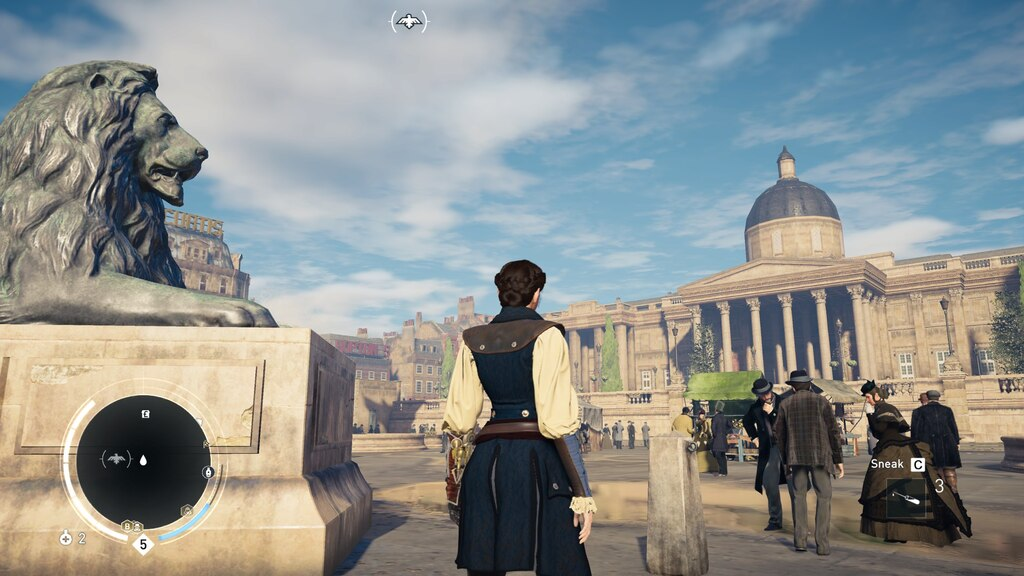
I am currently replaying one of the Assassin’s Creed games, in which players are invited to go back in time and hobnob with the likes of Queen Victoria, Leonardo da Vinci and Cleopatra in 19th century London, renaissance Florence and Ptolemaic Egypt. They’re wonderful games for tourists – but they’re also shallow and repetitive, filled with busywork and ludicrous plots about ancient conspiracies and precursor civilisations. For a long time, I would buy each new Assassin’s Creed and play it excitedly, like the history nerd I am, but almost always I would get tired of them before I was even close to the ending.
Nonetheless, when I’ve got a phase where I’m tired from work in the evenings and don’t want anything that engages me too deeply, I often revisit an Assassin’s Creed game, because of the sightseeing. I don’t always need deep, engaging gameplay or storylines – sometimes what I want to do is climb the clocktower of the Palace of Westminster and look out over Dickensian London, smog, chimney sweeps’n’all.
Welcome to Six Damn Fine Degrees. These instalments will be inspired by the idea of six degrees of separation in the loosest sense. The only rule: it connects – in some way – to the previous instalment. So come join us on our weekly foray into interconnectedness!
Young and innocent they are certainly not: When Marvel veteran Robert Downey Jr. and screenwriter Steven Knight (Peaky Blinders, Spencer) were announced to be working on a remake of no other than Hitchcock’s Vertigo – considered by many to be the best film ever made – the world of film (fandom) was aghast: a sacrilege to the Holy Grail in Hitch’s filmography! Two filmmakers gone madder than Norman Bates! Dizzy spells among even the most hardboiled critics! What a wonderful opportunity, I thought, to wrap my head around this, particularly after Alan’s delicious piece on watching early delights by the Master of Suspense.
Join us every week for a trip into the weird and wonderful world of trailers. Whether it’s the first teaser for the latest instalment in your favourite franchise, an obscure preview for a strange indie darling, whether it’s good, bad, ugly or just plain weird – your favourite pop culture baristas are there to tell you what they think.
Even someone who might consider themselves a reasonable Hitchcock fan might not have heard of Young and Innocent before – which is all the more reason to check out Alan’s Six Damn Fine Degrees post from this week. And as YouTube doesn’t seem to have a trailer for the film, here’s the next best thing: the entire movie. Enjoy!
What is it about films featuring androids called David that makes them, let’s say, not entirely successful with audiences and critics? Following their recent trip to the Stanley Kubrick Archive in London, Alan and Matt dedicate this this year’s Second Chances episode to two sci-fi films by iconic directors that are unlikely to feature on those directors’ best-of lists: Ridley Scott’s Alien prequel Prometheus (2012) and Steven Spielberg’s A.I. (2001). Both films have recently been revisited by critics who found more to like in them than they originally recognised. Will our baristas also enjoy these films better this time around? Or will the films fare worse the second (or third) time around? And just what is it about androids called David?
Welcome to Six Damn Fine Degrees. These instalments will be inspired by the idea of six degrees of separation in the loosest sense. The only rule: it connects – in some way – to the previous instalment. So come join us on our weekly foray into interconnectedness!
When it comes to the early British films by Alfred Hitchcock, there’s a famous few that grab all the attention: the likes of The Lodger, The Man Who Knew Too Much, The Lady Vanishes and The 39 Steps. They’re all hugely entertaining, but one of the reasons they retain their status is that watching them you can spot so many of the ideas that Hitchcock was to take to Hollywood with him and make his more famous classics. It’s like listening to the early songs of an artist who’ll go on to conquer the charts – it’s clearly the same talent, not quite as polished, but then there’s something thrilling in how unpolished it is.
Join us every week for a trip into the weird and wonderful world of trailers. Whether it’s the first teaser for the latest instalment in your favourite franchise, an obscure preview for a strange indie darling, whether it’s good, bad, ugly or just plain weird – your favourite pop culture baristas are there to tell you what they think.
If the past is a foreign country: how do we watch films that are approaching their hundred-year anniversary? While working on his Criterion backlog, Matt recently watched Show Boat, but while there are things there to enjoy without knowing the historical context intimately, the musical’s handling of the United States’ history of slavery and racism is a mixed bag, and it’s not always easy to look past what is problematic at the things that may be surprisingly progressive. And some scenes manage to tick both of those boxes at the same time.