The situation for movie theaters in my hometown is dire. The inner city places are closing up one after the other because the rent is said to be too expensive for the two chains, Kitag and Quinnie. The Capitol, where I saw Return of the King, is boarded up. So is the Gotthard, where I once took a girl who was way out of my league on a date. The Jura triplex is closed, the City triplex is a provisory pub, the Royal has reopened as a vegan burger restaurant. The Splendid, the only inner city theater still showing undubbed blockbusters in 2D, is said to close soon. Instead, soulless multiplexes have sprung up at the edge of town where it is cumbersome to get to by public transport. Their viewing rooms are bigger, so the small number of viewers seems even more lost. They are run by companies that have profit as their priority, not fine movie-making programmed along a common theme or name for an appreciative or even regular audience. Granted, Pathé is a movie production and distribution company, but their multiplex is just as anonymous as that by Swisscom, the national number one telecommunications company. I only go to either of them when I have to, for instance when I want to see Jordan Peele’s Us in its original language.
Continue reading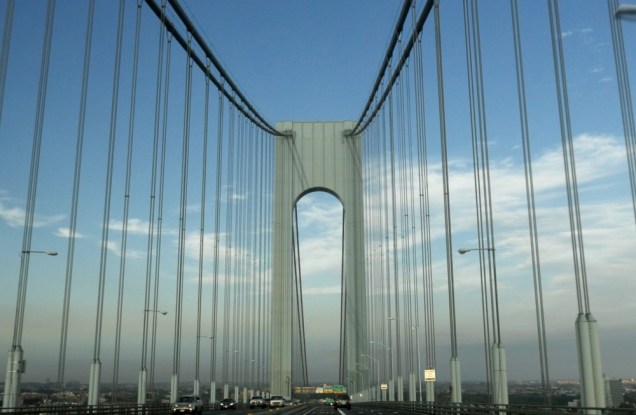 Maybe I am not the ideal audience for Martin Witz’ Gateways to New York. On the one hand, it’s a documentary about some of the bridges of New York. Since I have absolutely no spatial orientation, I was at a loss as to where these bridges are and which two areas they connect. Here’s an easy question: what does the George-Washington Bridge connect? I only faintly remembered that the answer is New York and New Jersey, maybe because of The Sopranos. And what does the Verrazzano-Narrows Bridge connect? Aha, see? I have no clue, and if you are not from the Eastern Seaboard, or an acolyte of architecture, you might be as lost as me. There are maps in Witz’ documentary, but they are gone before you can really grasp which bridge we are talking about now.
  Road movies are, in a way, like interconnected short story collections, no? You learn of a reason to take to the road – first story. You get to another place because it’s the way to get to your destination – second story. And another place, and another, a seemingly random sequence of loci, until you reach your destination, which makes for your last short story. Yeah, I know, my analogy holds up only roughly, but my point is: there should be an arc from the first to the last story, otherwise you get accused of fillers. And no-one, no filmmaker, no author, wants to get accused of producing fillers.
  I recently read an interview with a game designer. Among other things, she talked about how, in many computer games, your avatar is often in mortal peril, and how such a situation is not only an option, but the very point of many computer games. You might die, so your main goal is to survive. She called that the stress of dying. I am very much a non-gamer, but I know what she means. Although the drama of life vs. death, whether it be your avatar’s or any other character’s in a game, is higher in a potentially fatal scenario, it might take your attention away from the intriguing story, the elaborate graphics or the well-written characters themselves. Sometimes it’s about exploring and going places, about living in a new universe, not just surviving it. Or about admiring the craft.
  There is a point beyond which suspense does not increase. It’s a point that every filmmaker and editor should know, and avoid. In the words of a theatre director I once knew: “If you think your timing is just right, you are too slow.” He said this about most scenes, although maybe some scenes in horror movies are allowed to go on a little longer until the tension almost reaches tipping point, but even for horror flicks, there must be a limit to how long an audience is scared by ominous rumbling and blurry shadows moving in dark corners. It’s likely that horror movies depend more on suspenseful arcs than other genres. Obviously, writer and director Oz Perkins thought he would shoot his second feature I Am the Pretty Thing That Lives in the House a tad too slow, because slightly slower means slightly scarier, right?
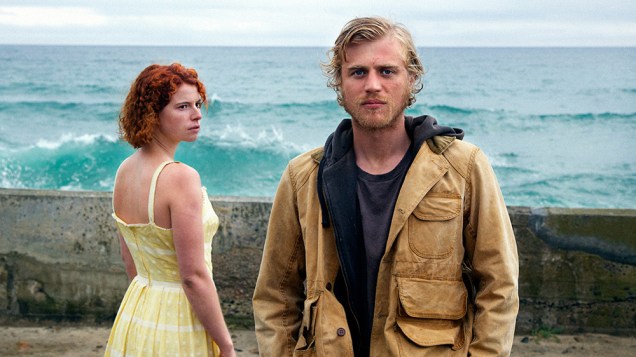 Michael Pierce’s feature debut Beast is less than the sum of its parts. It has very, very strong scenes, but just because the pearls are all beautiful doesn’t mean they belong on the same necklace. Here’s a list from memory: the moment when Moll (Jessie Buckley) runs away from her own birthday party to go dancing. The moment when she meets Pascal (Johnny Flynn) for the first time and is smitten with him, because he looks as wild as she wants to be, and he might be her ticket out of the stuffy surroundings of a small town on a small island called Jersey. The moment when Moll lies into the grave of a dead girl, pretending to be her. The well-meaning cruelty of her mother (Geraldine James). Moll’s apology to the girl she hurt back in school. The whole funeral sequence.
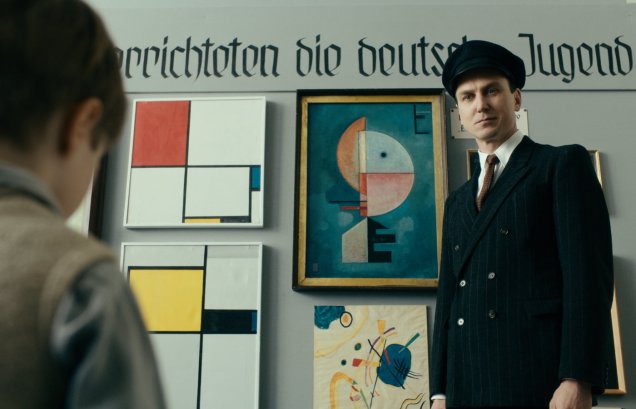 Reader, it’s not easy for me to describe why I like Never Look Away so much, so let me start with the title. The movie’s original title is Werk ohne Autor (Work without Author), which is much better, since it’s a movie about a fledgling painter who seems to see himself as a mere conduit for his paintings than an active artist. A title like Never Look Away suggests that it’s about the Holocaust, although that is not so wrong either. The movie was written and directed by Florian Henckel von Donnersmarck, who also wrote and shot The Lives of Others, an excellent movie, and the slightly disappointing The Tourist. Werk ohne Autor is loosely based on the life of German painter Gerhard Richter, who has seen the movie and disapproves of it.
 A Damn Fine Cup of Culture