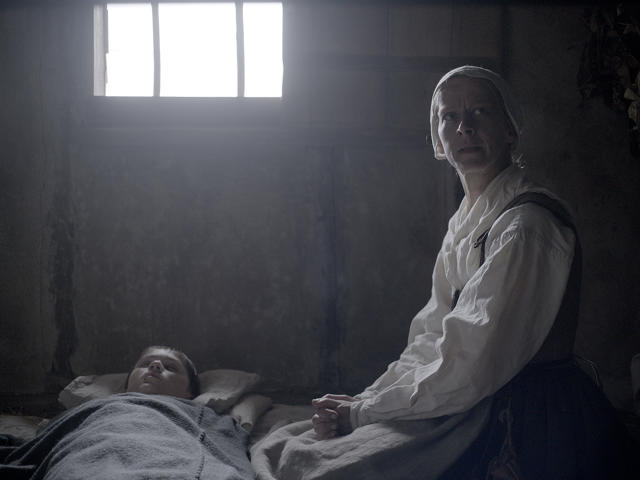
 Robert Eggers’ The VVitch: A New-England Folktale works both ways: if you think there is a witch in this movie, then there is one, and we’re in the realm of the supernatural. You can also explain the whole horror by claiming that these people are driving themselves and each other insane. Either way, it’s a pretty good horror flick. It features a Puritan family who are thrown out of their community and build a new home in the wilderness, next to some woods. In 1630, that might well be a death sentence. We are never told why exactly they get banished, but it has something to do with putting God’s law above that of men. They are almost glad about being banished, because to them, it is God’s will. Continue reading
Donuts and Depression
 While watching Olive Kitteridge, the 2014 four-part HBO miniseries, I kept thinking back to Six Feet Under more than once. Both are HBO, both feature Richard Jenkins, and while SFU has a lot to say about death and dying, OK deals with depression and suicide. Before you quit reading: it is surprisingly upbeat and wise about it. All right, upbeat is probably the wrong word, but it is not as dark and… well, as depressing as you might think. It’s a well-told story about a Maine family, so there is also good reason to think of John Irving’s stories. The series never goes for broke with guns and gore, but skates over thin ice while hinting at the dark waters underneath. Continue reading
If only you could talk to the mobsters
At this year’s San Diego Comic Con, Marvel once again planted a big, wet kiss on the fans’ mouths, with new footage and casting information covering everything from Captain Marvel (yay for female superheroes, double yay for Alison Brie) to Doctor Strange (nice-looking trailer, even if it looks a bit too much like a mashup of The Matrix and Inception). There were also a couple of titbits for those following the Netflix series, including an action-packed teaser for Luke Cage. I liked the character in Jessica Jones and I thought it’d be interesting to have a new Marvel property with a strong, individual style, so the promise of a blaxploitation-inspired series combined with a more modern sensitivity intrigued me.
Cue the teaser, which has Luke taking on a bunch of goons with the aid of his super strength and a car door, all biff-, bam- and pow-like. I’ve seen some fan reactions, and they all seem to agree: this is shaping up to be a badass series for a badass character.
Myself? I found it boring. Continue reading
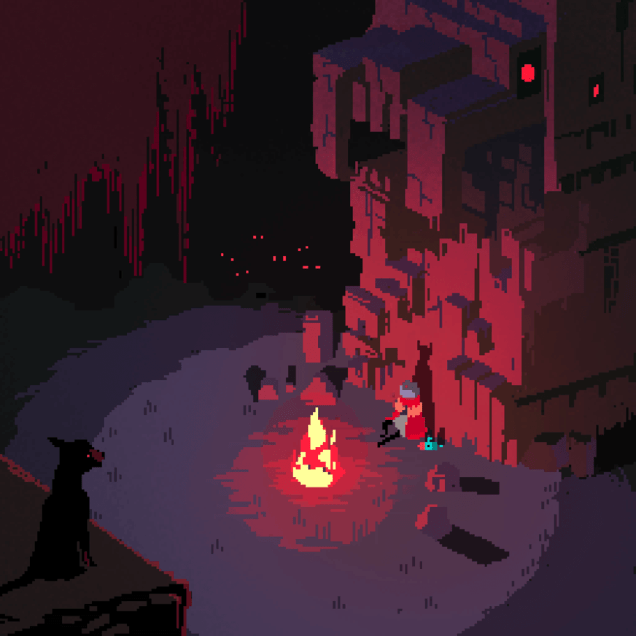
They create worlds: Disasterpeace
One of the things that video games can do magnificently is create worlds. These posts are an occasional exploration of games that I love because of where they take me.
Usually when people talk about the worlds games create, they’re talking about graphics first and foremost. I’ve been playing since the early ’80s, and perhaps the most readily apparent way to see how the medium has progressed since then is to look at screenshots: it’s pretty much like first looking at cave paintings and then a Caravaggio – although admittedly a Caravaggio that’s like to have been done by a teenage Caravaggio who’s been glutting on Michael Bay movies or the Lord of the Rings trilogy.
Virtuality is the new real
The first thing that came to my mind when I put on my Oculus Rift for the first time and found myself looking around virtual reality, was a line from the original Star Wars: “You’ve taken your first step into a larger world.” Thank you, Obi-Wan, you’ve put it well. While I haven’t yet spent all that much time in VR, only the occasional hour here and there, I’ve already stared up at the jaws of a T. Rex bellowing in my face, I’ve seen the Little Prince’s planet floating in mid-air just in front of me, and I’ve navigated a one-man submarine into the wide-open mouth of a giant prehistoric fish.

Beauty, Confusion, Assassination
 The Assassin is one of the most beautiful movies ever made. It is also one with the most difficult storytelling. That sounds like the obscurity of the story somehow sabotages the beauty of the movie. It doesn’t. Since you have to really pay attention in order to guess what exactly is happening, you get the occasional breather when the movie shows you a pond at sunrise, with two birds chasing each other across the water. It’s not that the story is complex, it’s just that the way of telling it is unconventional. Characters are introduced by simply being put on screen. Flashbacks don’t come when you expect them. The female protagonist has no more than three or four lines of dialogue. There are two long monologues by two different characters providing a lot of back story; they pause between sentences, and you are never sure if their words are all they are actually saying, or if they are telling all, or telling the truth.
A home movie
 This post is about me and my childhood at first, but I promise that it will lead to a movie – a proper feature, by a director you have heard of, with an interesting cast. Just bear with me. I grew up in Switzerland, in a small rural town called B. We once did a semi-serious census at school and came up with some 350 inhabitants. That sounds small, but it was just big enough to grow up in. The only two claims to fame are that 1979 movie and a H. R. Giger exhibition in 1986. Both caused a small scandal.
In the Green Room, the neo-Nazis come and go…
Green Room (directed by Jeremy Saulnier, whose Blue Ruin I liked a lot), may just be the most effective slice of siege thriller this side of early John Carpenter. After introducing us to the film’s protagonists, a punk rock band down on their luck, it quickly sets up the situation that drives the rest of the action: after a last-minute gig at a backwaters dive populated by white supremacists, one of the band members accidentally comes across a murder scene in the titular green room. The band is locked in the room with one of the bouncers, while the neo-Nazis consult with the bar’s owner and their leader, the commanding Darcy (played to pragmatic, evil perfection by Patrick Stewart), who concludes that the only way to resolve the situation is to kill the witnesses.

Four days of fun, then un-saved by the bell
 I am trying to come up with a more versatile director than Richard Linklater, but I am drawing a blank. Linklater might be best known for Boyhood, or for his Sunrise trilogy, featuring Ethan Hawke and Julie Delpy. All four movies follow a handful of characters, visiting and re-visiting them at certain points their lives. Then there’s the Linklater who made a well-mannered con-man drama called Bernie, slightly overlooked, featuring a surprisingly smarmy Jack Black who is after Shirley McLaine’s wealth. Then School of Rock, a comedy again featuring Jack Black, and almost too formulaic for a Linklater movie. A Scanner Darkly, based on a Philip K. Dick short story, shot with a real-life cast and then re-designed afterwards to make it look animated. And finally there is the Linklater of such philosophical essays as Waking Life that seem to work best if you are drunk and stoned and sitting around a campfire on a summer night with friends or strangers or both and discuss really deep concepts like art, or life, or beer. Continue reading
Captain America v Iron Man: Much More Fun
Reader, I smiled. I had a big, goofy, excited grin on my face as I exited the cinema where I’d just seen Captain America: Civil War. If you had asked me ten years ago if I’d even go to watch a film called Captain America (with or without subtitle) at the cinema, with a protagonist of the same name, I’m sure I would’ve laughed in your face and possibly bought a ticket to some Swedish drama, but Marvel has convinced me.


