One of the things that video games can do magnificently is create worlds. These posts are an occasional exploration of games that I love because of where they take me.
To my right is the station, Kronos II, looking decidedly worse for wear. To my left is Saturn, its rings glittering with a stark beauty. I can see the mining asteroids and container fields in the distance – and the inscrutable anomaly, extending tendrils of pure energy in my direction. Everywhere else is the cold infinity of space, beautiful and deadly. There is only one thing to do: I grab hold of the railing and, slowly and methodically, make my way towards my captain and friend, Liv, pulling my weightless body through space inch by inch.


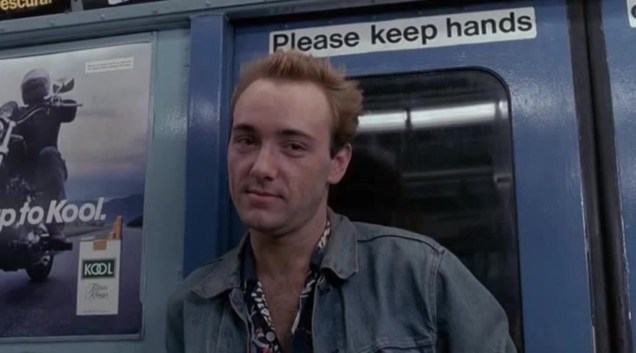 2017 has been a difficult year. I’ve realized that, since the news about them broke, I have avoided all films starring Kevin Spacey or produced by Harvey Weinstein. Same goes for Woody Allen, Bryan Singer and others. I would like to say that it was an unconscious decision, but I have to confess that it was largely intentional. Used to be a time when I could easily divorce an artist’s stupid statements or antics from his or her outstanding artistic performance. The fact that Morgan Freeman appears in a Turkish Airlines ad makes him look like an idiot, but it probably won’t keep me from watching The Shawshank Redemption again. With sexual threats or abuse by Weinstein, Spacey and far too many others, a line has been crossed. I can no longer sit there and watch John Doe do his grisly work without thinking of Spacey and his crimes. So how to react? Should I really stand before my movie shelf and start throwing out Seven? The Lord of the Rings trilogy? Anything ever produced by the Weinstein Company and Miramax? All the Tarantinos? The English Patient? How do Woody Allen fans react to such abuse? Fans of X-Men or The Usual Suspects? I know, of course, that the harm done to the abused persons is not limited to the movie business, and that the damage they suffered weighs far more than the harm done to cinema and acting, but since movies are a crucial way of storytelling, at least to me, and since storytelling has the human condition at its center, I suspect that those movies will play differently to me when (if?) I watch them next time. Something, a kind of honesty in storytelling, will be lacking.
  Surprise! Just in time for Christmas 2017, we’re bringing you a very special (and damn fine, we hope) cup of culture. When we started talking about launching a podcast to complement our blog, we did a pilot episode – or, more accurately, a test run. Although we had no intention at the time to release the pilot, we’re still proud of it – warts and all. The sound quality isn’t at its best, but the energy is there, and we had a lot of fun talking about the BBC’s Sherlock – so we’re sharing it with you. Enjoy – and happy holidays!
 It’s just about possible that this year’s best supernatural TV series comes from Germany. It’s called Dark, it’s available on Netflix since December 1st, so it probably won’t be on any best of lists for this year. It should be. Dark borrows from some of the most favorite horror TV series of the last two or three years; it takes what it can use from the recent Twin Peaks, Les Revenants, True Detective, Stranger Things and others, and distils those borrowed spare parts for long enough to turn into its very own material. There are two things that make it worth your while: it tones down the supernatural element and focuses on its characters enough so it doesn’t have to rely on its McGuffin too much, and it creates its own atmosphere so well that it’s easy to forgive it a few shortcomings. It’s a slow series, ten episodes of about one hour, but some scenes are almost bristling with intensity.
  Detroit is a miss. The beginning and the ending are weak bookends to a middle that is strong and impressive cinematically, but the movie as a whole lacks two basic ingredients: a moral point of view, and a minimum of Detroit-specific context. I don’t think either of these flaws are the director’s fault: Kathryn Bigelow knows how to place her audience in the middle of a scene involving crowds, be it a war or a riot. My guess is that the lack of context comes from the screenplay by Bigelow’s frequent collaborator Mark Boal, who wrote The Hurt Locker and Zero Dark Thirty, also directed by Bigelow.


