Each Friday we travel back in time, one year at a time, for a look at some of the cultural goodies that may appear closer than they really are in The Rear-View Mirror. Join us on our weekly journey into the past!
It took me ages to read Lolita. No, that’s not quite correct: it took me ages to get around to reading Lolita. I avoided the book for a long time because it sounded offputting: an older guy lusting after a young girl. You don’t need to read literature, you see that everywhere, every day already. In the end, my first encounter with Lolita was, well, not even the 1962 adaptation by Stanley Kubrick but the glossy, shallow film version by Adrian Lyne. It’s a miracle I ever did get around to reading Vladimir Nabokov’s novel after that.
The first half-dozen years or so of the 21st century saw some of the strongest arguments that a Golden Age of Television had arrived. Many of those were produced by HBO, from the New Jersey mobscapades of The Sopranos to the sprawling social canvas of The Wire. While it was cancelled after three season, the Western series Deadwood stands tall among the standouts of that time. Even thirteen years after its cancellation, it’s difficult to find a series as accomplished, with an ensemble cast as strong, and with writing as distinct.
After spending much of our summer looking into the abyss with our two episodes on cinematic psychopaths, A Damn Fine Cup of Culture is heading for British Hong Kong, 1962: we’ve rewatched Wong Kar-wai’s In the Mood for Love (2000) and we’ve got some things to say about it, from commenting on the echoes to Billy Wilder’s The Apartment to discussing the film’s sartorial choices. On our way there, we also touch upon the Elton John biopic Rocketman, the Nazi-shootin’ B-movie thrills of Wolfenstein: The New Colossus and the grandpappy of silent Soviet cinema, Battleship Potemkin… set to a live orchestra’s renditions of Shostakovich. How better to finish a summer of culture?
Each Friday we travel back in time, one year at a time, for a look at some of the cultural goodies that may appear closer than they really are in The Rear-View Mirror. Join us on our weekly journey into the past!
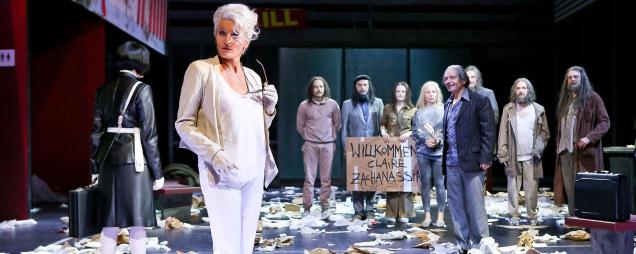
If you grow up around here in the German-speaking part of Switzerland, you will be confronted with the oeuvre of one Friedrich Dürrenmatt, if you want to or not, at some point during your school years. You might read some of his shorts, like The Tunnel (1952), or one of his crime novels, such as The Judge and His Hangman (1950, made into a 1975 film directed by Maximilian Schell and starring Jon Voight, Robert Shaw, Jacqueline Bisset and Martin Ritt). There is Max Frisch with his questions about identity, but it’s Fritz who has a slight advantage of seeing his plays performed in front of droves of school classes.
The first half hour of Alejandro Landes’ debut feature Monos contains some of the most beautiful images of any movie released this year. We are somewhere in Latin or South America, so high up that the clouds seem lower than the silhouettes of the child soldiers. There are red-burning clouds trying to scale the jungle-green mountaintops; there are lush meadows and old abandoned fortifications. There is a war, but we know less about it than even the eight teenagers in their rag-tag, mismatched dirty uniforms. Continue reading →
We’ve all been there. You find yourself in your late teens or early twenties with a profound sense of existential malaise. You’ve been to school for most of your life and you could go to school for a bit longer, but why? What for? To prepare for a job that, at best, bores you if it doesn’t outright depress the hell out of you? To lead a life of quiet desperation? Some try to escape by means of alcohol, drugs or sex, but not you. Oh, no.
Instead, you do you. You try to give your life a sense of meaning by organising an insane art heist with the aim of stealing the ultra-rare books on display at your university’s library. It’s obvious if you think about it.
And there goes another year and the ever more sci-fi sounding 2020 is just around the corner. We’ve had some good laughs, we cried, we watched the TV in terror, then disillusionment and then resignation, name-checking Kübler-Ross along the way – but that was just politics. In terms of media, 2019 hasn’t been a bad year at all, has it?
Each Friday we travel back in time, one year at a time, for a look at some of the cultural goodies that may appear closer than they really are in The Rear-View Mirror. Join us on our weekly journey into the past!
GUS: What do we do if it’s a girl? BEN: We do the same. GUS: Exactly the same? BEN: Exactly.
Pause.
GUS: We don’t do anything different? BEN: We do exactly the same. GUS: Oh.
GUS rises, and shivers.
Excuse me.
He exits through the door on the left. BEN remains sitting on the bed, still. The lavatory chain is pulled once off left, but the lavatory does not flush. Silence.
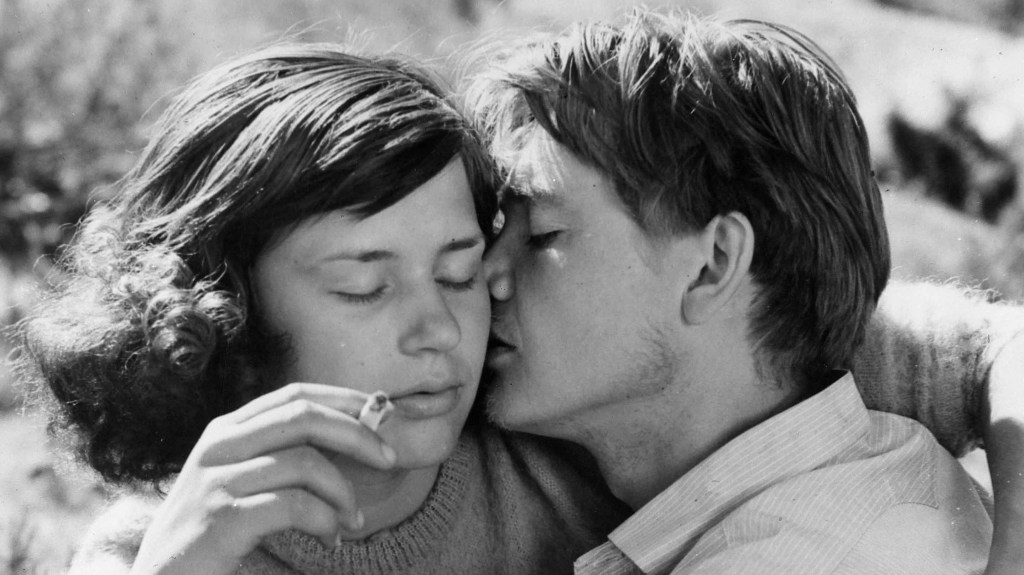
Summer with Monika (1953) is an odd yet fitting film with which to continue our Tour d’Ingmar. Like Crisis, A Ship to India, To Joy and Summer Interlude, its protagonists are flawed young characters in the process of becoming adults, though unlike many of the Bergman films earlier in the collection, the young man, Harry (Lars Ekborg), is selfless and arguably the more mature one, while Monika (Harriet Andersson), the female protagonist, is self-serving and at times downright unpleasant.
You have to give it to them: the Kims, the protagonists of Bong Joon-ho’s Parasite, are nothing if not resourceful. At the suggestion of a friend, the son Ki-woo (Choi Woo-shik) pretends to be a student in order to get a position as the English tutor for the daughter of a wealthy couple, complete with photoshopped diploma. It doesn’t take long and he’s introduced his sister Ki-jeong (Park So-Dam) to the Park family and she takes on the job of being the youngest child’s art therapist. It’s amazing how you can fake expertise with little more than Google skills and a knack for improvisation. Before long, the entire family – Ki-woo, Ki-jeong and the parents Ki-taek (Bong stalwart Song Kang-ho) and Choong Sook (Jang Hye-jin) – are in the gainful employ of the Parks, one recommending the other, as that’s how the Parks work: they only trust employees that come highly recommended by another trusted employee. Oh, my father has a friend who used to work as a chauffeur. Oh, I know of this housekeeper who’d be just perfect for you. And the rich, friendly (if patronising), gullible Parks eat it all up. They get the domestic help they want and the Kims get the gainful employment they need, so it’s a win-win situation, right?
To cut a long story short: no. Parasite isn’t a story about the joys of sucessful social mobility. It isn’t a hymn to faking it till you make it. No, Bong’s latest is a caustic comedy that turns into a war movie – the war in question being that between the classes. And as another war story set in Korea used to say: war is hell.



 The first half hour of Alejandro Landes’ debut feature Monos contains some of the most beautiful images of any movie released this year. We are somewhere in Latin or South America, so high up that the clouds seem lower than the silhouettes of the child soldiers. There are red-burning clouds trying to scale the jungle-green mountaintops; there are lush meadows and old abandoned fortifications. There is a war, but we know less about it than even the eight teenagers in their rag-tag, mismatched dirty uniforms.